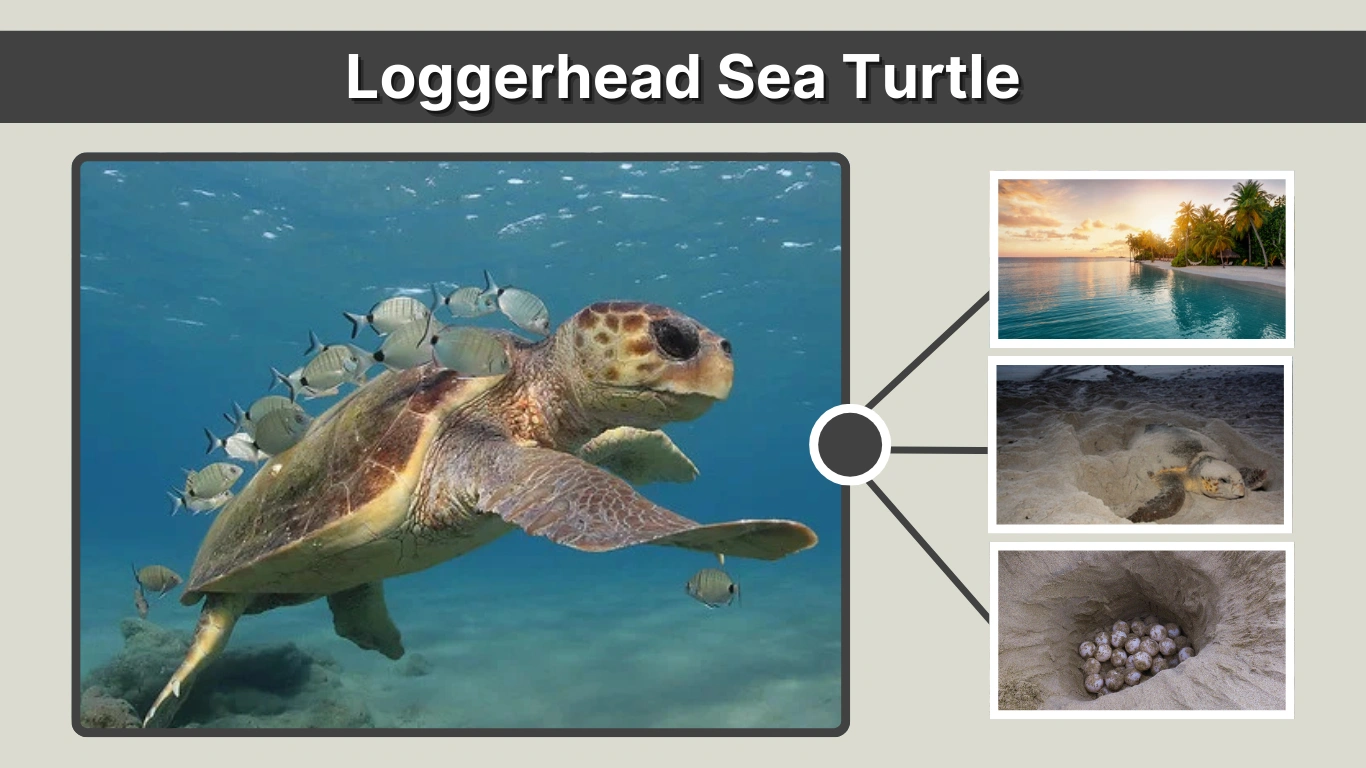
The loggerhead sea turtle (Caretta caretta) is one of the world’s most iconic marine reptiles, known for its massive head, powerful jaws, and impressive migrations across oceans. Found in warm and temperate waters, this species plays a vital ecological role but faces growing threats from habitat loss, pollution, and climate change. Understanding its biology, behavior, and conservation needs helps highlight why protecting this remarkable animal matters.
General Identification & Classification
The loggerhead sea turtle derives its name from its large, blocky head—a key trait that distinguishes it from other sea turtles. The scientific name, Caretta caretta, comes from the Latin word for “tortoise,” reflecting its robust build and hard, protective shell. As a marine reptile, it falls within the Cheloniidae family, which includes most hard-shelled sea turtles.
These turtles exhibit several defining characteristics: a reddish-brown carapace, sturdy flippers built for long-distance swimming, and a muscular jaw adapted for crushing prey. Unlike the green sea turtle, loggerheads are primarily carnivorous, shaping their role in the marine ecosystem.
Key Identification Traits
- Scientific name: Caretta caretta
- Family: Cheloniidae
- Color: Reddish-brown shell with yellowish underside
- Distinctive feature: Large, powerful head
Physical Description, Size & Anatomy
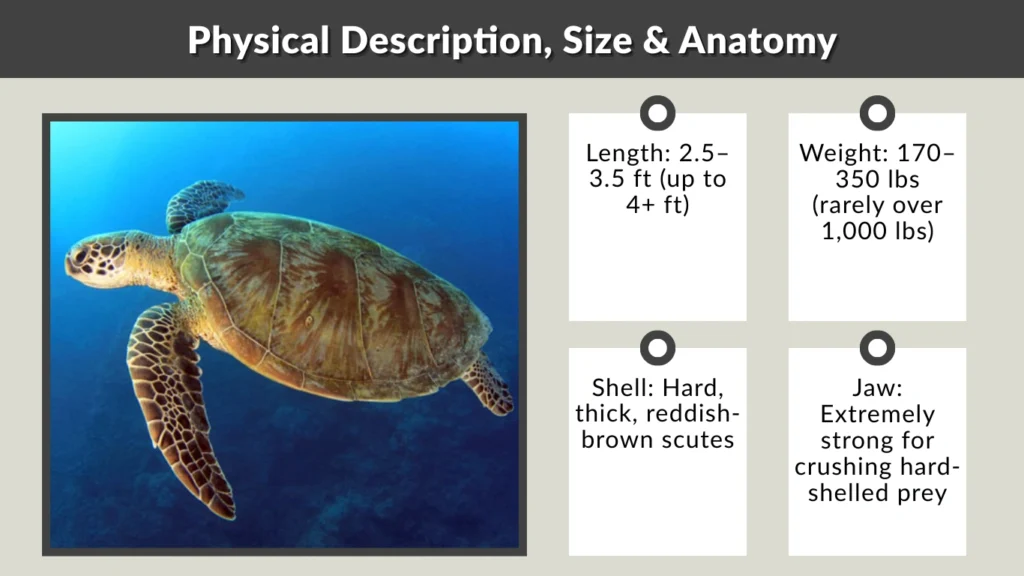
Loggerhead sea turtles are one of the largest hard-shelled turtles on Earth. Adults typically measure between 2.5 to 3.5 feet long, though some exceptional individuals surpass 4 feet. Their weight commonly ranges from 170 to 350 pounds, with the largest documented loggerheads reaching over 1,000 pounds.
The carapace (upper shell) is slightly heart-shaped and composed of thick scutes that provide both protection and structural strength. Their oversized head houses powerful jaw muscles capable of crushing conchs, crabs, and whelks. The skull is heavy and broad—another clue used to differentiate loggerheads from closely related species.
Juveniles and hatchlings are much smaller and darker than adults. As they grow, their shell lightens and becomes more textured, and their heads become proportionally larger.
Size Highlights
- Length: 2.5–3.5 ft (up to 4+ ft)
- Weight: 170–350 lbs (rarely over 1,000 lbs)
- Shell: Hard, thick, reddish-brown scutes
- Jaw: Extremely strong for crushing hard-shelled prey
Habitat & Geographic Range
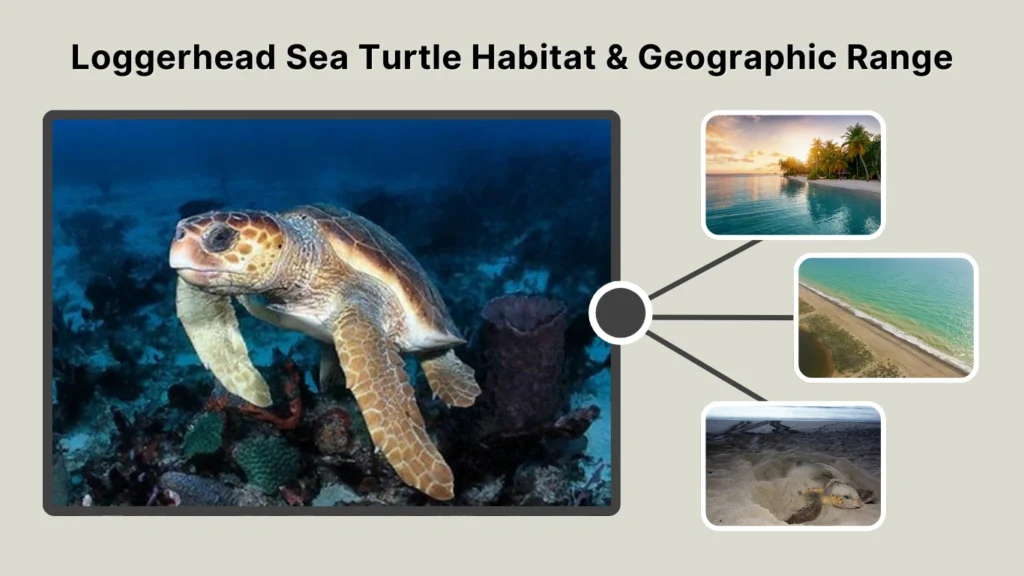
Loggerhead sea turtles occupy warm, temperate waters across the globe. Their range includes the Atlantic, Pacific, and Indian Oceans, as well as the Mediterranean Sea. They prefer coastal regions, continental shelves, estuaries, and open-ocean gyres depending on their life stage.
Adult females return to the beaches where they hatched—often after decades at sea—to lay their eggs. In the United States, Florida hosts the most significant nesting sites in the Atlantic. Meanwhile, the Mediterranean population nests primarily along Greece, Turkey, and Cyprus.
Because loggerheads use both coastal and pelagic (open-ocean) zones, they rely on diverse habitats: sandy beaches for nesting, nearshore waters for feeding, and deep ocean currents for migration.
Key Habitat Zones
- Warm-temperate coastal waters
- Continental shelves and shallow bays
- Sandy beaches for nesting
- Open-ocean currents used by juveniles
Diet, Feeding Behavior & Food Chain
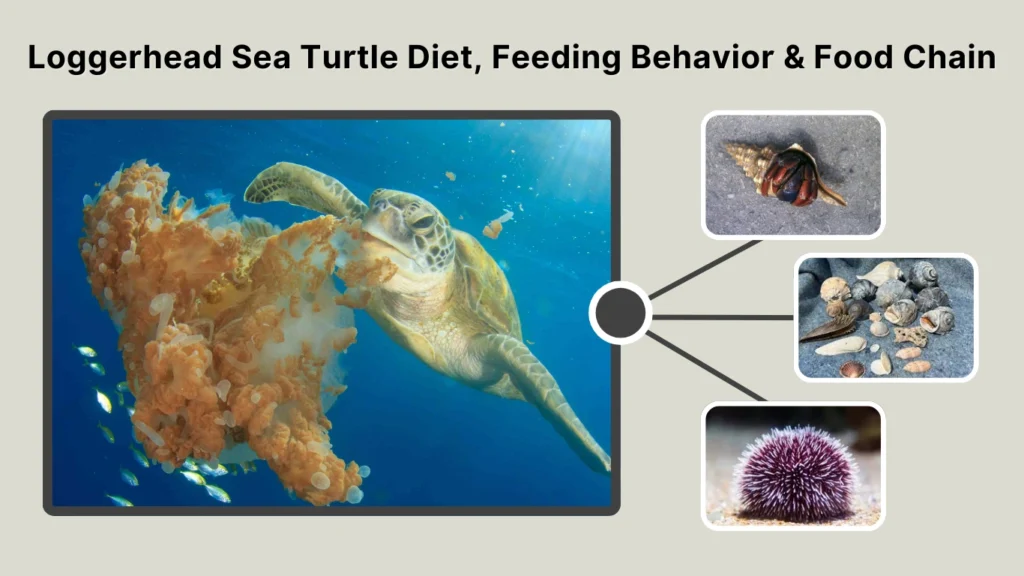
Loggerheads are primarily carnivorous, a trait reflected in their strong jaws and massive skulls. They feed on a wide variety of hard-shelled organisms such as crabs, mollusks, clams, conchs, and sea urchins. Their diet may also include jellyfish, fish, and occasionally plant material, especially during juvenile stages.
Their ability to crush tough shells allows them to compete successfully in benthic (sea-floor) environments. By consuming invertebrates, they help maintain healthy marine ecosystems and contribute to controlling prey populations.
The loggerhead’s role in the food chain is significant:
- As predators, they control crustacean and mollusk populations.
- As prey, especially as eggs and hatchlings, they feed numerous animals including birds, fish, raccoons, and sharks.
Common Loggerhead Foods
- Crabs and conchs
- Whelks and clams
- Sea urchins
- Jellyfish and small fish
Life Cycle & Development Stages
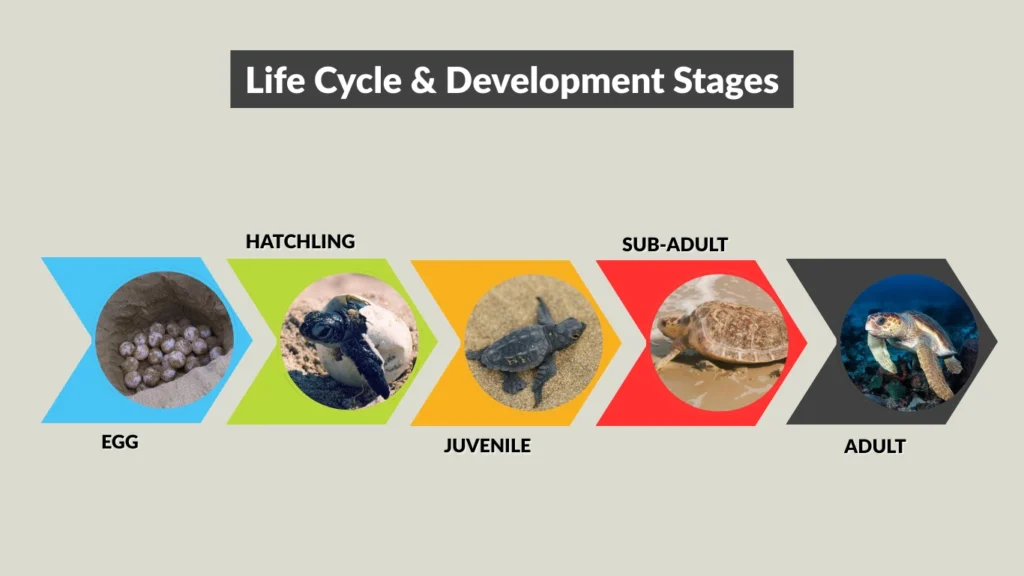
The loggerhead sea turtle has a complex life cycle that spans decades and crosses entire oceans. It begins when females haul themselves onto sandy beaches—usually at night—to dig nests and lay around 100–120 eggs. After a 45–60 day incubation period, hatchlings emerge and race toward the ocean, guided by moonlight.
This early stage is extremely dangerous, with predators such as gulls, crabs, and fish claiming many hatchlings. Those that survive enter the open ocean and drift in floating seaweed beds like the Sargassum, where they find food and shelter.
As juveniles mature, they eventually move into coastal feeding grounds, where they spend many years growing before reaching sexual maturity—often at 20–30 years old. Females then return to their natal beaches to repeat the cycle.
Key Life Stages
- Egg → Hatchling → Juvenile → Sub-adult → Adult
- Incubation: 45–60 days
- Age at maturity: 20–30 years
Lifespan & Aging
Loggerhead sea turtles are known for their remarkable longevity. In the wild, they typically live between 50 and 70 years, though some may exceed these estimates due to strong survival instincts and a life spent mostly in the ocean where threats are fewer. Their aging process is gradual, and unlike mammals, their physical decline is subtle and difficult for researchers to measure accurately.
Environmental conditions play a major role in how long a loggerhead lives. Stable food sources, safe nesting environments, and minimal human pressure all increase chances of reaching old age. Conversely, fishing gear, pollution, and habitat loss reduce survival prospects significantly. Researchers continue to monitor tagged individuals to better understand aging trends in this species.
Behavior, Migration & Navigation
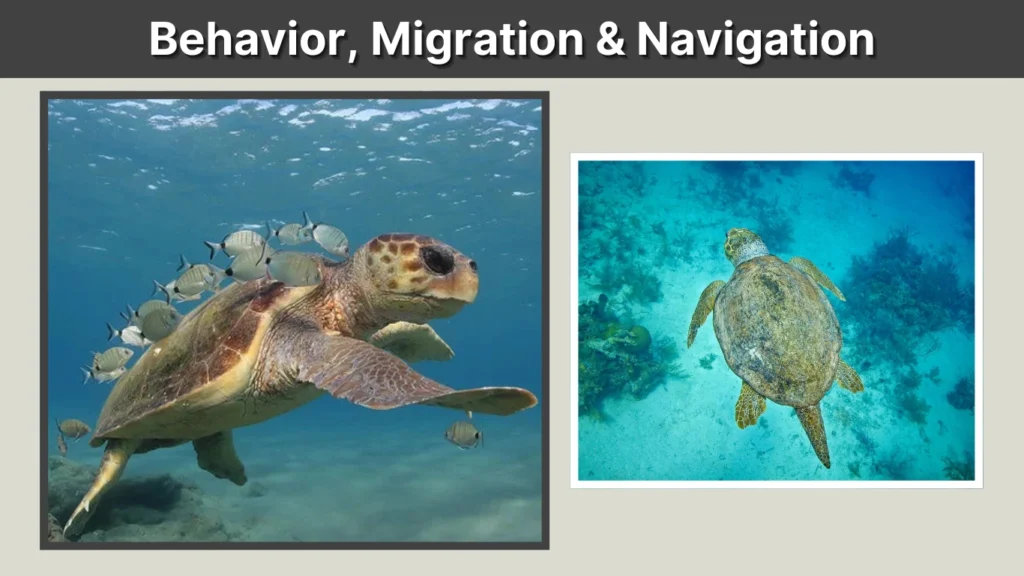
Loggerhead sea turtles are solitary for most of their lives, meeting only during the breeding season. They are strong swimmers capable of crossing entire oceans while following ancient migratory routes. Many adults travel thousands of miles between feeding grounds and nesting beaches, often returning to the same region every few years.
One of their most fascinating abilities is magnetoreception—the capacity to detect Earth’s magnetic field. This natural compass helps them navigate vast, featureless ocean environments with surprising accuracy. Young loggerheads imprint on the magnetic signature of their birth beach, allowing them to locate it as adults decades later. Their migrations highlight complex instincts and an impressive understanding of their environment.
Predators, Threats & Natural Enemies
Loggerhead sea turtles face different threats at each life stage. Eggs and hatchlings are particularly vulnerable. Birds, crabs, raccoons, foxes, and fish prey heavily on newly emerged hatchlings, which is why only about one in a thousand survives to adulthood.
Adult loggerheads have fewer natural predators, but large sharks—especially tiger sharks—pose a risk. However, human-related dangers cause far more harm today. Entanglement in fishing gear, accidental capture in nets, plastic pollution, coastal development, and artificial lighting all contribute to population decline. Climate change also affects nesting beaches, skewing hatchling sex ratios due to rising sand temperatures.
Major Threat Categories
- Natural predators (birds, crabs, sharks)
- Plastic ingestion
- Fishing gear entanglement
- Coastal development and beach erosion
- Climate-driven temperature changes
Population Status, Endangerment & Conservation
Loggerhead sea turtles are currently classified as Vulnerable globally, though certain regional populations are listed as Endangered. Their numbers have declined significantly over the past century due to human activities. Some populations, such as those in the Mediterranean, face intense pressure from fishing, pollution, and habitat loss.
Conservation efforts have increased worldwide. Many nesting beaches are now protected, and organizations run turtle patrols to safeguard nests and reduce artificial light that can disorient hatchlings. Turtle Excluder Devices (TEDs) installed in fishing nets allow loggerheads to escape accidental capture. Public awareness campaigns help coastal communities understand the importance of preserving nesting habitats.
Despite ongoing threats, population trends show gradual improvement in some regions thanks to long-term rescue and monitoring programs.
Comparison: Loggerhead vs. Green Sea Turtle
Although both species are large marine turtles, loggerheads and green sea turtles differ in several important ways. Loggerheads have a broader head and stronger jaws designed for crushing prey, while green sea turtles have a more streamlined skull suited for grazing seagrass. Their diets differ significantly: loggerheads are carnivores, whereas green turtles are mostly herbivores as adults.
Loggerheads tend to be smaller on average, with a reddish-brown shell, whereas green turtles often display a more oval, olive-colored carapace. Their behaviors and preferred habitats also vary, with loggerheads frequenting continental shelves and green turtles relying on seagrass meadows.
Key Differences
- Diet: Carnivore (loggerhead) vs. herbivore (green)
- Shell color: Reddish-brown vs. olive-green
- Head size: Large, blocky vs. small, smooth
- Habitat: Coastal/benthic vs. tropical seagrass beds
Interesting Facts & Quick Trivia
Loggerhead sea turtles possess numerous traits that make them especially fascinating. Their jaws are so strong they can easily crush a queen conch shell. Hatchlings instinctively swim toward the brightest horizon—usually the ocean—guided by moonlight and waves. Juveniles often spend years drifting in Sargassum seaweed mats, which act as nurseries by offering protection and abundant food.
Some loggerheads have been recorded traveling more than 7,500 miles in a single migration cycle. Their ability to return to their birthplace decades later remains one of the most remarkable navigational feats in the animal kingdom.
Images, Drawings & Visual Identifiers
Identifying a loggerhead is relatively easy thanks to its uniquely large head and reddish-brown shell. Photographs typically highlight the textured scales on the carapace and the broad, muscular jaws. Drawings often emphasize the distinctive head shape and flippers, which are proportionally shorter and thicker compared to other sea turtles.
For artists, sketching a loggerhead begins with outlining the domed shell, then adding the wide head and strong beak-like jaw. Juveniles appear darker, while adults display a brighter, more defined coloration pattern.
Human Interaction, Rescue & Protection Efforts
Rescue organizations frequently respond to stranded or injured loggerheads. Many turtles are found suffering from boat strikes, entanglement, or cold-stunning events. Rehabilitation centers treat injuries, perform medical evaluations, and release recovered individuals back into the ocean.
Beach communities often help by protecting nesting sites, reducing artificial lighting, and participating in volunteer monitoring programs. Eco-tourism initiatives also play a role by promoting responsible wildlife viewing practices that do not disturb nesting females or hatchlings.
FAQs
What is the scientific name of the loggerhead sea turtle?
The scientific name of the loggerhead sea turtle is Caretta caretta. This name reflects its membership in the Cheloniidae family of hard-shelled sea turtles and highlights its robust anatomical features, particularly the large head that makes the species so recognizable.
How long do loggerhead sea turtles live?
Loggerheads generally live between 50 and 70 years in the wild, and in some cases may exceed this range. Lifespan depends on environmental stability, food availability, and reduced human-related threats, all of which influence long-term survival and reproductive success.
Why are loggerhead sea turtles endangered?
Loggerheads face endangerment due to fishing gear entanglement, habitat loss, coastal development, pollution, and climate-related changes. Artificial lighting disrupts hatchling behavior, while warming sand temperatures affect sex ratios. These combined pressures reduce overall population stability and limit recovery efforts.
What do loggerhead sea turtles eat?
Loggerheads are carnivores with strong jaws designed to crush hard-shelled prey. Their diet includes crabs, conchs, whelks, sea urchins, jellyfish, and occasionally fish. By targeting benthic invertebrates, they play a key role in maintaining balanced marine ecosystems.
How big do loggerhead sea turtles get?
Adult loggerheads typically measure 2.5 to 3.5 feet in length and weigh between 170 and 350 pounds. Exceptional individuals may exceed 4 feet or reach weights approaching 1,000 pounds, though such sizes are rare.