
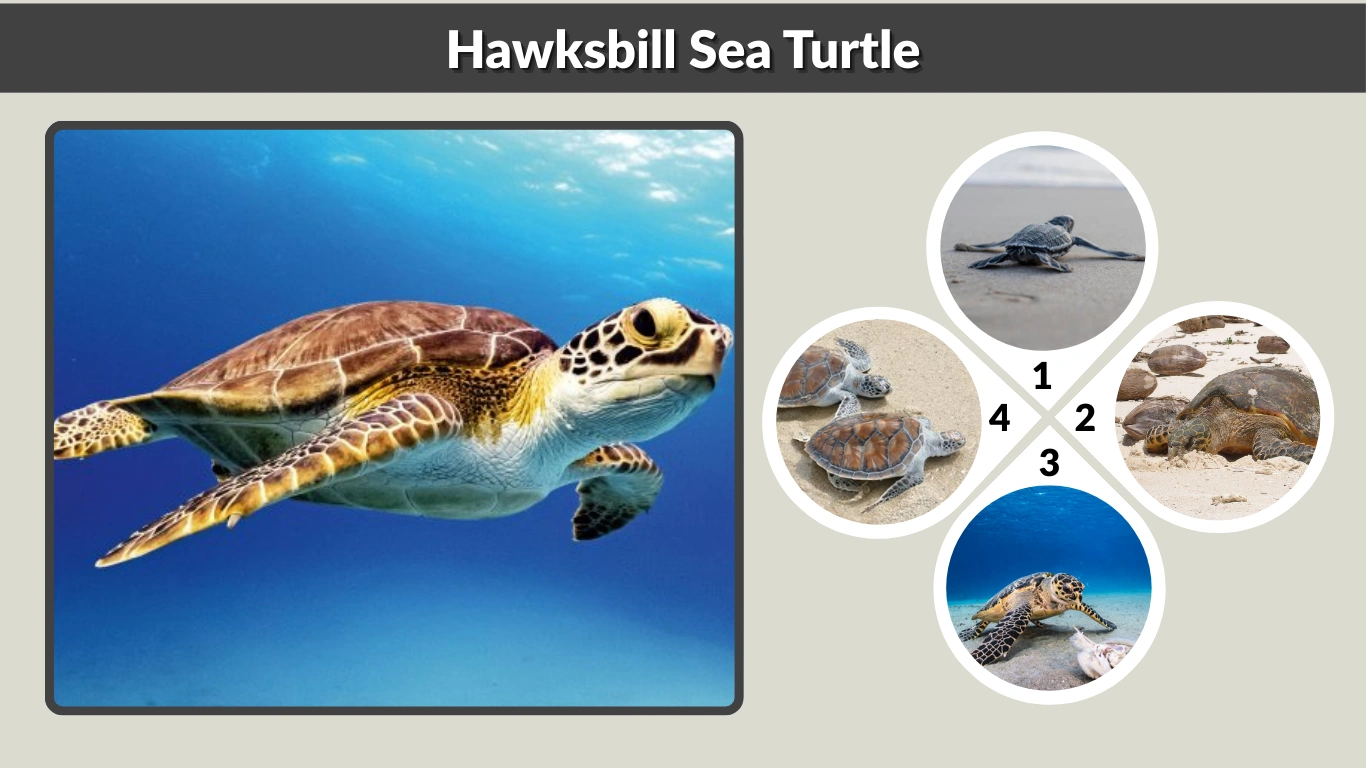
The hawksbill sea turtle is one of the most visually striking and ecologically important sea turtle species in the world. Known for its narrow, bird-like beak and beautifully patterned shell, this turtle plays a vital role in keeping coral reef ecosystems healthy. Found mainly in tropical and subtropical oceans, hawksbill sea turtles spend much of their lives weaving through coral reefs in search of food. Despite their beauty and importance, they are now critically endangered, largely due to human activity.
What Is a Hawksbill Sea Turtle?
The hawksbill sea turtle is a marine reptile belonging to the family Cheloniidae. Its scientific name is Eretmochelys imbricata. Unlike green sea turtles, which are mainly grazers, hawksbills are specialized reef feeders. Their unique body shape and beak allow them to reach deep into coral crevices to extract prey that other sea turtles cannot easily access.
Hawksbill sea turtles are usually associated with coral reefs, but they can also be found in lagoons, mangrove estuaries, and rocky coastal areas. They are strong swimmers but are often seen moving slowly and precisely among reefs, using their flippers to stabilize themselves while feeding. This close relationship with reef environments makes them a key species for maintaining coral health and diversity.
Scientific Classification
Hawksbill sea turtles belong to the order Testudines and the family Cheloniidae, which includes most hard-shelled sea turtles. The species Eretmochelys imbricata is distinguished from other sea turtles by its narrow head, overlapping shell scutes, and sharply curved beak. These traits reflect millions of years of adaptation to life in complex reef habitats where precision feeding is essential.
Why It’s Called a Hawksbill
The name “hawksbill” comes from the turtle’s narrow, pointed mouth, which resembles the curved beak of a hawk. This specialized beak is perfectly shaped for probing into cracks and holes in coral reefs to pull out sponges, anemones, and small invertebrates. In addition, the hawksbill’s shell features overlapping scutes that create a serrated edge, another distinctive trait that separates it from most other sea turtle species.
Identification and Physical Features
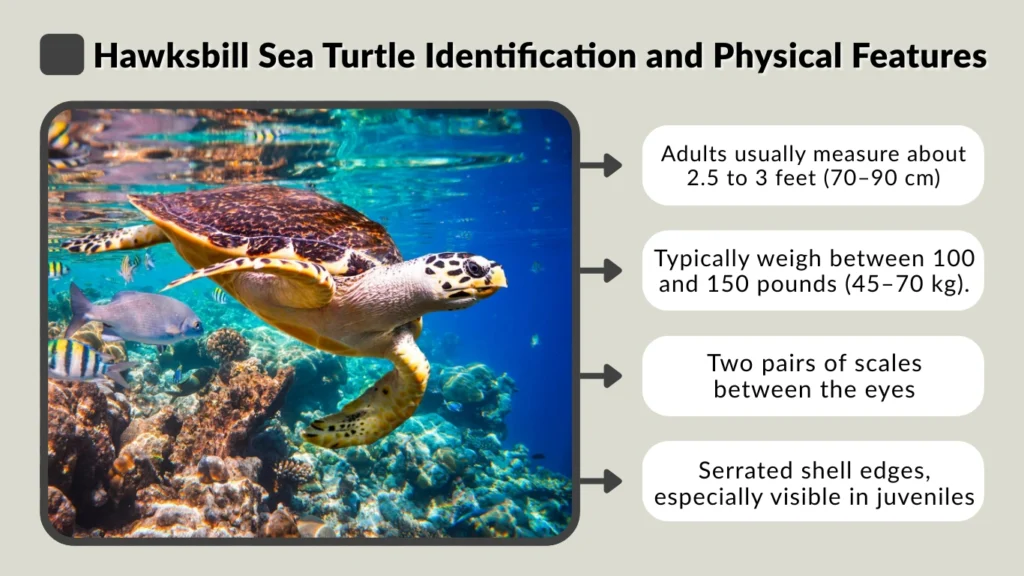
Hawksbill sea turtles are medium-sized compared to other sea turtles. Adults usually measure about 2.5 to 3 feet (70–90 cm) in shell length and typically weigh between 100 and 150 pounds (45–70 kg). Their bodies are built for agility rather than long-distance cruising, making them especially well suited to reef environments.
- Narrow, sharply pointed, hawk-like beak
- Overlapping scutes that give the shell a layered appearance
- Shell colors ranging from amber and brown to black and gold
- Distinctive streaked and mottled patterns on the carapace
- Two pairs of scales between the eyes
- Strong, narrow flippers adapted for maneuvering around reefs
- Serrated shell edges, especially visible in juveniles
- Juveniles often darker, with brighter coloration developing with age
Males and females look very similar, but adult males usually have longer, thicker tails and more curved front claws. Hatchlings are typically dark brown or black, helping them blend into ocean shadows and avoid predators.
Habitat and Global Distribution
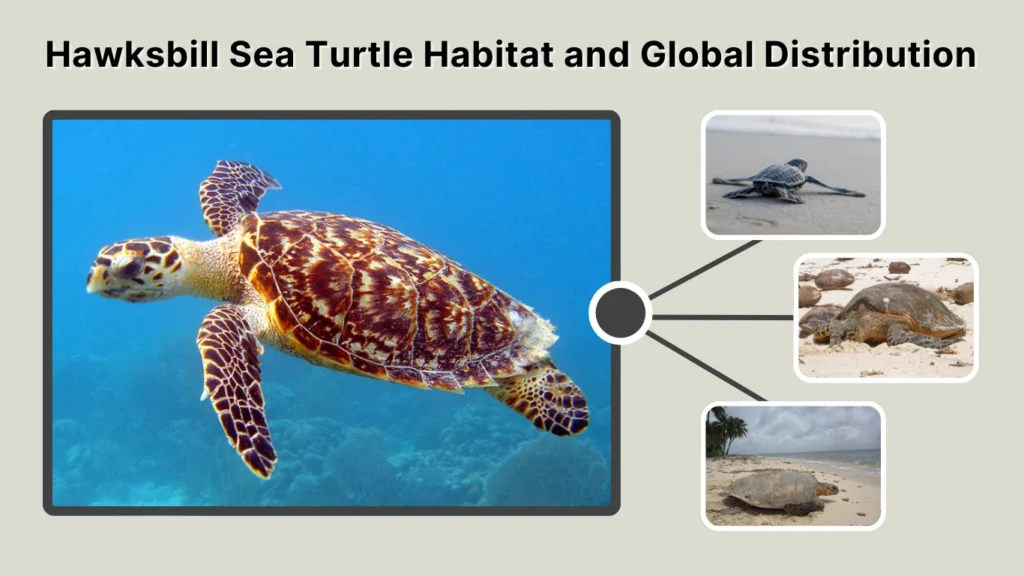
Hawksbill sea turtles are found mainly in tropical and subtropical regions of the world’s oceans. They show a strong preference for coral reef ecosystems, where food is abundant and shelter is readily available. However, different life stages occupy different habitats, allowing them to take advantage of a wide range of marine environments.
Coral Reef Environments
Coral reefs are the primary feeding grounds for adult hawksbill sea turtles. These complex structures provide hiding places, breeding sites, and a rich supply of sponges and invertebrates. Hawksbills are often seen navigating narrow reef passages and resting under ledges. Their presence helps prevent fast-growing sponges from outcompeting corals, supporting reef balance.
Ocean Regions They Inhabit
Hawksbill sea turtles live in the Atlantic, Pacific, and Indian Oceans. They are commonly found in the Caribbean Sea, along the coasts of Central America, around Southeast Asia, northern Australia, East Africa, and many tropical island chains. Although they prefer warm waters, some individuals migrate seasonally between feeding grounds and nesting beaches.
Nesting Beaches
Female hawksbills return to sandy tropical beaches to lay eggs. Unlike some sea turtles that prefer wide open beaches, hawksbills often nest near or under vegetation. These beaches are usually located close to coral reefs and lagoons, reducing the distance hatchlings must travel to reach suitable habitat.
Hawksbill Sea Turtle Diet
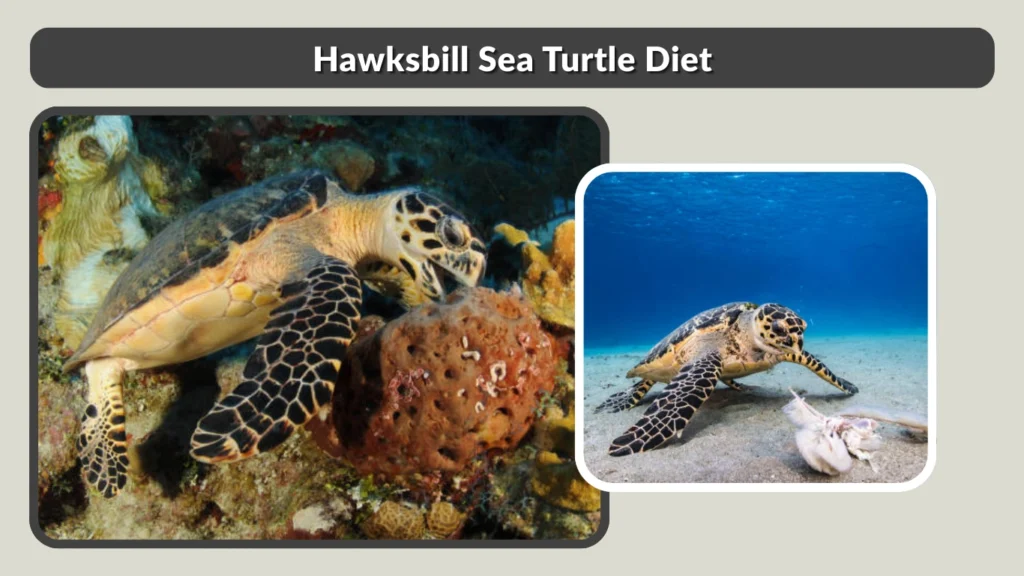
The hawksbill sea turtle has one of the most specialized diets of any sea turtle species. While juveniles may eat a wider variety of foods, adults are best known for feeding primarily on marine sponges, along with soft corals, sea anemones, and small reef invertebrates.
What Hawksbill Sea Turtles Eat
Sponges make up the majority of an adult hawksbill’s diet. Many of these sponges are toxic to other animals, but hawksbills have developed a tolerance that allows them to consume prey few other species can. This reduces competition and gives them access to a unique ecological niche.
Feeding Techniques
Hawksbill sea turtles use their narrow, pointed beaks like precision tools. They insert their beaks deep into coral crevices and reef cracks to pull out sponges, soft corals, and small invertebrates. Their strong jaws allow them to tear tough sponge tissues that most predators avoid. While feeding, hawksbills often brace themselves against coral with their flippers, carefully maneuvering through tight reef spaces without damaging their shells.
Because hawksbills selectively remove fast-growing sponges, they prevent these organisms from overwhelming reef-building corals. This feeding behavior promotes coral growth and increases overall reef diversity, making hawksbill turtles essential guardians of coral reef ecosystems.
Life Cycle of a Hawksbill Sea Turtle
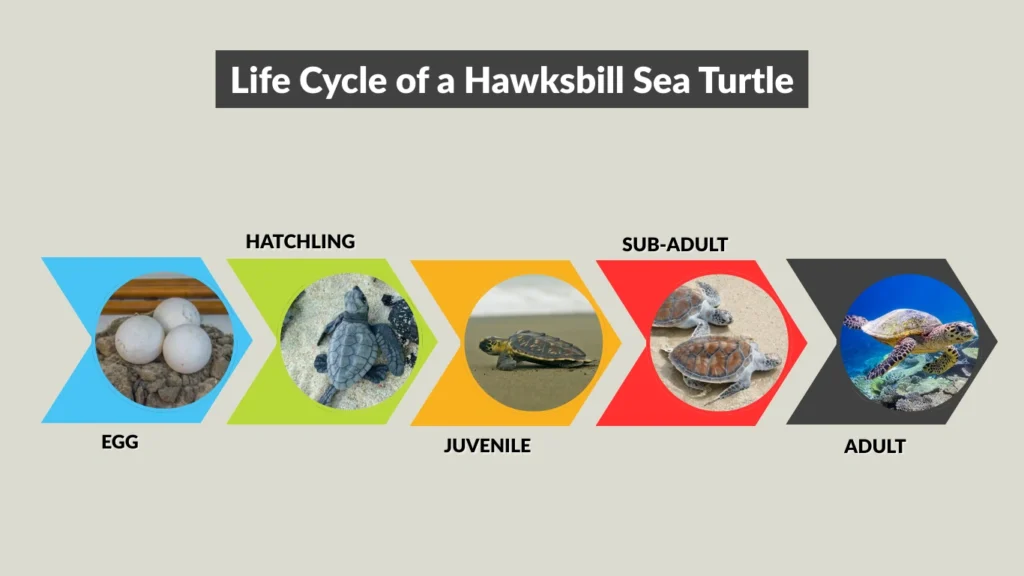
The life cycle of a hawksbill sea turtle is long and difficult, with very few individuals surviving to adulthood.
- Egg stage: Females dig nests in warm sand and lay about 100 to 140 eggs per clutch.
- Hatchling stage: After roughly 45 to 70 days, hatchlings emerge and rush toward the sea, guided by natural light.
- Juvenile stage: Young turtles drift in open ocean habitats, feeding on small floating organisms.
- Sub-adult stage: As they grow, they move into reef environments and begin specialized feeding.
- Adult stage: Adults settle in reef feeding grounds and migrate periodically to nesting beaches.
Hawksbill sea turtles grow slowly and may take 20 to 40 years to reach sexual maturity. Many are believed to live 50 years or more in the wild.
Reproduction and Nesting Behavior
Hawksbill sea turtles usually mate in shallow waters near nesting beaches. A single female may mate with several males and store sperm to fertilize multiple clutches during one nesting season.
Courtship and Mating
Mating occurs in warm coastal waters. Males use their curved claws to grip females during mating. Competition between males is common, but serious injuries are rare.
Nesting Process
Females come ashore at night, choosing quiet, undisturbed beaches. They dig body pits and then excavate egg chambers using their rear flippers. After laying eggs, the female carefully fills the nest and disguises it with sand and surrounding debris before returning to the sea.
Incubation and Hatching
Eggs incubate for several weeks. Sand temperature determines hatchling sex, with warmer sand producing more females. When the hatchlings emerge, they dig upward together and rush to the ocean, facing extreme predation during this vulnerable journey.
Predators and Natural Threats
Hawksbill sea turtles face predators at every life stage.
- Egg predators: Crabs, birds, raccoons, and monitor lizards
- Hatchling predators: Reef fish, seabirds, and crabs
- Juvenile predators: Large predatory fish and sharks
- Adult predators: Primarily sharks and, in some regions, killer whales
- Natural defenses: Camouflage, reef hiding behavior, and a hard shell
Despite these defenses, natural survival rates are very low, even without human pressures.
Conservation Status and Human Threats
Hawksbill sea turtles are listed as Critically Endangered, making them one of the most threatened sea turtle species.
Illegal Shell Trade
For centuries, hawksbills were hunted for their beautifully patterned shells, known as “tortoiseshell,” which were used in jewelry, combs, and ornaments. Although international trade is now banned, illegal harvesting still occurs.
Habitat Destruction
Coral reef degradation, coastal development, and beach erosion reduce both feeding habitats and nesting areas. Damaged reefs also mean fewer sponges and less shelter.
Fishing, Pollution, and Climate Change
Hawksbills are frequently caught accidentally in fishing gear. Marine pollution, especially plastics, causes injury and death. Climate change alters reef ecosystems and nesting beach conditions, threatening long-term survival.
Importance to Marine Ecosystems
Hawksbill sea turtles play a crucial role in coral reef health.
- Controlling sponge populations
- Allowing corals to compete successfully for space
- Maintaining reef species diversity
- Supporting fish populations indirectly
- Serving as indicators of reef ecosystem health
Without hawksbills, reefs can become dominated by sponges, reducing coral cover and overall biodiversity.
Hawksbill Sea Turtle vs Other Sea Turtles
Hawksbill sea turtles are easily distinguished by their narrow beaks and overlapping shell scutes. Unlike green sea turtles, which graze on seagrass, hawksbills specialize in reef feeding. Compared to loggerheads, they are smaller and more agile, adapted for complex coral environments rather than open seafloor hunting.
Interesting Facts About Hawksbill Sea Turtles
Hawksbill sea turtles can climb over reef structures using their flippers. They often rest under coral ledges during the day. Their shells were once so valuable that they were traded worldwide. Despite their slow movements on land, they are remarkably agile swimmers in reef habitats.
FAQs
Why are hawksbill sea turtles endangered?
Hawksbill sea turtles are critically endangered due to centuries of hunting for their shells, accidental capture in fishing gear, loss of coral reefs, coastal development, pollution, and climate change. Their slow growth and late maturity make population recovery extremely difficult.
What do hawksbill sea turtles eat?
Hawksbill sea turtles mainly eat marine sponges, along with soft corals, sea anemones, and small reef invertebrates. Their narrow beaks allow them to reach food hidden deep within coral reefs, giving them access to prey few other animals can use.
Where do hawksbill sea turtles live?
Hawksbill sea turtles live in tropical and subtropical oceans worldwide. They are most commonly found around coral reefs in the Atlantic, Pacific, and Indian Oceans, including the Caribbean, Southeast Asia, East Africa, Australia, and many island regions.
How can you identify a hawksbill sea turtle?
You can identify a hawksbill sea turtle by its narrow, hawk-like beak, overlapping shell scutes, serrated shell edges, and striking amber-and-brown shell patterns. These features clearly distinguish it from other sea turtle species.
Why are hawksbill sea turtles important to coral reefs?
Hawksbill sea turtles control sponge populations on coral reefs. By removing fast-growing sponges, they allow corals to thrive and maintain reef structure. This supports fish diversity, reef resilience, and overall marine ecosystem health.