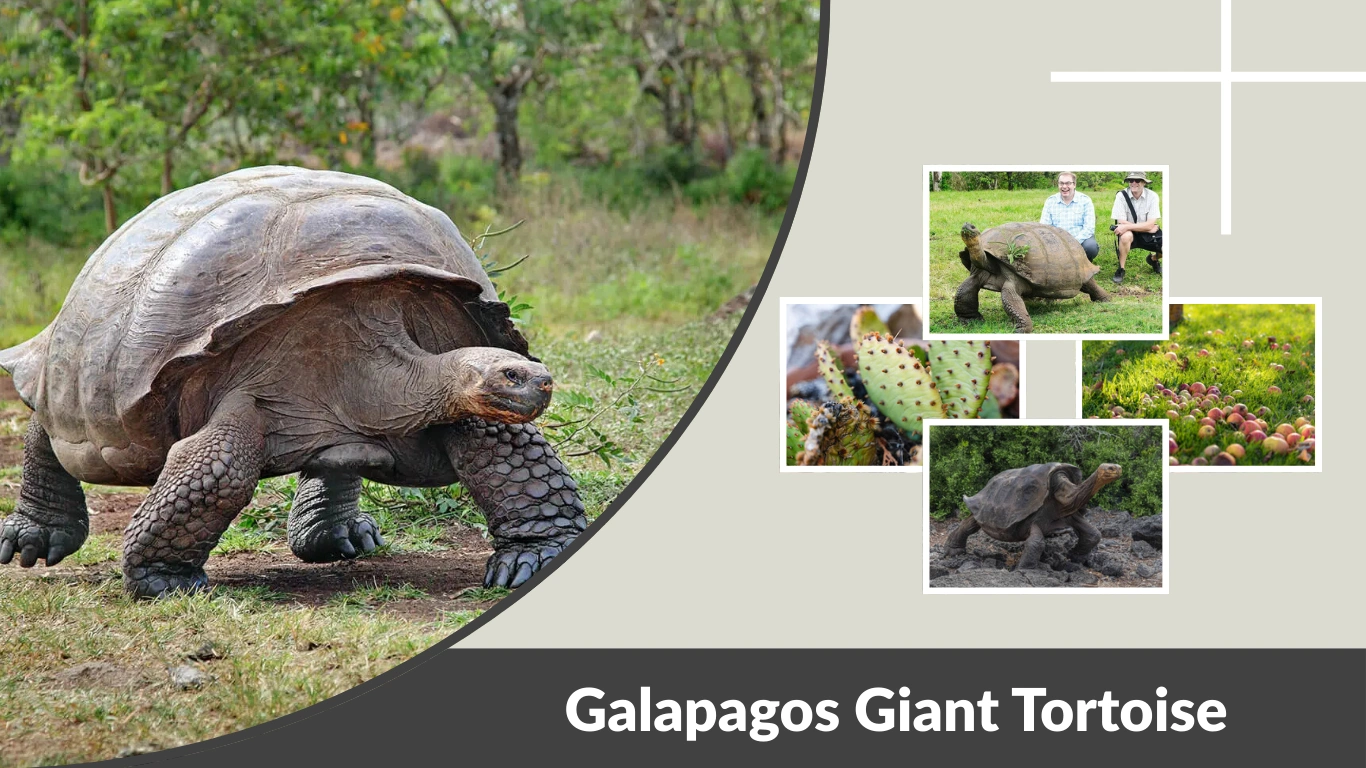
The Galapagos giant tortoise is one of the most remarkable reptiles on Earth, famous for its enormous size, extreme longevity, and strong connection to Charles Darwin’s studies of evolution. Found only on the Galapagos Islands, these ancient-looking animals have survived for millions of years with very little change. Their slow movement hides an important ecological role, as they help shape island vegetation and landscapes. Understanding their identification, habitat, behavior, and diet offers insight into why they are considered living symbols of natural history.
Taxonomy and Scientific Classification
The Galapagos giant tortoise belongs to a complex group of closely related tortoises rather than a single uniform type. Scientists classify them under Chelonoidis niger, a species group that includes multiple island-based subspecies. Each population evolved in isolation, developing different shell shapes, body sizes, and neck lengths depending on local food sources and terrain.
These differences are one of the most famous examples of adaptive radiation. On islands with tall cactus plants, tortoises evolved longer necks and saddleback shells, while those living in grassy, wetter areas developed domed shells and shorter necks. This variation strongly influenced Darwin’s early ideas about natural selection.
Scientific Name and Family
The accepted scientific name is Chelonoidis niger, and it belongs to the family Testudinidae, which includes all land tortoises. Members of this family are known for their heavy shells, thick limbs, and strictly terrestrial lifestyle.
Subspecies Diversity
Today, scientists recognize several living subspecies and some extinct ones. Each major island historically supported its own form. Differences can still be seen in shell shape, size, and behavior, reflecting how geography shaped their evolution.
Identification and Physical Characteristics
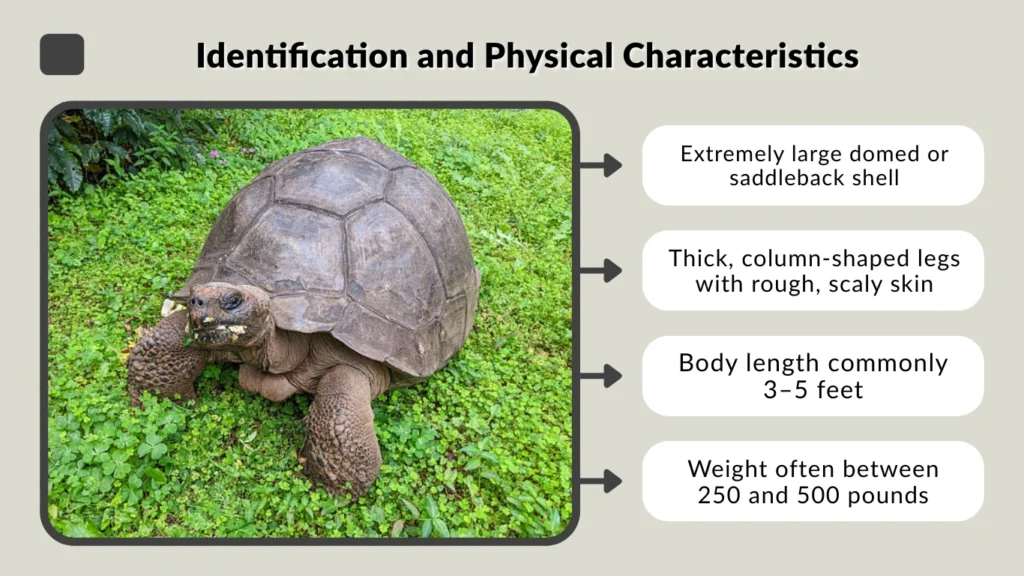
The Galapagos giant tortoise is the largest living tortoise species. Its massive shell, thick pillar-like legs, and slow, steady movement make it instantly recognizable. Despite their size, these tortoises are generally gentle and calm animals.
Identification
- Extremely large domed or saddleback shell
- Thick, column-shaped legs with rough, scaly skin
- Small head with a blunt, beak-like mouth
- Gray to black wrinkled skin
- Body length commonly 3–5 feet
- Weight often between 250 and 500 pounds
- Males noticeably larger than females
- Long neck adapted for grazing or browsing
Shell Types and Shape
Two main shell forms exist: dome-shaped and saddleback. Dome-shaped shells are rounded and common on islands with abundant ground vegetation. Saddleback shells arch upward at the front, allowing the tortoise to stretch its neck higher to reach cactus pads and shrubs.
Size and Growth Rate
Galapagos giant tortoises grow very slowly. Hatchlings may fit in the palm of a hand, but it can take several decades for them to reach full size. Growth continues gradually throughout life, contributing to their long lifespan and late maturity.
Natural Habitat and Geographic Range
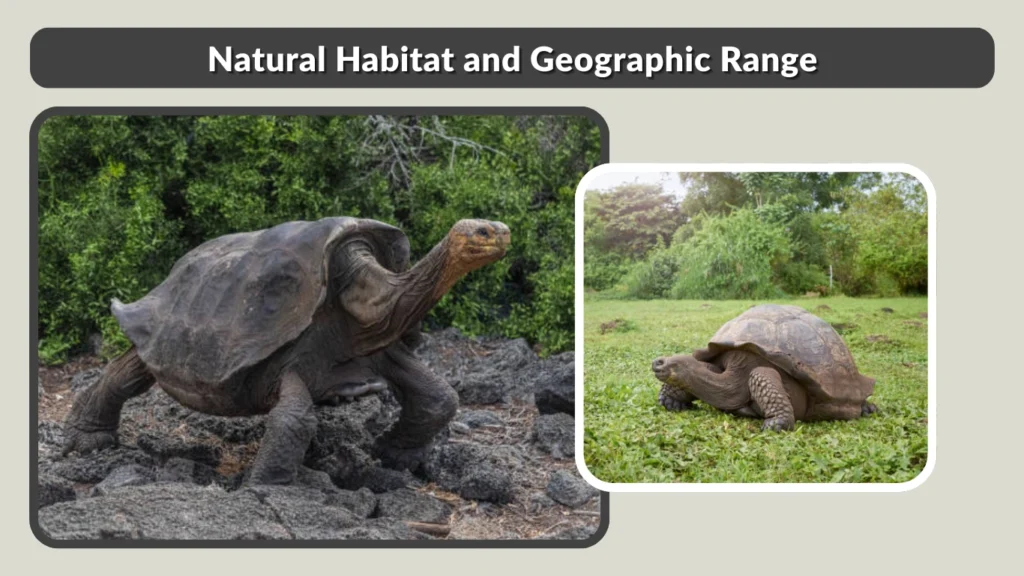
Galapagos giant tortoises are found only in the Galapagos Islands, an isolated volcanic archipelago in the Pacific Ocean. Their distribution depends largely on elevation, moisture, and vegetation type.
Habitat
These tortoises occupy a wide range of environments, from dry coastal lowlands to cool, humid highlands. During dry seasons, many individuals migrate uphill in search of fresh plants and water. In wet seasons, they often return to lower areas where grasses and fruits become abundant.
Geographic Distribution
Large populations live on islands such as Isabela, Santa Cruz, San Cristóbal, and Española. Each island’s terrain and climate influenced how local tortoises evolved, resulting in distinct physical forms and behaviors.
Behavior and Daily Activity
Galapagos giant tortoises are generally slow-moving and spend much of their day resting, feeding, or regulating body temperature. Despite their solitary reputation, they often gather in feeding areas or water holes.
Behaviors
They frequently bask in the sun to warm their bodies and wallow in muddy pools to cool down and protect their skin from parasites. Males may display dominance by stretching their necks high and attempting to raise their heads above rivals.
Communication and Social Interaction
Although mostly quiet, tortoises communicate through body posture, gentle nudging, and low sounds during mating. Their social interactions are usually calm, with little aggression.
Diet and Feeding Habits

The Galapagos giant tortoise is strictly herbivorous and plays a major role in shaping island plant communities.
Diet
Their diet includes grasses, leaves, cactus pads, fallen fruits, flowers, and shrubs. They consume large quantities of vegetation daily and can survive long periods without food or water by storing it in their bodies.
Feeding Strategy
Dome-shaped tortoises mainly graze on low plants, while saddleback tortoises browse higher vegetation. This feeding diversity helps prevent any single plant species from dominating the landscape.
Lifecycle and Reproduction
The Galapagos giant tortoise has one of the slowest life cycles in the animal kingdom. Every stage of its life—from hatching to maturity—unfolds gradually, reflecting its long lifespan and low metabolic rate.
Lifecycle
After mating, females travel to dry, sandy zones to dig nests using their powerful hind legs. They typically lay between 5 and 20 eggs, which are covered and left to incubate naturally. Incubation lasts four to eight months, depending on temperature and humidity. Warmer nests usually produce more females, while cooler nests produce more males.
Hatchlings emerge tiny and vulnerable, often no larger than a tennis ball. During their early years, they face threats from birds and introduced predators. Survivors grow slowly, taking 20 to 40 years to reach sexual maturity. Once adulthood is reached, growth continues at a slower pace throughout life.
Reproduction and Nesting
Mating generally occurs during warm seasons when food is abundant. Males compete by raising their heads as high as possible, pushing rivals until one retreats. Females may store sperm and lay eggs months later, helping ensure reproductive success even when mates are scarce.
Lifespan and Growth
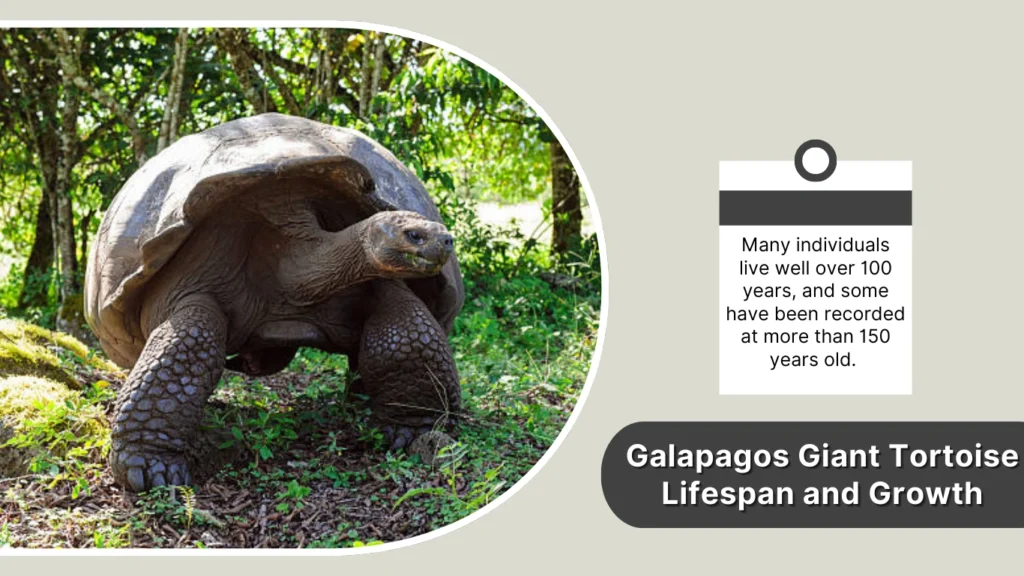
Galapagos giant tortoises are famous for their extreme longevity. Many individuals live well over 100 years, and some have been recorded at more than 150 years old. Their slow metabolism, strong immune systems, and steady growth patterns contribute to this remarkable lifespan.
Scientists study these tortoises to understand aging, DNA repair, and disease resistance. Famous individuals such as “Lonesome George” brought global attention to both their longevity and conservation needs. Their ability to remain reproductively active for decades also supports long-term population recovery efforts.
Ecological Importance
Galapagos giant tortoises are considered keystone species because their activities strongly influence island ecosystems. By feeding, moving, and nesting, they shape the structure of plant communities across multiple habitats.
Seed Dispersal Role
As tortoises consume fruits and vegetation, they transport seeds across long distances. These seeds pass through their digestive systems and are deposited in nutrient-rich droppings, helping many plant species spread between zones and islands.
Vegetation Shaping
Their grazing prevents overgrowth, maintains open grasslands, and creates natural pathways used by other animals. In highland regions, their movements also help shape wetlands and soil structure.
Conservation Status and Threats
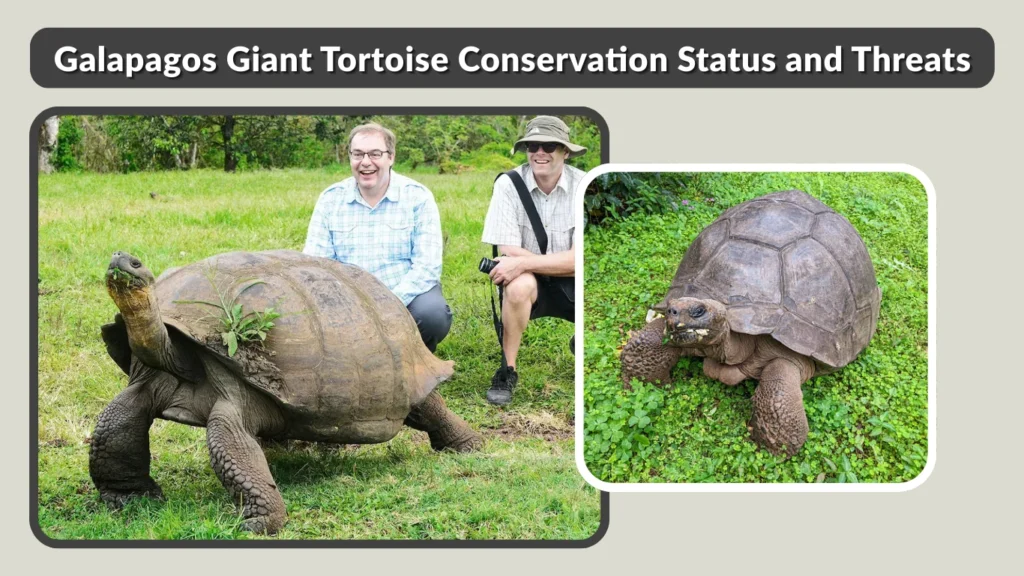
Although Galapagos giant tortoises are now protected, their populations were once pushed close to extinction. Sailors historically hunted them for meat and oil, and many island populations were wiped out.
Major Threats
- Historic overhunting by humans
- Habitat destruction and fragmentation
- Introduced predators such as rats and dogs
- Competition from invasive herbivores
- Climate change affecting nesting success
- Low natural reproductive rates
Conservation Programs
Modern conservation focuses on captive breeding, habitat restoration, and invasive species control. Breeding centers raise hatchlings until they are large enough to survive in the wild. Protected areas and strict regulations now allow many populations to slowly recover.
Galapagos Giant Tortoise vs Other Giant Tortoises
The Galapagos giant tortoise is often compared to the Aldabra giant tortoise of the Indian Ocean. While both are enormous and long-lived, they evolved independently on different island systems. Galapagos tortoises show greater variation in shell shape, reflecting the diverse environments across the archipelago.
Interesting Facts About Galapagos Giant Tortoises
These ancient reptiles continue to fascinate scientists and wildlife enthusiasts alike due to their unique biology and history.
Unique Facts
- They can survive up to a year without fresh food or water
- Their shells can reveal which island they came from
- They inspired early ideas about evolution
- Some individuals outlive several human generations
- They can carry over 80% of their body weight in vegetation and water
FAQs
What is the scientific name of the Galapagos giant tortoise?
The Galapagos giant tortoise is classified under the species complex Chelonoidis niger. Scientists recognize multiple subspecies across different islands, each shaped by unique environmental conditions. These variations in shell form and body structure make them a classic example of adaptive evolution.
How long do Galapagos giant tortoises live?
Galapagos giant tortoises are among the longest-living vertebrates on Earth. Many live beyond 100 years, and some have exceeded 150 years. Their slow metabolism, steady growth, and strong genetic traits contribute to their extraordinary longevity.
What do Galapagos giant tortoises eat?
They are strict herbivores that feed on grasses, leaves, cactus pads, fruits, and flowers. Their diet changes by season and location. Saddleback tortoises browse taller plants, while dome-shaped tortoises mainly graze on low vegetation.
Why are Galapagos giant tortoises important to the ecosystem?
They act as ecosystem engineers by shaping vegetation, dispersing seeds, and creating pathways across landscapes. Their feeding and movement patterns help maintain balanced habitats that support many other plant and animal species.
Are Galapagos giant tortoises endangered?
Conservation status varies by subspecies, ranging from vulnerable to critically endangered. Past overhunting and invasive species caused dramatic declines. Ongoing breeding programs, habitat protection, and predator control now support slow but steady population recovery.