
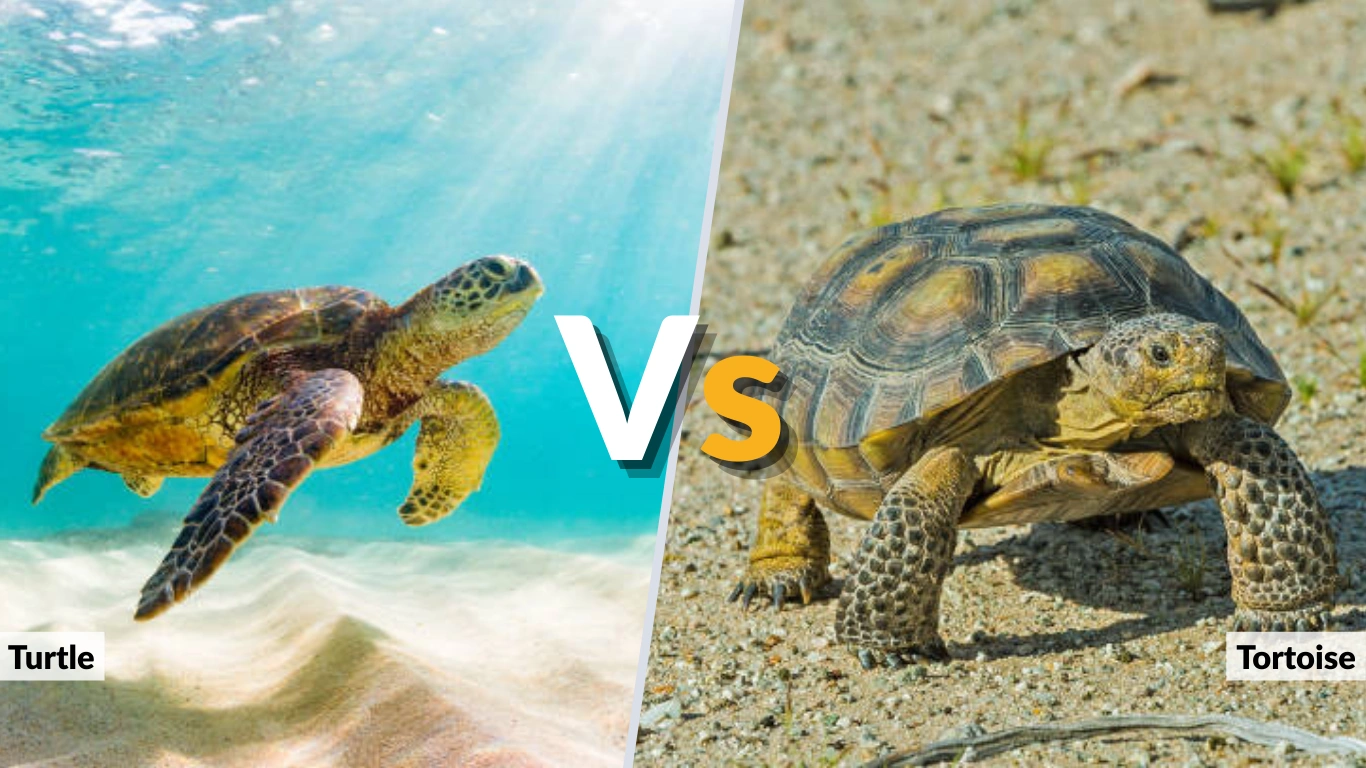
Turtles and tortoises are often mistaken for one another because they share a similar appearance and belong to the same group of reptiles. However, despite these similarities, turtles and tortoises differ in many important ways, including where they live, how they move, what they eat, and how their bodies are adapted to their environments. Understanding these differences helps with proper identification and also highlights how each animal has evolved to survive in very different habitats. This article explains the key differences between turtles and tortoises in a clear and simple way.
Overview of Turtles and Tortoises
Both turtles and tortoises belong to the reptile order Testudines, which includes all animals with a bony shell. Members of this group are characterized by their hard shells, slow metabolism, and long lifespans. While they share a common ancestry, turtles and tortoises have adapted to different environments over millions of years.
In general, the term “turtle” is often used broadly to describe many shell-bearing reptiles, especially those that live in water. Tortoises, on the other hand, are specifically adapted for life on land. These differences in habitat have led to noticeable physical and behavioral distinctions between the two.
Are Turtles and Tortoises the Same?
Scientifically speaking, tortoises are a type of turtle, but not all turtles are tortoises. All tortoises fall under the larger turtle group, yet they form a specialized subgroup that is fully terrestrial. This classification often causes confusion, especially in everyday language.
A common misconception is that turtles live in water while tortoises live on land, and although this is generally true, there are exceptions. Some turtles are semi-aquatic and spend time both in water and on land. Tortoises, however, are strictly land-dwelling and are not adapted for swimming.
Habitat Differences Between Turtles and Tortoises
Turtle Habitats
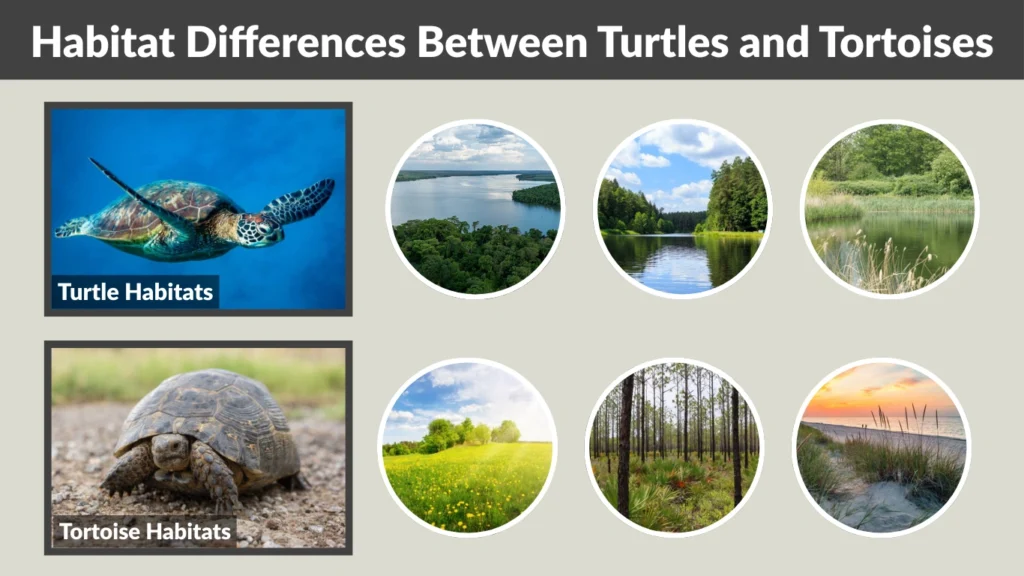
Turtles are primarily aquatic or semi-aquatic animals. Many species live in freshwater environments such as rivers, lakes, ponds, and wetlands. Others, such as sea turtles, live almost entirely in marine environments and travel long distances across oceans.
Aquatic habitats require turtles to be strong swimmers, and their bodies are adapted accordingly. Turtles usually bask on logs or rocks but return to water for feeding and protection.
Tortoise Habitats
Tortoises live exclusively on land and are commonly found in dry environments such as deserts, grasslands, and scrub forests. Some species also inhabit tropical forests or savannas. These habitats require strong legs for walking and digging rather than swimming.
Because tortoises live in dry areas, they have evolved behaviors such as burrowing to escape extreme temperatures and conserve moisture.
Physical Differences Between Turtle and Tortoise
| Feature | Turtle | Tortoise |
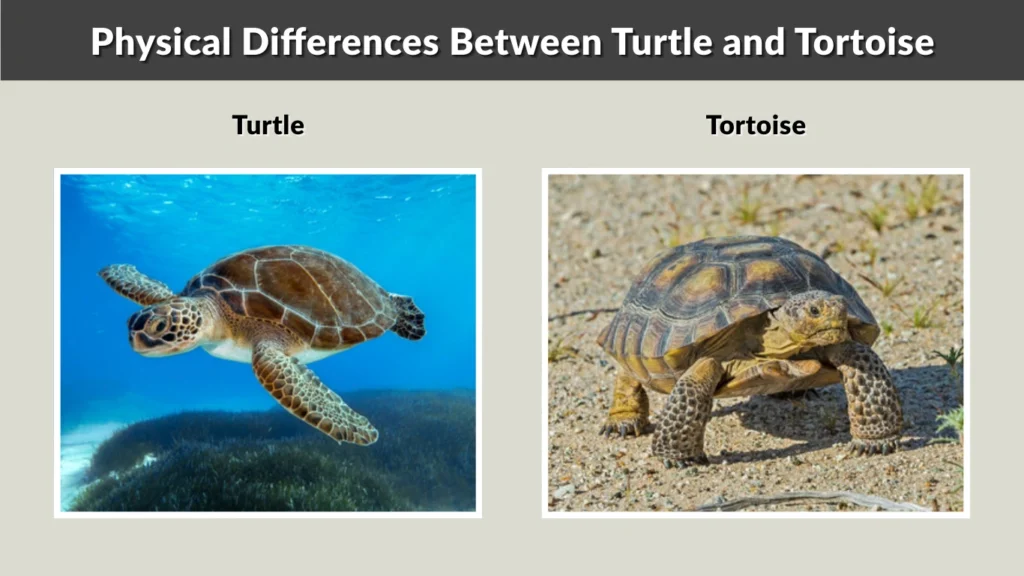
| Habitat Adaptation | Aquatic or semi-aquatic | Fully terrestrial (land-dwelling) |
| Shell Shape | Flat or streamlined for swimming | High-domed and rounded for land protection |
| Shell Weight | Lighter shell to aid movement in water | Heavier, thicker shell for defense |
| Legs | Slim legs or flippers | Thick, column-shaped legs |
| Feet | Webbed feet or flippers | Non-webbed, elephant-like feet |
| Swimming Ability | Strong swimmers | Cannot swim and may drown in deep water |
| Neck Retraction | Often retract sideways or straight back | Retracts straight back into shell |
| Body Structure | Sleeker body for water movement | Sturdy body built for walking and digging |
Movement and Behavior
Swimming Ability
Turtles are strong swimmers and rely on water for feeding, mating, and protection. Many species spend most of their lives in water and only come ashore to bask or lay eggs.
Tortoises lack the physical features needed for swimming. Their heavy shells and non-webbed legs make movement in water difficult, which is why they stay on land throughout their lives.
Daily Behavior Patterns
Turtles and tortoises also differ in how they behave throughout the day. Turtles spend much of their time swimming, resting underwater, or basking in the sun on rocks and logs. Their behavior is closely tied to water temperature and availability. Many turtles retreat into water when threatened, using it as their primary form of protection.
Tortoises, in contrast, are slow-moving land animals that spend much of their day walking, grazing, or resting in shaded areas or burrows. During extreme heat or cold, tortoises often remain underground to regulate their body temperature. Their behavior is shaped by the need to conserve energy and moisture in dry environments.
Diet and Feeding Differences
What Do Turtles Eat?
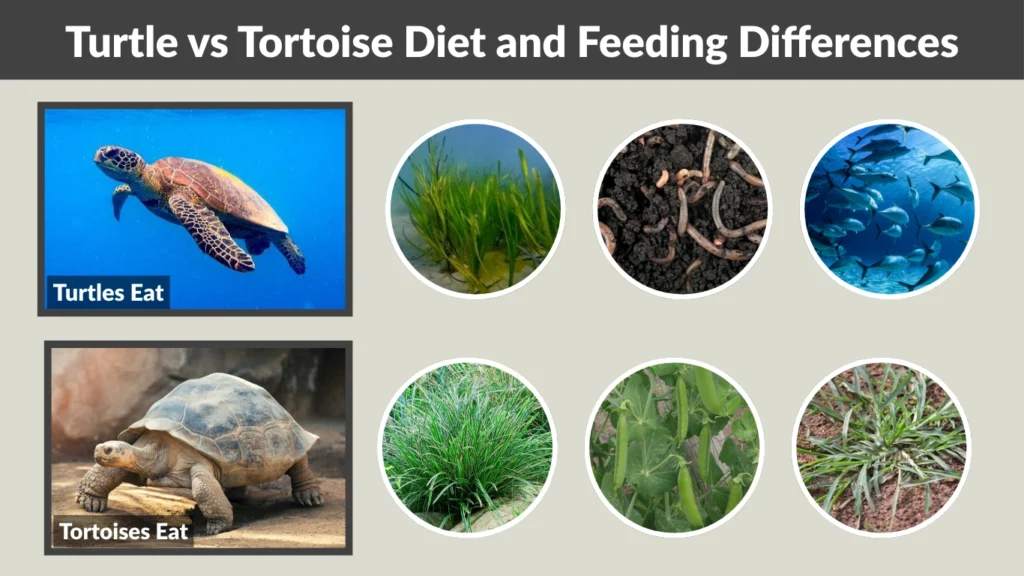
Most turtles are omnivores, meaning they eat both plant and animal matter. Their diet may include aquatic plants, insects, worms, fish, and small invertebrates. Some species are more carnivorous, especially when young, while others become more herbivorous as they age.
Aquatic turtles usually feed in water, using their sharp beaks to tear or swallow food. Their flexible diet allows them to adapt to a wide range of environments.
What Do Tortoises Eat?
Tortoises are primarily herbivores. They feed on grasses, leaves, flowers, and fruits found on land. Their digestive systems are adapted to process tough plant material, and a high-fiber diet is essential for their health.
Unlike turtles, tortoises do not hunt or eat animal prey. Feeding habits are slow and deliberate, reflecting their overall lifestyle.
Lifespan and Growth Comparison
Both turtles and tortoises are known for their long lifespans, but tortoises generally live longer. Many turtle species live between 20 and 40 years, although some can exceed 50 years. Tortoises, especially larger species, often live 50 to 100 years or more.
Growth rates are slow in both groups, with individuals taking many years to reach maturity. This slow growth makes populations vulnerable to threats because recovery takes a long time when numbers decline.
Reproduction and Life Cycle
Turtles and tortoises reproduce by laying eggs on land. Females dig nests in sandy or loose soil and leave the eggs unattended. Hatchlings emerge weeks or months later and must survive on their own from birth.
In turtles, hatchlings often move quickly toward water, where they find food and shelter. Tortoise hatchlings, however, remain on land and are highly vulnerable to predators during their early years. Survival rates are low, but those that reach adulthood can live for decades.
Turtle vs Tortoise: Key Differences at a Glance
At a glance, the main differences between turtles and tortoises can be summarized by their lifestyle and physical traits. Turtles are adapted for life in water, with streamlined shells, webbed feet or flippers, and swimming ability. Tortoises are adapted for life on land, with domed shells, thick legs, and a strictly herbivorous diet. These differences reflect how each group has evolved to thrive in its specific environment.
Turtle vs Tortoise as Pets
Keeping turtles or tortoises as pets requires careful consideration. Turtles often need large aquatic enclosures, clean water, and specialized lighting. Tortoises require spacious land enclosures, proper temperature control, and a carefully balanced plant-based diet.
In many areas, it is illegal to keep native turtles or tortoises as pets. Additionally, both animals can live for decades, making them a long-term commitment that many people underestimate.
Conservation and Protection
Both turtles and tortoises face threats from habitat loss, pollution, climate change, and illegal wildlife trade. Road mortality and human disturbance also contribute to population declines. Conservation efforts focus on habitat protection, public education, and enforcing wildlife protection laws.
Conclusion
While turtles and tortoises share a common ancestry, they differ significantly in habitat, physical features, behavior, and diet. Understanding these differences makes identification easier and highlights the unique adaptations that allow each to survive. Protecting both turtles and tortoises is essential for maintaining healthy ecosystems and preserving these ancient reptiles for future generations.