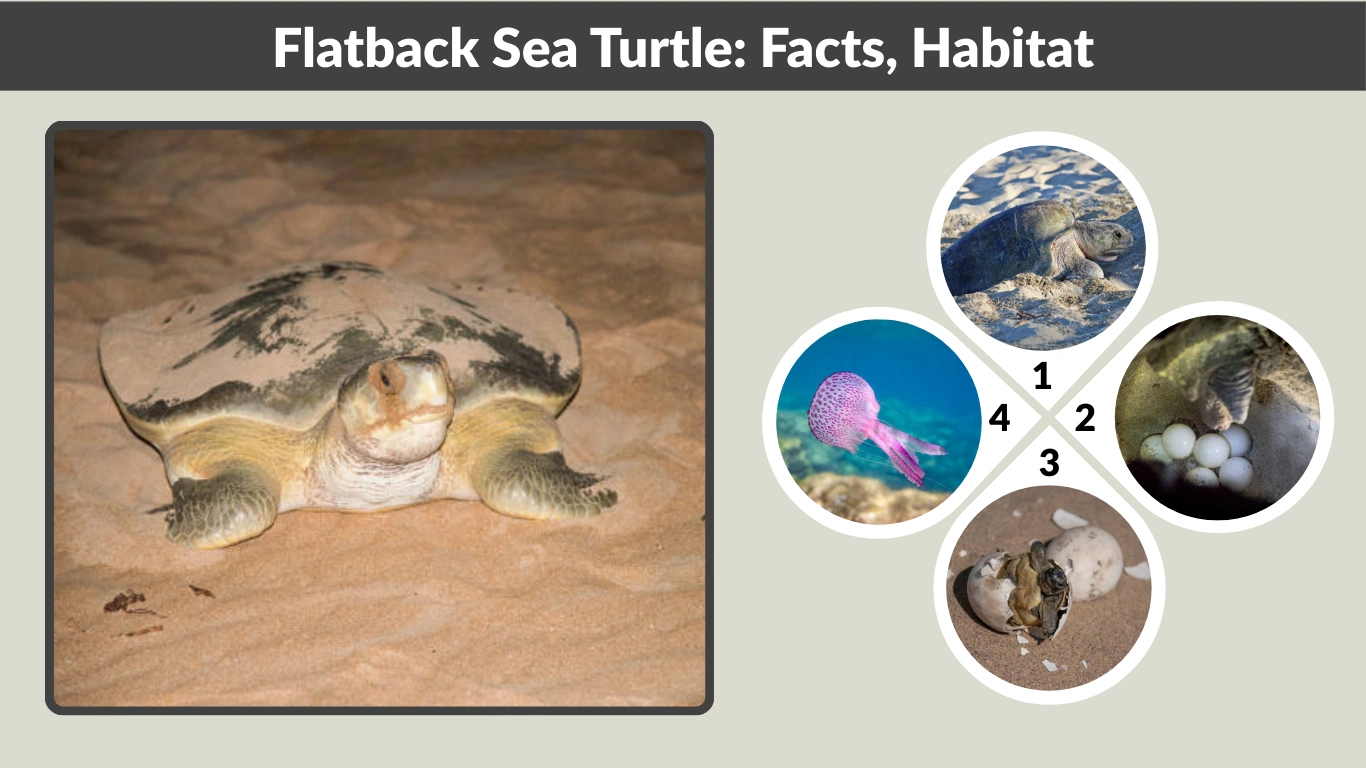
The flatback sea turtle (Natator depressus) is one of the most unique and least widely known sea turtle species in the world. Native primarily to the coastal waters of northern Australia, this turtle stands out because of its unusually flat shell and limited migration range. Unlike other sea turtles that travel across entire oceans, the flatback remains close to home. Understanding its characteristics, habitat, and behavior helps highlight why this remarkable marine reptile deserves greater attention and conservation efforts.
What Is the Flatback Sea Turtle?
Scientific Classification
The flatback sea turtle belongs to the family Cheloniidae, which includes most hard-shelled sea turtles. Its scientific name, Natator depressus, reflects its distinctive body shape. “Natator” means swimmer, while “depressus” refers to its flattened shell. This species is the only member of its genus, making it biologically unique among marine turtles.
Why It’s Called a “Flatback”
As the name suggests, the flatback sea turtle has a noticeably flatter carapace (upper shell) compared to other sea turtles. Most sea turtles have high-domed shells, but the flatback’s shell is smooth and low-profile. The edges of its shell are slightly upturned, giving it a distinct outline when viewed from above. This flatter shape may help it move efficiently through shallow coastal waters.
How It Differs from Other Sea Turtles
One of the biggest differences between the flatback and other sea turtles is its geographic range. While species like the green sea turtle and loggerhead migrate across oceans, the flatback is mostly restricted to the continental shelf of Australia and nearby waters of Papua New Guinea. It also lays fewer but larger eggs than other sea turtle species. These differences make it both biologically fascinating and regionally important.
Physical Characteristics of the Flatback Sea Turtle
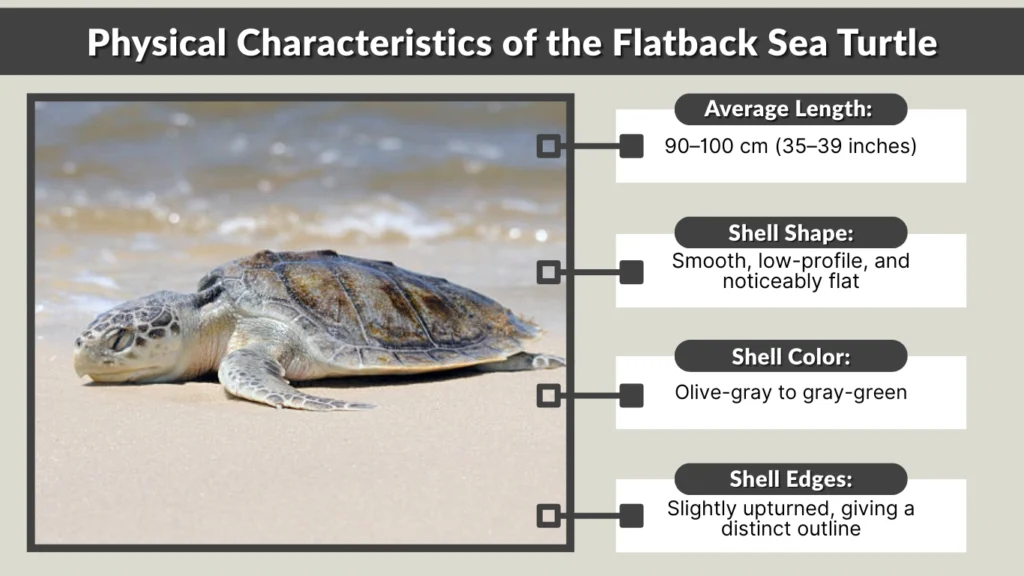
The flatback sea turtle has a distinctive appearance that sets it apart from other sea turtle species. As its name suggests, its shell is noticeably flatter and smoother than the high-domed shells of turtles like the green or loggerhead. This streamlined shape is well suited for life in shallow coastal waters along Australia’s continental shelf. Medium in size and built for efficient swimming, the flatback combines strength, agility, and subtle camouflage to survive in its marine environment.
Key Physical Features
- Average Length: 90–100 cm (35–39 inches)
- Average Weight: 70–90 kg (154–198 pounds)
- Shell Shape: Smooth, low-profile, and noticeably flat
- Shell Color: Olive-gray to gray-green
- Plastron (Underside): Pale yellow or cream-colored
- Shell Edges: Slightly upturned, giving a distinct outline
- Head: Moderately sized with a single pair of prefrontal scales
- Flippers: Long, paddle-shaped front flippers for strong swimming
- Body Type: Streamlined for movement in shallow coastal waters
These physical traits not only help researchers identify the species but also allow the flatback sea turtle to thrive in its specific habitat.
Habitat and Geographic Range
Where Does the Flatback Sea Turtle Live?
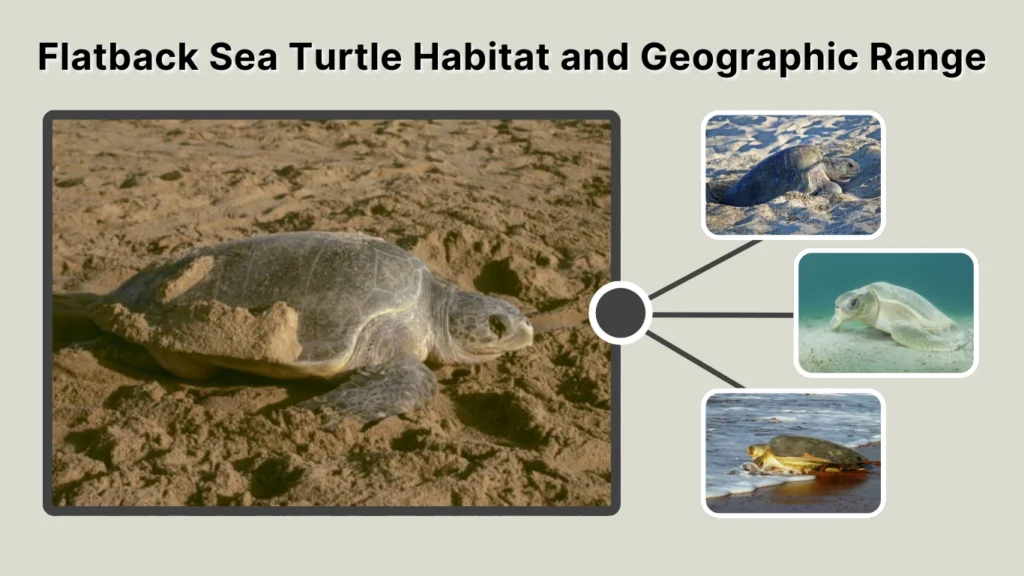
The flatback sea turtle has one of the most restricted ranges of all sea turtles. It is found mainly in the coastal waters of northern Australia, including Queensland, the Northern Territory, and Western Australia. Some populations are also found near Papua New Guinea.
Unlike other sea turtles that migrate across entire ocean basins, flatbacks remain within the continental shelf region. This means they stay relatively close to land rather than venturing into deep open ocean waters.
Preferred Habitat
Flatback sea turtles prefer shallow, soft-bottomed sea floors where they can easily find food. They are commonly found in coastal bays, lagoons, estuaries, and near coral reefs. These environments provide both feeding opportunities and safer areas away from large oceanic predators.
Because they stay in shallower waters, flatbacks are more closely tied to coastal ecosystems than many other sea turtle species. Their habitat choice makes them especially vulnerable to coastal development and human activity.
Why It Stays Near the Continental Shelf
One of the most interesting traits of the flatback sea turtle is its limited migration pattern. Most sea turtles travel thousands of miles between feeding and nesting grounds. In contrast, flatbacks typically move only within Australia’s continental shelf.
Scientists believe this behavior is linked to the availability of food sources and suitable nesting beaches within this region. Since their needs are met locally, there is less evolutionary pressure to undertake long-distance ocean migrations.
Diet and Feeding Behavior
What Do Flatback Sea Turtles Eat?
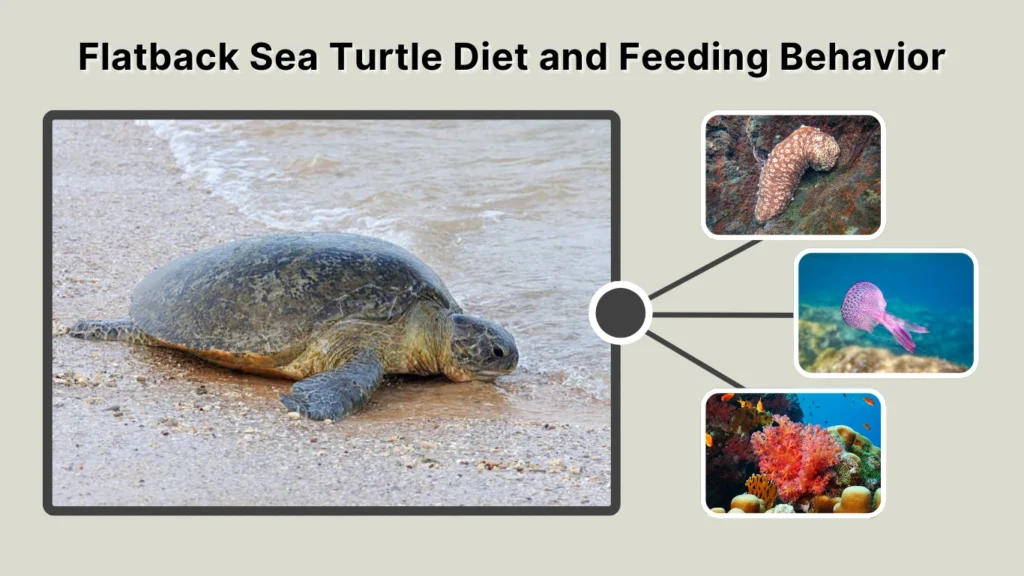
The flatback sea turtle is primarily carnivorous. Its diet consists mostly of soft-bodied marine invertebrates found along the sea floor. Common food sources include sea cucumbers, jellyfish, soft corals, sea pens, mollusks, shrimp, and other small crustaceans. Because they live in shallow coastal waters, they have easy access to these bottom-dwelling organisms.
Unlike green sea turtles, which shift to a largely herbivorous diet as adults, flatbacks remain meat-eaters throughout their lives. Their jaw structure is well suited for crushing and consuming soft prey.
Hunting and Feeding Habits
Flatback sea turtles typically forage along sandy or muddy sea floors. They use their strong flippers to maneuver close to the bottom and their sharp beaks to grasp prey. Since they feed in relatively shallow water, they do not need to make extremely deep dives like some other sea turtle species.
As predators of soft-bodied invertebrates, flatbacks play an important ecological role. By feeding on jellyfish and other marine organisms, they help maintain balance within coastal ecosystems.
Life Cycle and Reproduction
Mating Behavior
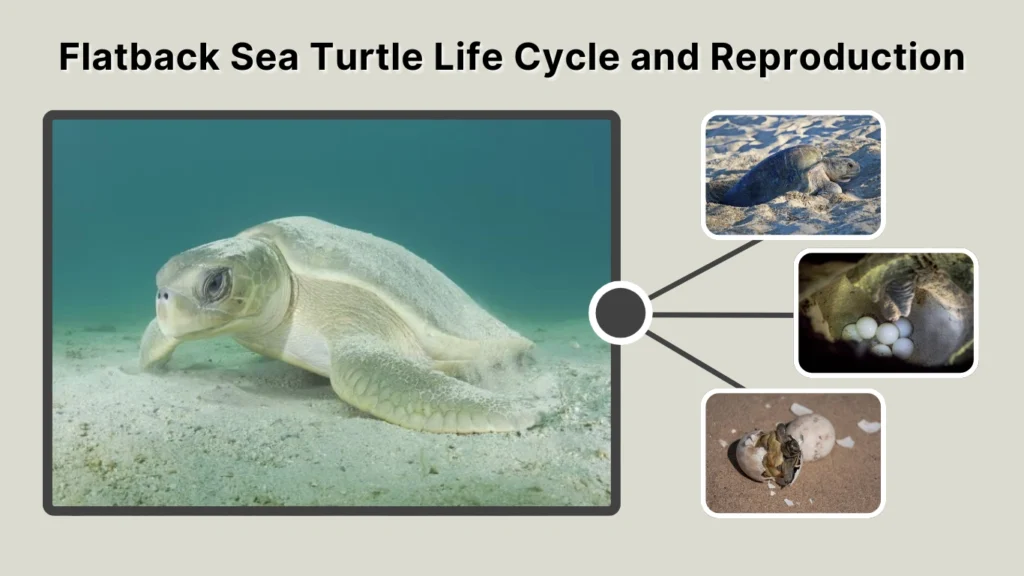
Mating usually occurs offshore near nesting beaches. Like other sea turtles, flatbacks are believed to reach sexual maturity after several decades, although exact age estimates are still being studied. Males rarely come ashore, spending their entire lives at sea, while females return to land to lay eggs.
Nesting Season
Flatback sea turtles nest primarily on sandy beaches along northern Australia. The nesting season generally occurs during warmer months, although timing can vary by region. Females return to the beaches where they were born—a behavior known as natal homing.
During nesting, a female crawls ashore at night, digs a deep chamber in the sand using her rear flippers, and lays a clutch of eggs. She then carefully covers the nest with sand before returning to the ocean.
Eggs and Hatchlings
Flatback sea turtles lay fewer eggs per clutch compared to other sea turtles, but their eggs are larger. A typical clutch contains about 40 to 60 eggs. The larger egg size produces bigger hatchlings, which may improve their chances of survival.
After about 45 to 60 days of incubation, the hatchlings emerge and make their way to the sea, usually at night to avoid predators. Despite their size advantage, many hatchlings fall victim to birds, crabs, and fish during this vulnerable journey.
Predators and Threats
Natural Predators
Adult flatback sea turtles have relatively few natural predators due to their size. However, large sharks and saltwater crocodiles may prey on them in coastal waters. Eggs and hatchlings face far greater danger from predators such as seabirds, ghost crabs, and monitor lizards.
Human-Related Threats
Although flatbacks remain mostly within Australian waters, they are not free from human impact. One of the biggest threats is accidental capture in fishing gear, known as bycatch. Trawling and gillnet fisheries can unintentionally trap turtles, leading to injury or drowning.
Coastal development also poses risks by disturbing nesting beaches. Artificial lighting near beaches can confuse hatchlings, causing them to move away from the ocean. Plastic pollution is another serious concern, as turtles may mistake floating debris for food.
Climate change adds further pressure. Rising sand temperatures can affect egg incubation and may influence hatchling sex ratios, since sea turtle sex is determined by temperature during development.
Conservation Status and Protection Efforts
IUCN and Australian Protection Status
Globally, the flatback sea turtle has been listed as “Data Deficient” by the International Union for Conservation of Nature (IUCN), meaning there is not enough information to determine its overall risk level. However, within Australia, it is legally protected under national environmental laws.
Conservation Programs
Australia has implemented several conservation initiatives to protect flatback sea turtles. These include monitoring nesting beaches, restricting development in sensitive areas, and using turtle-excluder devices (TEDs) in fishing nets to reduce bycatch.
Researchers also conduct tagging and tracking studies to better understand migration patterns and population trends. Community education programs play a key role in raising awareness about protecting nesting beaches and reducing pollution.
How Individuals Can Help
People can support flatback sea turtle conservation by reducing plastic use, properly disposing of waste, and supporting organizations that protect marine wildlife. Responsible tourism—such as avoiding disturbance of nesting turtles—also makes a difference.
Interesting Facts About the Flatback Sea Turtle
The flatback sea turtle is the only sea turtle species found exclusively within one country’s continental shelf. It has the largest eggs of all sea turtle species, producing relatively large hatchlings. Unlike most sea turtles, it does not migrate across entire oceans. Scientists believe flatbacks can live for several decades, although their exact lifespan is still being studied.
FAQs
Is the flatback sea turtle endangered?
Globally, the flatback sea turtle is classified as Data Deficient due to limited information about its total population. However, it is protected under Australian law because of regional threats such as bycatch, habitat loss, and climate change.
Why is the flatback sea turtle only found in Australia?
The flatback sea turtle evolved to live within Australia’s continental shelf, where food sources and nesting beaches are readily available. Because its needs are met locally, it never developed the long-distance migration patterns seen in other sea turtle species.
How big does a flatback sea turtle get?
Adult flatback sea turtles typically grow to about 90–100 centimeters (35–39 inches) in shell length and weigh between 70 and 90 kilograms. They are considered medium-sized compared to other sea turtle species.
What does the flatback sea turtle eat?
Flatback sea turtles mainly eat soft-bodied marine animals such as jellyfish, sea cucumbers, mollusks, shrimp, and soft corals. They forage in shallow coastal waters where these food sources are abundant.
How long do flatback sea turtles live?
While the exact lifespan of flatback sea turtles is not fully known, scientists estimate they can live for several decades, similar to other sea turtle species. Ongoing research continues to provide more accurate data about their longevity.