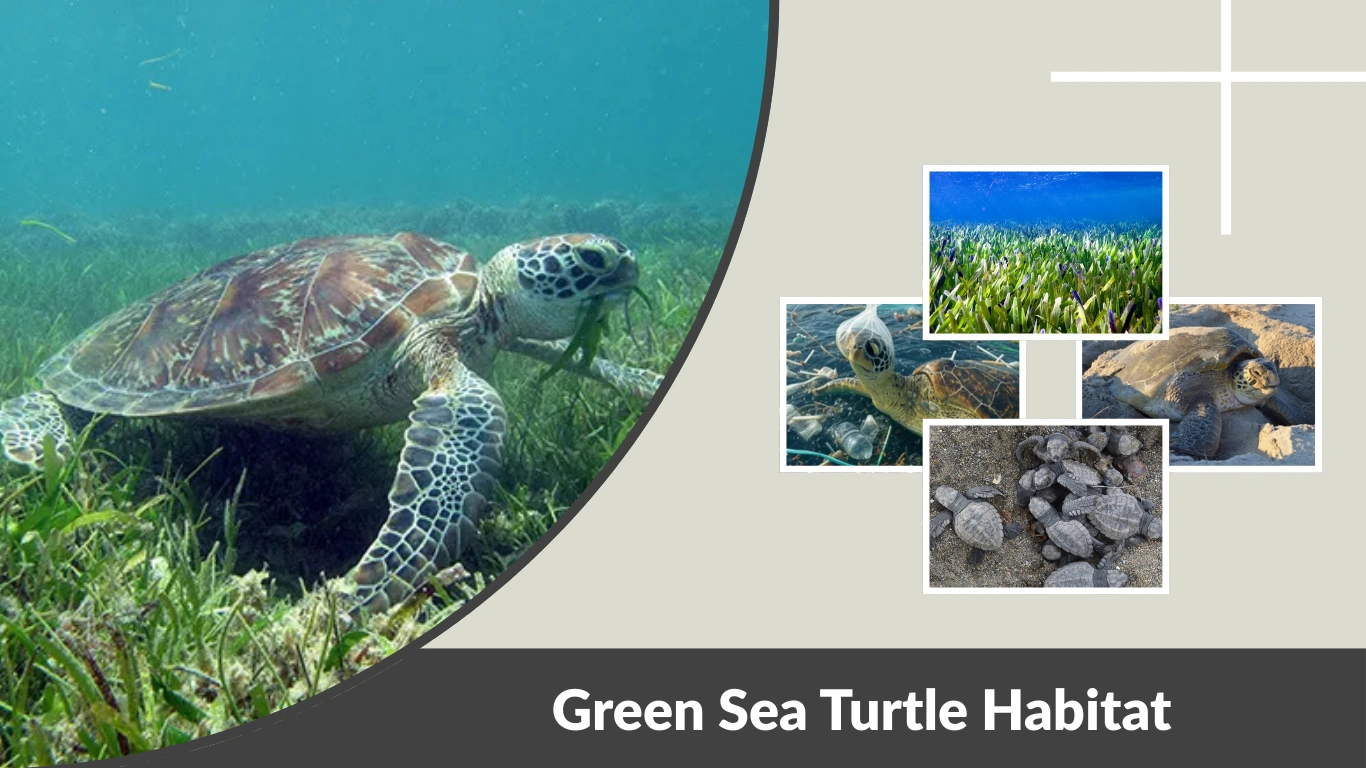
Green sea turtles live in some of the most productive marine ecosystems on Earth, relying on warm coastal waters, seagrass beds, and sandy beaches for survival. Their habitat stretches across tropical and subtropical oceans worldwide, shaping their feeding, nesting, and migration patterns. Understanding their habitat is essential for conservation, since habitat loss and climate change are major threats to this endangered species. This article explores their habitat in detail, from maps to climate needs.
Habitat Overview
Green sea turtles occupy a wide variety of marine and coastal habitats throughout their life cycle. Their habitat use changes dramatically as they grow, beginning with open-ocean drifting as hatchlings before transitioning to shallow coastal zones as juveniles and adults. The quality of these habitats directly affects their health, growth, and long-term survival.
Identification
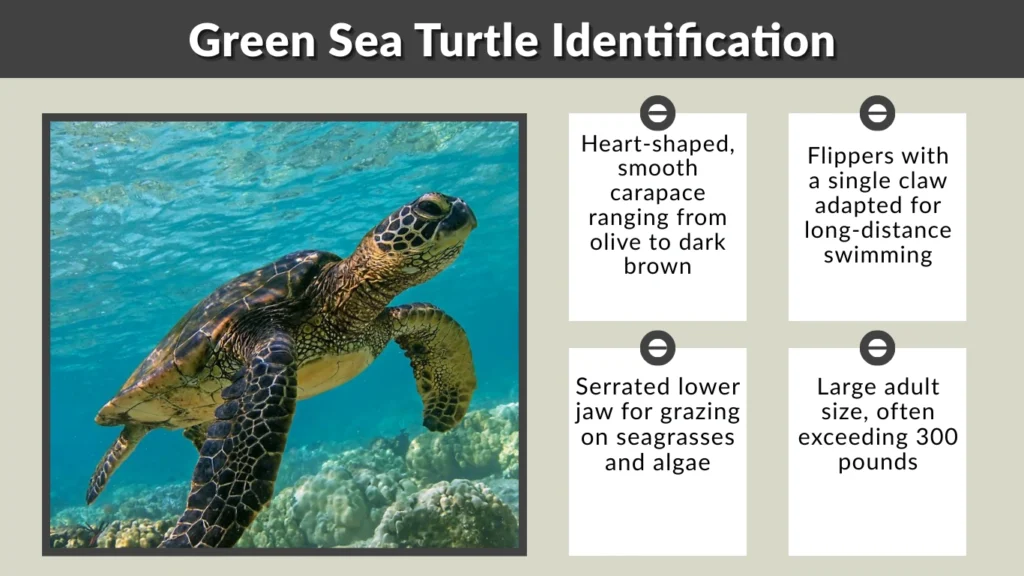
- Heart-shaped, smooth carapace ranging from olive to dark brown
- Flippers with a single claw adapted for long-distance swimming
- Serrated lower jaw for grazing on seagrasses and algae
- Blunt head compared to other sea turtle species
- Large adult size, often exceeding 300 pounds
Habitat Types
Coastal Foraging Habitats
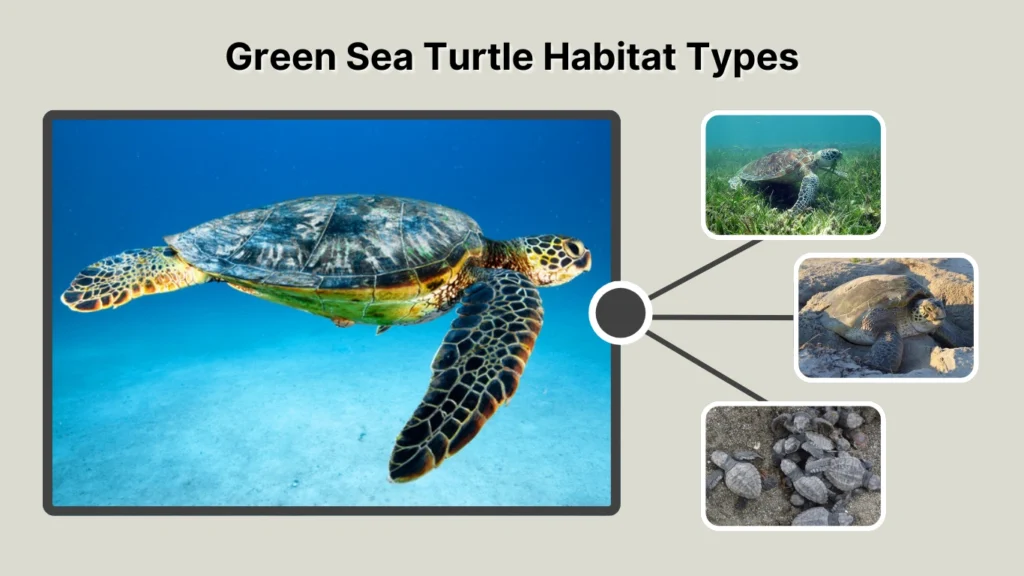
Green sea turtles spend most of their adult lives in shallow coastal zones where seagrass thrives. Seagrass beds are their primary feeding grounds, providing both food and shelter. Coral reefs also play a key role, offering algae-rich surfaces and protective structures for resting. Lagoons and estuaries serve as nursery areas for younger turtles, offering abundant food with reduced predation risk.
Nesting Habitats
Tropical and subtropical sandy beaches form the core of green sea turtle nesting zones. Ideal beaches have soft, warm sand that allows females to dig deep nests and maintain stable temperatures for incubation. Warm sand—generally between 26°C and 33°C—determines hatchling survival and even influences the sex ratio. Human activities such as coastal development, seawalls, and lighting can severely disrupt these delicate nesting environments.
Juvenile Pelagic Habitat
Before reaching coastal feeding grounds, juvenile green sea turtles spend several years drifting in the open ocean. They travel within mats of floating Sargassum seaweed, which provide shelter from predators, insects, and small fish that become early food sources. This oceanic phase is essential for their early growth and survival.
Habitat Range & Distribution
Green sea turtles have one of the widest habitat ranges of any marine reptile. They inhabit the Atlantic, Pacific, and Indian Oceans, with established populations in Australia, Hawaii, Florida, the Caribbean, Galápagos Islands, Southeast Asia, the Eastern Pacific, and parts of Africa and the Middle East. Each region has unique combinations of seagrass beds, reefs, and nesting beaches, making the species highly adaptable yet dependent on healthy coastal ecosystems.
Their range is shaped by ocean currents, temperature gradients, and migration routes. Green turtles migrate thousands of miles between feeding and nesting sites, often crossing entire ocean basins. Historic habitat ranges were even larger, but coastal destruction, reef decline, and climate change have reduced available habitat in some regions.
Habitat Climate & Environmental Conditions
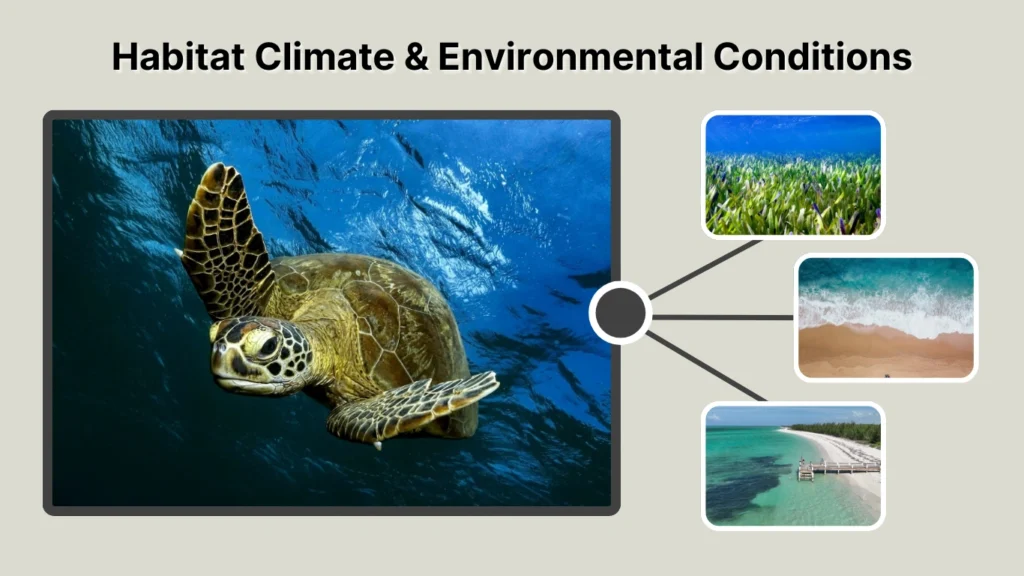
Green sea turtles require warm tropical and subtropical climates. Ideal water temperatures generally fall between 20°C and 30°C, supporting the growth of seagrass and algae. Nesting beaches require warm sand with stable temperatures to ensure proper embryonic development. Rising temperatures can skew hatchling sex ratios and threaten future populations, making climate stability crucial for the species.
Habitat Requirements
Green sea turtles depend on healthy seagrass meadows, clean coastal waters, stable beaches, and thriving coral reefs. They require minimal human disturbance in nesting areas and abundant sunlight for underwater plant growth. Safe migratory corridors free of entanglement risks and heavy boat traffic are essential for long-term habitat sustainability.
Habitat Adaptations
Green sea turtles have evolved specialized adaptations that allow them to thrive across these varied habitats. Their flippers enable powerful, energy-efficient swimming across long distances. Serrated jaws help them graze effectively in dense seagrass beds. Their coloration blends with marine vegetation, offering natural camouflage. They also use Earth’s magnetic fields to navigate between distant feeding and nesting grounds.
Habitat Loss & Threats
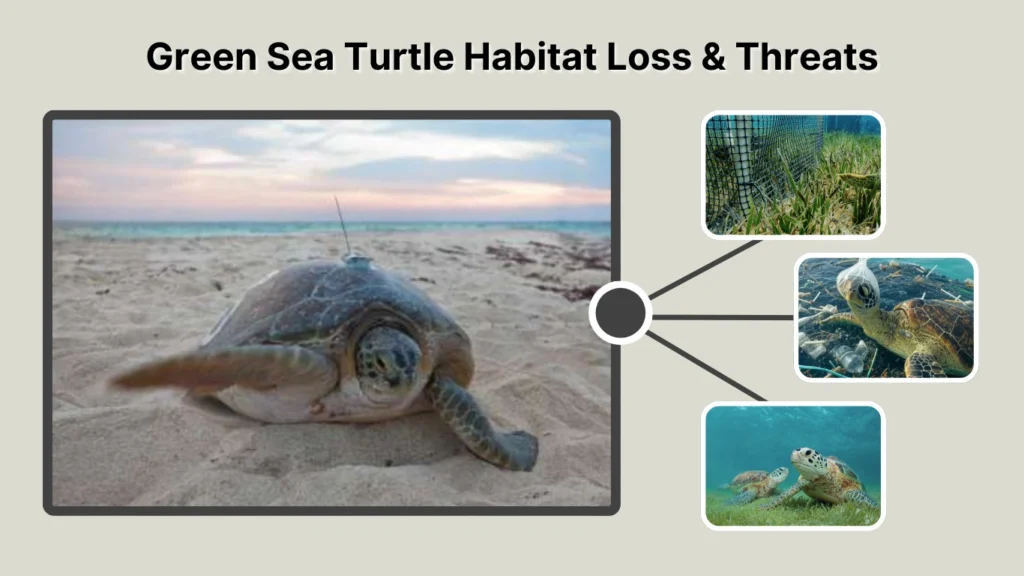
Green sea turtle habitats have been heavily impacted by human activities. Seagrass beds—crucial feeding grounds—are declining due to pollution, agricultural runoff, and destructive fishing practices. Boats, anchors, and propellers damage large swaths of underwater vegetation, reducing food sources and shelter. Coral reefs, another essential habitat, are suffering from bleaching, disease, and warming seas, limiting algae growth and reducing areas where turtles can rest.
Coastal development presents another major threat. Construction of hotels, seawalls, and artificial lighting near beaches can disrupt nesting females and disorient hatchlings. Rising sea levels and stronger storms caused by climate change erode beaches, destroy nests, and alter sand temperature. Plastics and discarded fishing gear also pose significant risks, as turtles often mistake plastic bags for jellyfish or become entangled in nets. These combined pressures have contributed to population declines and habitat fragmentation across the globe.
Critical Habitat Protection
Several regions have been designated as critical habitat for green sea turtles, particularly in the United States, Australia, and parts of the Pacific. In the U.S., NOAA has established protected feeding grounds and nesting beaches where development and harmful activities are restricted. These areas help to preserve essential seagrass meadows and reduce disturbances during nesting seasons. Many countries also maintain marine protected areas (MPAs) that safeguard reefs, lagoons, and coastal waters from overfishing and pollution.
International agreements, such as the Endangered Species Act (ESA) and CITES, further strengthen habitat protection. Conservation groups actively restore damaged seagrass beds, remove marine debris, and monitor beach conditions. These protection efforts are essential for maintaining stable population trends and improving survival rates for future generations.
Green Sea Turtle Habitat by Region
Atlantic Region
In the Atlantic, green sea turtles inhabit the Caribbean Sea, Florida coast, Gulf of Mexico, and West African shores. Warm, shallow waters support extensive seagrass meadows, while Florida and the Caribbean provide major nesting beaches. Bermuda and Brazil also host critical feeding grounds.
Pacific Region
The Pacific Ocean contains some of the most diverse turtle habitats in the world. Australia, Fiji, and Southeast Asia offer expansive lagoons and reefs, while Japan hosts nesting beaches for specific populations. Eastern Pacific turtles use habitats from Mexico to Peru, feeding on algae-covered reefs and nesting in places like the Galápagos and Costa Rica.
Indian Ocean Region
The Indian Ocean population relies heavily on coral reefs and coastal bays around India, Sri Lanka, the Maldives, East Africa, and the Seychelles. These regions feature deep seagrass beds and warm climates ideal for feeding and nesting.
Australia & Great Barrier Reef
Australia supports one of the largest green turtle populations. The Great Barrier Reef provides vast feeding grounds, while sandy beaches along the Queensland and Northern Territory coasts serve as major nesting areas.
Florida & Caribbean
These waters contain some of the healthiest seagrass ecosystems globally. Turtles migrate between feeding grounds in Florida Bay, the Bahamas, Cuba, and other Caribbean islands.
Hawaii
Hawaiian green turtles primarily inhabit coastal reefs and volcanic shorelines. The Northwestern Hawaiian Islands serve as major nesting sites, particularly French Frigate Shoals.
Galápagos
Galápagos green turtles feed in rich coastal waters and nest on volcanic beaches. The area’s isolation and biodiversity create a unique habitat rarely found elsewhere.
Ecosystem & Species Sharing Their Habitat
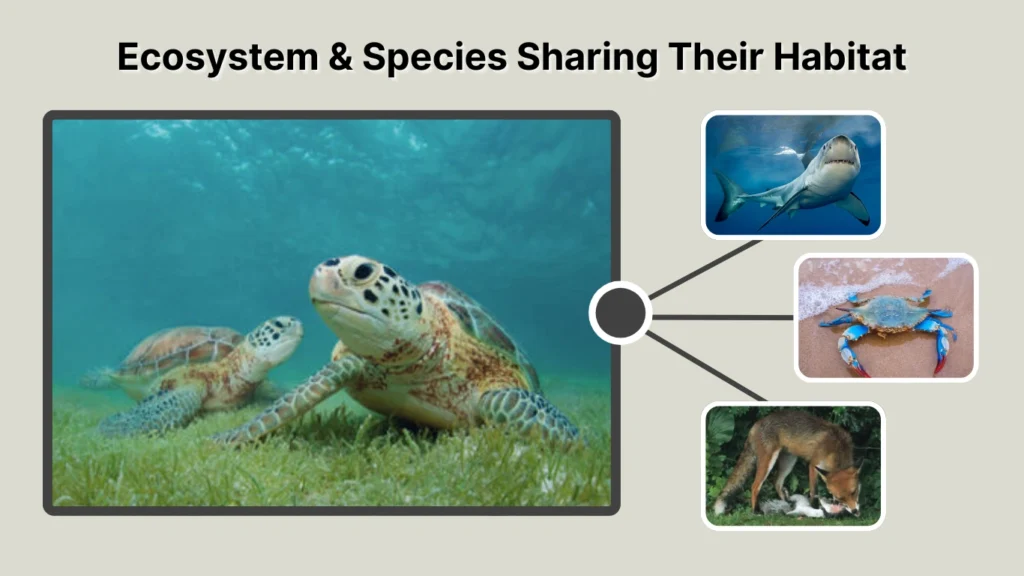
Green sea turtles coexist with a wide range of marine species. Seagrass beds support dugongs, manatees, sea urchins, and grazing fish, all competing or collaborating in nutrient cycling. Coral reefs host reef fish, octopuses, crustaceans, and sharks. These ecosystems rely on turtles to prevent seagrass overgrowth, maintain ocean floor health, and support biodiversity.
Predators such as tiger sharks, orcas, and large fish help regulate turtle populations. At nesting beaches, species like crabs, birds, and foxes interact within the broader coastal ecosystem.
Green Sea Turtle Behavior in Habitat
Green sea turtles display distinct behaviors depending on their environment. In feeding grounds, they graze for several hours each day and rest beneath coral outcrops or in shallow sand beds. During migration, they use ocean currents and magnetic navigation to travel thousands of miles without stopping. In nesting areas, females emerge at night, cautiously selecting suitable spots above the high-tide line.
Hatchlings behave differently. After emerging, they orient toward moonlight and rush to the ocean, beginning their pelagic drift phase. Many spend years at sea before returning to coastal habitats.
Green Sea Turtle Nesting Habitat Details
Nesting beaches must offer warm temperatures, soft sand, and minimal disturbance. Females dig deep chambers where they lay 80–120 eggs at a time. Beach slope, sand moisture, and shade affect nest success. After 45–75 days, hatchlings emerge, often at night to avoid predators. Human disruption—such as beachfront lighting—can disorient them and reduce survival rates dramatically.
Green Sea Turtle Habitat Facts
- Found in over 140 countries
- Nest on tropical and subtropical beaches
- Feed mainly in seagrass beds and algae-rich reefs
- Climate change affects their habitat’s temperature and structure
- Migrate thousands of miles between feeding and nesting grounds
Green Sea Turtle Habitat vs. Other Species
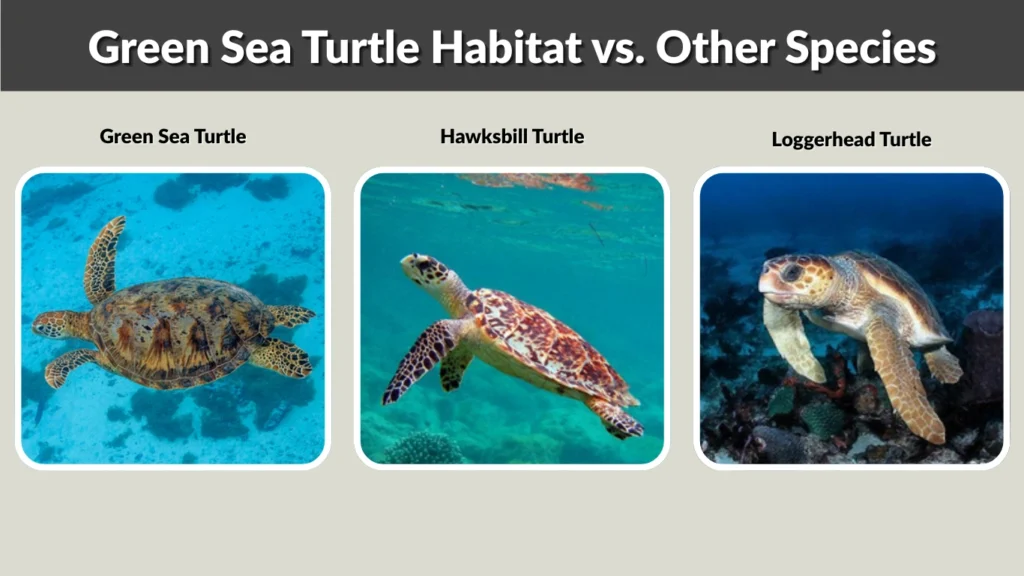
| Feature | Green Sea Turtle | Hawksbill Turtle | Loggerhead Turtle |
| Main Habitat | Seagrass beds, reefs | Coral reefs | Open ocean & coastal zones |
| Nesting Climate | Tropical/subtropical | Tropical | Temperate & tropical |
| Diet Influence | Herbivorous → seagrass | Sponges → reefs | Carnivorous → varied |
| Major Regions | Worldwide tropics | Indo-Pacific | Atlantic, Pacific |
FAQs
What is the habitat of a green sea turtle?
Green sea turtles live in warm tropical and subtropical oceans. They spend most of their time in shallow coastal areas like seagrass beds, reefs, and lagoons, where food is abundant. They also rely on sandy beaches for nesting, making both marine and coastal environments essential to their survival.
Where do green sea turtles live?
Green sea turtles are found worldwide, including the Atlantic, Pacific, and Indian Oceans. They inhabit regions such as Florida, Hawaii, Australia, the Caribbean, Southeast Asia, and Africa. Their habitats include coral reefs, seagrass meadows, open ocean areas for juveniles, and tropical nesting beaches.
What climate do green sea turtles need?
Green sea turtles thrive in warm marine climates with water temperatures between 20°C and 30°C. Nesting beaches require warm, stable sand temperatures for the eggs to develop properly. Both ocean and land climates must remain stable for healthy feeding, growth, and reproduction.
What does a green sea turtle habitat look like?
Their habitat typically includes shallow, clear waters filled with seagrass, algae, and coral structures. These areas offer food and resting places. Nesting habitats are sandy beaches with little human disturbance, where females lay eggs in soft, warm sand above the high-tide line.
Why are green sea turtle habitats endangered?
Green sea turtle habitats are endangered due to pollution, seagrass destruction, coral bleaching, rising sea levels, beach development, and climate change. Plastics, fishing gear, and artificial lighting also disrupt feeding and nesting. Protecting coastal ecosystems and reducing human impact are essential for habitat recovery.