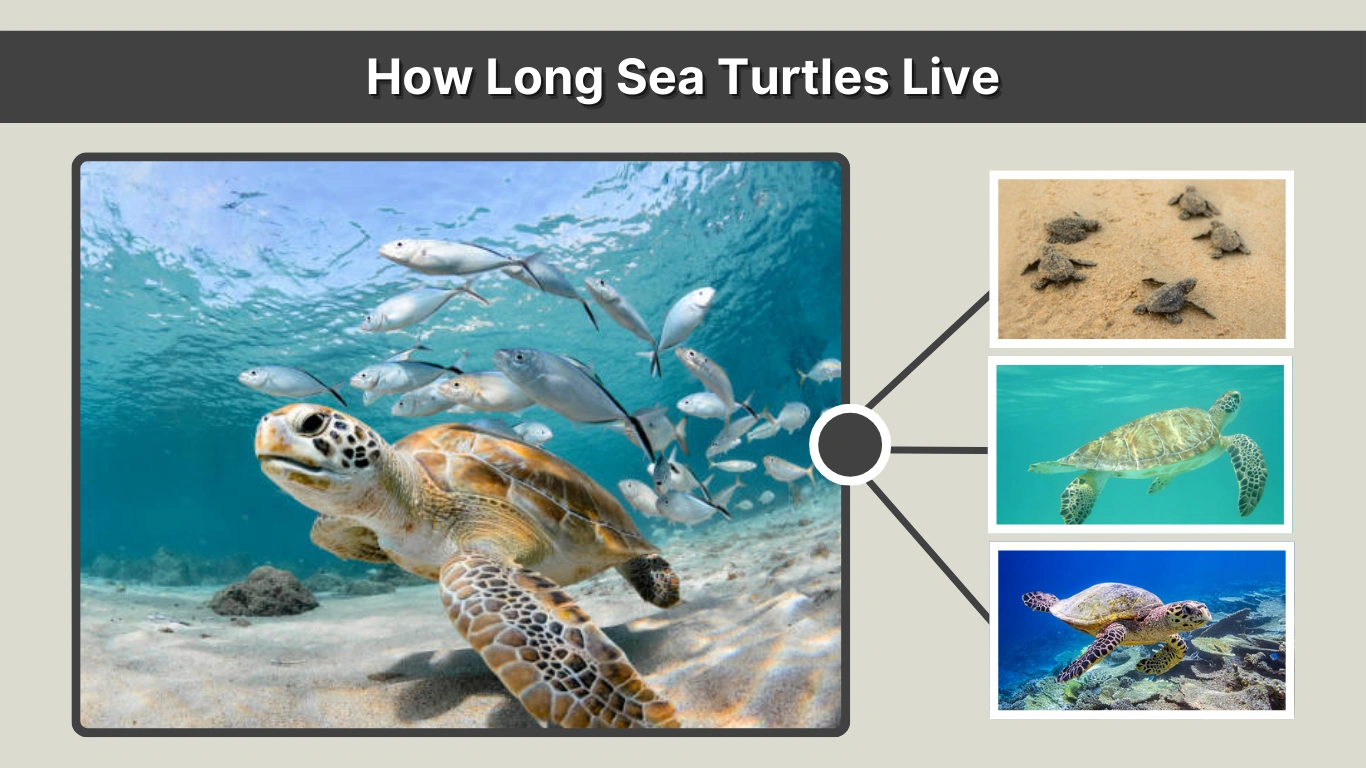
Sea turtles are among the ocean’s most enduring creatures, known for their remarkable lifespans that can stretch across many decades. Although each species ages differently, most sea turtles live well beyond half a century, with some capable of surpassing a full century. Their longevity has fascinated scientists, divers, and ocean lovers for generations. This guide explores how long they live, why they live so long, and how each species compares across different environments.
How Long Do Sea Turtles Live?
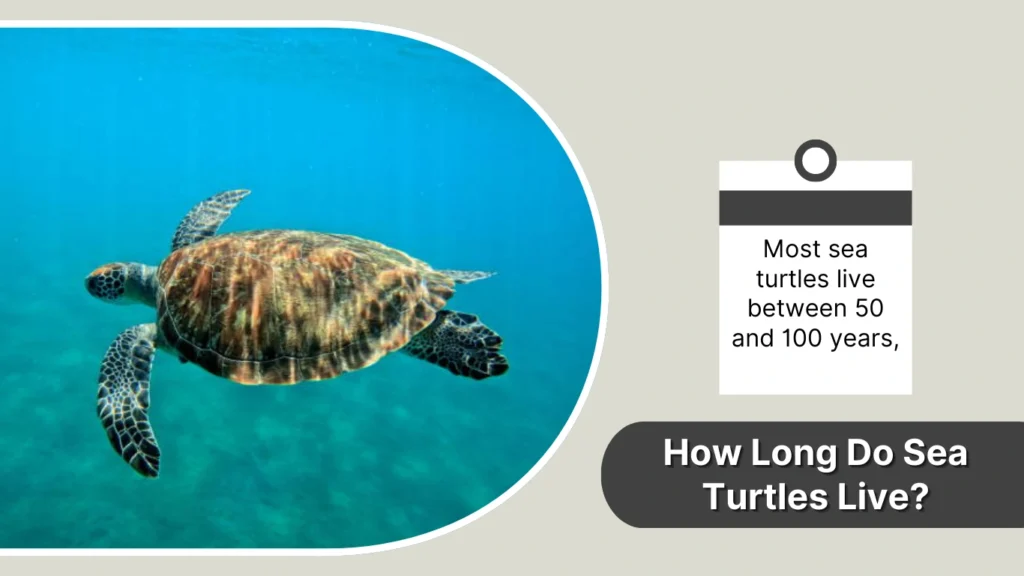
Most sea turtles live between 50 and 100 years, though estimates vary depending on habitat, species, and environmental challenges. Because sea turtles spend nearly their entire lives in the ocean—sometimes migrating thousands of miles—scientists rarely document their complete lifespan from birth to natural death. However, decades of tracking, tagging, and conservation work have provided reasonably accurate ranges.
General Lifespan Overview
- Many species regularly reach 60 to 80 years.
- Some individuals are believed to pass the 100-year mark.
- Natural longevity is influenced by location, genetics, and survival of early life stages.
These broad ranges make sea turtles some of the ocean’s longest-living reptiles.
Why Sea Turtles Live So Long
Sea turtles possess several evolutionary traits that contribute to their extended lifespan. Their bodies are built for endurance rather than speed, and their internal systems age slowly compared to many other animals.
Reasons Behind Their Longevity
- Slow Metabolism: As cold-blooded reptiles, their bodies use energy slowly, which reduces wear on cells.
- Large Adult Size: Once fully grown, sea turtles have few natural predators, allowing them long periods of safe adulthood.
- Efficient Physiology: Their organs and immune systems are adapted for long-term survival in challenging marine environments.
- Evolutionary Stability: Sea turtles have existed for over 100 million years, refining traits that protect them from early aging.
These factors allow them to outlive most marine creatures of similar size.
Green Sea Turtle Lifespan
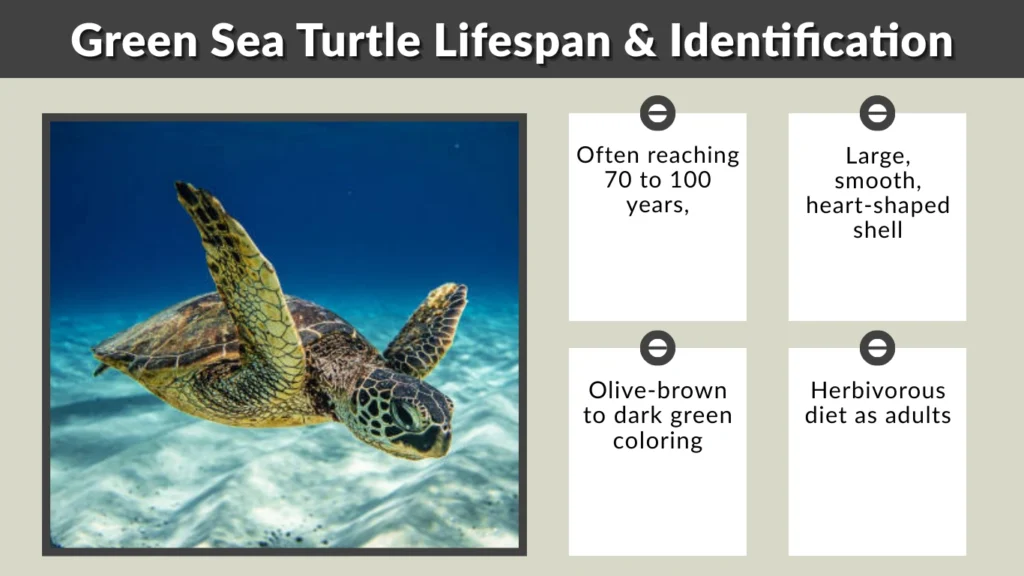
Green sea turtles are known for their long lives, often reaching 70 to 100 years, and in rare cases even longer. They mature slowly, usually not reproducing until they are 20 to 40 years old, which naturally stretches their overall lifespan.
Identification
- Large, smooth, heart-shaped shell
- Olive-brown to dark green coloring
- Herbivorous diet as adults
Lifespan Details
Green sea turtles in the wild typically live several decades beyond maturity. Populations in regions with strong protection, such as parts of Hawaii and the Pacific, tend to have higher survival rates. In captivity, however, they often experience more stress and a shorter overall lifespan due to limited swimming space and environmental changes.
Loggerhead Sea Turtle Lifespan
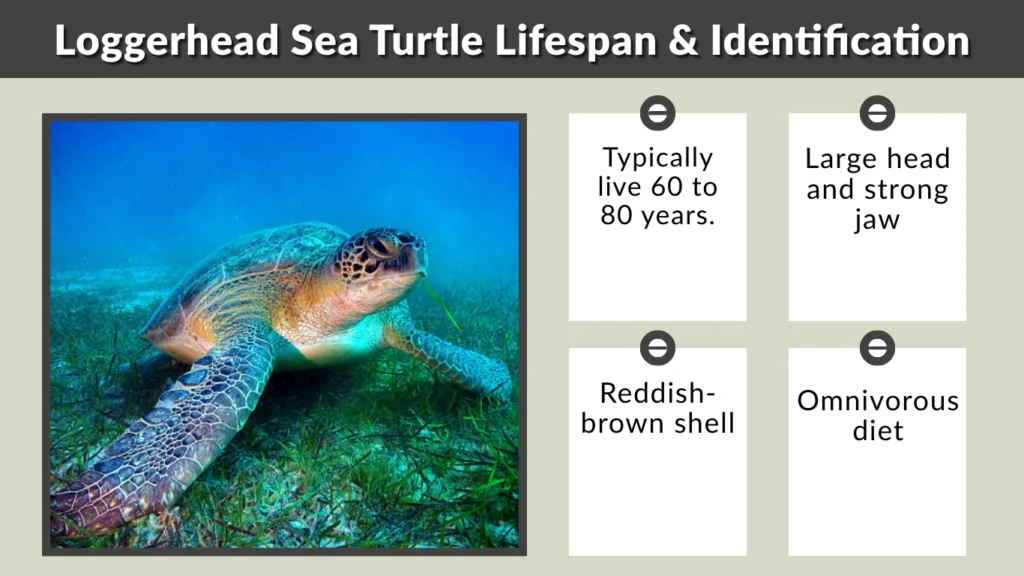
Loggerheads are robust, broad-headed turtles that typically live 60 to 80 years. Their powerful jaws help them feed on hard-shelled prey, which supports a long and stable adult life.
Identification
- Large head and strong jaw
- Reddish-brown shell
- Omnivorous diet
Lifespan Details
In the wild, loggerheads benefit from wide-ranging habitats across the Atlantic, Pacific, and Indian Oceans. Their lifespan can decrease in captivity, where conditions do not always replicate the vast spaces they rely on for migration.
Leatherback Sea Turtle Lifespan
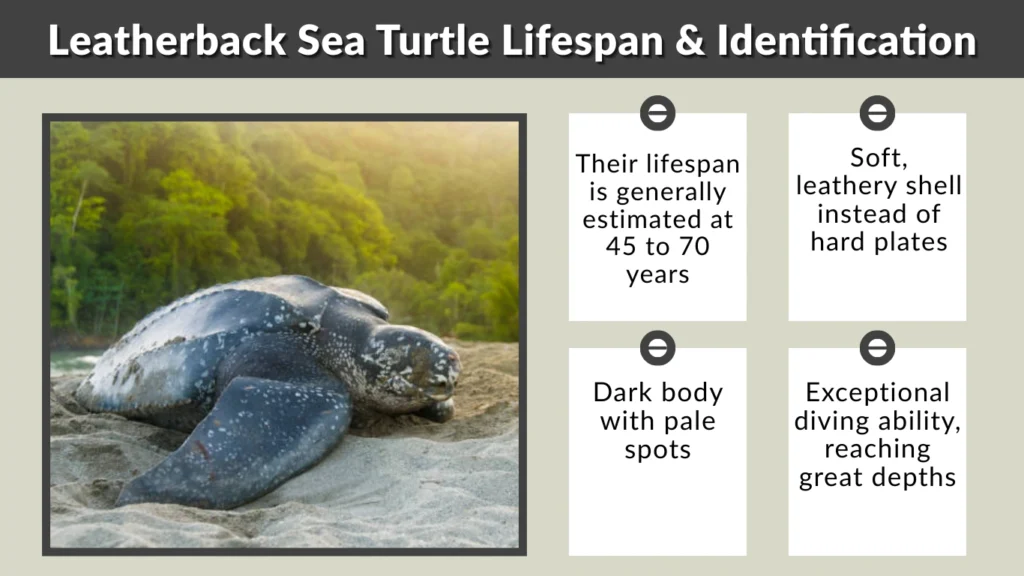
Leatherbacks are the largest of all sea turtles and have a unique biological design that sets them apart. Their lifespan is generally estimated at 45 to 70 years, though scientists believe some may live longer than current data shows.
Identification
- Soft, leathery shell instead of hard plates
- Dark body with pale spots
- Exceptional diving ability, reaching great depths
Lifespan Details
Because leatherbacks roam enormous distances across oceans and dive to extreme depths, it is difficult to track long-term survival. They rarely survive in captivity, so most lifespan information comes from wild populations. Their size and physiology help protect them from many adult predators.
Hawksbill Sea Turtle Lifespan
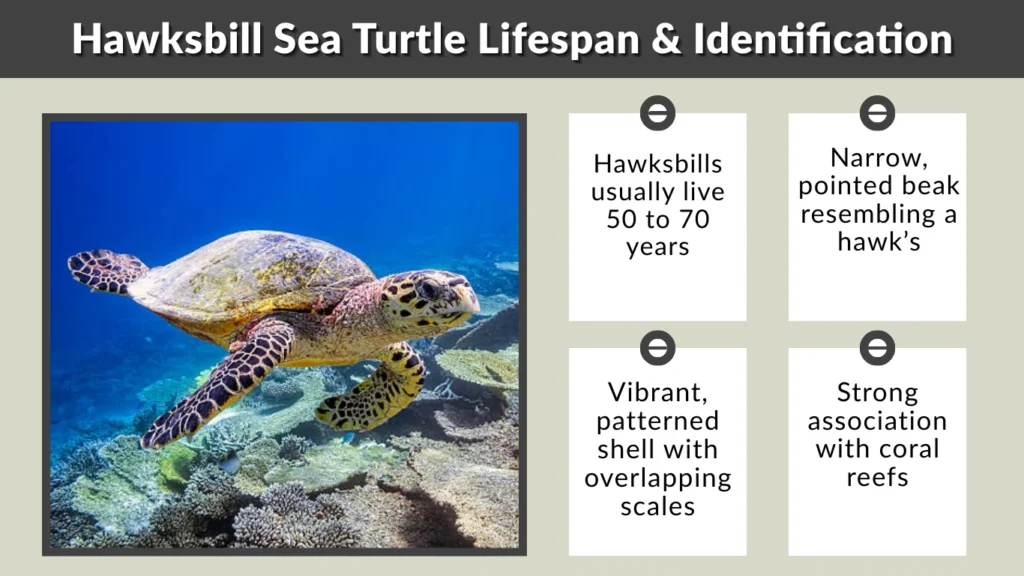
Hawksbills usually live 50 to 70 years and are known for their beautifully patterned shells, which unfortunately made them a target for historical hunting.
Identification
- Narrow, pointed beak resembling a hawk’s
- Vibrant, patterned shell with overlapping scales
- Strong association with coral reefs
Lifespan Details
These turtles rely heavily on reef ecosystems. Where reefs are healthy, hawksbills tend to live longer and reproduce more reliably. Captive individuals typically experience shorter lifespans due to stress and feeding challenges.
Flatback Sea Turtle Lifespan
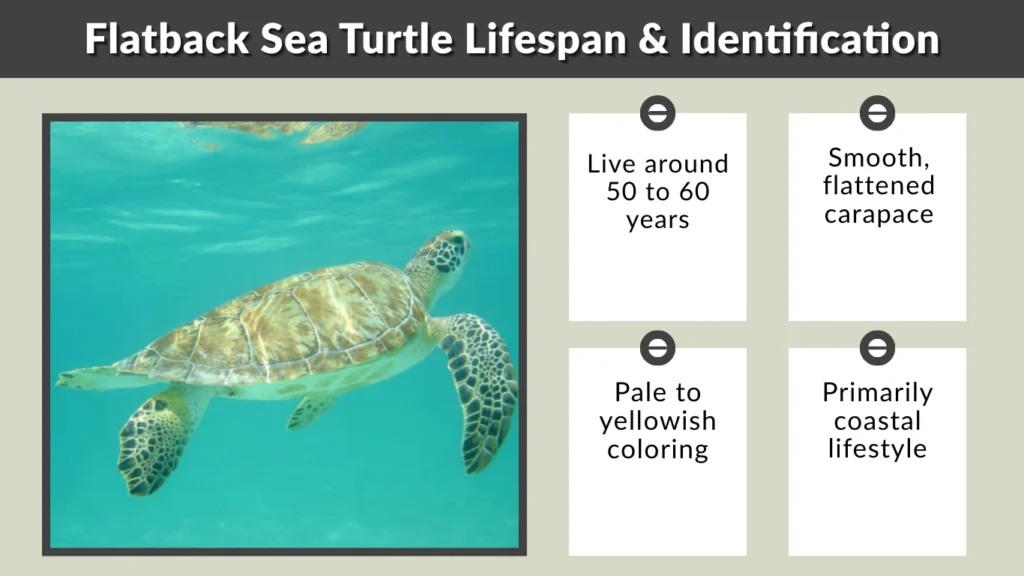
Flatbacks, found only in Australia, live around 50 to 60 years and are one of the least-studied sea turtle species because of their limited geographic range.
Identification
- Smooth, flattened carapace
- Pale to yellowish coloring
- Primarily coastal lifestyle
Lifespan Details
Flatbacks are rarely kept in captivity, and most lifespan information comes from tagged wild individuals. Their preference for shallow coastal waters makes them more visible than some deep-ocean species.
Olive Ridley Sea Turtle Lifespan
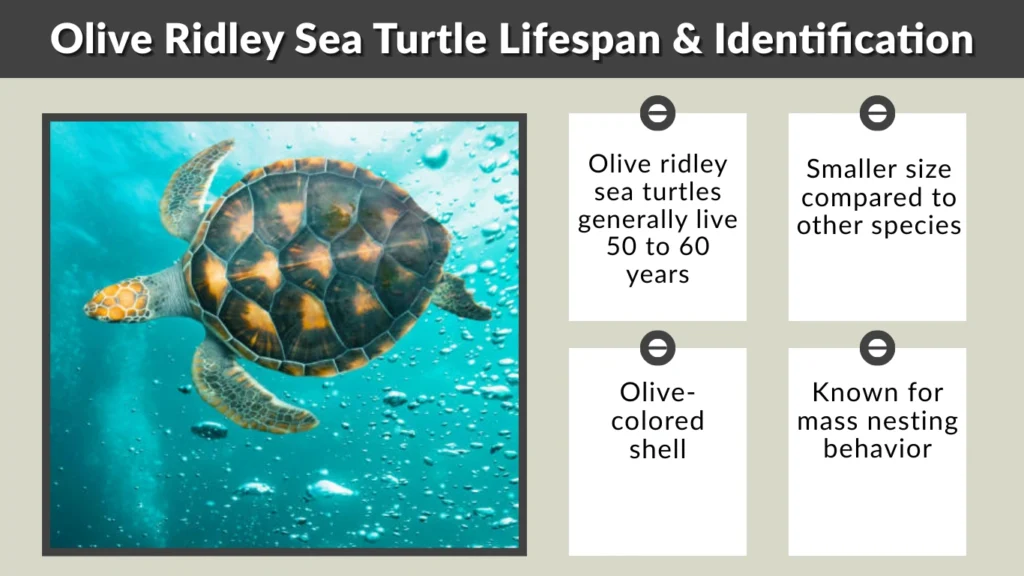
Olive ridley sea turtles generally live 50 to 60 years, though individuals may exceed these estimates in protected regions. They are known for their synchronized nesting events called arribadas, where thousands come ashore at once to lay eggs.
Identification
- Smaller size compared to other species
- Olive-colored shell
- Known for mass nesting behavior
Lifespan Details
Because olive ridleys often inhabit tropical and subtropical waters, their survival depends heavily on coastal protection. While adults can live several decades, the mortality rate for hatchlings is extremely high, affecting overall population longevity.
Kemp’s Ridley Sea Turtle Lifespan
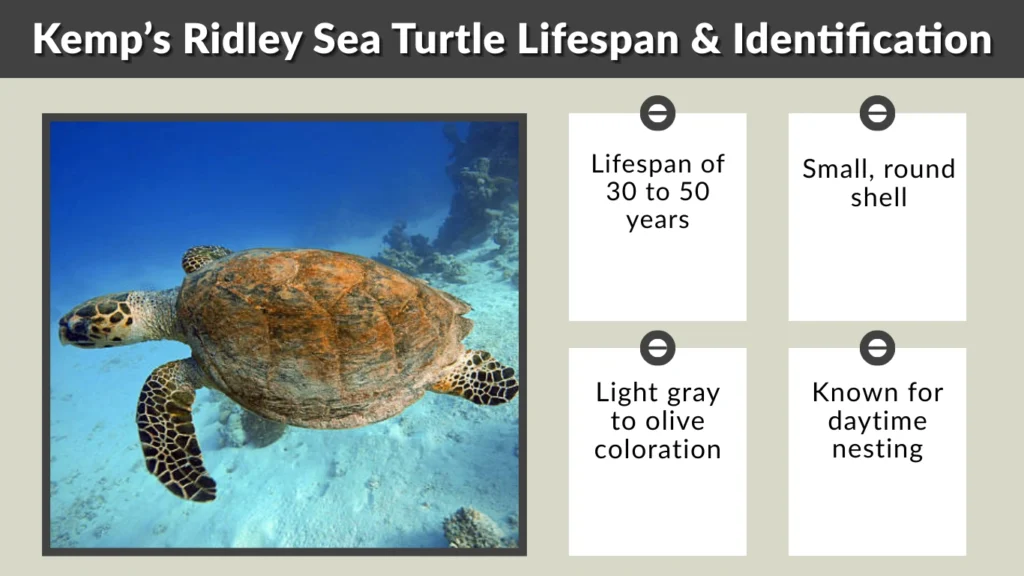
Kemp’s ridleys are the smallest and most endangered of all sea turtles, with a lifespan of 30 to 50 years. Their populations have been severely affected by fishing nets, habitat loss, and egg harvesting.
Identification
- Small, round shell
- Light gray to olive coloration
- Known for daytime nesting
Lifespan Details
Conservation programs in the Gulf of Mexico have played a major role in extending their average lifespan. Captive living is uncommon and often results in significantly shorter lives because these turtles are extremely sensitive to stress and temperature changes.
Baby Sea Turtle Lifespan
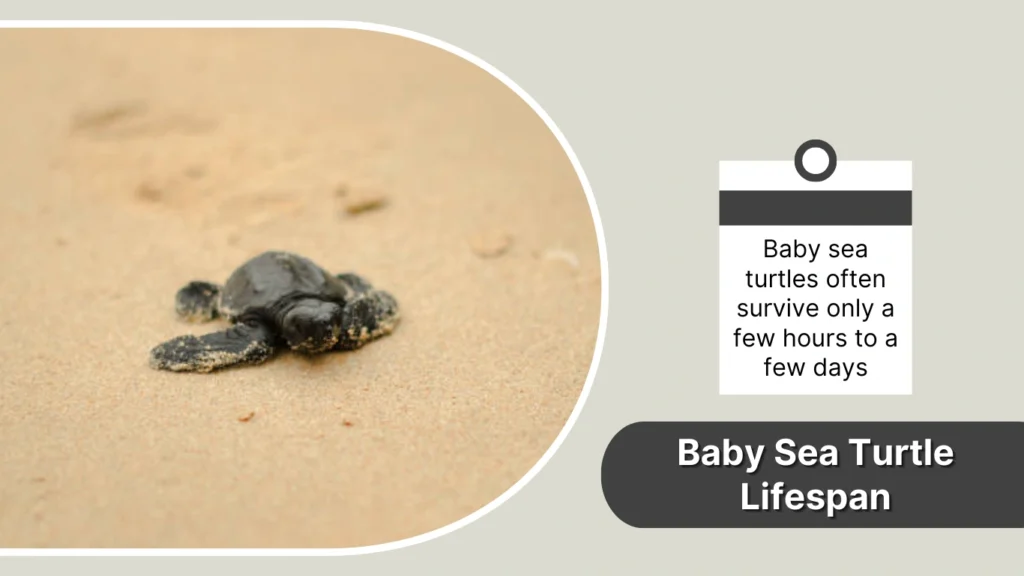
Although adult sea turtles are long-lived, baby sea turtles often survive only a few hours to a few days after leaving the nest. Only about 1 in 1,000 hatchlings reaches adulthood.
Lifecycle Challenges
- Predation by birds, crabs, fish, and mammals
- Artificial lighting that disrupts orientation
- Human development and beach disturbances
- Exhaustion during the crawl to the ocean
Once they reach the open sea, young turtles enter a stage known as the “lost years,” floating among seaweed mats where they feed and grow. Their survival during this period largely determines long-term population stability.
Sea Turtles in the Wild vs. Captivity
Sea turtles almost always live longer in the wild than in captivity. Their bodies are built for constant movement, long-distance migration, and changing ocean conditions—environments that captivity cannot fully replicate.
Wild Lifespan
- Access to natural diets
- Large migration routes
- Natural behavior and stress cycles
- Fewer human-imposed limitations
Captivity Lifespan
- Restricted swimming space
- Artificial feeding routines
- Increased disease risk
- Stress from confinement and human presence
Some species, like leatherbacks and flatbacks, almost never survive long-term captivity, while others, like loggerheads or green turtles, may live for decades but still shorter than their natural lifespan.
Giant Sea Turtles and Exceptional Lifespans
Stories about giant sea turtles living for 150 years or more often circulate among divers and fishermen. While scientific evidence for such extraordinary ages is limited, extremely old individuals—especially large green turtles—have been documented. Their slow growth and biological durability make the existence of unusually long-lived individuals entirely plausible, even if difficult to verify.
Sea Turtles in Popular Culture
One of the most famous portrayals of a long-lived sea turtle is “Crush” in Finding Nemo, who claims to be 150 years old. While this age is exaggerated for entertainment, it reflects the common belief that sea turtles live exceptionally long lives. In reality, a sea turtle reaching 100 to 120 years is possible, though not typical.
How Long Sea Turtles Live in the Ocean
Sea turtles spend nearly their entire lives in the ocean, and their longevity depends on open-water conditions, food availability, predators, and migration patterns. Ocean-dwelling individuals can thrive for decades because adults face few natural predators. However, pollution, boat strikes, fishing gear, and climate change significantly influence survival rates today.
Full Lifespan Comparison Table
| Species | Estimated Lifespan (Wild) | Captivity Lifespan | Notes |
| Green | 70–100+ years | Shorter | Known for long lives |
| Loggerhead | 60–80 years | Moderately shorter | Wide distribution |
| Leatherback | 45–70 years | Rare in captivity | Deep-diving species |
| Hawksbill | 50–70 years | Shorter | Reef dependent |
| Flatback | 50–60 years | Very rare | Australian only |
| Olive Ridley | 50–60 years | Shorter | Mass nesters |
| Kemp’s Ridley | 30–50 years | Shorter | Most endangered |
FAQs
Why do sea turtles live so long?
Sea turtles age slowly because of their cold-blooded physiology, efficient metabolism, and large adult size. Few predators can take down a fully grown sea turtle. Their organs and cells also resist long-term deterioration better than many species, allowing them to remain healthy well into old age.
Do all sea turtles live more than 50 years?
While many do, not all species consistently reach 50 years. Smaller species like Kemp’s ridleys may live closer to 30 or 40 years, especially in regions with heavy human activity. Larger species, such as greens and loggerheads, more commonly surpass 60 years.
Can sea turtles live over 100 years?
It’s possible, especially for green sea turtles and a few exceptionally large individuals of other species. Confirming such ages is difficult because sea turtles don’t have bones or shells that reliably show growth rings throughout life. However, scientific estimates and long-term observations strongly suggest some do reach a century.
Do sea turtles live longer in the ocean than near coastlines?
Generally yes. Open-ocean turtles face fewer threats and have access to more consistent food sources. Coastal areas expose them to pollution, development, boat traffic, and fishing gear, all of which increase mortality.
What reduces a sea turtle’s lifespan the most today?
Human activity is the primary threat. Fishing nets, plastic pollution, illegal harvesting, climate change, habitat destruction, and light pollution all reduce sea turtle survival. Conservation programs that protect nesting beaches and regulate fishing gear significantly improve the chances that sea turtles live out their natural lifespan.