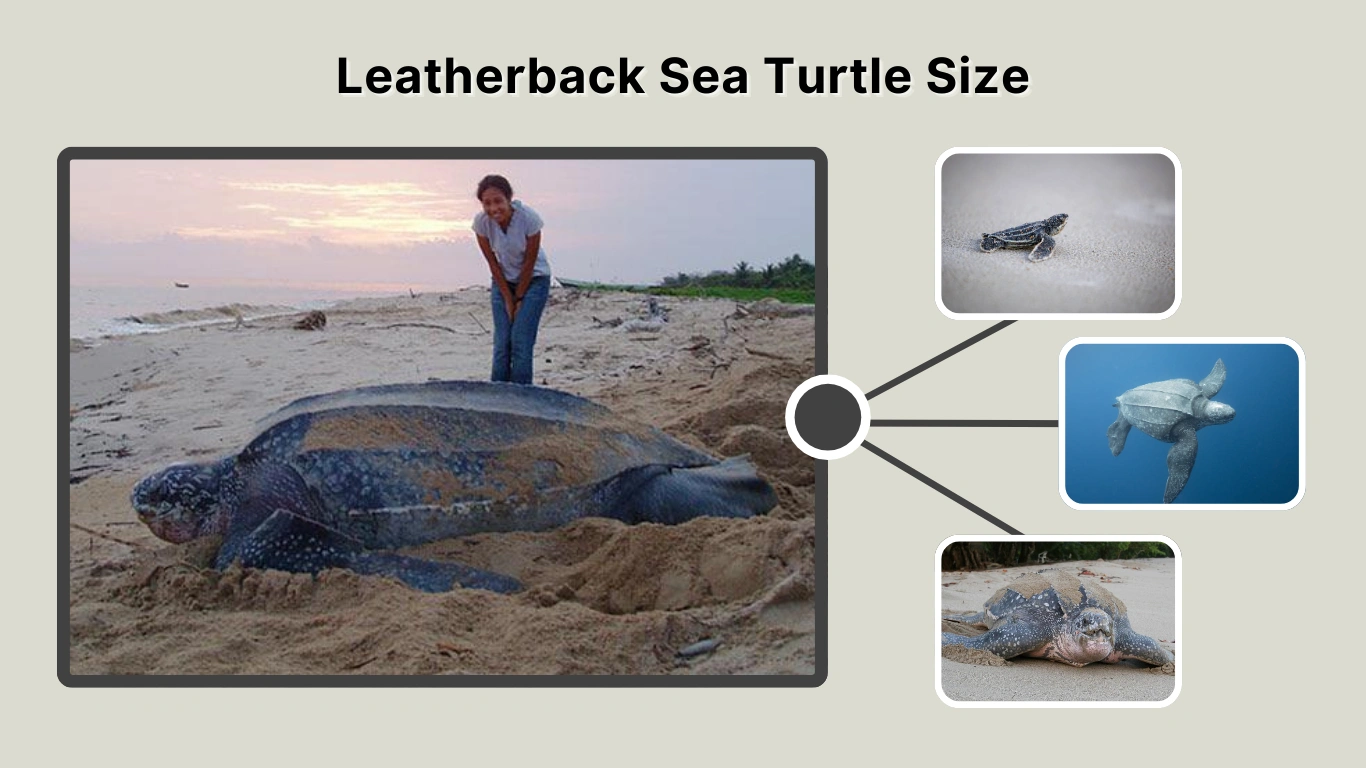
The leatherback sea turtle is the largest turtle on Earth, reaching lengths and weights unmatched by any other modern reptile. Known for its soft, leathery shell and incredible oceanic power, this species can grow as large as a small car. Understanding leatherback sea turtle size helps explain how these giants travel thousands of miles, dive to extreme depths, and survive in cold oceans. This guide breaks down their average size, maximum size, hatchling size, shell dimensions, and human size comparisons.
Identification
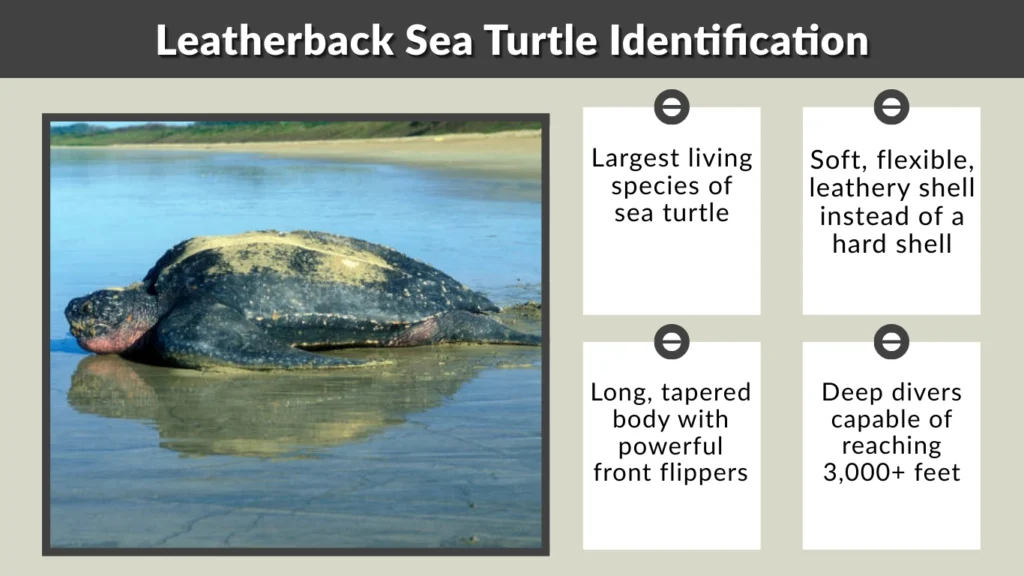
- Largest living species of sea turtle
- Soft, flexible, leathery shell instead of a hard shell
- Long, tapered body with powerful front flippers
- Deep divers capable of reaching 3,000+ feet
- Found across Pacific, Atlantic, and Indian Oceans
- Dark bluish-black skin with white spotting or mottling
These physical characteristics support their enormous size and make them distinct from all other sea turtles.
Leatherback Sea Turtle Size Overview
Average Size of a Leatherback
Adult leatherbacks typically measure 4 to 7 feet (1.2–2.1 m) in length and weigh between 550 and 1,500 pounds (250–700 kg). This wide range depends on sex, age, and region. Pacific leatherbacks tend to grow slightly larger than Atlantic individuals due to colder waters and longer migrations, which favor larger body mass and fat reserves.
Maximum Size (Record Holders)
Leatherbacks can reach astonishing sizes. The largest ever recorded measured nearly 10 feet long and weighed 2,019 pounds (916 kg). These rare giants were found in the Atlantic and Caribbean regions, where rich jellyfish populations support substantial growth. Many coastal residents describe leatherbacks as being “the size of a small car,” which is accurate for extreme individuals.
Female vs Male Size
Although both sexes are enormous, females are often slightly larger because they store extra energy for laying eggs. Their shells also appear a bit broader during nesting season. Males, meanwhile, may be a little slimmer and have longer tails. Overall, the difference is subtle and hard to notice without measurement.
Leatherback Size & Weight Table
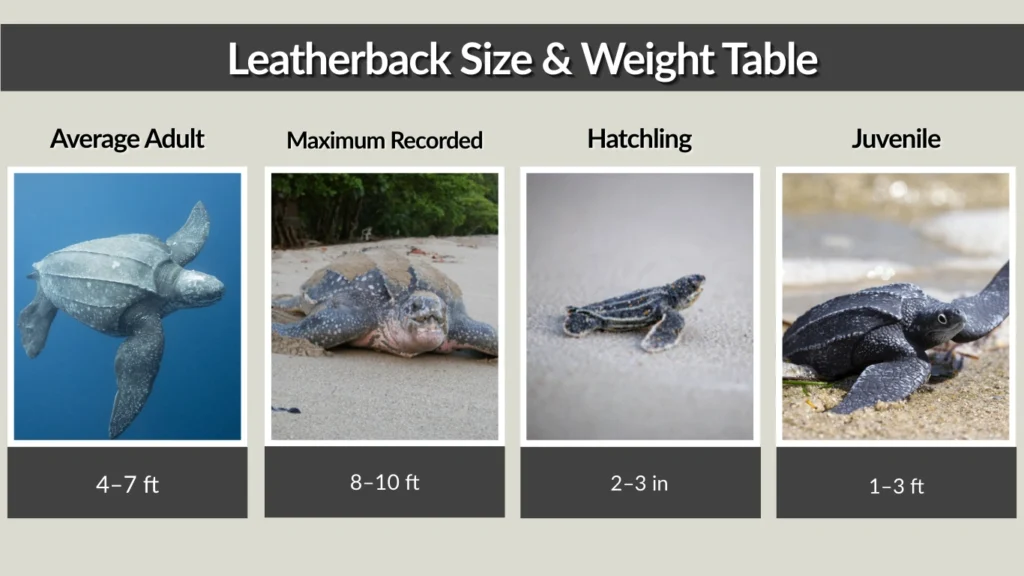
| Category | Length | Weight | Notes |
| Average Adult | 4–7 ft | 550–1,500 lbs | Most common size worldwide |
| Maximum Recorded | 8–10 ft | 2,019 lbs | Largest turtle ever documented |
| Hatchling | 2–3 in | 1.5–2 oz | Tiny, rapid early growth |
| Juvenile | 1–3 ft | 20–100 lbs | Size varies by age and region |
Baby, Hatchling & Birth Size
Newly hatched leatherbacks are incredibly tiny compared to the giants they become. Hatchlings measure 2–3 inches long and weigh only 1.5–2 ounces. Their small size and soft shell make them vulnerable to predators, waves, dehydration, and human disturbances. Despite their fragile beginnings, leatherbacks grow rapidly during the first years of life as they move into open ocean habitats rich in prey.
Clutch Size, Egg Size & Reproduction
Leatherback Clutch Size
Female leatherbacks usually lay 60–100 fertilized eggs per nest, sometimes more. They also deposit additional smaller “spacer eggs,” which do not develop but help cushion the real eggs. Because so few hatchlings survive to adulthood, large clutch sizes are essential for population stability.
Leatherback Egg Size
Leatherback eggs are about the size of a billiard ball—round, soft, and flexible. This leathery texture prevents breakage during nesting and helps embryos develop in shifting sand environments.
Shell Size, Mouth Size & Anatomy Related to Size
Shell Size (Carapace)
The leatherback’s shell measures 4–6 feet on average and is composed of thousands of small dermal plates covered by thick, rubbery skin. Unlike hard-shell sea turtles, leatherbacks have seven pronounced ridges that help them cut through water like a hydrodynamic blade. This flexible shell design supports deep diving and cold-water survival.
Mouth Size
Their mouths are wide with backward-pointing spines, allowing them to grip slippery jellyfish. These spines prevent prey from escaping but are not suited for chewing harder foods. The mouth design directly connects to their large body size, as jellyfish are low-calorie prey requiring high intake volume.
Leatherback Sea Turtle Size Compared to Humans
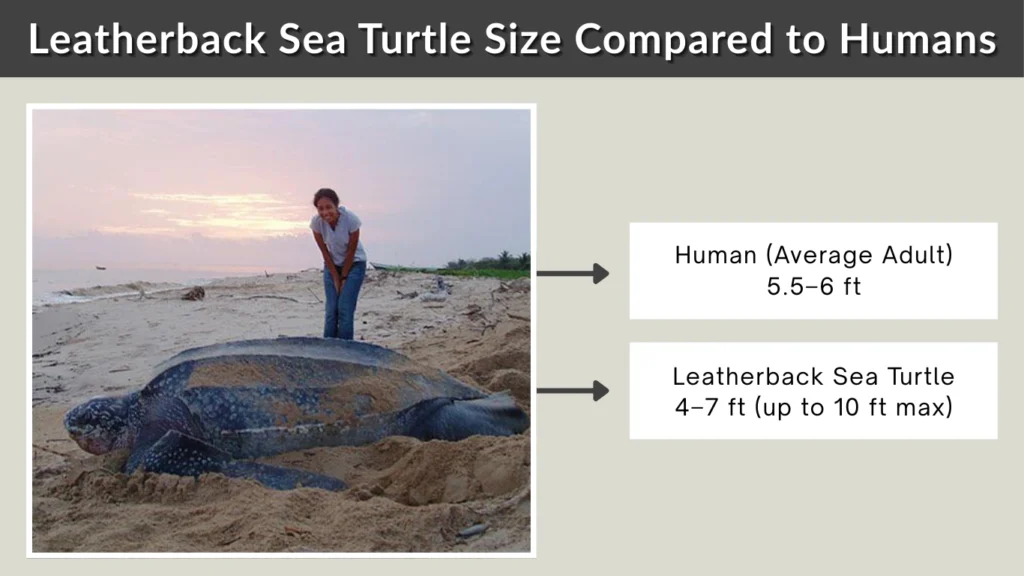
A full-grown leatherback sea turtle is enormous next to a human. Most adults measure longer than the average person is tall, and the heaviest individuals can outweigh 10–12 adult humans combined. Their flippers can stretch nearly the length of a person’s arm and torso together, giving them powerful propulsion in the open ocean. Standing beside one, a human would appear small—even child-sized compared to the largest leatherbacks.
Human vs Leatherback Comparison Table
| Feature | Human (Average Adult) | Leatherback Sea Turtle |
| Height/Length | 5.5–6 ft | 4–7 ft (up to 10 ft max) |
| Weight | 150–200 lbs | 550–2,019 lbs |
| Arm/Flipper Span | 5–6 ft | 6–9 ft flippers |
| Body Thickness | Narrow | Broad, barrel-shaped |
Leatherback Sea Turtle Size of a Small Car
Because exceptional leatherbacks can reach 8–10 feet in length and over 2,000 pounds, many people compare them to the size of a compact car. While they aren’t as tall or as boxy, their length and weight are indeed similar to small vehicles, making the comparison accurate for record-sized individuals.
Leatherback vs Tortoise Size Comparison

Leatherbacks are the largest turtles ever recorded, while giant tortoises—though enormous—remain smaller and much heavier for their size. The major differences center on body shape, shell type, and weight distribution.
Size Comparison Table
| Feature | Leatherback Sea Turtle | Giant Tortoise (e.g., Galápagos) |
| Average Length | 4–7 ft | 3–4 ft |
| Average Weight | 550–1,500 lbs | 250–650 lbs |
| Maximum Weight | 2,019 lbs | ~900 lbs |
| Shell Type | Soft, leathery | Hard, domed |
| Habitat | Ocean | Land |
Population Size
Global Population
Leatherback sea turtles are experiencing steep population declines. Current global estimates range around 34,000 nesting females, with some Pacific populations having dropped by more than 90% in recent decades. Different regions show vastly different trends—while some Atlantic groups are stable, Pacific populations are nearing collapse.
Male Population Size
Estimating male leatherbacks is extremely difficult because males never return to land after hatching. They spend their entire lives at sea. Scientists use indirect data—such as genetic sampling and hatchling sex ratios—to estimate male numbers, but overall, males are believed to be far fewer due to warming sand temperatures producing predominantly female hatchlings.
Why Leatherbacks Grow So Large
Leatherbacks evolved large bodies because size provides essential survival benefits:
- Thermal Regulation: Their mass allows them to retain heat like warm-blooded animals.
- Deep Diving: Larger bodies withstand cold and pressure during 3,000-foot dives.
- Long Migration: They travel thousands of miles between feeding and nesting areas.
- Predator Avoidance: Adults have few natural predators besides orcas and sharks.
Their massive size is therefore both a survival tool and a biological necessity.
Leatherback Size Facts
- Largest turtle species in the world
- Adults weigh 550–1,500 lbs on average
- Maximum individuals exceed 2,000 lbs
- Hatchlings are only 2–3 inches long
- Females are often slightly larger than males
- Shells reach 4–6 feet in length
- Flippers can span 6–9 feet
- Comparable in size to a small car
FAQs
What is the size of a leatherback sea turtle?
Leatherbacks typically measure 4–7 feet long and weigh 550–1,500 pounds, making them the largest living turtle species. Their streamlined bodies and long flippers allow them to travel vast distances across the world’s oceans.
How big is the largest leatherback ever recorded?
The largest recorded leatherback weighed 2,019 pounds and measured close to 10 feet long. These exceptional giants are rare but demonstrate the species’ impressive size potential.
How big are baby leatherback sea turtles at birth?
Hatchlings are tiny—only 2–3 inches long and weighing 1.5–2 ounces. Despite their small size, they grow rapidly once they reach the open ocean and begin feeding.
How does a leatherback’s size compare to a human?
Leatherbacks can grow longer than most adults are tall and may weigh as much as a dozen humans combined. Their flippers can be the size of a human’s entire upper body.
Why do leatherbacks grow larger than other sea turtles?
Their diet, physiology, and oceanic lifestyle encourage large body size. A massive frame helps them retain heat, dive deep, avoid predators, and migrate thousands of miles efficiently.