
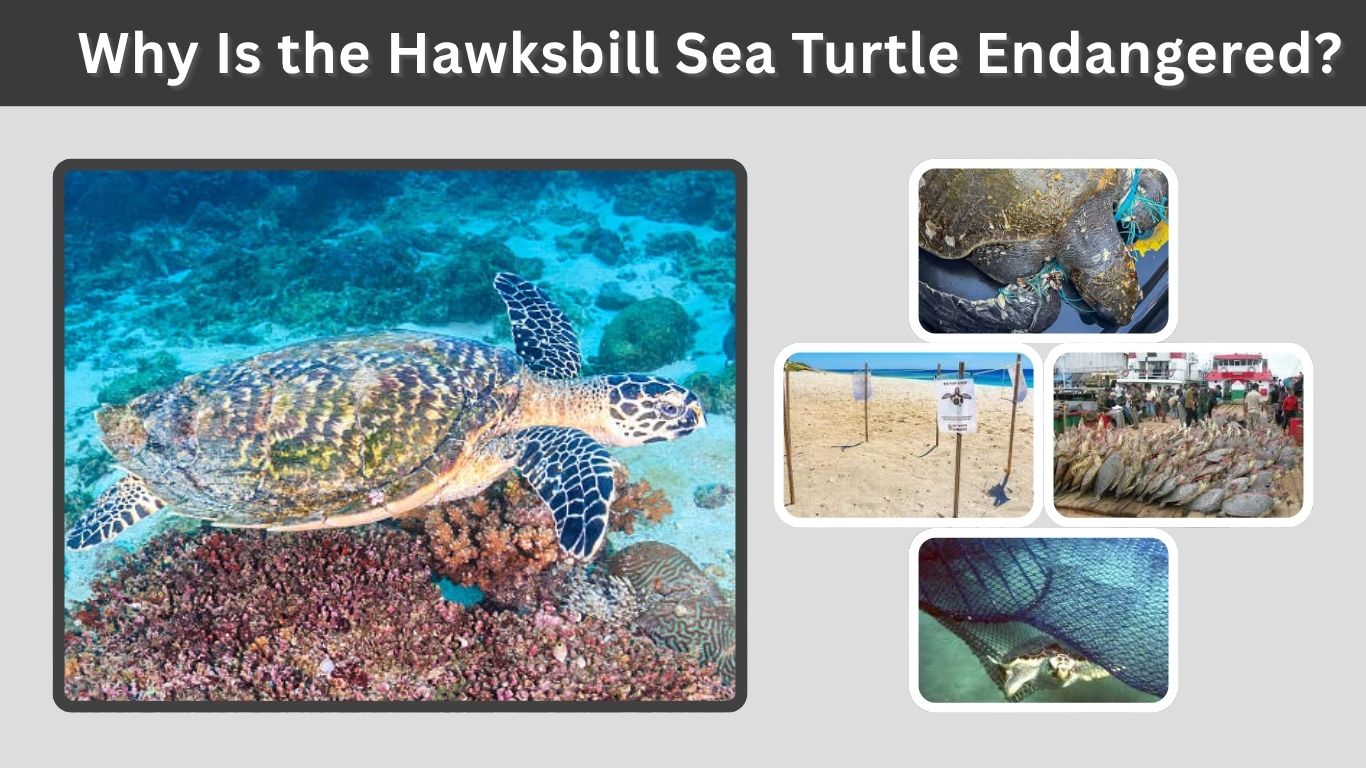
The hawksbill sea turtle is endangered because of centuries of hunting, illegal shell trade, egg collection, fishing bycatch, coral reef loss, pollution, and climate change. This tropical sea turtle is especially known for its beautiful shell and close connection to coral reefs. Today, it is protected by national and international laws, but many populations still face serious threats across nesting beaches and ocean habitats.
Are Hawksbill Sea Turtles Endangered?
Yes, hawksbill sea turtles are endangered. In the United States, they are listed as Endangered under the Endangered Species Act. Globally, the hawksbill sea turtle is classified as Critically Endangered on the IUCN Red List, which means it faces an extremely high risk of extinction in the wild.
This difference in wording can confuse readers. “Endangered” is the legal status used under the U.S. Endangered Species Act. “Critically Endangered” is the global category used by the IUCN Red List. Both terms show that the hawksbill sea turtle is in serious trouble and needs strong conservation protection.
Hawksbills are not endangered because of one single problem. They became endangered because several threats have affected them at the same time for many generations.
Hawksbill Sea Turtle Endangered Status
The hawksbill sea turtle’s endangered status depends on the conservation system being used. The two most common references are the U.S. Endangered Species Act and the IUCN Red List.
| Conservation System | Hawksbill Status | What It Means |
| U.S. Endangered Species Act | Endangered | The species is in danger of extinction in all or a significant portion of its range |
| IUCN Red List | Critically Endangered | The species faces an extremely high risk of extinction in the wild |
| CITES | Appendix I | International commercial trade is generally prohibited |
| Many national laws | Protected species | Hunting, egg collection, trade, or disturbance may be illegal |
Hawksbill turtles were protected in 1970 under the precursor to the U.S. Endangered Species Act. This means they have had federal protection for decades, but recovery is slow because sea turtles take many years to mature and face threats across large ocean ranges.
Why Are Hawksbill Sea Turtles Endangered?
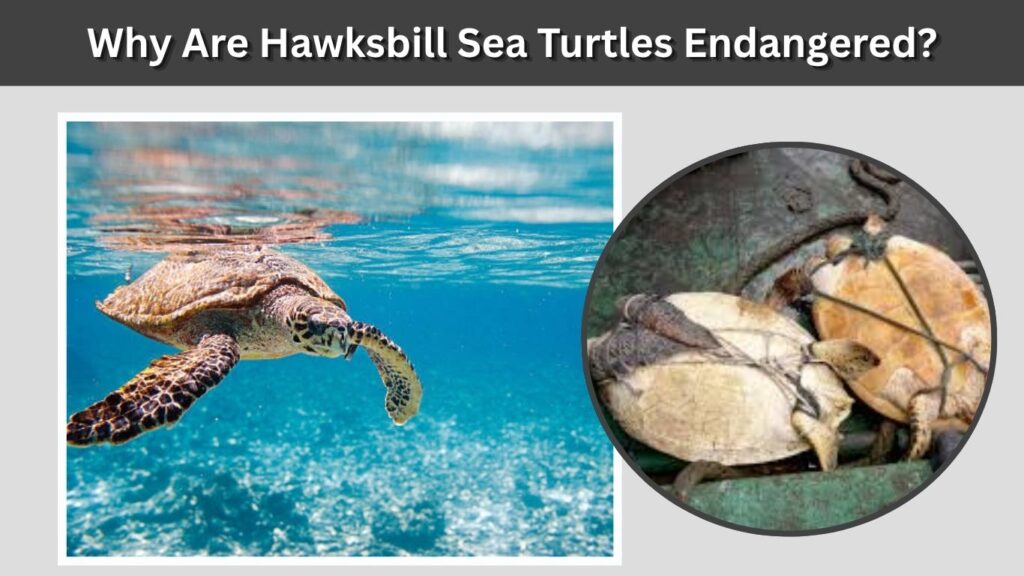
Hawksbill sea turtles are endangered mainly because people hunted them for their shells, meat, and eggs for many years. Their shell, often called “tortoiseshell,” was historically used to make jewelry, combs, ornaments, eyeglass frames, and decorative items.
The tortoiseshell trade was one of the biggest causes of hawksbill decline. Hawksbill shells have colorful overlapping plates that made them highly valuable in international markets. Large numbers of turtles were killed for this trade before stronger protections were introduced.
Although international commercial trade is now banned, illegal hunting and black-market trade still happen in some regions. This continued demand makes recovery more difficult.
Main Reasons Hawksbill Sea Turtles Are Endangered
The reasons hawksbill sea turtles are endangered include both direct killing and habitat damage. Some threats affect adult turtles, while others affect eggs, hatchlings, and nesting females.
Major threats include:
- Illegal trade in tortoiseshell products
- Hunting for meat and shells
- Collection of eggs from nesting beaches
- Accidental capture in fishing gear
- Coral reef destruction
- Coastal development
- Plastic pollution and marine debris
- Climate change and sea level rise
- Artificial lighting near nesting beaches
- Predation by introduced animals such as dogs, pigs, rats, and foxes
Because hawksbills use both land and sea habitats, they face danger in many places. A nesting female may be threatened on the beach, while juveniles and adults may be harmed in reefs, coastal waters, or migration routes.
What Caused the Hawksbill Sea Turtle to Become Endangered?
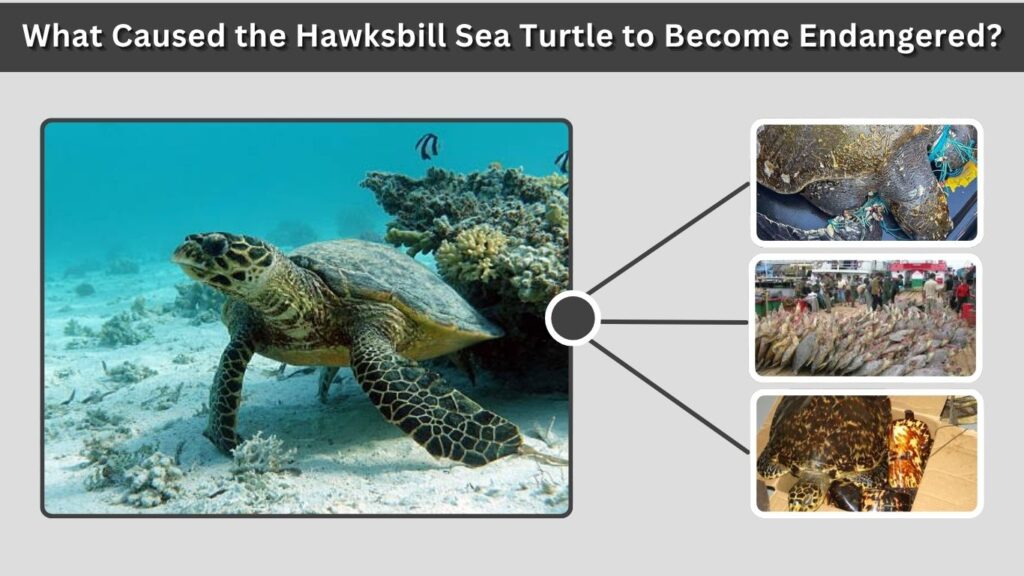
The main historical cause was overexploitation. For centuries, hawksbill sea turtles were killed for their beautiful shells. Their eggs were collected for food, and in some places their meat was also consumed.
This long-term exploitation reduced populations before scientists had enough data to understand the full damage. Since hawksbills take many years to reach breeding age, populations cannot quickly replace adults that are killed.
Several factors made their decline worse:
Slow Reproduction
Hawksbill sea turtles do not reproduce quickly. Females may take decades to mature. Even when a female lays many eggs, only a small number of hatchlings survive to adulthood.
Nesting Beach Dependence
Females need safe sandy beaches to nest. If beaches are developed, eroded, brightly lit, or disturbed, nesting success drops.
Reef Dependence
Adult hawksbills rely heavily on coral reefs for food and shelter. When reefs decline, hawksbills lose important feeding habitat.
International Trade
Because tortoiseshell products were traded globally, hawksbills were hunted across many countries and oceans.
Why Are Hawksbill Sea Turtles Critically Endangered?
Hawksbill sea turtles are critically endangered because their global population has declined severely and many threats continue today. Even with legal protection, they still face illegal trade, accidental capture, habitat loss, and climate impacts.
Their critically endangered status reflects both past decline and current risk. Some local nesting populations are protected and monitored, but others remain small, scattered, or poorly studied. In many regions, hawksbills nest in low numbers, making every adult female important.
The species is especially vulnerable because it depends on healthy coral reefs. Coral reefs are among the most threatened ecosystems on Earth due to warming seas, bleaching, pollution, and coastal damage. As reefs decline, the hawksbill’s feeding habitat also declines.
How Are Hawksbill Sea Turtles Endangered by Fishing?
Fishing bycatch is a major threat to many sea turtles, including hawksbills. Bycatch happens when turtles are accidentally caught in fishing gear meant for other animals.
Hawksbills may become trapped in:
- Gillnets
- Longlines
- Trawls
- Fishing lines
- Fish traps
- Abandoned nets
When turtles are trapped underwater, they can drown because they must come to the surface to breathe. Even if they survive, they may suffer injuries from hooks, lines, or entanglement.
Lost or abandoned fishing gear, sometimes called ghost gear, is also dangerous. It can continue trapping marine animals long after fishers have stopped using it.
How Habitat Loss Endangers Hawksbill Sea Turtles
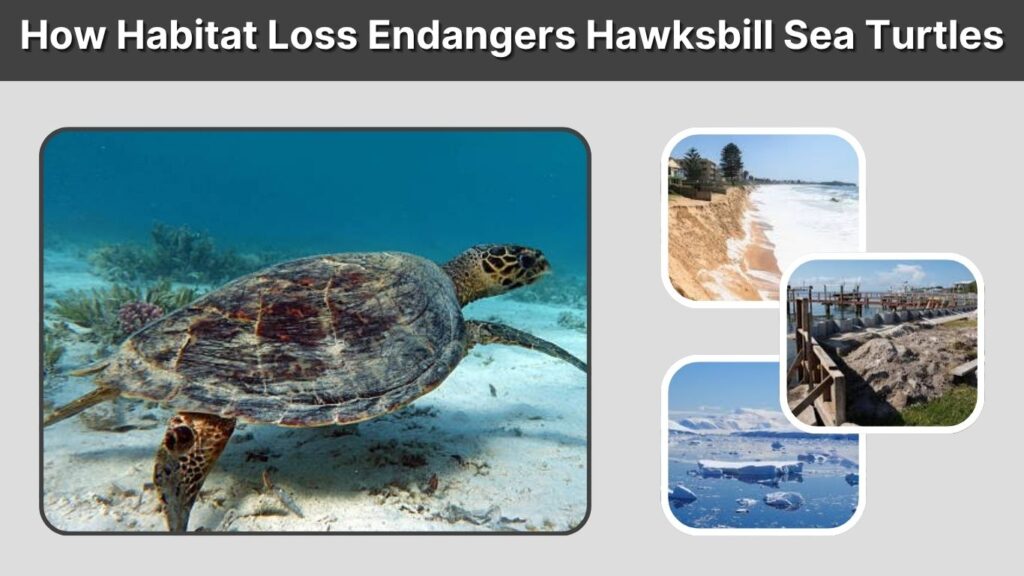
Hawksbill sea turtles need both nesting beaches and coral reef habitats. Damage to either one can reduce their chances of survival.
Nesting Beach Loss
Coastal development can destroy or disturb nesting beaches. Hotels, roads, seawalls, and beachfront buildings may reduce available nesting space. Artificial lighting can confuse hatchlings and lead them away from the ocean.
Nesting beach threats include:
- Beach erosion
- Sand mining
- Seawalls
- Human disturbance
- Vehicle traffic
- Bright coastal lights
- Beach furniture and barriers
Coral Reef Decline
Hawksbills are strongly connected to coral reefs because they feed mainly on sponges and other reef organisms. When coral reefs are damaged, hawksbills lose food and shelter.
Reefs are harmed by:
- Coral bleaching
- Ocean warming
- Pollution
- Sediment runoff
- Destructive fishing
- Disease
- Physical damage from boats and anchors
This is why the phrase “hawksbill sea turtle endangered animals coral reefs” is so important. Hawksbills are endangered animals closely tied to the future of coral reef ecosystems.
Climate Change and Hawksbill Sea Turtle Survival
Climate change affects hawksbill sea turtles in several ways. Rising sea levels can flood or shrink nesting beaches. Stronger storms can wash away nests. Warmer ocean temperatures can damage coral reefs through bleaching.
Temperature also affects sea turtle eggs. In many sea turtles, sand temperature influences whether hatchlings develop as male or female. Warmer sand can produce more female hatchlings, which may create population imbalance over time.
Climate-related threats include:
- Sea level rise
- Stronger coastal storms
- Warmer nesting sand
- Coral bleaching
- Changes in ocean currents
- Loss of reef food sources
Climate change does not act alone. It makes existing threats worse, especially in areas already affected by development, pollution, and reef damage.
Hawksbill Sea Turtle Endangered Facts
Here are key endangered hawksbill sea turtle facts for students, worksheets, and quick reference:
- Hawksbill sea turtles are endangered under U.S. law.
- They are critically endangered on the global IUCN Red List.
- They were protected in 1970 under the precursor to the U.S. Endangered Species Act.
- Their shell was historically used for tortoiseshell products.
- Illegal trade still threatens them in some areas.
- They rely heavily on coral reefs for food and shelter.
- Females nest on sandy tropical beaches.
- Eggs and hatchlings are vulnerable to predators and human disturbance.
- Climate change threatens both reefs and nesting beaches.
- International protection is important because hawksbills migrate across borders.
Hawksbill Sea Turtle Endangered Species in the Philippines
The Philippines is part of the hawksbill sea turtle’s tropical range. Hawksbills may use Philippine waters for feeding, migration, and nesting. Like in many parts of Southeast Asia, they face threats from coastal development, illegal wildlife trade, egg collection, fishing bycatch, and habitat loss.
The Philippines is especially important because it has coral reefs, islands, and coastal habitats that can support sea turtles. Protecting reefs and nesting beaches helps not only hawksbills but also many other marine species.
Conservation actions in the Philippines may include marine protected areas, community beach patrols, anti-poaching work, education campaigns, and enforcement against illegal turtle shell trade.
Hawksbill Sea Turtle Endangered in Florida and U.S. Waters
In the United States, hawksbill sea turtles are most often associated with warm waters near Florida, Puerto Rico, the U.S. Virgin Islands, and the Pacific Islands. In Florida, hawksbills are much less common nesters than loggerheads, green turtles, and leatherbacks, but they may be seen around reefs, especially in the Florida Keys.
Hawksbills are also listed as endangered across U.S. jurisdictions, including states where they may appear rarely or only as part of broader endangered species references. This is why searches mention Connecticut, Maine, Maryland, Massachusetts, Rhode Island, South Carolina, Louisiana, Virginia, and Florida. Some of these states are not major hawksbill habitats, but the species may still appear in endangered species databases or educational lists.
Hawksbill Sea Turtles in Costa Rica, the Great Barrier Reef, and the UAE
Hawksbill sea turtles occur in many tropical regions around the world. Location-based searches often reflect local conservation interest.
Costa Rica
Costa Rica has important sea turtle habitats, including nesting beaches and coastal waters. Hawksbills in the region face threats from bycatch, illegal harvest, coastal development, and habitat degradation.
Great Barrier Reef
The Great Barrier Reef region provides coral reef habitat used by hawksbill turtles. Threats include climate-related coral bleaching, marine pollution, coastal pressures, and fishing interactions.
UAE
In the United Arab Emirates and the wider Arabian Gulf region, hawksbills nest and forage in warm coastal waters. Conservation concerns include coastal development, marine debris, boat activity, and climate stress.
These regional examples show that hawksbill conservation is not limited to one country. The species depends on international cooperation.
When Did Hawksbill Sea Turtles Become Endangered?
In the United States, hawksbill sea turtles were protected in 1970 under the law that came before the Endangered Species Act. The modern Endangered Species Act was passed in 1973, but hawksbills were already recognized as needing federal protection.
The answer to “when was the hawksbill sea turtle listed as endangered?” is commonly given as 1970 for U.S. federal protection. Globally, their IUCN Red List status has been assessed through international conservation science, and the species is currently recognized as Critically Endangered.
How Long Have Hawksbill Sea Turtles Been Endangered?
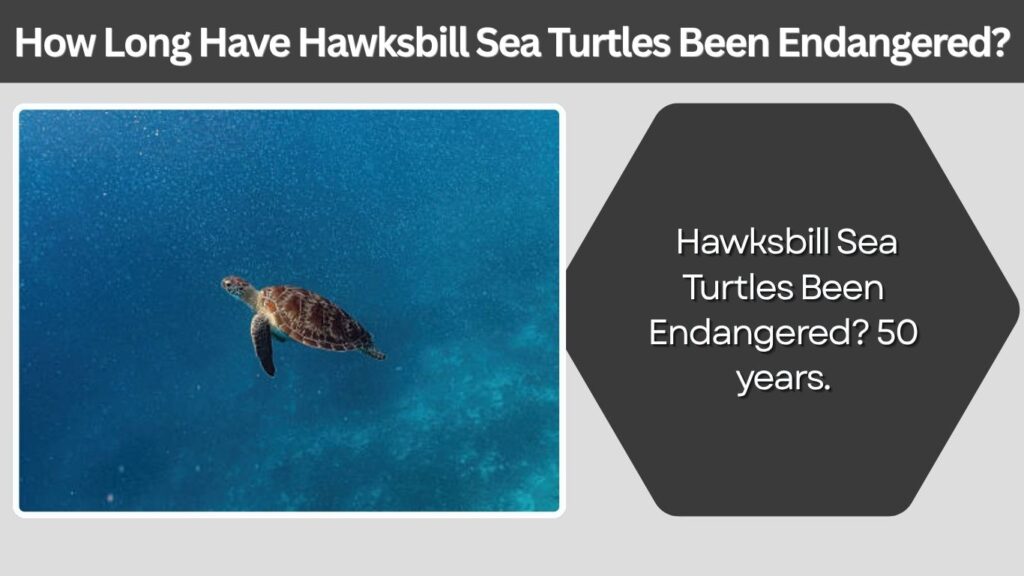
Hawksbill sea turtles have been legally protected as endangered in the United States since 1970. That means they have been recognized as endangered for more than 50 years.
However, their decline began long before legal protection. The tortoiseshell trade, hunting, and egg collection affected hawksbills for centuries. By the time strong protections were created, many populations had already been greatly reduced.
Recovery takes a long time because hawksbills are slow-growing animals. A turtle hatched today may not reproduce for many years, so conservation success is measured across decades.
How Can Hawksbill Sea Turtles Be Protected?
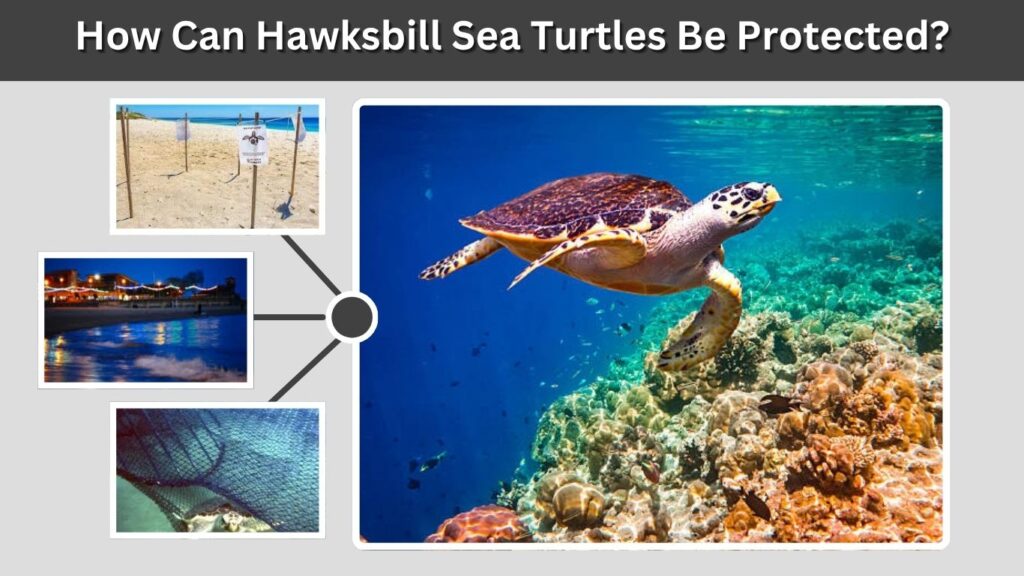
Protecting hawksbill sea turtles requires action on land, at sea, and in global trade systems. Since they migrate across borders, no single country can protect them alone.
Important conservation steps include:
- Enforcing bans on tortoiseshell trade
- Protecting nesting beaches
- Reducing artificial lighting near beaches
- Preventing egg collection and poaching
- Using turtle-safe fishing practices
- Reducing plastic pollution
- Protecting coral reefs
- Creating marine protected areas
- Supporting community-based conservation
- Educating tourists not to buy turtle shell products
People can help by avoiding tortoiseshell souvenirs, reducing plastic use, supporting reef-safe tourism, and respecting turtle nesting beaches.
FAQs
Why is the hawksbill sea turtle endangered?
The hawksbill sea turtle is endangered because of hunting, illegal tortoiseshell trade, egg collection, fishing bycatch, coral reef loss, coastal development, pollution, and climate change. Its slow reproduction makes recovery difficult, even after legal protections are introduced.
Are hawksbill sea turtles endangered?
Yes, hawksbill sea turtles are endangered. They are listed as Endangered under the U.S. Endangered Species Act and Critically Endangered on the IUCN Red List. This means they face a serious risk of extinction without continued conservation.
What caused the hawksbill sea turtle to become endangered?
The main historical cause was overhunting for the tortoiseshell trade. Hawksbill shells were used to make jewelry, combs, ornaments, and other products. Egg collection, meat harvest, habitat loss, and fishing bycatch also contributed to their decline.
When did the hawksbill sea turtle become endangered?
In the United States, hawksbill sea turtles were protected in 1970 under the law that came before the Endangered Species Act. They have been legally recognized as endangered for more than 50 years.
Why are hawksbill sea turtles critically endangered?
Hawksbill sea turtles are critically endangered globally because their populations declined severely from exploitation and still face ongoing threats. Illegal trade, fishing bycatch, coral reef destruction, nesting beach loss, pollution, and climate change continue to put the species at risk.