Green sea turtles have many adaptations that help them live in warm oceans, travel long distances, find food, avoid predators, and return to nesting beaches. These adaptations include strong flippers, a streamlined shell, salt glands, underwater swimming ability, and special feeding habits. Their physical, behavioral, and reproductive adaptations all work together to help them survive in marine environments.
What Are Green Sea Turtle Adaptations?
Green sea turtle adaptations are special body features and behaviors that help them survive in the ocean. These adaptations allow them to swim efficiently, breathe air while living mostly in water, find food in seagrass beds, migrate across long distances, and reproduce on sandy beaches.
Green sea turtles are marine reptiles, so they must come to the surface to breathe. However, they are highly adapted for ocean life. Their bodies are built for swimming, diving, feeding underwater, and moving through coastal habitats. Unlike land turtles, green sea turtles cannot walk well on land, but they are powerful and graceful swimmers in the sea.
Main Types of Adaptations
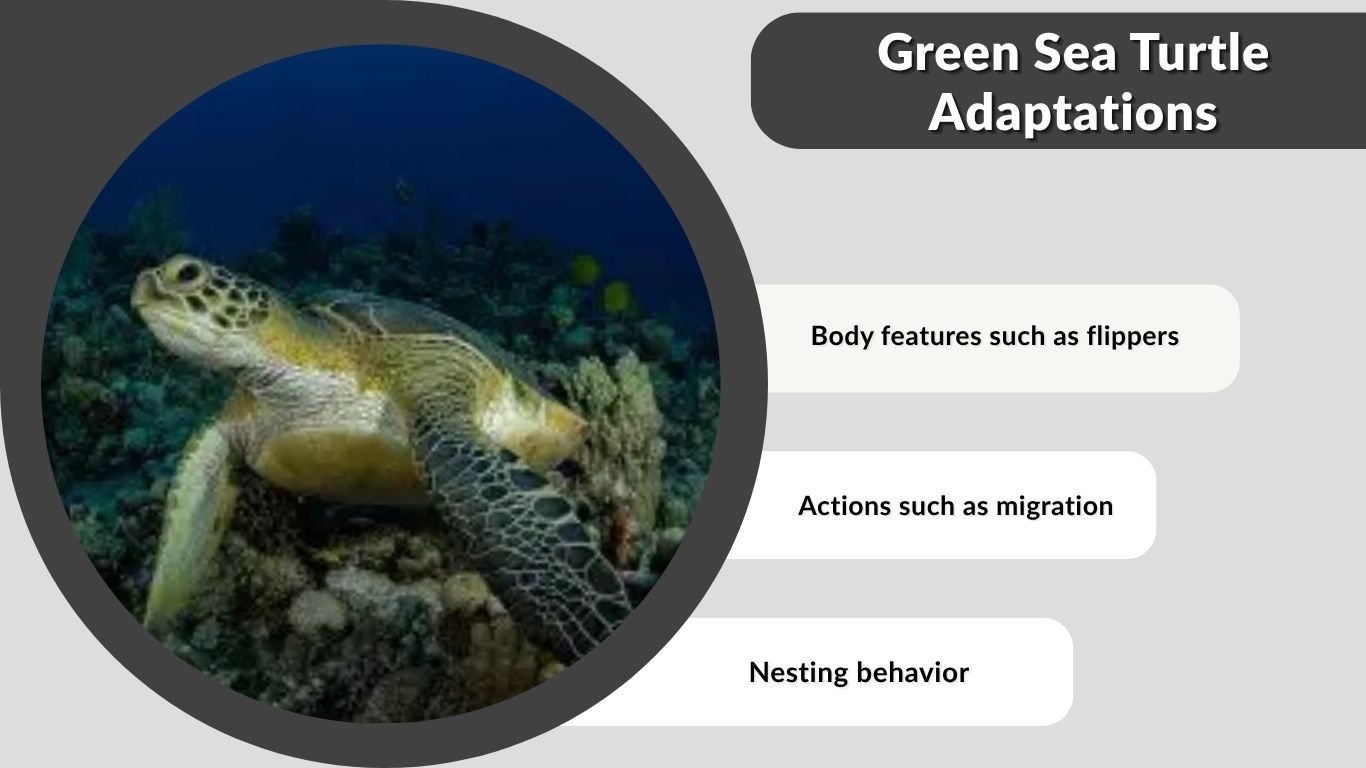
Green sea turtle adaptations can be grouped into several types:
- Physical adaptations: Body features such as flippers, shell shape, and beak structure.
- Behavioral adaptations: Actions such as migration, basking, nesting, and diving.
- Physiological adaptations: Internal functions such as salt removal and oxygen use.
- Reproductive adaptations: Nesting behavior, egg laying, and hatchling emergence.
- Feeding adaptations: Jaw shape and diet changes that help them eat seagrass and algae.
These adaptations help green sea turtles survive in different stages of life, from tiny hatchlings to large adults.
Physical Adaptations of Green Sea Turtles
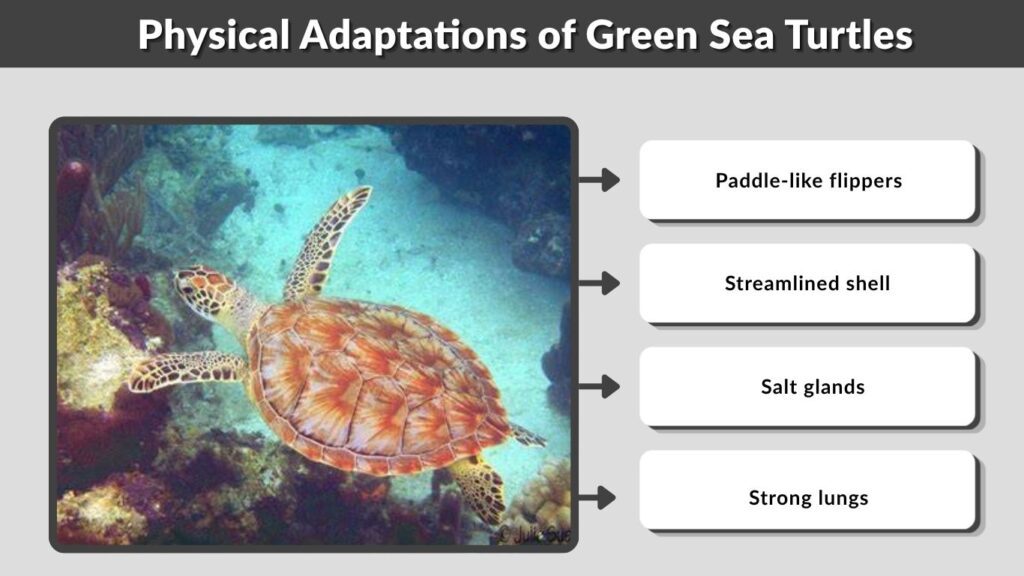
Physical adaptations are body features that help green sea turtles live in the ocean. Their body is designed for swimming, diving, and moving through water with less resistance. Unlike freshwater turtles, green sea turtles have long, paddle-like flippers instead of feet.
Their shell is also different from many land turtles. It is smoother and more streamlined, helping them glide through water. However, green sea turtles cannot pull their head and flippers completely inside the shell. This makes them better swimmers but gives them less protection on land.
| Adaptation | How It Helps |
|---|---|
| Paddle-like flippers | Help with strong swimming and long-distance migration |
| Streamlined shell | Reduces drag in water |
| Sharp-edged beak | Helps cut seagrass and algae |
| Salt glands | Remove extra salt from the body |
| Strong lungs | Allow longer dives |
| Camouflage coloring | Helps blend with ocean habitats |
Flippers for Swimming
Green sea turtles have large front flippers that act like wings underwater. These flippers help them move smoothly through the ocean. Their smaller rear flippers help with steering and are also used by females to dig nests in sand.
Important flipper adaptations include:
- Long front flippers for powerful swimming
- Rear flippers for steering in water
- Rear flippers for digging egg chambers
- Strong muscles for long-distance migration
- Smooth movement that saves energy while swimming
Because of these flippers, green sea turtles can travel across oceans between feeding areas and nesting beaches.
Shell Adaptations of the Green Sea Turtle
The shell of a green sea turtle is one of its most important structural adaptations. The upper part of the shell is called the carapace, and the lower part is called the plastron. Together, they protect the turtle’s body and support its ocean lifestyle.
The shell is broad, smooth, and oval-shaped. This shape helps the turtle swim efficiently. A heavy, box-like shell would slow the turtle down, but the green sea turtle’s shell is shaped to move through water more easily.
How the Shell Helps Survival
The shell helps green sea turtles in several ways. It protects the body from some predators, gives support to muscles, and helps with swimming balance. Adult turtles are large, so their shell also makes them harder for many predators to eat.
However, the shell has limits. Green sea turtles cannot fully hide inside it. Sharks, especially tiger sharks, can still attack adult turtles. Even so, the shell is a major reason why adult green sea turtles have fewer predators than eggs, hatchlings, and juveniles.
Feeding Adaptations of Green Sea Turtles
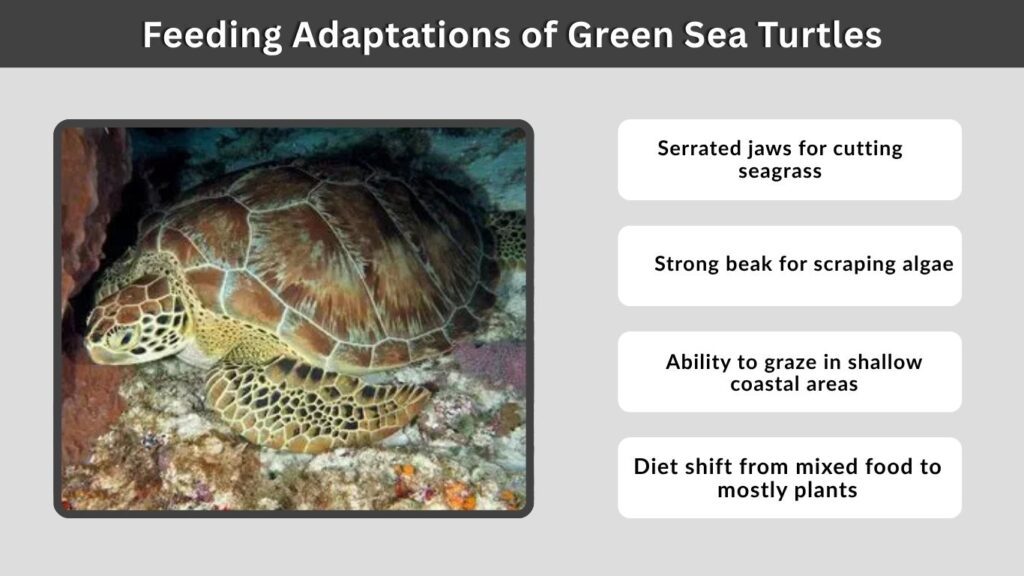
Adult green sea turtles are mostly herbivores. They feed mainly on seagrass and algae. Their jaws and beak are adapted for cutting and tearing plant material underwater. This diet is different from many other sea turtles, which may eat jellyfish, sponges, or shellfish.
Young green sea turtles may eat more animal matter, such as small invertebrates, fish eggs, and jellyfish. As they grow, they shift toward a plant-based diet. This change is an important feeding adaptation that helps adults survive in seagrass-rich coastal areas.
Adaptations for Eating
Green sea turtles have several feeding adaptations:
- Serrated jaws for cutting seagrass
- Strong beak for scraping algae
- Ability to graze in shallow coastal areas
- Diet shift from mixed food to mostly plants
- Good underwater vision for finding food
- Slow grazing behavior that saves energy
Their feeding also helps the ecosystem. By grazing on seagrass, green sea turtles keep seagrass beds healthy and encourage fresh growth.
Behavioral Adaptations of Green Sea Turtles
Behavioral adaptations are actions that help an animal survive. Green sea turtles have many important behaviors, including migration, diving, nesting, basking, and hatchling movement toward the sea.
One of their most impressive behaviors is long-distance migration. Green sea turtles may travel hundreds or even thousands of miles between feeding grounds and nesting beaches. Females often return to the same general beach area where they were born or where they nested before.
Migration Behavior
Migration helps green sea turtles find food and reproduce. Feeding areas and nesting beaches are not always close together, so turtles must travel across large ocean distances.
During migration, green sea turtles may use:
- Ocean currents
- Earth’s magnetic field
- Memory of nesting beaches
- Water temperature
- Coastal landmarks
- Chemical cues in the ocean
This navigation ability is one of the most fascinating green sea turtle adaptations. It allows females to find nesting beaches after years at sea.
Diving and Breathing Adaptations
Green sea turtles breathe air, but they spend most of their time underwater. This means they need special diving adaptations. They have strong lungs and can hold their breath for long periods, especially when resting.
When active, they come up to breathe more often. When resting or sleeping underwater, they can stay submerged much longer. Their body can slow down some functions to use oxygen more efficiently.
How They Stay Underwater
Green sea turtles survive underwater by using several adaptations:
- Large lungs that store oxygen
- Slow heart rate during resting dives
- Efficient oxygen use in muscles
- Ability to rest under ledges or in shallow areas
- Regular surfacing behavior to breathe
- Calm movement that saves energy
These adaptations help them feed, avoid predators, rest, and travel without needing to stay at the surface all the time.
Saltwater Adaptations
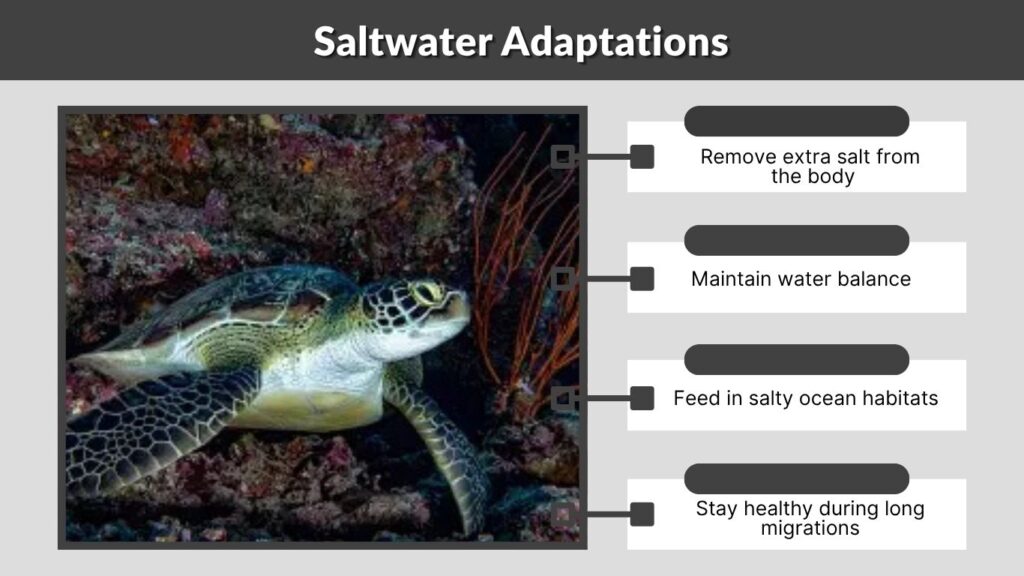
Green sea turtles live in saltwater, but too much salt can be dangerous for their bodies. Like other sea turtles, they have special salt glands near their eyes. These glands remove extra salt from the bloodstream.
When a green sea turtle appears to be “crying,” it is usually removing salt, not showing emotion. This adaptation is very important because sea turtles swallow saltwater while feeding and living in the ocean.
Why Salt Glands Matter
Salt glands allow green sea turtles to live in marine habitats without becoming dehydrated from excess salt. Without this adaptation, they would not be able to survive long in ocean water.
The glands help them:
- Remove extra salt from the body
- Maintain water balance
- Feed in salty ocean habitats
- Survive without drinking freshwater
- Stay healthy during long migrations
This is one of the key physiological adaptations that separates marine reptiles from many land reptiles.
Reproductive Adaptations of Green Sea Turtles
Green sea turtles have special reproductive adaptations that help them produce the next generation. Females come ashore at night to lay eggs in sandy nests. Nesting at night helps reduce heat stress and lowers the chance of disturbance.
A female uses her rear flippers to dig a deep egg chamber. After laying eggs, she covers the nest with sand and returns to the ocean. She does not care for the eggs or hatchlings. Instead, green sea turtles rely on laying many eggs to increase survival chances.
Nesting Adaptations
Important reproductive adaptations include:
- Returning to familiar nesting beaches
- Nesting mostly at night
- Digging deep sand chambers
- Laying many eggs in one clutch
- Covering nests to hide them from predators
- Hatchlings emerging together for better survival
Hatchlings also have strong instincts. After leaving the nest, they move toward the brightest natural horizon, which is usually the ocean. This helps them reach the water quickly.
Hatchling Adaptations for Survival
Baby green sea turtles are very vulnerable. They are small, soft, and exposed to many predators. However, they have several adaptations that improve their chances of survival.
Hatchlings usually emerge from the nest together at night. This group emergence can overwhelm predators, allowing at least some hatchlings to escape. They also instinctively crawl toward the ocean and begin swimming quickly once they enter the water.
Early-Life Survival Traits
Hatchling adaptations include:
- Emerging mostly at night
- Crawling toward natural ocean light
- Moving together in groups
- Using small flippers to crawl and swim
- Fast swimming after entering the water
- Instinctive movement away from shore
Even with these adaptations, many hatchlings do not survive. Predators, artificial lights, beach obstacles, and ocean dangers make early life extremely risky.
Green Sea Turtles Adaptations to Their Environment
Green sea turtles are adapted to warm coastal and ocean environments. They live in tropical and subtropical waters, especially around seagrass beds, coral reefs, lagoons, and shallow coastal feeding areas.
Their greenish-brown shell helps them blend with seagrass, rocks, and reef shadows. This camouflage is especially helpful for juveniles, which are more vulnerable to predators.
Habitat Adaptations
Green sea turtles survive in their environment by combining body structure and behavior. Their flippers help them swim through open water, their jaws help them feed in seagrass beds, and their salt glands help them live in salty habitats.
They are also able to use different habitats during different life stages. Hatchlings begin in open ocean zones, juveniles may use floating seaweed or coastal areas, and adults often settle into seagrass-rich feeding grounds.
Hawaiian and Galapagos Green Sea Turtle Adaptations
Hawaiian green sea turtles, often called honu, show some local behaviors that help them survive in their environment. One well-known behavior is basking on beaches. While many sea turtles stay mostly in water, Hawaiian green sea turtles are often seen resting on shore.
Basking may help them warm their bodies, rest, and possibly reduce some parasites. This behavior is especially famous in Hawaii, where green turtles are culturally important and legally protected.
Galapagos green sea turtles also show adaptations to island environments. They use coastal waters, reefs, and nesting beaches around the islands. Like other green turtles, they depend on warm beaches for nesting and productive marine habitats for feeding.
FAQs
What adaptations do green sea turtles have?
Green sea turtles have flippers for swimming, streamlined shells, salt glands, strong lungs, sharp beaks, camouflage coloring, nesting instincts, and long-distance migration behavior. These adaptations help them survive in saltwater, find food, avoid predators, and reproduce on sandy beaches.
How do green sea turtles adapt to their environment?
Green sea turtles adapt to their environment by using flippers to swim, salt glands to remove extra salt, strong lungs for diving, and serrated jaws for eating seagrass. Their shell shape also helps them move smoothly through ocean water.
What are the physical adaptations of a green sea turtle?
Physical adaptations include paddle-like flippers, a streamlined shell, strong jaws, a sharp-edged beak, large lungs, and special salt glands. These body features help green sea turtles swim, dive, feed, breathe, and survive in marine habitats.
What are behavioral adaptations of green sea turtles?
Behavioral adaptations include migration, nesting at night, returning to familiar beaches, diving, basking in some regions, and hatchlings moving toward ocean light. These behaviors help green sea turtles reproduce, avoid danger, and survive in their environment.
What is a green sea turtle’s best survival adaptation?
One of the best survival adaptations is its streamlined body with powerful flippers. This allows the turtle to swim long distances, escape some predators, migrate between feeding and nesting areas, and move efficiently through the ocean.