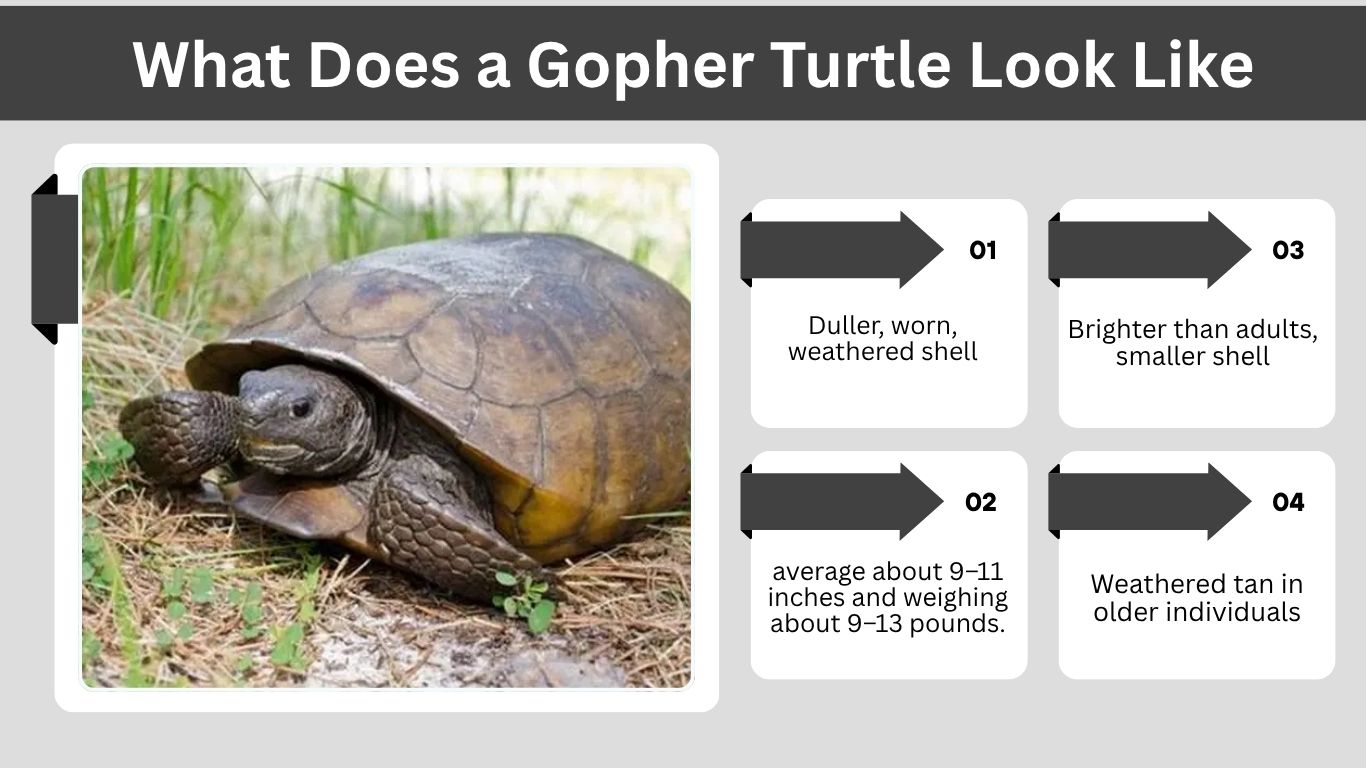
A “gopher turtle” is more correctly called a gopher tortoise. It is a land-dwelling reptile found in the southeastern United States, especially in dry, sandy habitats. You can identify it by its domed brown-gray shell, shovel-like front legs, elephant-like back legs, and strong claws used for digging. Adult gopher tortoises are usually 9–11 inches long, though some can grow up to about 15 inches.
Gopher Turtle vs. Gopher Tortoise: What Is the Correct Name?
Many people say “gopher turtle,” but the correct common name is gopher tortoise. This matters because turtles and tortoises are related, but they are not exactly the same in appearance, behavior, or habitat.
Gopher tortoises are terrestrial, which means they live on land. Unlike many aquatic turtles, they are not built for swimming. Their legs are thick, sturdy, and adapted for walking and digging, not paddling through water. Their bodies are heavy, their shells are high and domed, and their feet look more like digging tools than webbed swimming feet.
The name “gopher” comes from their burrowing behavior. Like a gopher, this tortoise digs long underground burrows in sandy soil. These burrows are one of the easiest signs that a gopher tortoise may be nearby.
| Feature | Gopher Tortoise |
|---|---|
| Common mistaken name | Gopher turtle |
| Correct name | Gopher tortoise |
| Habitat | Dry, sandy uplands |
| Lifestyle | Land-dwelling |
| Feet | Not webbed |
| Main skill | Digging burrows |
Overall Appearance of a Gopher Tortoise
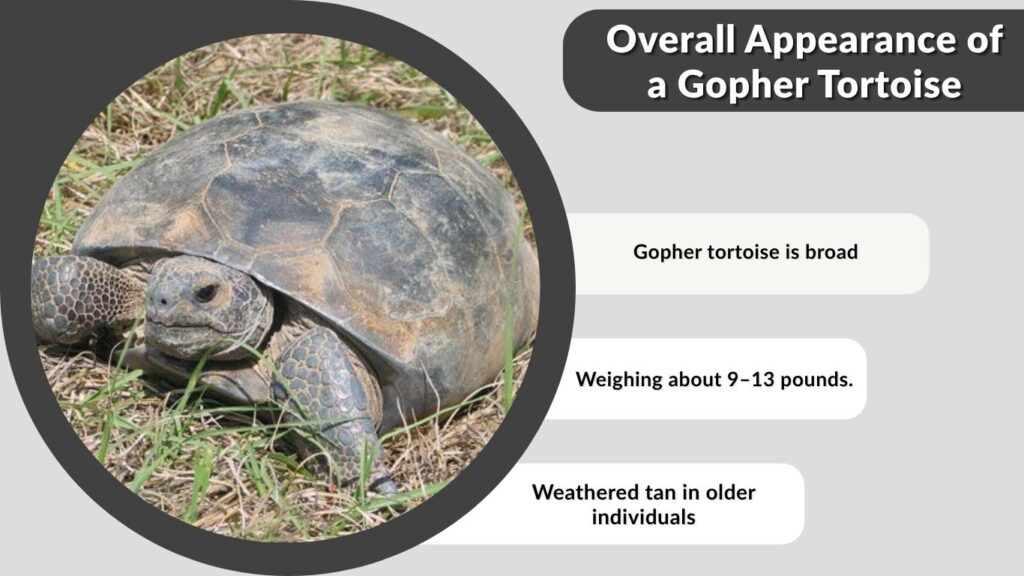
A gopher tortoise has a strong, compact, rugged look. It does not look smooth or delicate like some water turtles. Instead, it looks built for dry ground, digging, and pushing through sandy vegetation.
Its body is low but sturdy, with a large domed upper shell and thick legs. The shell is usually brown, grayish brown, or grayish black. Older individuals may look duller and more worn, while young tortoises can have brighter yellow-orange and brown markings that fade with age.
Body Shape
The body of a gopher tortoise is broad, heavy, and oval-shaped. From above, the shell looks rounded and slightly elongated. From the side, the shell rises into a dome, giving the tortoise a strong armored appearance.
Its head is fairly small compared to its shell, but the neck is strong. The legs are short and powerful. The front legs are especially noticeable because they are flattened and covered with thick scales.
Size and Weight
Adult gopher tortoises are moderate-sized reptiles. Most adults average about 9–11 inches in shell length, but some may reach up to 15 inches. The U.S. Fish and Wildlife Service describes adults as having a top shell around 10–15 inches long and weighing about 9–13 pounds.
Younger tortoises are much smaller and can be harder to spot because they hide in vegetation or small burrows.
Color
Adult gopher tortoises are usually not brightly colored. Their top shell may be:
- Brown
- Grayish brown
- Dark gray
- Grayish black
- Weathered tan in older individuals
The bottom shell, called the plastron, is usually yellowish. The skin is generally gray, brown, or dark tan. Hatchlings and juveniles may show more yellow-orange and brown tones, but these colors become duller as the tortoise grows.
Shell Identification
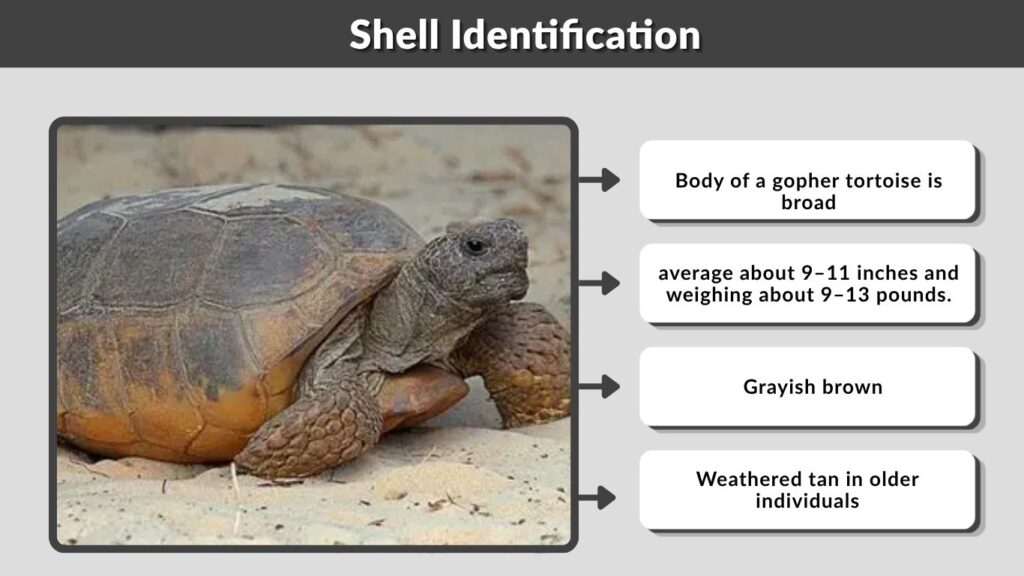
The shell is one of the best features to examine when identifying a gopher tortoise. It protects the animal from predators, harsh weather, and rough ground.
Gopher tortoises have a domed upper shell called the carapace and a lower shell called the plastron. Unlike some turtles, the bottom shell does not have a hinge. This means the tortoise cannot fully close itself inside its shell the way a box turtle can.
Carapace: The Top Shell
The carapace is the top part of the shell. In gopher tortoises, it is usually domed, oval, and rough-looking. The color is commonly brown to grayish black. The shell may have visible scutes, which are the plate-like sections that make up the outer shell surface.
In older tortoises, the shell may look worn, scratched, faded, or chipped from years of digging, moving through brush, and living in sandy environments. This weathered appearance is normal.
Plastron: The Bottom Shell
The plastron is the bottom shell. In gopher tortoises, it is usually yellowish and does not have a hinge. This is a useful clue when comparing a gopher tortoise with a box turtle.
Males often have a more concave plastron than females. This means the lower shell curves inward slightly. Males may also have a longer gular projection, which is the front part of the lower shell beneath the head.
Nuchal Scute
One important identification feature is the nuchal scute. This is a bony plate on the front edge of the upper shell, directly behind the head. Florida Fish and Wildlife Conservation Commission lists the nuchal scute as one of the features used to identify a gopher tortoise.
Legs and Feet: The Most Important Clue
The legs and feet are often the easiest way to recognize a gopher tortoise. Since this reptile spends much of its life digging burrows, its limbs are shaped for strength and movement through soil.
Unlike aquatic turtles, gopher tortoises do not have webbed feet. Their limbs look thick, dry, scaly, and powerful.
Shovel-Like Front Feet
The front legs are flattened and shovel-like. They are covered with thick protective scales and have strong claws. These front limbs are used to dig burrows into sandy soil.
When viewed from the front, the forelimbs can look wide and muscular. This is one of the clearest signs that you are looking at a land tortoise rather than a water turtle.
Elephant-Like Back Legs
The back legs are often described as elephant-like because they are round, stumpy, and column-shaped. They are not webbed and do not look like the thin paddling legs of aquatic turtles.
These back legs help support the tortoise’s heavy body as it walks slowly across dry ground.
Strong Claws
Gopher tortoises have strong claws on their front feet. These claws help them loosen soil and dig deep burrows. The claws may look thick, worn, and slightly curved.
Head, Face, and Neck
The head of a gopher tortoise is usually gray, brown, or dark tan. It has a blunt shape, with a beak-like mouth used for eating plants. The eyes are positioned on the sides of the head, giving the tortoise a wide field of view.
The face may look dry and rough, especially in adults. The skin on the head and neck often has a wrinkled texture. This is normal and helps distinguish it from smoother-looking aquatic turtles.
Gopher tortoises do not have flashy facial markings. Their appearance is mostly plain and earthy, which helps them blend into sandy soil, dry grass, pine needles, and scrub habitat.
What Do Baby Gopher Tortoises Look Like?
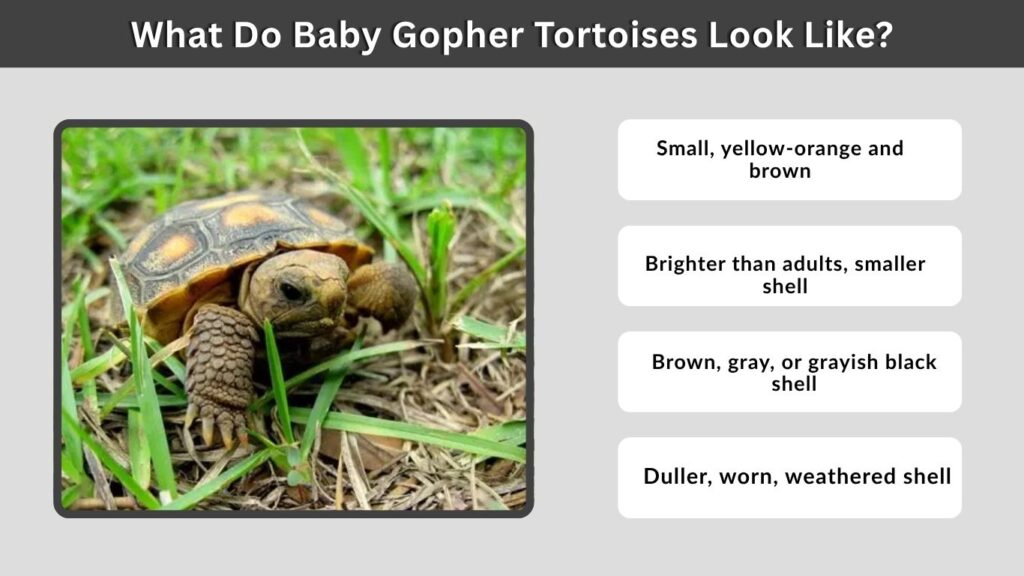
Baby gopher tortoises, also called hatchlings, look different from adults. They are much smaller and often brighter in color.
Hatchlings are usually yellow-orange and brown. Their shells may look cleaner, smoother, and more patterned than adult shells. As they age, the bright colors fade into dull brown, gray, or dark earth tones.
Young tortoises may be only a few inches long and are vulnerable to predators. They often stay hidden in vegetation or use small burrows for protection.
| Age | Appearance |
|---|---|
| Hatchling | Small, yellow-orange and brown |
| Juvenile | Brighter than adults, smaller shell |
| Adult | Brown, gray, or grayish black shell |
| Older adult | Duller, worn, weathered shell |
How to Identify a Gopher Tortoise Burrow
Sometimes you may see the burrow before you see the tortoise. Gopher tortoise burrows are very distinctive and can help with identification.
A typical gopher tortoise burrow has a half-moon-shaped entrance. The entrance usually slopes gently into the ground. In front of the opening, there is often a spread of loose sandy soil called a burrow apron. Active burrows may show fresh soil and tracks.
Signs of an Active Burrow
An active gopher tortoise burrow may have:
- A half-moon-shaped entrance
- Loose sand near the opening
- A fan-shaped soil apron
- Tortoise tracks
- A smooth, gently sloping tunnel entrance
- Nearby cropped plants or feeding signs
Burrow entrance size can vary from about 2.5 to 15 inches wide, depending on the size of the tortoise that made it.
Gopher Tortoise vs. Similar Turtles
Gopher tortoises are sometimes confused with box turtles, snapping turtles, or other land and freshwater turtles. Looking closely at the shell, feet, and habitat can help you tell them apart.
A gopher tortoise usually lives in dry upland areas, not ponds or wetlands. It has shovel-like front legs, elephant-like back legs, and no webbing between the toes. Its shell is domed but does not close tightly like a box turtle’s shell.
Gopher Tortoise vs. Box Turtle
Box turtles are usually smaller and have a hinged bottom shell that allows them to close up tightly. Gopher tortoises do not have a hinged plastron. Box turtles may also have brighter shell patterns, while adult gopher tortoises are usually dull brown, gray, or blackish.
Gopher Tortoise vs. Water Turtle
Water turtles often have webbed feet, flatter shells, and smoother bodies adapted for swimming. Gopher tortoises have thick legs, heavy bodies, and digging claws. If the animal looks like it is built for digging instead of swimming, it may be a gopher tortoise.
Where You Are Most Likely to See One
Gopher tortoises live in dry, sandy upland habitats. In Florida, they may be found in forests, pastures, yards, scrub, pine flatwoods, sandhills, and other open areas with well-drained soil. They feed on low-growing plants and use burrows for shelter.
They are most often seen walking slowly near burrows, feeding on plants, basking in sunny areas, or crossing roads. If you see one on a road, do not take it home or move it far away. If it is safe, help it cross in the same direction it was already going.
Quick Identification Checklist
Use this checklist when trying to identify a gopher tortoise:
- Domed brown, gray, or grayish-black shell
- Adult shell usually around 9–11 inches long
- Heavy land-dwelling body
- Shovel-like front legs
- Thick, elephant-like back legs
- No webbed feet
- Strong claws for digging
- Yellowish bottom shell without a hinge
- Blunt head and rough gray-brown skin
- Often near a half-moon-shaped sandy burrow
FAQs
Is a gopher turtle the same as a gopher tortoise?
Yes. Many people say “gopher turtle,” but the correct name is gopher tortoise. It is a land-dwelling tortoise, not an aquatic turtle.
What color is a gopher tortoise?
Adult gopher tortoises are usually brown, grayish brown, gray, or grayish black. Their bottom shell is usually yellowish. Young tortoises may be more yellow-orange and brown.
How big does a gopher tortoise get?
Most adult gopher tortoises are about 9–11 inches long, but some can reach about 15 inches. They may weigh around 9–13 pounds as adults.
How can you tell a gopher tortoise from a turtle?
Look at the feet and habitat. Gopher tortoises have thick, non-webbed feet, shovel-like front legs, and elephant-like back legs. Water turtles usually have webbed feet and are better adapted for swimming.
What does a gopher tortoise burrow look like?
A gopher tortoise burrow usually has a half-moon-shaped entrance, a gentle slope, and loose sandy soil spread around the opening. Active burrows may also show tracks and fresh sand.
land ecosystems across the southeastern United States.