
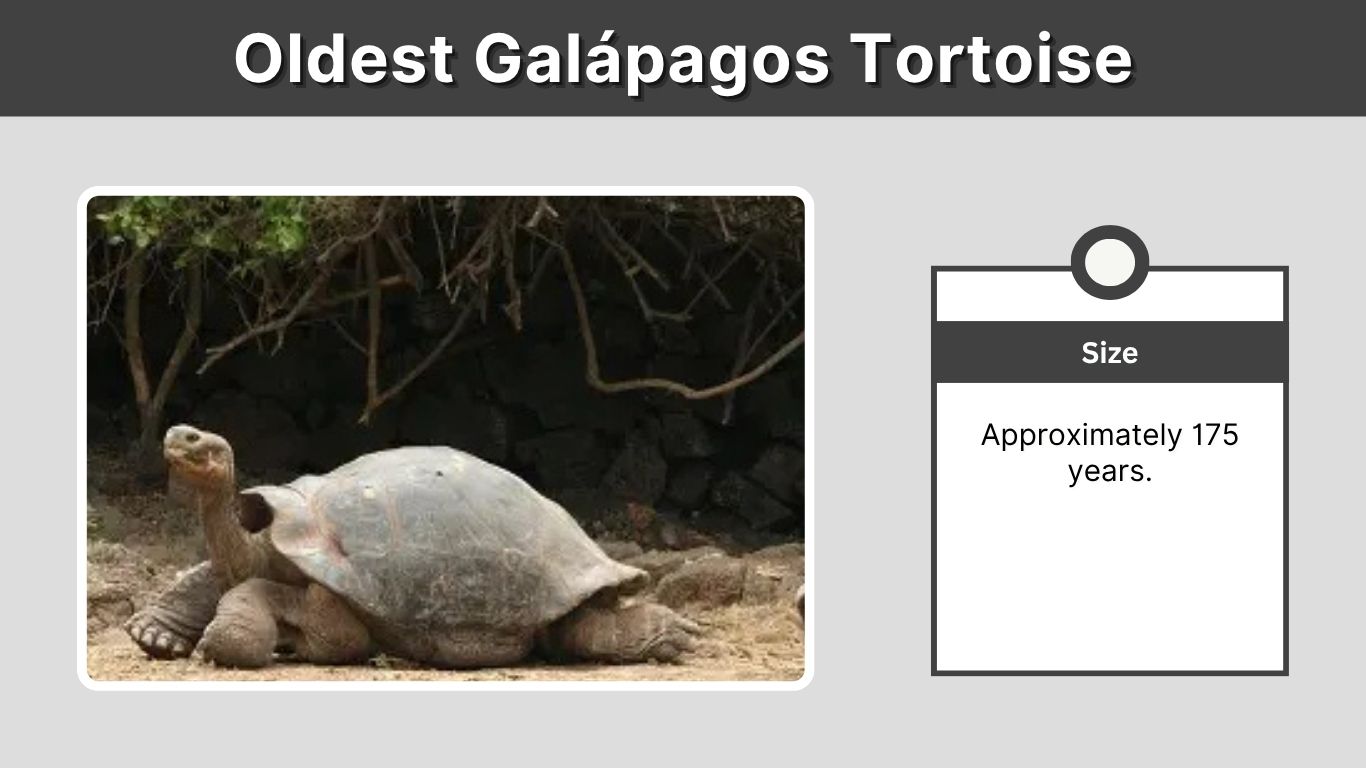
The oldest widely documented Galápagos tortoise was Harriet, a female giant tortoise estimated to have lived for approximately 175 years. She died at Australia Zoo on June 23, 2006. Harriet became famous not only for her extraordinary age but also because she was sometimes claimed to have been collected during Charles Darwin’s 1835 visit to the Galápagos Islands. However, parts of that story remain disputed.
Galápagos tortoises regularly live beyond 100 years, but determining the precise age of very old individuals is difficult because reliable birth records often do not exist.
What Was the Oldest Galápagos Tortoise?
Harriet is generally described as one of the oldest known Galápagos giant tortoises. She was believed to have hatched around 1830 and was approximately 175 years old when she died in 2006.
Some reports describe her as 176 years old because historical birth dates were estimated rather than documented precisely. Australia Zoo confirms that Harriet was a Galápagos land tortoise and that she died peacefully at the zoo on June 23, 2006.
A recent Associated Press report also identified Harriet, who lived to around 175, as the oldest known Galápagos tortoise.
Quick facts about Harriet
| Fact | Information |
| Name | Harriet |
| Species | Galápagos giant tortoise |
| Estimated birth | Around 1830 |
| Death | June 23, 2006 |
| Estimated age | Approximately 175 years |
| Final home | Australia Zoo, Queensland |
| Sex | Female |
How Old Was Harriet When She Died?
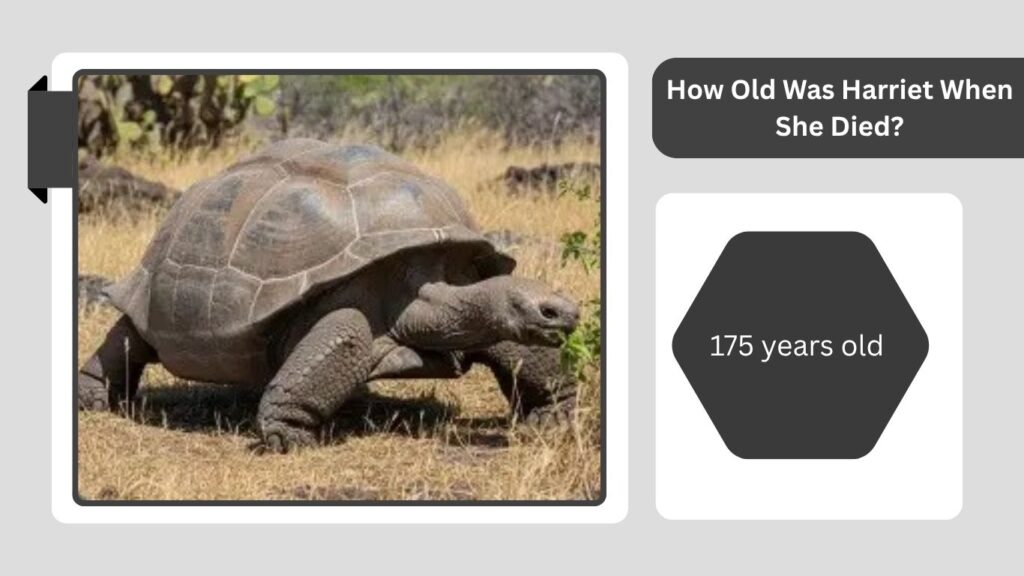
Harriet was approximately 175 years old at the time of her death. Because no one recorded her hatching, scientists and historians estimated her age using her size, travel history and historical documents.
Her estimated birth around 1830 means that Harriet lived through major historical changes, including the Victorian era, two world wars and the beginning of modern wildlife-conservation programs.
Australia Zoo celebrated what it regarded as Harriet’s 175th birthday in November 2005. She died about seven months later after a short illness.
Was Harriet Collected by Charles Darwin?
A popular story claims that Charles Darwin collected Harriet during the voyage of HMS Beagle in 1835. According to the story, she was transported from the Galápagos to England before eventually being taken to Australia.
However, researchers have questioned this account. Harriet was identified as a western Santa Cruz tortoise, while Darwin did not visit Santa Cruz Island during his Galápagos stay. It is possible that another member of the expedition collected her, or that her history became mixed with stories about other tortoises.
Therefore, it is safer to say that Harriet may have been connected to the Beagle expedition, but there is no conclusive proof that Darwin personally collected her.
Is the World’s Oldest Tortoise a Galápagos Tortoise?
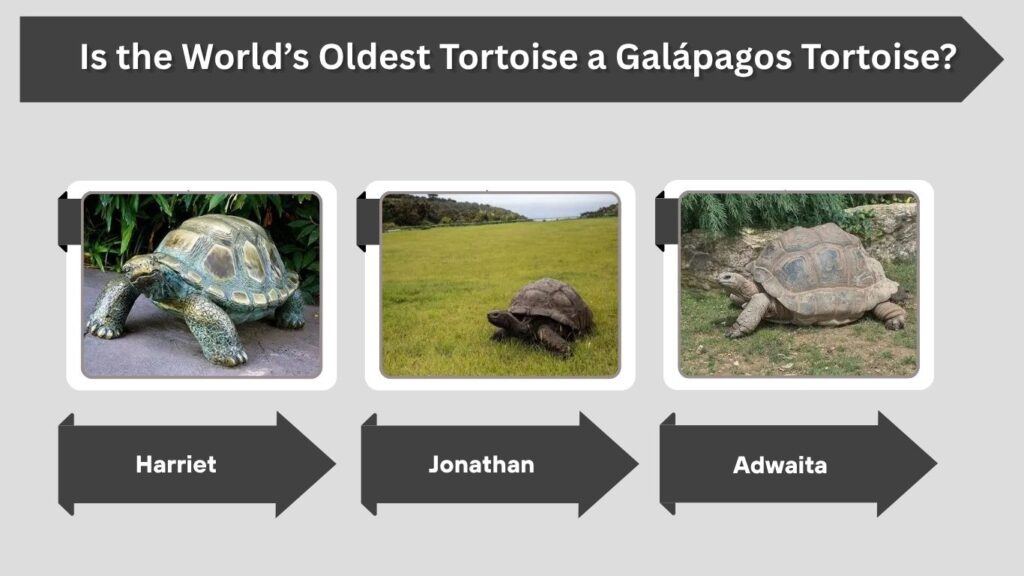
No. The world’s oldest known living land animal is Jonathan, but he is not a Galápagos tortoise.
Jonathan is a Seychelles giant tortoise living on Saint Helena. In 2026, he was estimated to be around 194 years old.
This distinction is important because online searches frequently confuse Jonathan with a Galápagos giant tortoise. Although the animals look similar and both belong to groups of giant island tortoises, they come from different regions.
| Tortoise | Type | Estimated age or lifespan |
| Harriet | Galápagos giant tortoise | About 175 years |
| Jonathan | Seychelles giant tortoise | About 194 years in 2026 |
| Adwaita | Aldabra giant tortoise | Claimed to be about 250 years |
| Lonesome George | Pinta Island tortoise | More than 100 years |
Was Adwaita the Oldest Galápagos Tortoise?
No. Adwaita was an Aldabra giant tortoise, not a Galápagos tortoise.
Adwaita lived at Alipore Zoo in India and was sometimes claimed to have been about 250 or 255 years old when he died in 2006. However, the exact age was not fully verified because dependable records from the beginning of his life were unavailable.
Therefore, Adwaita should not be included as the oldest Galápagos tortoise. He belonged to a different species originating from the Aldabra Atoll in the Seychelles.
Was Jonathan the Oldest Galápagos Tortoise?
Jonathan is also frequently mislabeled as a Galápagos tortoise. He is a Seychelles giant tortoise and has lived on Saint Helena since the 19th century.
Jonathan is older than Harriet was when she died, but he cannot hold the record for the oldest Galápagos tortoise because he is not part of the Galápagos group.
The confusion probably occurs because Galápagos, Aldabra and Seychelles giant tortoises share several characteristics:
- Very large bodies
- Thick, domed shells
- Long necks
- Slow movement
- Plant-based diets
- Lifespans exceeding 100 years
Despite these similarities, they represent separate evolutionary lineages.
What Is the Oldest Living Galápagos Tortoise Today?
There does not appear to be a universally recognized, publicly verified record holder for the oldest living Galápagos tortoise.
Several living individuals are more than 100 years old. One notable example is Diego, an Española giant tortoise that was removed from his island during the first half of the 20th century and later became part of a highly successful breeding program. Diego was described as more than 100 years old when he returned to Española Island in 2020.
Another elderly Galápagos tortoise, called Gramma, died at the San Diego Zoo in 2025 at an estimated age of about 141.
Because many tortoises hatched before detailed zoological records were maintained, their ages are usually estimated. For that reason, declaring one individual the oldest living Galápagos tortoise can be difficult.
How Long Do Galápagos Tortoises Live?
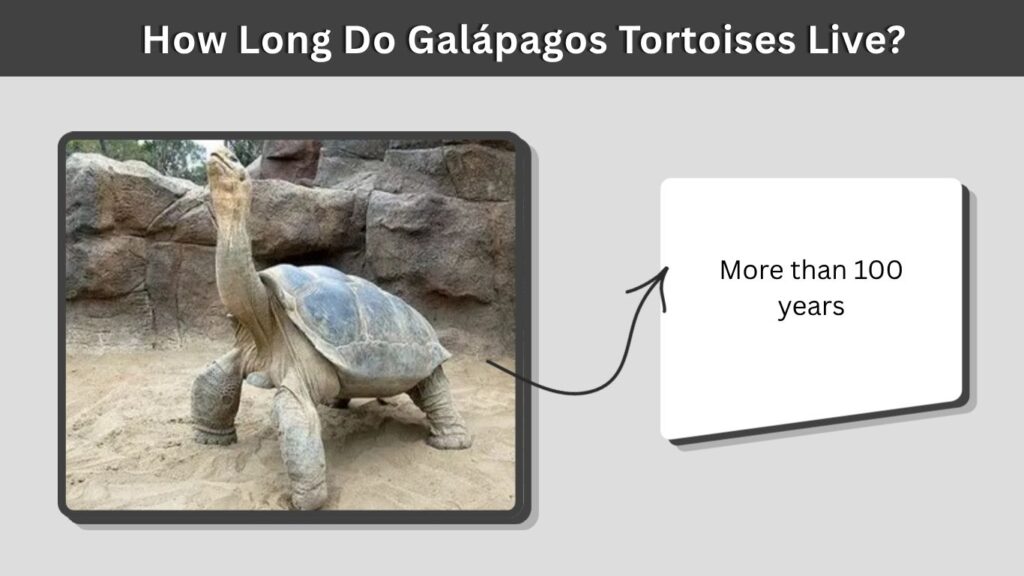
Galápagos giant tortoises commonly live for more than 100 years, and exceptional individuals may survive for 150 years or longer.
Their exact maximum lifespan remains uncertain. Wild tortoises are rarely observed continuously from hatching until death, while many elderly captive individuals arrived before accurate records were created.
Why do they live so long?
Scientists associate their longevity with several biological and environmental characteristics:
- Slow metabolism
- Slow growth and development
- Low-energy lifestyle
- Strong protective shells
- Few natural predators as adults
- Efficient use of food and water
- Biological resistance to some age-related damage
Their slow metabolism allows their bodies to use energy gradually. Adult tortoises also face relatively little natural predation because their large size and thick shells provide substantial protection.
Can Scientists Tell a Tortoise’s Age From Its Shell?
Scientists cannot determine an old Galápagos tortoise’s exact age simply by looking at its shell.
Young tortoises sometimes have visible growth rings on their shell plates. However, these rings become worn, damaged and difficult to interpret over time. Their formation can also be influenced by nutrition, rainfall and growth conditions rather than representing exactly one year.
Researchers therefore estimate age using several sources of evidence:
- Historical transportation records
- Zoo arrival documents
- Body size and development
- Old photographs
- Written eyewitness accounts
- Genetic and veterinary information
Even when these methods are combined, the final age may still include a margin of error.
Other Famous Old Galápagos Tortoises
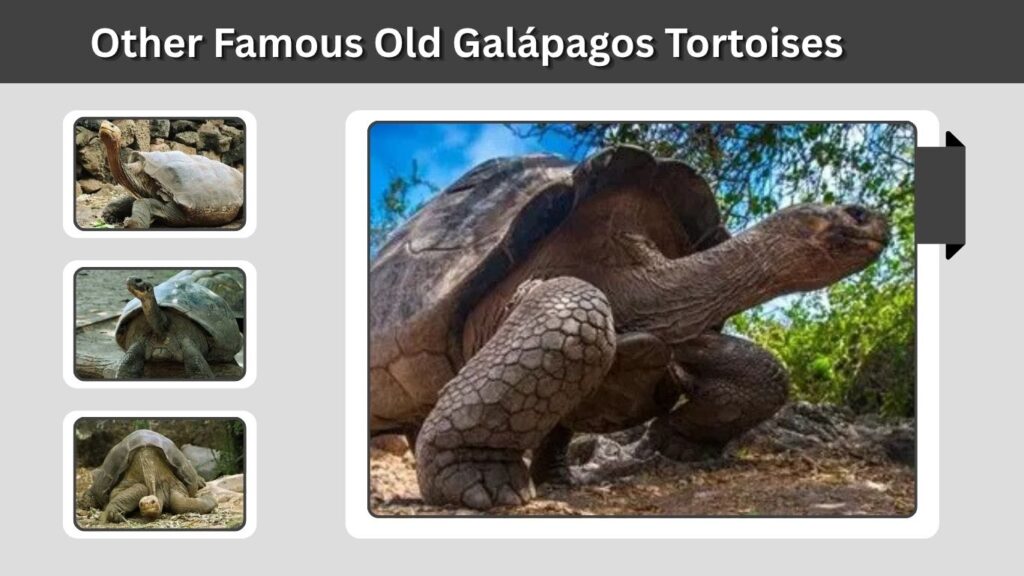
Harriet was not the only Galápagos tortoise known for reaching an exceptional age.
Lonesome George
Lonesome George was the last known pure Pinta Island tortoise. His exact age was uncertain, but he was believed to be more than 100 years old when he died in 2012.
His death made him an international symbol of extinction and the importance of protecting isolated species.
Diego
Diego is an Española giant tortoise famous for his role in restoring his species. He reportedly fathered hundreds of offspring during a captive-breeding program and returned to Española Island in 2020.
He was already more than 100 years old at the time of his return and remained active despite his advanced age.
Gramma
Gramma lived at the San Diego Zoo for many decades and was believed to be approximately 141 years old when she died in 2025. She had arrived at the zoo around 1928 or 1931, although her precise hatching date was unknown.
Why Is Galápagos Tortoise Longevity Important?
The long lifespan of Galápagos tortoises affects how they must be protected. A tortoise may live longer than several generations of scientists, conservation workers and park employees.
However, their longevity does not mean their populations recover quickly. They grow slowly, take years to mature and experience high mortality while young. Conservation programs sometimes raise hatchlings until they are around five years old, when they have a better chance of surviving after release.
Protecting a tortoise population therefore requires planning that may continue for many decades.
FAQs
Who was the oldest Galápagos tortoise ever?
Harriet is generally recognized as the oldest well-documented Galápagos giant tortoise. She lived at Australia Zoo and was estimated to be approximately 175 years old when she died in June 2006.
How old is the oldest living Galápagos tortoise?
No single living Galápagos tortoise currently appears to have a universally accepted and publicly verified age record. Several individuals are older than 100, but incomplete birth records make it difficult to identify the oldest with certainty.
Is Jonathan a Galápagos tortoise?
No. Jonathan is a Seychelles giant tortoise living on Saint Helena. Although he is the oldest known living land animal, he does not hold the record for a Galápagos tortoise.
Was Harriet really Charles Darwin’s tortoise?
Harriet was traditionally associated with Darwin’s voyage, but the story is disputed. Genetic and geographic evidence suggests she came from Santa Cruz Island, which Darwin did not visit. Another expedition member may have collected her.
Can Galápagos tortoises live for 200 years?
Galápagos tortoises can live well beyond 100 years, but a verified lifespan of 200 years has not been clearly documented for this group. Harriet’s estimated 175-year life remains one of the strongest known records.