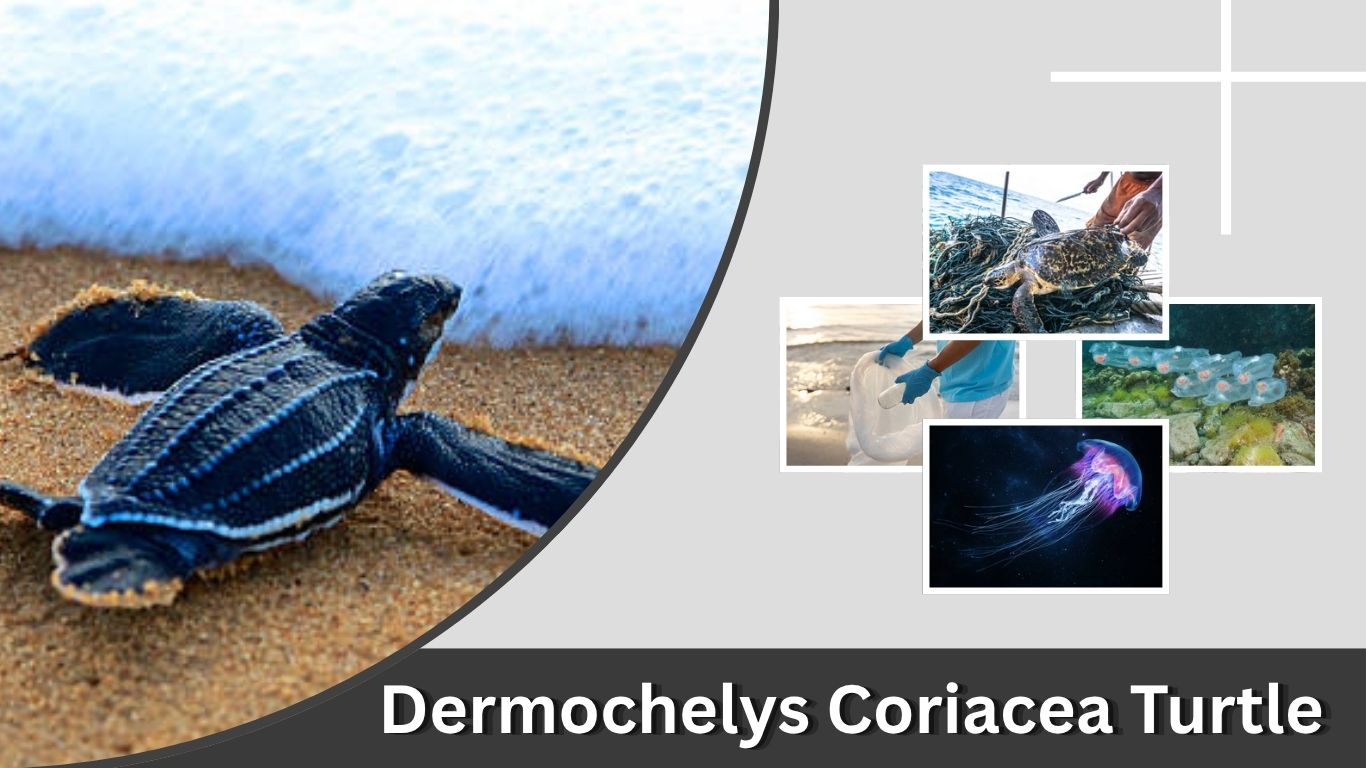
The Dermochelys coriacea turtle is better known by its English name, the leatherback sea turtle. It is the largest living turtle in the world, one of the deepest-diving reptiles, and the only living species in its family, Dermochelyidae. Unlike most turtles, it does not have a hard bony shell. Instead, its back is covered with tough, leathery skin that gives this remarkable sea turtle its common name.
What Is Dermochelys Coriacea?
Dermochelys coriacea is a species of sea turtle and the only living member of the genus Dermochelys. It is also the only surviving species in the family Dermochelyidae, which makes it very different from other modern sea turtles.
Most sea turtles have hard shells made of bony plates covered with scutes. The leatherback sea turtle does not. Its shell is flexible, dark, rubbery, and marked by long ridges running from front to back. This unusual body design helps it swim long distances and dive to impressive depths.
Dermochelys Coriacea English Name
The English name of Dermochelys coriacea is the leatherback sea turtle. It is also sometimes called the leatherback turtle, lute turtle, or leathery turtle.
The name “leatherback” comes from its shell-like back, which feels leathery rather than hard. This is one of the easiest ways to separate it from other sea turtles such as green turtles, loggerheads, hawksbills, and olive ridleys.
Scientific Classification
| Rank | Classification |
|---|---|
| Common name | Leatherback sea turtle |
| Scientific name | Dermochelys coriacea |
| Family | Dermochelyidae |
| Genus | Dermochelys |
| Species | D. coriacea |
| Animal group | Reptile |
| Habitat type | Marine/oceanic |
What Does the Leatherback Turtle Look Like?
The leatherback turtle has a powerful, streamlined body built for ocean travel. Its body is usually dark gray, black, or bluish-black with pale white or pinkish spots. Adults often have a noticeable pink spot on the top of the head.
Instead of a hard shell, the leatherback has a flexible carapace covered by firm, rubber-like skin. This carapace has seven long ridges, also called keels, that run lengthwise along the back. These ridges help water flow smoothly over the body as the turtle swims.
Key Identification Features
You can identify a leatherback sea turtle by these traits:
- Very large body size
- Leathery, flexible shell instead of a hard shell
- Seven ridges along the back
- Dark body with pale spotting
- Long front flippers
- Streamlined, teardrop-shaped body
- Lack of hard scutes on the shell
The leatherback’s front flippers are especially long compared with many other turtles. They help the animal travel across entire oceans during migration.
How Big Is Dermochelys Coriacea?
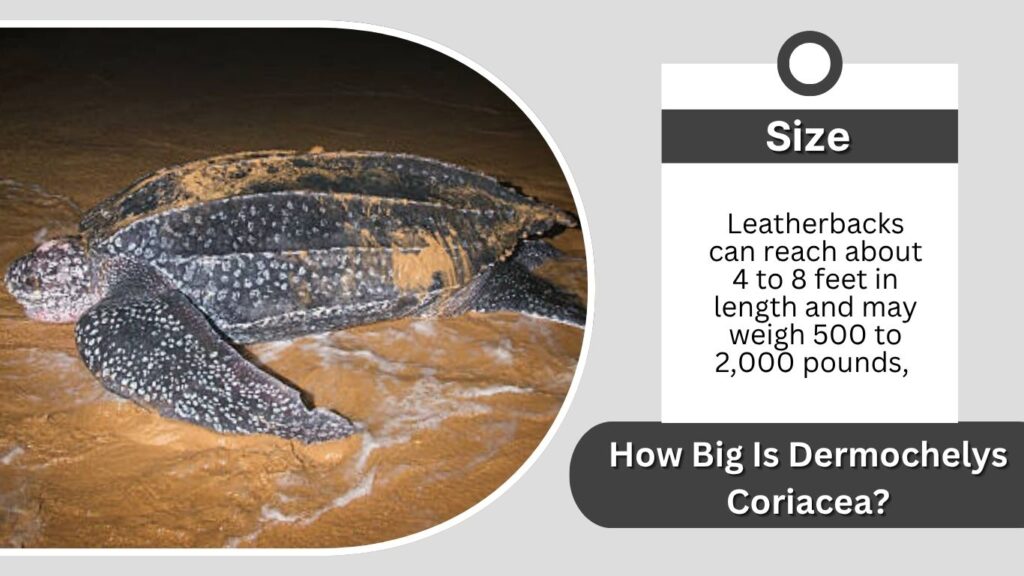
The leatherback is the largest living turtle species. Adult leatherbacks can reach about 4 to 8 feet in length and may weigh 500 to 2,000 pounds, according to the U.S. Fish & Wildlife Service.
NOAA Fisheries also describes leatherbacks as extremely large sea turtles that can grow to more than 6 feet and weigh over 1,000 pounds.
Largest Turtle Ever Recorded
The largest turtle ever recorded was a leatherback sea turtle. Reports of record-sized leatherbacks vary by source, but the species is widely recognized as the largest living turtle and the heaviest non-crocodilian reptile.
This huge size helps leatherbacks survive in open oceans, travel long distances, and dive deep in search of jellyfish. Even newly hatched leatherbacks are built for a difficult ocean life, although they are tiny compared with adults.
Dermochelys Coriacea Distribution
The Dermochelys coriacea distribution is one of the widest of any reptile. Leatherback turtles are found in tropical, subtropical, and temperate oceans around the world. NOAA Fisheries states that leatherbacks have the widest global distribution of any reptile and were once found in every ocean except the Arctic and Antarctic.
They nest mainly on tropical and subtropical beaches, but adults often travel far into cooler waters to feed. Animal Diversity Web notes that leatherbacks are highly migratory and can occur in temperate oceans and even near subarctic waters.
Where Leatherback Turtles Live
Leatherback turtles can be found in:
- Atlantic Ocean
- Pacific Ocean
- Indian Ocean
- Caribbean Sea
- Mediterranean region
- Tropical nesting beaches
- Temperate feeding waters
They spend most of their lives in the ocean. Females come ashore only to nest, while males may never return to land after entering the sea as hatchlings.
Nesting Beaches
Leatherback turtles nest on sandy beaches in warm regions. Females usually return to nesting areas at night, dig a nest in the sand, lay eggs, cover the nest, and return to the ocean.
Important nesting regions include parts of the Caribbean, Central America, South America, West Africa, Southeast Asia, and the western Pacific. Nesting populations vary greatly by region, and some are declining more severely than others.
What Does Dermochelys Coriacea Eat?
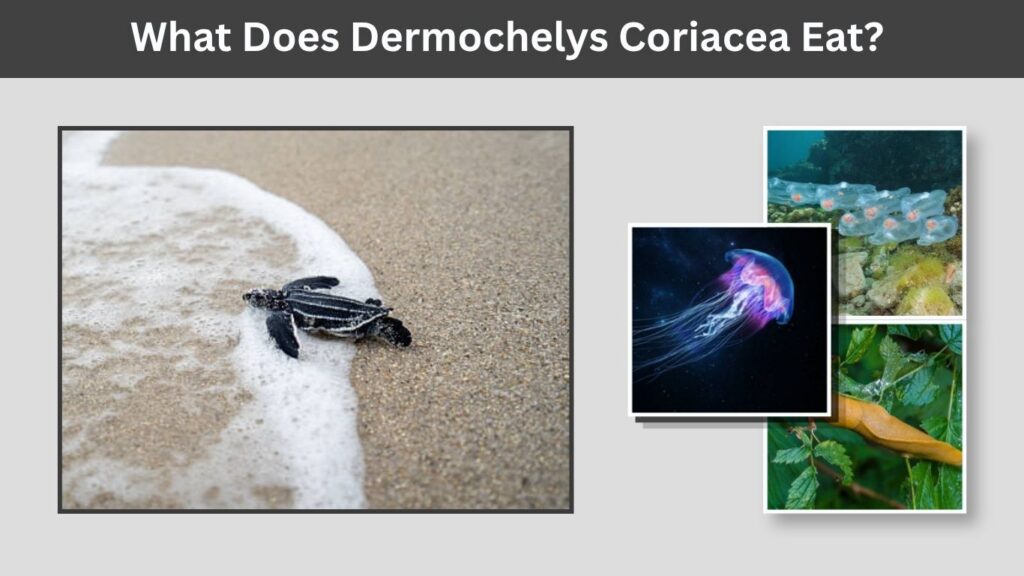
The leatherback sea turtle mainly eats jellyfish and other soft-bodied ocean animals. Its throat and mouth have backward-pointing spines called papillae that help it swallow slippery prey and keep jellyfish from escaping.
This diet makes the leatherback very important in marine ecosystems. By feeding on jellyfish, leatherbacks help balance ocean food webs.
Common Food Sources
Leatherback turtles may eat:
- Jellyfish
- Salps
- Soft-bodied invertebrates
- Other gelatinous marine animals
Because plastic bags and floating trash can look like jellyfish in the water, leatherbacks are especially vulnerable to plastic pollution. Eating plastic can block the digestive system, cause starvation, or lead to death.
Diving and Migration
Leatherback turtles are famous for deep diving and long-distance migration. NOAA Fisheries reports that leatherbacks are accomplished divers, with the deepest recorded dive reaching nearly 4,000 feet.
They migrate between nesting beaches and feeding areas, sometimes crossing entire ocean basins. Their large size, strong flippers, and flexible shell help them handle cold water and deep pressure better than many other reptiles.
Why They Dive So Deep
Leatherbacks dive deeply to search for jellyfish and other prey. Their flexible bodies help them withstand pressure at depth. They can also regulate body temperature better than many reptiles, allowing them to forage in colder waters.
This ability gives them access to food sources that many other sea turtles cannot use.
Is Dermochelys Coriacea a Turtle or Tortoise?
Dermochelys coriacea is a turtle, not a tortoise. More specifically, it is a sea turtle.
Turtles and tortoises are related reptiles, but they are adapted to different environments. Tortoises are mainly land-dwelling and have sturdy legs for walking. Sea turtles are adapted for life in the ocean and have flippers for swimming.
Leatherback Turtle vs Tortoise
A leatherback turtle differs from a tortoise in several ways:
- Leatherbacks live in the ocean; tortoises live on land.
- Leatherbacks have flippers; tortoises have thick walking legs.
- Leatherbacks are strong swimmers; tortoises are not.
- Leatherbacks nest on beaches but spend most of life at sea.
- Leatherbacks have a flexible leathery shell; tortoises have hard domed shells.
So, if someone asks whether Dermochelys coriacea is a turtle or tortoise, the correct answer is that it is a sea turtle.
Conservation Status of Dermochelys Coriacea
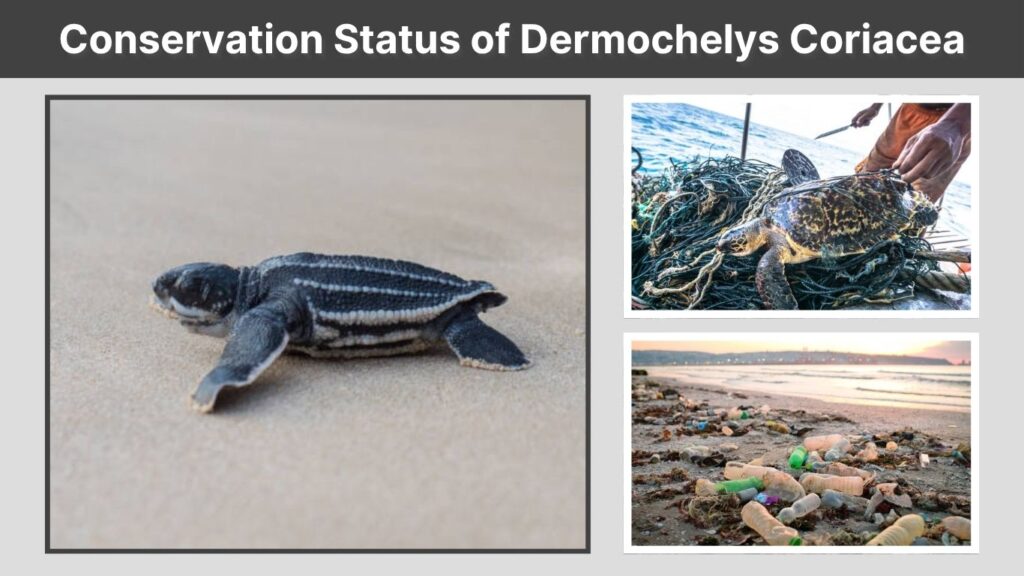
The leatherback sea turtle is a protected species in many parts of the world. Its global IUCN Red List status is listed as Vulnerable, but several regional subpopulations are more threatened, including some that are Critically Endangered.
NOAA Fisheries notes that leatherback populations are rapidly declining in many areas and face threats both on nesting beaches and in the marine environment.
Main Threats
Leatherback turtles face many human-related threats, including:
- Accidental capture in fishing gear
- Plastic pollution
- Egg collection
- Coastal development
- Beach erosion
- Artificial lighting near nesting beaches
- Boat strikes
- Climate change
- Loss of nesting habitat
Fishing bycatch is one of the most serious threats. Leatherbacks can become entangled in nets, lines, and other fishing gear. Because they must surface to breathe, entanglement can lead to drowning.
Why Climate Change Matters
Climate change affects leatherback turtles in several ways. Rising sea levels can flood nesting beaches. Stronger storms can wash away nests. Warmer sand temperatures can affect hatchling sex ratios, because sea turtle sex is influenced by nest temperature.
This means climate change may not only reduce nesting success but also affect future population balance.
Why Leatherback Sea Turtles Matter
Leatherback turtles are important because they help maintain healthy ocean ecosystems. By feeding on jellyfish, they help control jellyfish populations. They also connect distant marine habitats through migration.
Their survival matters not only because they are ancient and unique, but also because they are part of the ocean’s natural balance.
Ecological Importance
Leatherbacks support marine ecosystems by:
- Controlling jellyfish numbers
- Moving nutrients between ocean regions
- Supporting beach ecosystems through nesting
- Serving as indicators of ocean health
A decline in leatherback turtles can signal broader problems in the marine environment, including pollution, overfishing, and habitat loss.
How People Can Help Leatherback Turtles
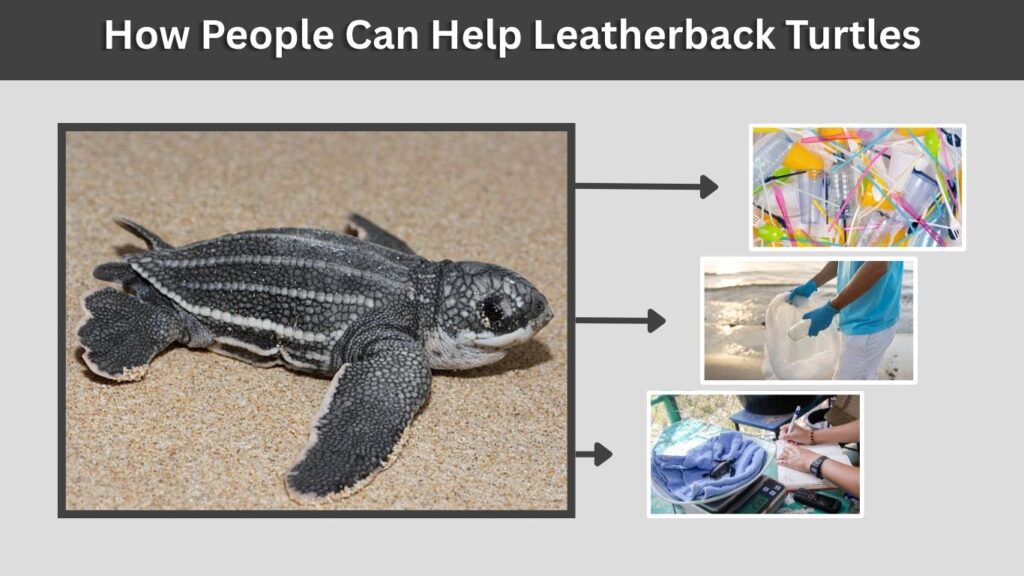
Protecting leatherback turtles requires action on beaches, in fisheries, and across oceans. Governments, conservation groups, fishers, coastal communities, and individuals all play a role.
Simple Ways to Help
You can help leatherback turtles by:
- Reducing single-use plastics
- Keeping beaches clean
- Avoiding disturbance of nesting turtles
- Turning off bright beach lights during nesting season
- Supporting sustainable seafood choices
- Reporting injured or stranded sea turtles to local authorities
- Supporting turtle conservation programs
Never touch, ride, disturb, or shine lights directly on nesting sea turtles. If you see a nesting turtle, watch quietly from a distance and follow local wildlife rules.
FAQs
What is the English name of Dermochelys coriacea?
The English name of Dermochelys coriacea is the leatherback sea turtle. It is also commonly called the leatherback turtle. The name comes from its unusual leathery shell, which is softer and more flexible than the hard shells of most other turtles.
Is Dermochelys coriacea the largest turtle?
Yes, Dermochelys coriacea is the largest living turtle species. Adult leatherbacks can grow several feet long and weigh hundreds to thousands of pounds. Their huge size, long flippers, and streamlined bodies help them migrate across oceans and dive deeply for food.
What family is Dermochelys coriacea in?
Dermochelys coriacea belongs to the family Dermochelyidae. It is the only living species in that family and the only living species in the genus Dermochelys. This makes the leatherback very different from other modern sea turtles.
Where is Dermochelys coriacea found?
Dermochelys coriacea has a very wide distribution and is found in many tropical, subtropical, and temperate oceans. It nests mainly on warm sandy beaches but may travel into cooler waters to feed. It is one of the most widely distributed reptiles in the world.
Is Dermochelys coriacea endangered?
Globally, the leatherback sea turtle is listed as Vulnerable, but several regional populations are more seriously threatened. Some subpopulations are listed as Critically Endangered. Major threats include fishing bycatch, plastic pollution, nesting beach loss, egg collection, and climate change.