The Galápagos tortoise is one of the largest tortoises in the world. A full-grown male may weigh more than 500 pounds (227 kilograms), while females generally weigh much less. Large individuals can have shells measuring several feet long, making them comparable in weight to a large motorcycle or a small pony.
However, Galápagos tortoise size varies by sex, species, island, habitat, and shell type. Domed tortoises are generally larger and heavier than saddleback tortoises.
How Big Is a Galápagos Tortoise?
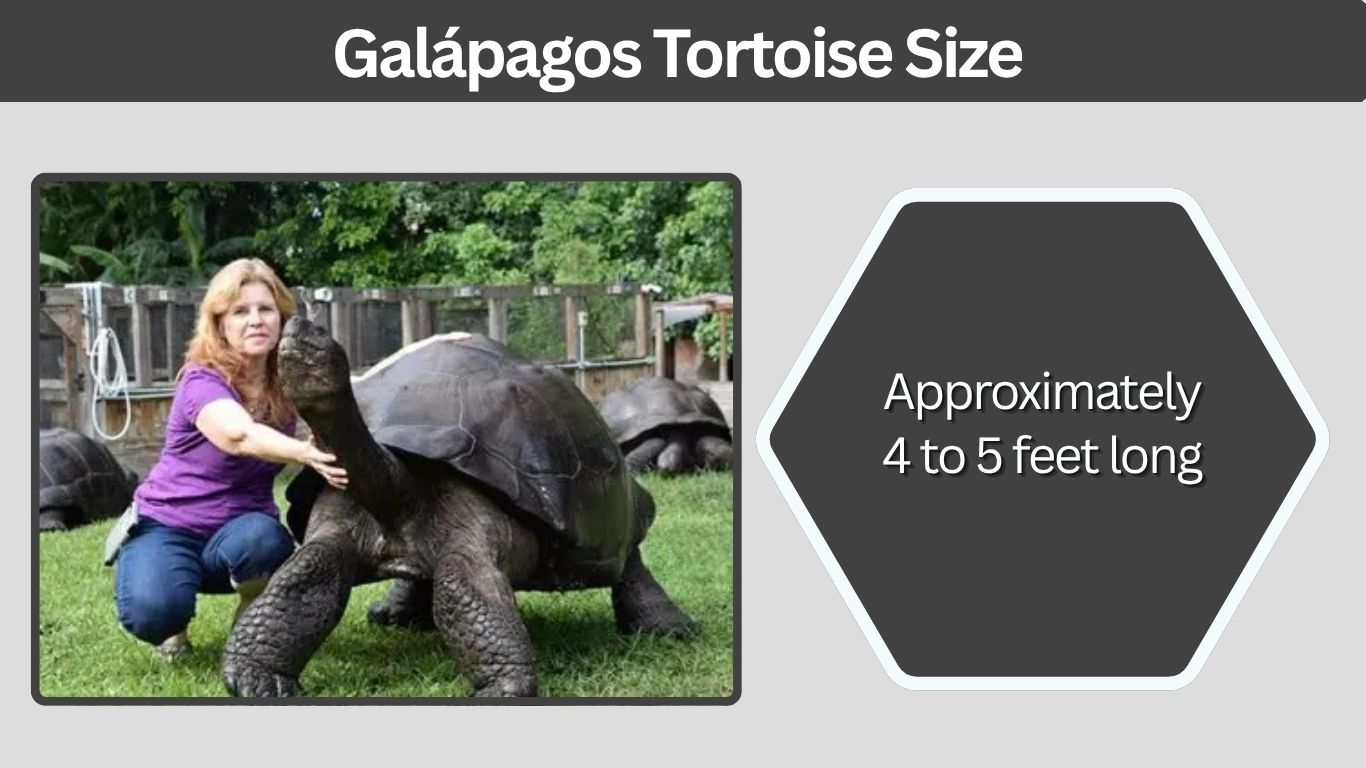
An adult Galápagos tortoise may measure approximately 4 to 5 feet long, although exceptionally large shells can approach 6 feet. Large animals can reach around 3 feet in height when standing normally and appear even taller when stretching their necks upward.
Adult males commonly weigh between 300 and 500 pounds, while particularly large males can exceed 500 pounds. Females are smaller and average approximately 250 pounds
| Measurement | Typical adult size |
| Body or shell length | About 4–5 feet |
| Maximum reported shell length | Nearly 6 feet |
| Adult male weight | Approximately 300–500+ pounds |
| Average female weight | About 250 pounds |
| Standing height | Roughly 2–3 feet |
| Lifespan | Commonly more than 100 years |
These numbers describe the general size range. Individual tortoises may be considerably smaller or larger.
Galápagos Tortoise Size and Weight

Weight is often the easiest way to understand how massive a Galápagos giant tortoise can become.
Male Galápagos Tortoise Size
Males are considerably larger than females. Mature males may weigh more than 500 pounds, or 227 kilograms. Their bodies are supported by thick, heavily scaled legs that resemble small elephant legs.
A large male may weigh about as much as:
- Three average adult people
- A large motorcycle
- A vending machine
- A small pony
- Four or five large dogs
Some sources report exceptional Galápagos tortoises weighing substantially more than the usual 500-pound figure. However, weights near 900 pounds represent unusual historical extremes rather than the normal size of a living adult.
Female Galápagos Tortoise Size
Females are normally smaller and lighter than males. An adult female averages around 250 pounds (113 kilograms), although weight varies by population and physical condition.
Females also tend to have shorter tails and more compact bodies. Their smaller size helps distinguish them from adult males, although sex cannot always be identified by size alone.
Galápagos Tortoise Size Comparison With a Human
A large Galápagos tortoise is shorter than an adult person but may be much heavier. Its shell can reach approximately waist height, while its extended head and neck may rise higher.
| Feature | Galápagos tortoise | Average adult human |
| Height | Around 2–3 feet normally | Around 5–6 feet |
| Length | Around 4–5 feet | Around 5–6 feet tall |
| Weight | 250–500+ pounds | Around 130–200 pounds |
| Lifespan | Often over 100 years | Roughly several decades |
A large male can weigh two or three times as much as an average adult person. However, its weight is distributed across a broad shell and four thick legs, giving it a low and powerful appearance.
How Large Is a Full-Size Galápagos Tortoise?
A Galápagos tortoise reaches full size very slowly. These reptiles continue growing for many years, and their growth rate depends on food, rainfall, habitat, genetics, and health.
A fully grown male may have:
- A shell several feet long
- A body weighing more than 500 pounds
- Thick legs capable of supporting tremendous weight
- A long neck for reaching vegetation
- A broad or raised shell depending on its species
Galápagos Conservancy notes that giant tortoises can weigh more than 550 pounds, demonstrating the exceptional size achieved by large adults.
Growth slows greatly after maturity, but a tortoise’s body and shell may continue changing gradually throughout its long life.
How Big Is a Baby Galápagos Tortoise?
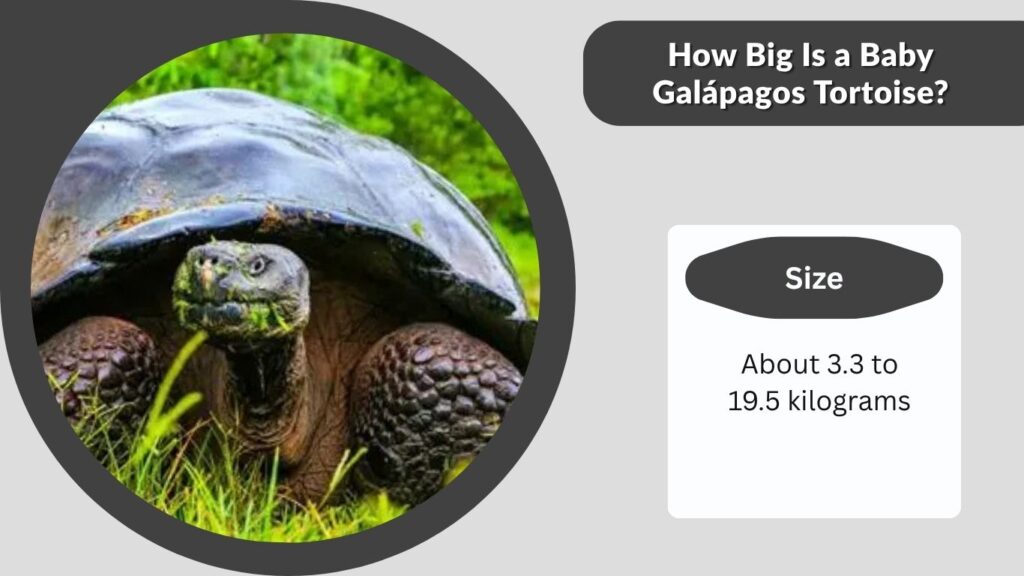
Galápagos tortoise hatchlings are surprisingly small compared with adults. A newly hatched tortoise is generally small enough to fit in a person’s hand and may measure only a few inches long.
The babies emerge from eggs roughly comparable in size to a tennis ball. Their shells are initially softer and become stronger as they grow and absorb calcium.
Young tortoises remain vulnerable to:
- Rats
- Pigs
- Feral cats
- Birds
- Drought
- Habitat disturbance
Conservation centers sometimes raise young tortoises in protected conditions until they become large enough to resist many introduced predators. Historical Galápagos research recorded young tortoises ranging from about 3.3 to 19.5 kilograms, with substantial size differences during their early years.
It may take several decades for a young tortoise to approach its full adult size.
Domed vs. Saddleback Tortoise Size
Galápagos tortoises have different shell shapes associated with their habitats and feeding strategies.
Domed Tortoises
Domed tortoises have large, rounded shells. They generally live in wetter environments where grasses and other vegetation grow near the ground.
They tend to be:
- Larger and heavier
- Broad-bodied
- Strongly built
- Adapted for grazing
- Equipped with relatively shorter necks
The largest Galápagos tortoises usually belong to the domed forms.
Saddleback Tortoises
Saddleback tortoises have shells that rise at the front, creating an opening around the neck. This shape allows them to extend their necks higher to reach cactus pads, leaves, and other elevated vegetation.
They tend to be:
- Smaller and lighter
- More upright while feeding
- Longer-necked
- Adapted to dry islands
- Less heavily built than domed tortoises
These differences show how habitat and food availability influenced tortoise body shape over generations.
Galápagos Tortoise Shell Size
The shell is the most visually impressive part of a Galápagos tortoise. Large shells may measure around 4 to 5 feet long, and exceptional examples may approach 6 feet in length and 4 feet across.
Despite its huge appearance, the shell is not a solid block of bone. It contains a lighter internal structure that reduces weight while maintaining strength.
The shell consists of two principal sections:
- Carapace: The upper shell
- Plastron: The lower shell
The ribs and spine are permanently connected to the shell, so a tortoise cannot leave it. The outer surface is covered with keratin plates called scutes.
Shell size and shape differ among island populations. Food availability, rainfall, elevation, and evolutionary history all contribute to these variations.
Aldabra vs. Galápagos Tortoise Size
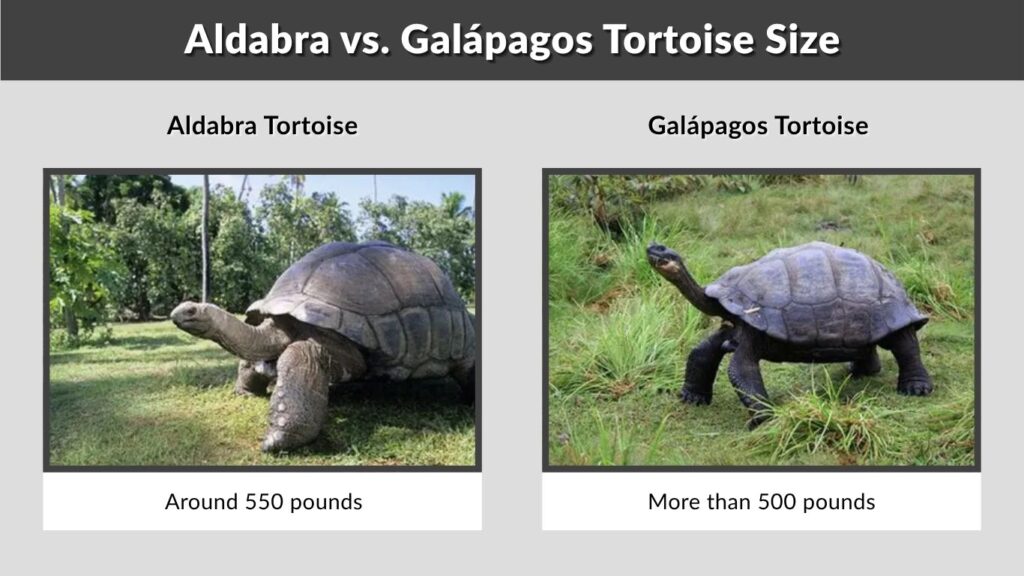
Galápagos and Aldabra tortoises are the two best-known groups of living giant tortoises. They are similar in size, but their average measurements vary.
| Feature | Galápagos tortoise | Aldabra tortoise |
| Large male weight | More than 500 pounds | Around 550 pounds on average |
| Female weight | Around 250 pounds on average | Around 351 pounds on average |
| Shell length | Commonly 4–5 feet | Around 4 feet in large males |
| Native range | Galápagos Islands | Seychelles |
Male Aldabra tortoises reportedly average approximately 550 pounds and have shells around 48 inches long. Females average about 351 pounds and 36 inches in shell length.
Neither group is always larger in every comparison. Individual Galápagos tortoises may exceed many Aldabra tortoises, while large Aldabra males may outweigh typical Galápagos adults.
Why Did Galápagos Tortoises Become So Large?
Island gigantism is the evolutionary process in which island animals become much larger than their mainland relatives.
Several factors may have contributed to Galápagos tortoise size:
Limited Adult Predators
Historically, full-grown tortoises had few natural predators in the Galápagos. Their isolation allowed them to grow large without needing speed or agility to escape major land predators.
Competition for Food
A large body and long neck help tortoises reach different plants and travel between feeding areas. Bigger animals can also store more water and energy during periods of scarcity.
Long Lifespan
Galápagos tortoises grow slowly and may live for more than a century. Their extended growth period allows them to reach enormous sizes.
Island Isolation
Populations became isolated on different islands and volcanoes. Over many generations, each population developed body sizes and shell shapes suited to its particular environment.
Does Large Size Help Galápagos Tortoises Survive?
Their large size offers several advantages. Adult tortoises can store substantial amounts of water and energy, allowing them to endure dry periods. Their height and long necks provide access to plants that smaller animals may not reach.
Large size also protects adults from most natural predators. A fully grown tortoise has a heavy shell and powerful legs, making it difficult for another animal to attack.
However, being enormous also creates challenges. Giant tortoises need considerable habitat, mature slowly, and cannot quickly escape roads, fires, or human disturbance.
Is the Galápagos Tortoise the Largest Tortoise?
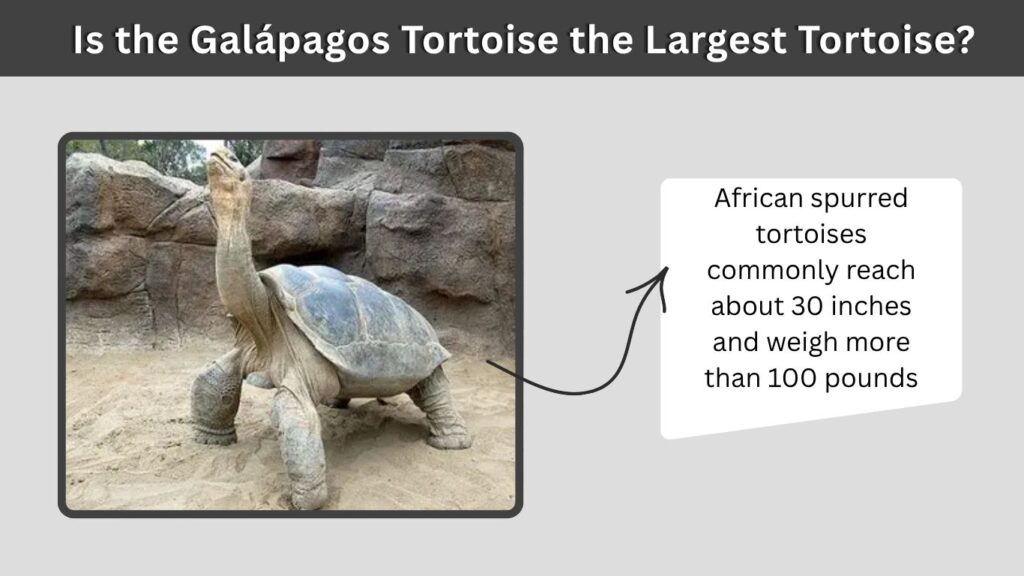
Galápagos tortoises are among the world’s largest living tortoises. Together with Aldabra giant tortoises, they greatly exceed the size of mainland species such as the African spurred tortoise.
For comparison, African spurred tortoises commonly reach about 30 inches and weigh more than 100 pounds, while some males reach 200 pounds. Galápagos males may exceed 500 pounds.
The heaviest individual records are difficult to compare because some are historical, estimated, or based on exceptionally overweight captive animals.
FAQs
What is the average size of a Galápagos tortoise?
Adult size varies by species and sex. Females average approximately 250 pounds, while males may weigh 300 to more than 500 pounds. Large adults commonly measure around 4 to 5 feet long, although exceptional shells may be longer.
How tall is a Galápagos giant tortoise?
A large tortoise may stand roughly 2 to 3 feet high at the shell. Its head can rise higher when it stretches its long neck upward to reach leaves or cactus pads.
Is a Galápagos tortoise bigger than a human?
It is usually shorter than a human but can be much heavier. A large male weighing more than 500 pounds may weigh two or three times as much as an average adult person.
How big is a newborn Galápagos tortoise?
A hatchling is only a few inches long and can often fit in a person’s hand. Despite their enormous adult size, young tortoises begin life small and vulnerable and require many years to become large.
Are Galápagos tortoises bigger than Aldabra tortoises?
They are broadly similar in size. Large individuals from either group may outweigh typical members of the other. Aldabra males average about 550 pounds, while large Galápagos males can exceed 500 pounds.