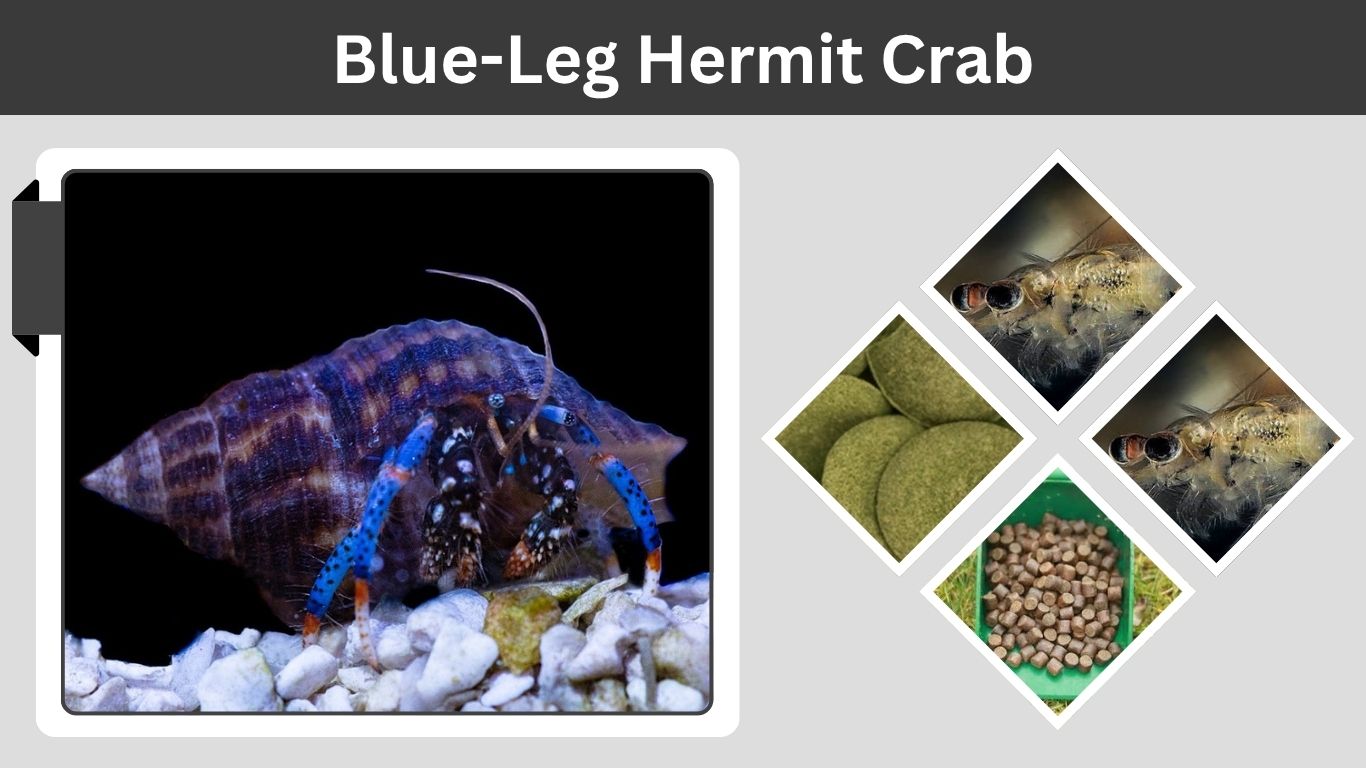
The blue-leg hermit crab is a small marine crustacean commonly kept as part of a saltwater aquarium’s cleanup crew. Its bright blue legs, orange antennae, active scavenging, and compact size make it popular with reef keepers. Although generally easy to maintain, it still needs stable water, sufficient food, hiding places, and spare shells. It may also attack snails or other hermit crabs when food or suitable shells are limited.
What Is a Blue-Leg Hermit Crab?
The blue-leg hermit crab’s accepted scientific name is Clibanarius tricolor. It is also called the blue-legged hermit crab, tricolor hermit crab, dwarf blue hermit, or equal-handed hermit crab. It belongs to the family Diogenidae and is a true marine species—not a freshwater or land hermit crab.
Identification
You can identify a blue-leg hermit crab by its:
- Bright blue legs with darker or reddish bands
- Orange or reddish antennae
- Small, similarly sized claws
- Dark body with blue highlights
- Borrowed snail shell
- Small overall body size
The species occurs naturally in the tropical western Atlantic, including Florida, the Gulf of Mexico, and the Caribbean. It is associated with shallow rocky areas, rubble, and intertidal habitats where it searches for algae and organic matter.
How Big Do Blue-Leg Hermit Crabs Get?
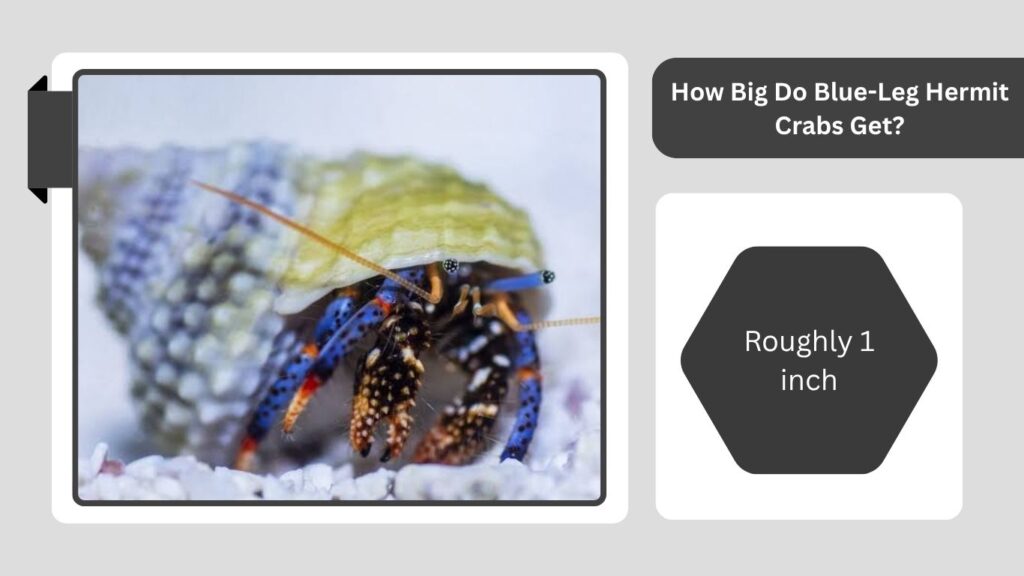
Blue-leg hermit crabs are among the smaller hermit crabs found in marine aquariums. Adults are commonly described as reaching roughly 1 inch, although the animal may appear larger depending on the shell it occupies. The shell should not be used as the only measurement of the crab’s body size.
Their compact size allows them to search between rocks, around coral bases, and across the substrate. However, even a small hermit crab may move loose coral fragments or irritate coral polyps by crawling over them.
How Many Legs Does a Hermit Crab Have?
A hermit crab has five pairs of legs, giving it ten leg-like appendages in total. However, not all ten are normally visible.
| Leg pair | Primary function |
| First pair | Claws used for feeding and defense |
| Second pair | Walking |
| Third pair | Walking |
| Fourth pair | Holding and moving within the shell |
| Fifth pair | Anchoring and maintaining the shell interior |
The two rear pairs are reduced and remain largely hidden inside the shell. This is why a healthy hermit crab may appear to have only six obvious legs when its claws are included.
Blue-Leg Hermit Crab Care
Blue-leg hermit crabs are often considered hardy, but they should only be introduced into a properly cycled marine aquarium. They depend on stable saltwater conditions and should never be placed in an unheated freshwater bowl.
Water Requirements
A suitable aquarium should maintain approximately:
- Temperature: 75–82°F or 24–28°C
- Specific gravity: 1.023–1.025
- pH: approximately 8.1–8.2
- Ammonia: 0 ppm
- Nitrite: 0 ppm
- Nitrate: kept low and stable
- Adequate calcium and alkalinity
Rapid changes in salinity, temperature, or pH can stress marine invertebrates. Ammonia is toxic to invertebrates, while high nitrate levels may also harm sensitive reef animals. Regular testing is more reliable than assuming clear-looking water is safe.
Nitrate Tolerance
There is no dependable species-specific nitrate level that should be treated as a maximum tolerance test. General marine-aquarium guidance recommends keeping ammonia and nitrite at zero and nitrate around 5–10 mg/L for aquariums containing invertebrates, depending on the other species present. Stability and gradual correction are safer than sudden parameter changes.
Copper Warning
Never use copper-based medications in an aquarium containing blue-leg hermit crabs. Copper can be deadly to marine invertebrates, even when a treatment is safe for certain fish. Move fish requiring copper treatment to a separate hospital aquarium rather than dosing the reef tank.
What Do Blue-Leg Hermit Crabs Eat?
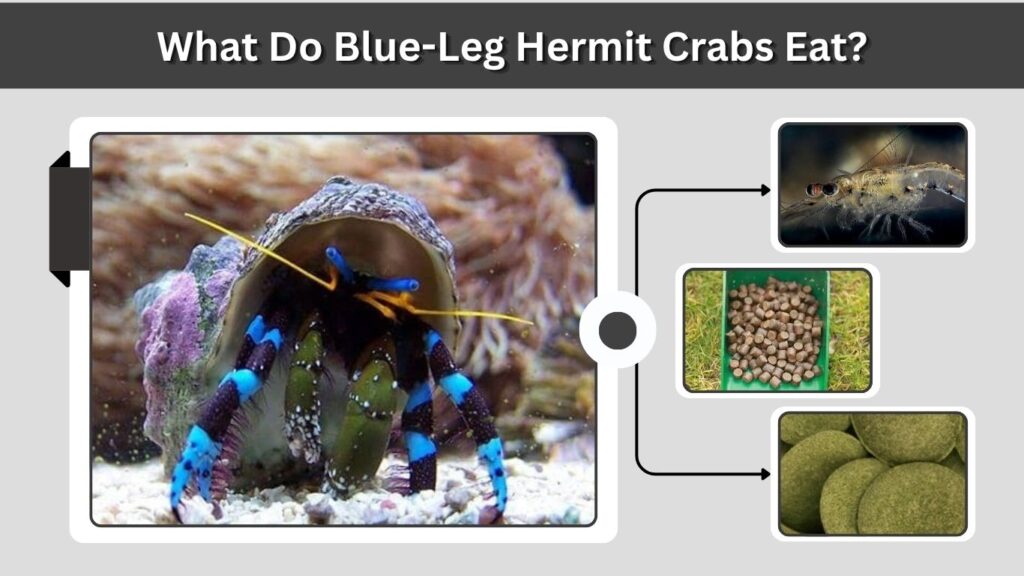
Blue-leg hermit crabs are omnivorous scavengers. They graze on algae and consume detritus, uneaten fish food, and other edible organic material found on rocks and substrate. However, they should not be expected to survive only on waste.
Suitable Foods
A blue-leg hermit crab may eat:
- Green hair algae
- Other soft algae growth
- Marine algae wafers
- Sinking crustacean pellets
- Mysis shrimp
- Small pieces of unseasoned seafood
- Leftover fish food
- Detritus and dead organic matter
Provide supplemental food when the aquarium is extremely clean or does not contain enough natural algae. Feeding small portions after the lights dim may help because this species is often more active at night. Remove uneaten food before it decomposes and lowers water quality.
Are Blue-Leg Hermit Crabs Reef Safe?
Blue-leg hermit crabs are usually sold as reef-safe cleanup animals. They commonly graze algae without deliberately eating healthy coral tissue. However, “reef safe” does not mean completely harmless.
A crab may walk across coral polyps, knock over unsecured fragments, steal food from corals, or fight with other invertebrates. Coral polyps may temporarily close when a crab crawls over them.
Do They Attack Snails?
Blue-leg hermit crabs sometimes attack snails or other hermit crabs to obtain their shells. This risk increases when correctly shaped empty shells are unavailable.
Keep several clean, natural shells in different sizes near the crab’s preferred area. Shell openings should be slightly larger than its current shell, with several shapes available. Spare shells reduce competition, but they cannot guarantee that every snail will be safe.
Do They Eat Coral?
They are not normally considered coral eaters. Apparent “coral eating” may actually be the crab picking algae, trapped food, or dying tissue from the coral’s surface. Nevertheless, a crab repeatedly damaging or disturbing a particular coral may need to be moved.
Blue-Leg Hermit Crab Molting
A blue-leg hermit crab must periodically shed its exoskeleton to grow. During molting, the new covering is soft, leaving the crab vulnerable to fish, shrimp, and other crabs.
A molting crab may hide deeply within rockwork or remain unusually inactive. The empty exoskeleton can look like a dead crab, especially because it may include complete-looking legs and claws. Do not immediately remove it; the crab may eat portions to recover minerals.
Crustaceans can also regenerate lost limbs through successive molts. A replacement leg may initially be smaller and require several molts to approach its normal size.
Why Is My Hermit Crab Losing Legs?
Leg loss is not a normal part of every molt. A hermit crab may lose a limb because of:
- Fighting with another crab
- Attack by a fish or other tank inhabitant
- Poor water quality
- Sudden salinity or temperature changes
- Copper or chemical exposure
- Injury during handling
- Severe stress
- An unsuccessful molt
Test the aquarium immediately for ammonia, nitrite, nitrate, salinity, pH, and temperature. Check for aggressive tank mates and provide food, cover, and spare shells. A single lost leg may regenerate, but several legs falling off can indicate a serious environmental or health problem.
Blue-Leg vs. Red-Leg Hermit Crab
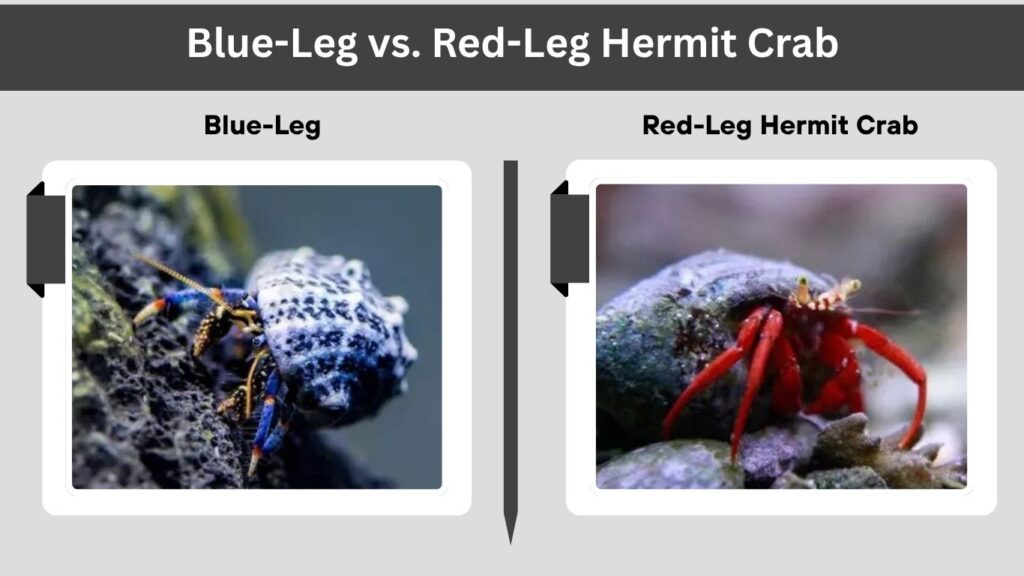
Both types are commonly used as marine cleanup animals, but their exact identity can vary among aquarium retailers.
| Feature | Blue-leg hermit crab | Red-leg hermit crab |
| Typical leg color | Blue with darker or red bands | Red, orange, or reddish brown |
| Common species name | Clibanarius tricolor | May refer to several species |
| Size | Small, often around 1 inch | Depends on the species |
| Diet | Algae and organic debris | Algae and organic debris |
| Reef safety | Generally safe with caution | Generally safe with caution |
| Snail risk | May attack for shells | May attack for shells |
The blue-leg crab’s scientific identity is relatively consistent, while “red-leg hermit crab” is a broad trade name. Confirm the scientific name before purchasing because adult size and temperament may differ.
FAQs
Can blue-leg hermit crabs live in freshwater?
No. Clibanarius tricolor is a marine species and requires a properly maintained saltwater aquarium. Placing one in freshwater can cause severe osmotic stress and death. It should not be confused with terrestrial hermit crabs that use both freshwater and saltwater dishes.
How many blue-leg hermit crabs should be kept per gallon?
There is no reliable universal number. Stock according to available algae, aquarium maturity, shell availability, and the other animals present. Begin with only a few crabs and add more only when the tank produces enough natural food to support them.
How long do blue-legged hermit crabs live?
Published aquarium estimates vary, and individual survival depends heavily on water quality, diet, predation, acclimation, and molting success. Rather than relying on a fixed lifespan, provide stable water, varied food, safe tank mates, and enough shells.
Do blue-legged hermit crabs eat hair algae?
Yes, they may graze green hair algae and other soft growth. However, they may not eliminate a serious outbreak. Excess nutrients, overfeeding, unsuitable lighting, and poor maintenance must also be corrected to control persistent algae.
Can a blue-leg hermit crab grow its legs back?
Yes. Like other crustaceans, it can regenerate a lost limb through molting. The first replacement may be smaller than the original leg, and additional molts may be required for it to regain a more normal size.