
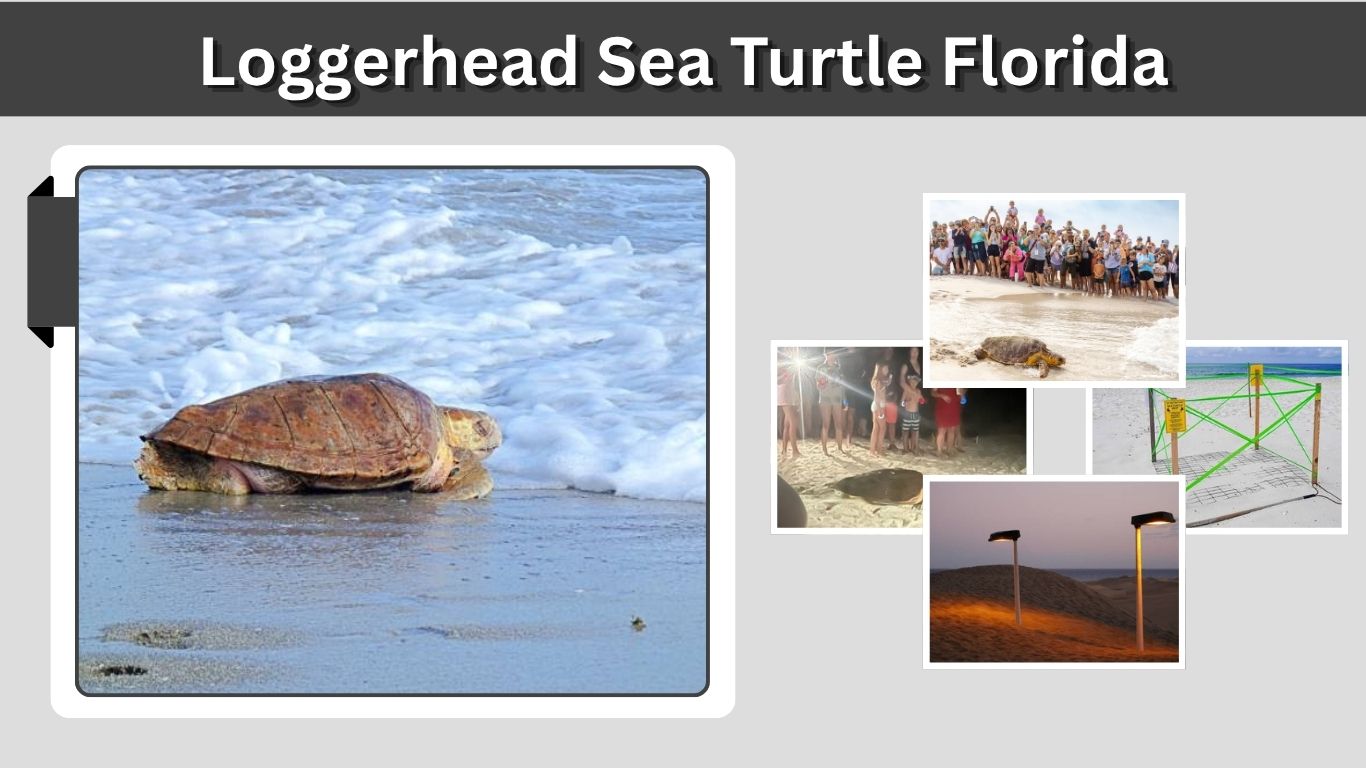
The loggerhead sea turtle is one of Florida’s most important and recognizable marine animals. Every year, thousands of loggerheads come to Florida beaches to nest, making the state one of the most significant nesting areas for this species in the world. From the Atlantic coast to the Gulf and the Florida Keys, these turtles play a major role in Florida’s coastal ecosystem and conservation story.
Loggerhead Sea Turtles in Florida
Loggerhead sea turtles are large marine reptiles known for their broad heads, strong jaws, and reddish-brown shells. Their powerful jaws help them crush hard-shelled prey such as crabs, conchs, whelks, and other marine animals.
Florida is especially important for loggerheads because many adult females return to the state’s sandy beaches to lay eggs. Some beaches may hold hundreds or thousands of nests during a strong nesting season. Although loggerheads spend most of their lives in the ocean, their survival depends heavily on safe nesting beaches.
In Florida waters, loggerheads may be seen near reefs, bays, coastal waters, seagrass beds, and offshore habitats. They are not limited to one region of the state, but nesting is especially concentrated along parts of the Atlantic coast.
Loggerhead Sea Turtle Identification in Florida
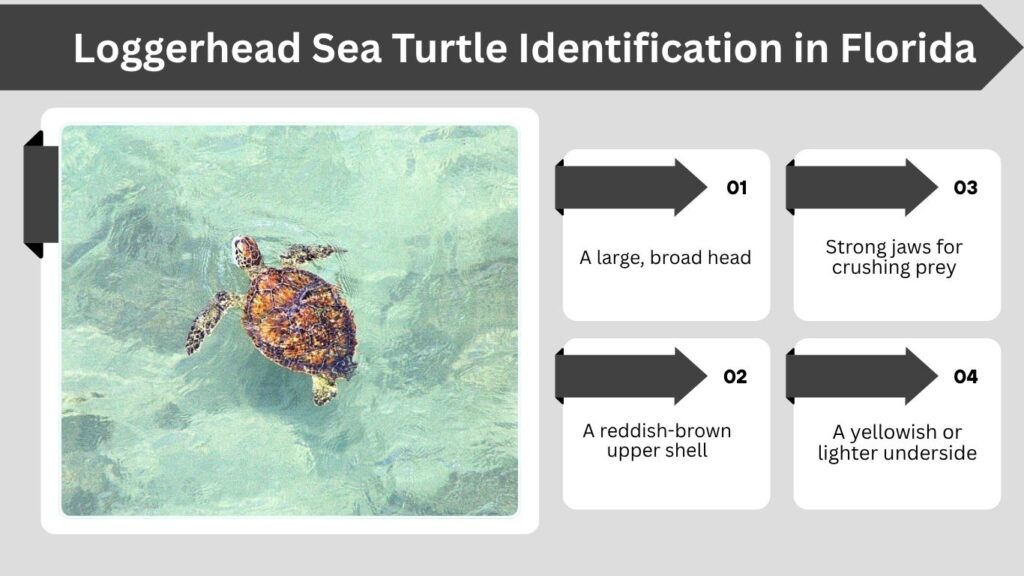
A loggerhead sea turtle can often be identified by its large head and strong, muscular jaws. Adults usually have a reddish-brown upper shell and a lighter underside. Compared with green sea turtles, loggerheads tend to have a larger head and a more robust appearance.
Loggerheads can be confused with other Florida sea turtles, especially by people who see them briefly in the water. Florida is also home to green turtles, leatherbacks, Kemp’s ridleys, and hawksbills. Each species has different shell shapes, head sizes, and feeding habits.
Common Loggerhead Features
Loggerhead sea turtles often have:
- A large, broad head
- Strong jaws for crushing prey
- A reddish-brown upper shell
- A yellowish or lighter underside
- A heart-shaped or slightly elongated shell
- Powerful front flippers for swimming
If you see a sea turtle on the beach in Florida, never try to touch, move, or identify it closely. Keep your distance and contact local wildlife officials if the turtle appears injured, stranded, or in danger.
Loggerhead Sea Turtle Nesting in Florida
Loggerhead sea turtle nesting in Florida is one of the state’s most important wildlife events. Females crawl onto sandy beaches at night, dig nest cavities with their rear flippers, lay eggs, cover the nest, and return to the ocean.
Florida’s beaches support a major share of loggerhead nesting in the Northwest Atlantic. The east coast of Florida is especially important, with many nests recorded in counties such as Brevard, Indian River, St. Lucie, Martin, and Palm Beach.
A female loggerhead may lay several nests in one season. Each nest can contain around 100 or more eggs. After incubation, hatchlings emerge from the sand and crawl toward the ocean, usually at night.
Loggerhead Sea Turtle Nesting Season Florida
Loggerhead sea turtle nesting season in Florida generally runs from spring through fall. In many areas, sea turtle nesting season is recognized from March through October, although exact timing can vary by location and year.
Nesting activity usually increases as the weather warms. Hatchlings often begin emerging later in the season after weeks of incubation in the sand. During this period, beaches need to remain dark, clean, and free of obstacles.
Beachfront lights are a major problem because they can confuse nesting females and hatchlings. Hatchlings naturally move toward the brightest horizon, which should be the ocean. Artificial lights can lead them inland, where they may die from exhaustion, dehydration, predators, or vehicles.
Loggerhead Sea Turtle Hatching in Florida
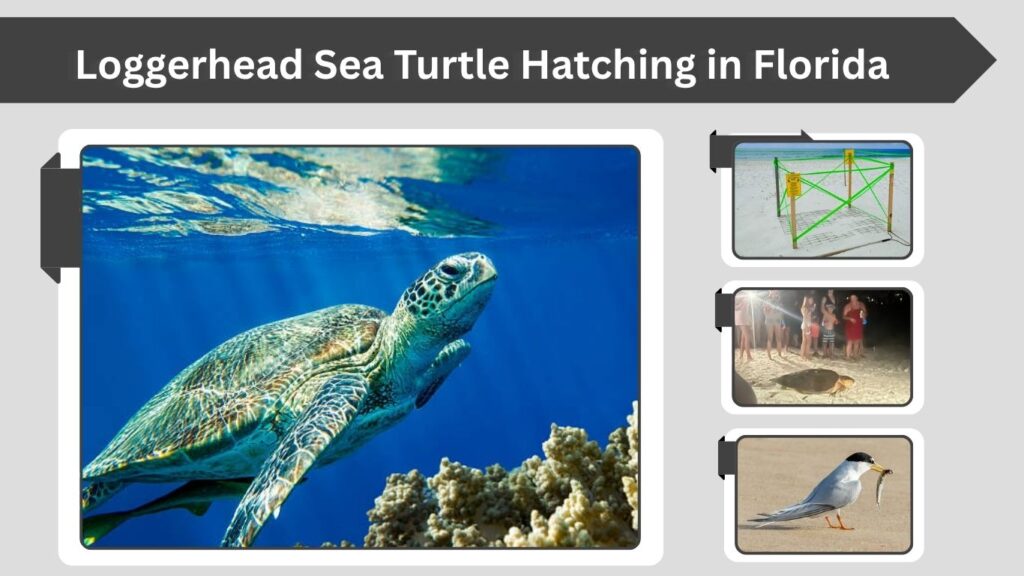
Loggerhead sea turtle hatching in Florida is a delicate process. After the eggs incubate under the sand, hatchlings work together to climb out of the nest. They usually emerge at night when temperatures are cooler and predators may be less active.
Once above the sand, hatchlings move toward the ocean. This journey is dangerous. Birds, crabs, raccoons, fish, artificial lighting, beach furniture, and holes in the sand can all reduce their chances of survival.
How Beachgoers Can Help Hatchlings
You can help loggerhead hatchlings by:
- Turning off beach-facing lights at night
- Removing chairs, umbrellas, and tents from the sand
- Filling holes and flattening sandcastles
- Keeping dogs away from marked nests
- Never touching hatchlings or eggs
- Avoiding flashlights and flash photography
- Respecting marked nest areas
Small actions by beach visitors can make a big difference during nesting and hatching season.
Loggerhead Sea Turtle Population in Florida
Florida has one of the largest loggerhead nesting populations in the world. Nest numbers can vary from year to year because of environmental conditions, female nesting cycles, storms, beach changes, and long-term population trends.
Scientists monitor loggerhead sea turtle population patterns by counting nests on selected beaches. These surveys help track whether nesting is increasing, decreasing, or staying stable. Florida’s long-term sea turtle monitoring programs are important because they provide data that conservation managers can use to protect nesting beaches.
| Florida Loggerhead Topic | Key Detail |
|---|---|
| Main nesting area | Florida Atlantic coast |
| Nesting season | Generally spring through fall |
| Legal status | Threatened |
| Major threats | Lights, boats, fishing gear, beach disturbance |
| Common food | Crabs, conchs, whelks, and other marine prey |
| Hatchling challenge | Reaching the ocean safely |
| Conservation need | Dark, clean, protected beaches |
Nest counts are useful, but they do not tell the whole story. Adult survival, ocean conditions, boat strikes, fishing interactions, and climate change also affect the future of loggerhead sea turtles in Florida.
Are Loggerhead Sea Turtles Endangered in Florida?
Loggerhead sea turtles are protected in Florida and listed as threatened under federal law. This means they are at risk and need ongoing protection, but their exact status can vary by population segment.
In Florida, loggerheads are protected by state and federal laws. It is illegal to harm, harass, disturb, capture, or kill sea turtles, eggs, or hatchlings. It is also illegal to disturb marked nests or interfere with nesting females.
These protections are necessary because loggerheads face many threats on land and in the ocean. Even though Florida has many nests, the species still needs long-term conservation support.
Why Are Loggerhead Sea Turtles Threatened in Florida?
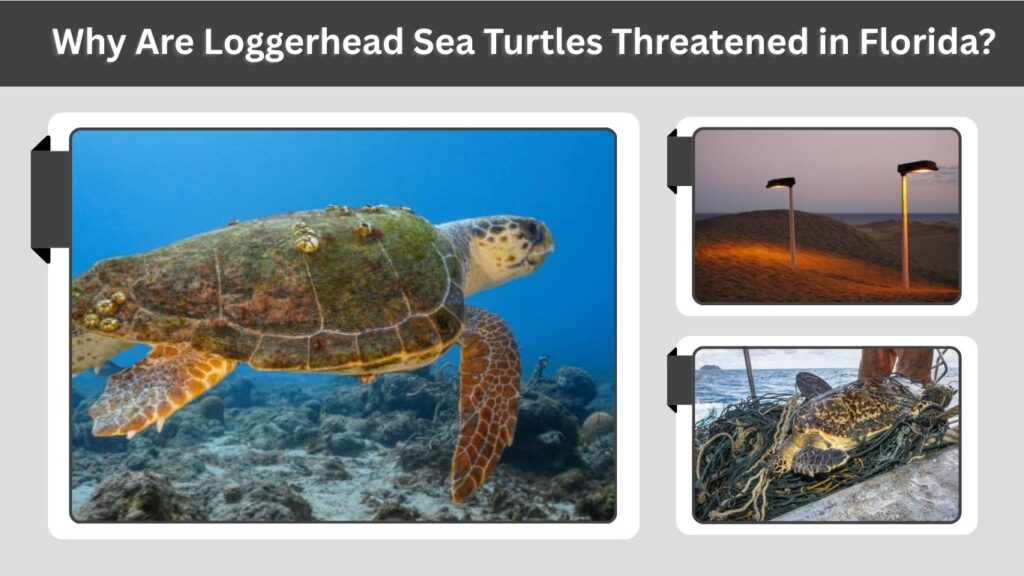
Loggerhead sea turtles are threatened in Florida because they face dangers throughout their life cycle. Eggs and hatchlings are vulnerable on beaches, while juveniles and adults face risks in coastal and offshore waters.
Major threats include:
- Artificial lighting on nesting beaches
- Coastal development and habitat loss
- Boat strikes
- Fishing gear entanglement
- Plastic pollution and marine debris
- Beach erosion and storms
- Climate change
- Predation on eggs and hatchlings
Climate change is a growing concern because sand temperature affects sea turtle development. Warmer sand can influence hatchling sex ratios and may affect nesting success. Stronger storms and sea-level rise can also wash away or flood nests.
Loggerhead Sea Turtle Deaths in Florida
Loggerhead sea turtle deaths in Florida can happen for many reasons. Some turtles are hit by boats, tangled in fishing gear, weakened by disease, injured by predators, or affected by pollution. Others may strand on beaches because of illness, cold stress, or unknown causes.
When people find a dead, sick, or injured sea turtle, they should not try to move it unless instructed by wildlife officials. Reporting the turtle to the proper authorities helps scientists track threats and respond when possible.
Beach strandings and mortality data help researchers understand what is harming sea turtles and where conservation action is needed most.
Loggerhead Sea Turtle Rehabilitation and Release in Florida
Florida has several sea turtle rehabilitation centers that treat sick or injured turtles. One well-known facility is Loggerhead Marinelife Center in Juno Beach near Jupiter, Florida. Rehabilitation centers care for turtles affected by boat strikes, fishing line, hooks, infections, predator injuries, buoyancy problems, and other medical issues.
A loggerhead sea turtle release in Florida can happen after a turtle has recovered and veterinarians determine it is ready to return to the ocean. Releases are often emotional events because they show the result of rescue, medical care, and conservation work.
Some turtles are fitted with satellite tags before release. These tags help researchers study migration routes, diving behavior, habitat use, and survival after rehabilitation.
Loggerhead Sea Turtles in Jupiter, Sanibel, the Keys, and the Everglades
Loggerhead sea turtles can be associated with many coastal parts of Florida. Jupiter and Juno Beach are especially known because of sea turtle nesting activity and the presence of Loggerhead Marinelife Center. Sanibel and southwest Florida beaches also provide important coastal habitat, although nesting numbers vary by beach and year.
The Florida Keys support sea turtles in surrounding waters and on suitable beaches. Loggerheads may feed, travel, and nest in parts of the Keys region. In and around the Everglades, sea turtles may be found in nearby marine and coastal environments, especially where seagrass beds, bays, and coastal waters provide habitat.
These places show how closely loggerheads are connected to Florida’s beaches, coastal waters, and marine ecosystems.
Florida Studies on Loggerhead Sea Turtles
Florida has been central to loggerhead sea turtle research for decades. Scientists, universities, conservation groups, and state agencies study nesting trends, migration distance, hatchling success, climate effects, genetics, disease, and threats from human activity.
Research may include beach nest surveys, satellite tracking, genetic sampling, hatchling studies, and rehabilitation data. These studies help answer important questions about where loggerheads travel, which beaches are most important, and how threats are changing over time.
Florida university researchers and conservation organizations often work with state and federal agencies to improve protection plans.
How To Protect Loggerhead Sea Turtles in Florida
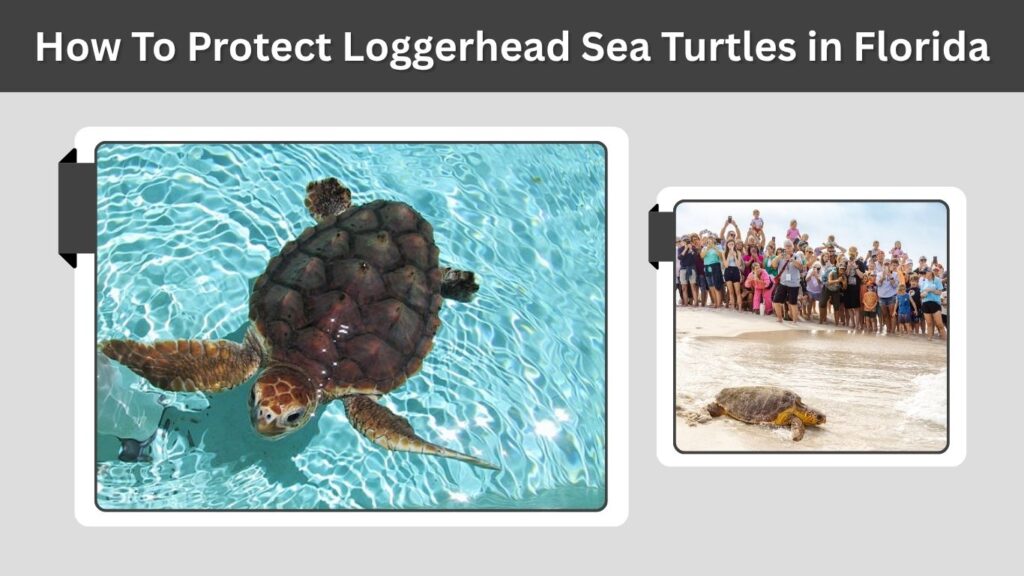
Anyone visiting or living near Florida beaches can help protect loggerhead sea turtles. The most important rule is to keep beaches dark, clean, and flat during nesting season.
Turn off lights that shine toward the beach, close curtains at night, remove beach furniture, and never leave trash behind. If you see a nesting turtle, stay quiet, keep your distance, and do not use flash photography.
If you find an injured turtle, stranded turtle, or disturbed nest, contact local wildlife authorities or a permitted sea turtle organization. Do not attempt to rescue or relocate the turtle yourself unless directed by professionals.
FAQs
When is loggerhead sea turtle nesting season in Florida?
Loggerhead sea turtle nesting season in Florida generally runs from spring through fall, often recognized from March through October. Nesting females usually come ashore at night, while hatchlings emerge later in the season after incubating in the sand for several weeks.
Are loggerhead sea turtles endangered in Florida?
Loggerhead sea turtles are protected in Florida and listed as threatened under federal law. They are not safe from risk, even though Florida has many nests. Habitat loss, artificial lights, boat strikes, fishing gear, pollution, and climate change continue to threaten them.
Where can you see loggerhead sea turtles in Florida?
Loggerhead sea turtles may be seen on Florida nesting beaches during approved guided turtle walks or in rehabilitation centers such as Loggerhead Marinelife Center near Jupiter. In the wild, viewers must keep a distance and avoid disturbing nesting turtles or hatchlings.
What do loggerhead sea turtles eat in Florida?
Loggerhead sea turtles eat hard-shelled marine animals such as crabs, conchs, whelks, and other invertebrates. Their large heads and strong jaws help them crush prey. Young loggerheads may eat a wider variety of small marine animals as they grow.
What should you do if you find a sick or injured loggerhead?
If you find a sick, injured, stranded, or dead loggerhead sea turtle in Florida, do not touch or move it unless directed by authorities. Report it to local wildlife officials, beach patrol, or a permitted sea turtle rescue group so trained responders can help.