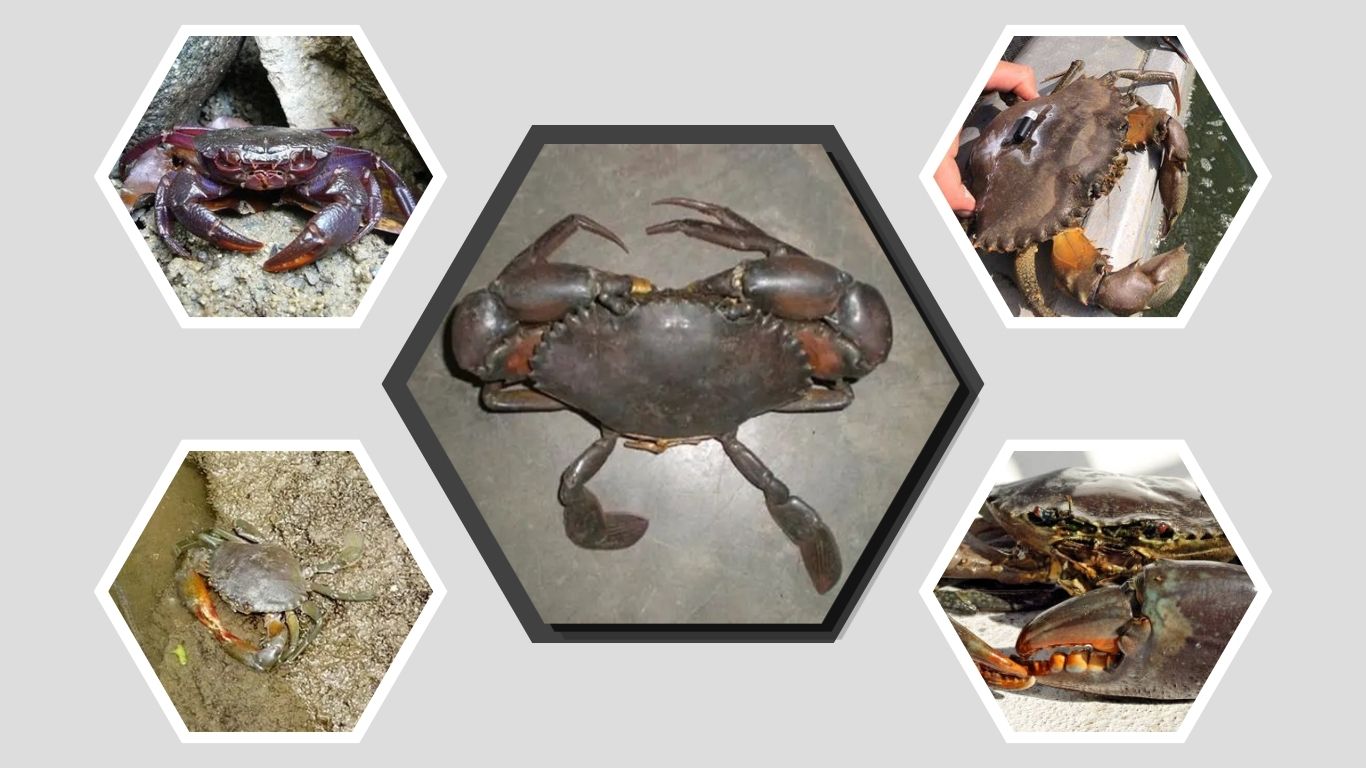
Mud crabs are large, powerful coastal crabs commonly found in mangrove forests, estuaries, tidal creeks, and muddy shorelines. They are recognized by their broad shells, strong claws, and paddle-shaped rear legs. Different mud crab species vary in size, color, claw pattern, and the shape of the teeth along the front of the shell. This guide covers four types of mud crabs, including their scientific names, habitats, sizes, colors, identification features, diets, and behavior.
1. Giant Mud Crab (Scylla serrata)
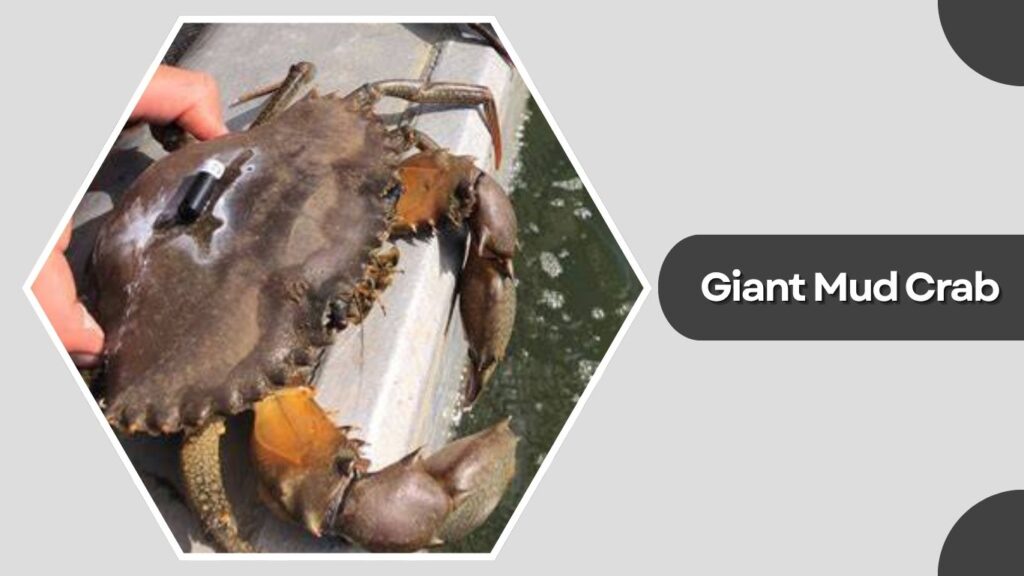
The giant mud crab, also called the mangrove crab, is a large swimming crab found throughout the Indo-West Pacific. It is recognized by its broad green shell, powerful claws, and paddle-shaped rear legs. This valuable coastal species inhabits muddy shorelines, mangrove forests, tidal creeks, river mouths, and nearby offshore waters.
Identification
- Broad, smooth carapace with strong transverse ridges
- Deep H-shaped groove in the middle of the shell
- Four broad frontal lobes between the eyes
- Nine teeth along each side of the carapace
- Large, muscular claws covered with strong spines
- Final pair of legs flattened into swimming paddles
- Green, dark olive, brown, or nearly black body
- Legs may have pale, irregular marbled markings
Size and Color
The giant mud crab is the largest species in the genus Scylla. Adult males may reach approximately 25–28 centimetres across the carapace and weigh between 2 and 3 kilograms. The body ranges from green and olive to dark brown or almost black, while the legs may display lighter marbled patterns.
Habitat and Distribution
This species has a wide Indo-West Pacific distribution. It occupies brackish and marine environments, including muddy bottoms, mangrove swamps, estuaries, river mouths, tidal creeks, and sheltered coastal areas. In Bangladesh, it occurs in coastal habitats around Cox’s Bazar and the Sundarbans.
Diet and Behavior
The giant mud crab is mainly a nocturnal predator and scavenger. It feeds primarily on mollusks, marine worms, smaller crustaceans, fish remains, and limited plant material. Its strong claws can crush hard shells, while its paddle-shaped rear legs help it swim through tidal channels. It often digs deep burrows in muddy substrates for shelter.
2. Orange Mud Crab (Scylla olivacea)
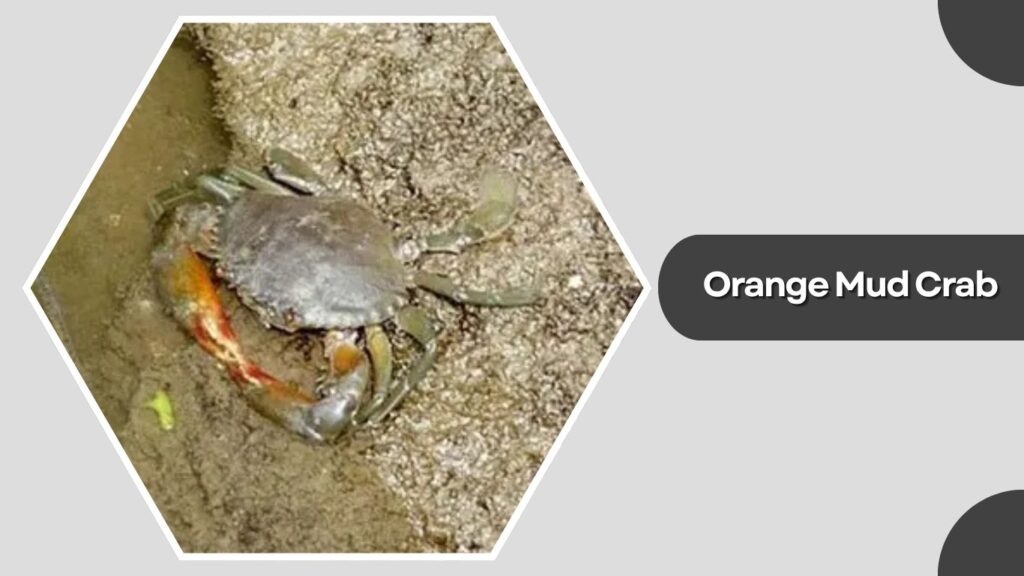
The orange mud crab is a commercially important mangrove crab found across tropical parts of Asia and the Indo-Pacific. It is generally smaller than the giant mud crab and can be recognized by its rounded frontal teeth, rusty-orange claws, and lack of strong net-like patterns on its legs.
Identification
- Broad, oval, and relatively smooth carapace
- Nine teeth along each side of the shell
- Four low, rounded frontal teeth between the eyes
- Rusty orange, reddish-brown, or brown claws
- Deep-green or grayish-green carapace
- Little or no polygonal pattern on the legs and claws
- Flattened final pair of legs used for swimming
Size and Color
Adult orange mud crabs commonly measure around 10–15 centimetres across the carapace. One population study recorded maximum widths of approximately 14.5 centimetres for males and 13.7 centimetres for females. The shell is generally olive green, dark green, or grayish green, while the claws and legs may appear rusty orange or reddish brown.
Habitat and Distribution
This species occurs around the South China Sea and extends into parts of the Indian and western Pacific oceans. It commonly inhabits mangrove forests, estuaries, tidal creeks, and muddy coastlines that receive lower-salinity water during wet seasons. It is often found in the same regions as the purple mud crab.
Diet and Behavior
The orange mud crab is an omnivorous predator and scavenger. It feeds on mollusks, marine worms, small crustaceans, fish remains, plant material, and organic debris. It usually shelters in muddy burrows or beneath mangrove roots and becomes more active during high tide or at night.
3. Purple Mud Crab (Scylla tranquebarica)
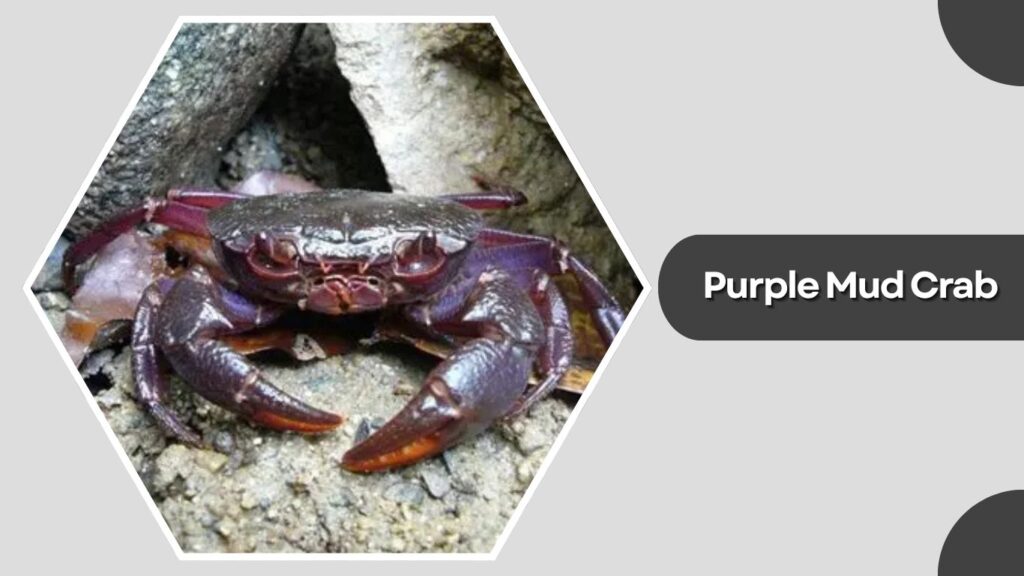
The purple mud crab is a large mangrove species distinguished by its purple claws and patterned swimming legs. It resembles the giant mud crab, but its frontal teeth are generally lower and blunter. The crab is widely harvested for food throughout its Indo-Pacific distribution.
Identification
- Broad, smooth, oval-shaped carapace
- Nine strong teeth along each side
- Low or moderately raised frontal teeth
- Frontal teeth have relatively blunt tips
- Purple, violet, or dark-colored claws
- Polygonal markings on the claws and swimming legs
- Patterns gradually fade on the front walking legs
- Paddle-shaped final pair of legs
Size and Color
Purple mud crabs commonly grow to around 10–15 centimetres across the carapace. Large males may approach 19 centimetres, while females are usually smaller. The shell is often dark green, brownish green, or nearly black, with purple claws and visible net-like markings on the rear legs.
Habitat and Distribution
This species occurs around the South China Sea and extends into the Indian and western Pacific oceans. It inhabits mangrove forests, brackish estuaries, muddy coastlines, river mouths, and tidal channels. It is particularly associated with coastal areas that experience seasonal reductions in salinity.
Diet and Behavior
The purple mud crab feeds on bivalves, snails, worms, fish remains, smaller crabs, and other available organic material. It is usually active at night and may remain inside a burrow during low tide. Its powerful claws are used for feeding, territorial disputes, and protection from predators.
4. Green Mud Crab (Scylla paramamosain)
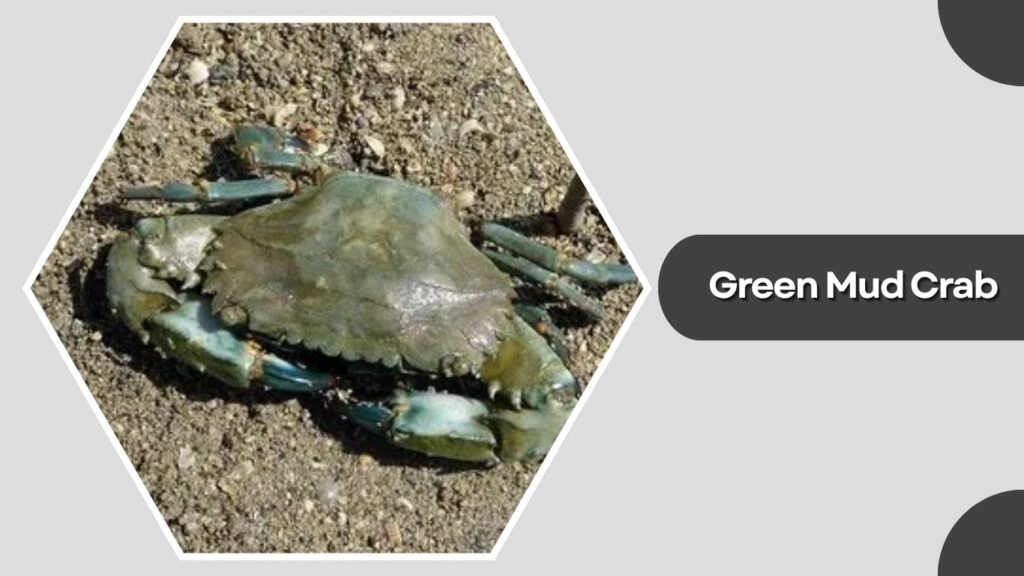
The green mud crab is an important aquaculture and fishery species in Southeast and East Asia. It has a deep-green shell, orange-toned claws, sharply pointed frontal teeth, and prominent polygonal markings. These features help distinguish it from the orange and purple mud crabs.
Identification
- Broad, fan-shaped carapace
- Nine pointed teeth along each side
- Four moderately high frontal teeth
- Frontal teeth are pointed and triangular
- Deep-green or grayish-green shell
- Orange, brown-orange, or reddish claws
- Clear polygonal markings on the shell and claws
- Strong patterns on the swimming legs
- Flattened final pair of legs
Size and Color
The green mud crab commonly reaches approximately 15–18 centimetres across its carapace, while especially large individuals may approach 20 centimetres. Its shell is generally deep green or grayish green. Orange claws and dark polygonal patterns are commonly visible across the shell, claws, and rear swimming legs.
Habitat and Distribution
This species has a more restricted natural distribution than the giant mud crab. It occurs mainly around the South China and Java seas and is especially common along the coasts of China and Vietnam. It inhabits mangrove forests, estuarine ponds, shallow subtidal flats, coral rubble, and brackish coastal waterways.
Diet and Behavior
The green mud crab is an aggressive omnivore that feeds on mollusks, worms, small crustaceans, fish, carrion, and plant matter. Young crabs use shallow mangrove edges as nursery areas, while larger individuals occupy burrows and subtidal habitats, entering mangrove forests to feed during high tide.
FAQs
1. What is the largest type of mud crab?
The giant mud crab is the largest of the four main Scylla species. Large males may reach about 25–28 centimetres across the carapace and can weigh up to approximately 3 kilograms.
2. Where do mud crabs live?
Mud crabs mainly live in mangrove forests, estuaries, tidal creeks, river mouths, lagoons, and muddy coastal areas. They prefer sheltered brackish or marine habitats where they can dig burrows and hide among roots.
3. What do mud crabs eat?
Mud crabs are opportunistic predators and scavengers. They eat mollusks, worms, small fish, crustaceans, carrion, plant material, and organic debris. Their powerful claws help them crush hard-shelled prey.
4. How can you identify different mud crab species?
Mud crab species can be identified by their shell color, claw color, frontal teeth, side spines, and leg patterns. The shape of the four teeth between the eyes is especially useful for distinguishing closely related species.
5. Are mud crabs dangerous to humans?
Mud crabs are not venomous, but their strong claws can cause a painful injury. They usually avoid people, although they may pinch when handled, trapped, or threatened. Large individuals should be handled carefully.