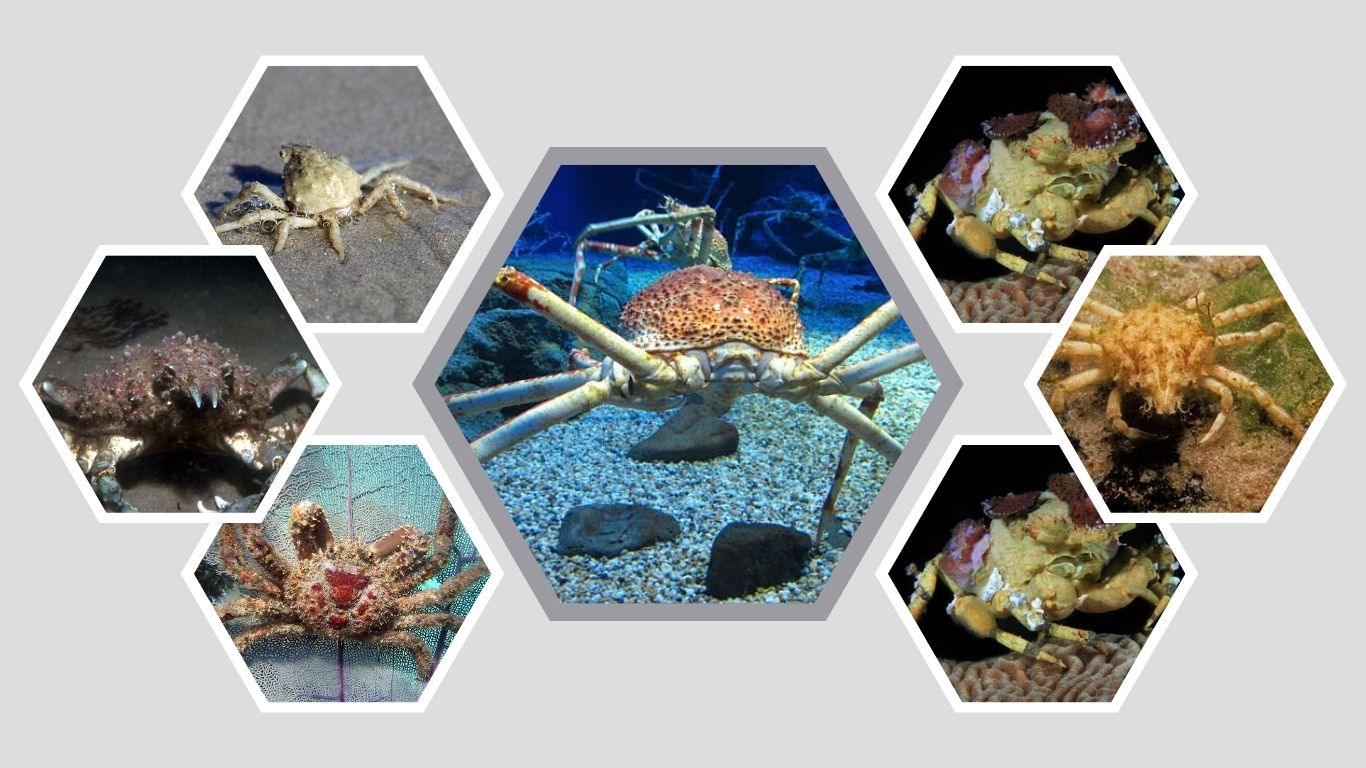
Spider crabs are fascinating marine crustaceans recognized by their long legs, rough shells, and unusual spider-like appearance. They live in many ocean habitats, including coral reefs, rocky shores, sandy seabeds, kelp forests, and deep waters. Some species decorate their bodies with algae, sponges, and other materials for camouflage, while others rely on sharp spines and strong claws for protection. This guide covers 10 types of spider crabs, including their species, habitat, size, color, identification features, diet, and behavior.
1. Japanese Spider Crab (Macrocheira kaempferi)
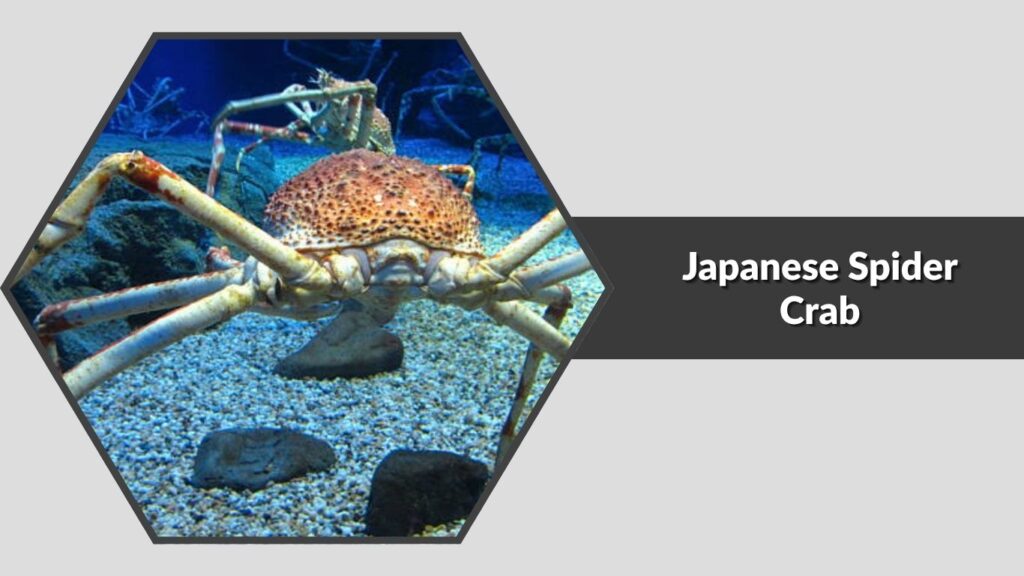
The Japanese spider crab is the world’s largest living arthropod by leg span. This enormous marine crab is famous for its extremely long legs, pear-shaped shell, and orange-and-white coloring. It lives on deep, rocky and sandy seafloors along Japan’s Pacific coast. Despite its intimidating appearance, it is generally slow-moving and nonaggressive.
Identification
- Pear-shaped, rounded carapace
- Extremely long and slender walking legs
- Two claw-bearing front legs
- Orange, tan, or reddish-brown body
- White or cream markings along the legs
- Rough shell covered with small bumps and spines
- Two narrow spines projecting between the eyes
- Adult males have much longer front claws than females
Size and Color
A fully grown Japanese spider crab may have a leg span approaching 3.7–4 metres, while its hard carapace can measure around 37 centimetres long. Adults commonly weigh between 16 and 20 kilograms. The shell ranges from light tan to dark orange, while the legs are usually orange with irregular white patches.
Habitat and Distribution
Japanese spider crabs primarily inhabit the Pacific side of Japan. They live on rocky and sandy continental shelves and slopes, commonly at depths of around 150–300 metres. During the breeding season, adults migrate into shallower waters approximately 50 metres deep.
Diet and Behavior
The Japanese spider crab is mainly a scavenger that slowly walks across the seabed searching for dead fish, decaying invertebrates, algae, and other organic material. It may occasionally open mollusks or capture small marine animals. Young crabs sometimes attach sponges and seaweed to their shells for camouflage.
2. European Spider Crab (Maja brachydactyla)
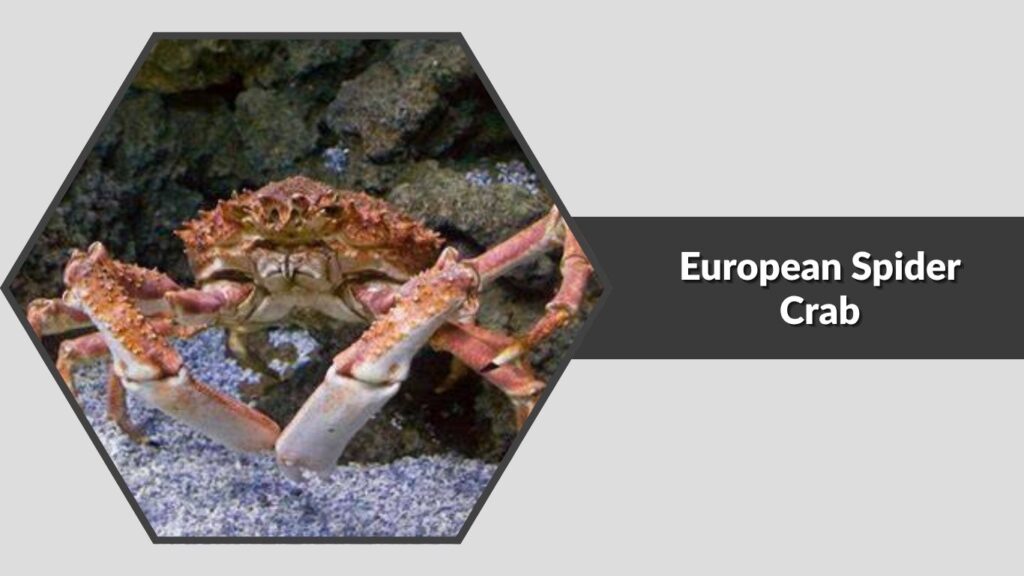
The European spider crab, also called the common or Atlantic spider crab, is a large coastal species with a heavily spined shell and long walking legs. It often covers its body with algae, sponges, and other marine organisms, helping it blend into rocky seabeds and seaweed-covered habitats.
Identification
- Rounded or oval, strongly curved carapace
- Narrower front and broad rear section
- Two short, diverging horns between the eyes
- Five large spines along each side of the shell
- Numerous smaller spines and bumps across the upper surface
- Long, hairy walking legs with dark tips
- Red, reddish-brown, or yellowish-brown coloration
Size and Color
The European spider crab’s carapace can grow to approximately 20 centimetres long. Its body is commonly red, brownish red, orange-brown, or yellowish brown. Algae, barnacles, hydroids, and sponges may cover much of the shell, sometimes hiding its natural color and spiny surface.
Habitat and Distribution
This species occurs in the northeastern Atlantic, ranging from Morocco to Scotland. It lives from the extreme low-tide zone to depths of around 50 metres, generally occupying rocky bottoms, coarse sand, seaweed beds, and mixed seabed habitats.
Diet and Behavior
The European spider crab is an opportunistic omnivore and scavenger. It consumes algae, mollusks, worms, small crustaceans, echinoderms, and dead organic material. Juveniles often attach living organisms to their hooked shell hairs for camouflage, while adults may gather in large groups during migration or molting.
3. Mediterranean Spider Crab (Maja squinado)
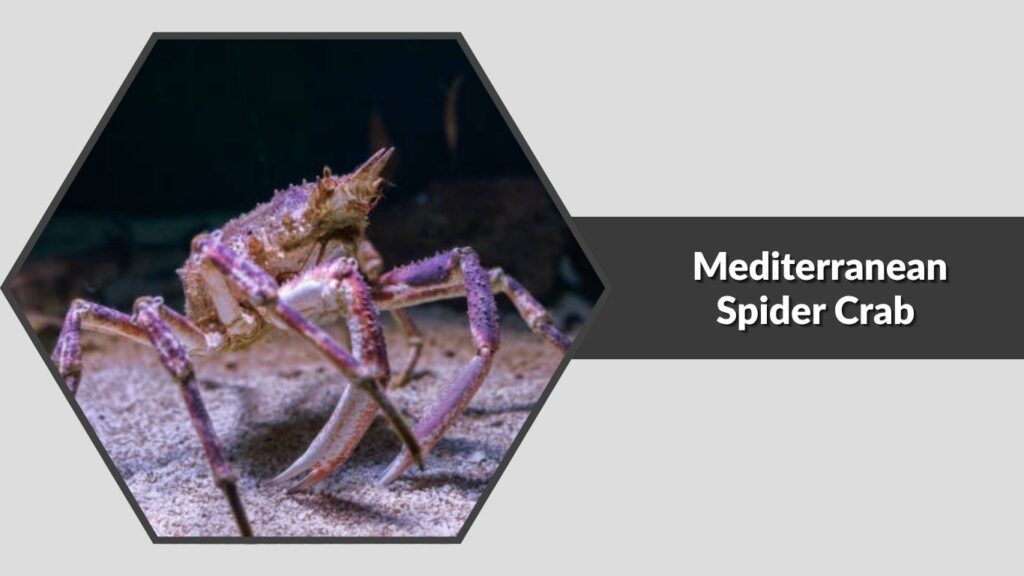
The Mediterranean spider crab is a large, heavily armored crab native to the Mediterranean region. It closely resembles the European spider crab but is recognized as a separate species. Its spiny shell, long legs, and reddish coloration help it blend among algae-covered rocks and seabed vegetation.
Identification
- Large, rounded, and strongly curved carapace
- Numerous sharp spines and raised bumps
- Two short horns projecting from the front
- Long, slender walking legs
- Small claws compared with the overall body
- Red, reddish-orange, or brownish shell
- Frequently covered with algae or other organisms
Size and Color
Large Mediterranean spider crabs may have carapaces measuring approximately 20–25 centimetres long and around 18 centimetres wide. Their natural color ranges from orange-red and reddish brown to darker red. The underside is usually paler, while algae and encrusting organisms may alter the crab’s visible appearance.
Habitat and Distribution
This species is mainly associated with the Mediterranean Sea. It inhabits rocky or sandy bottoms, particularly areas covered with algae. It is commonly recorded from shallow water to depths of approximately 150 metres, although individuals may occur below 200 metres in some regions.
Diet and Behavior
The Mediterranean spider crab feeds on mollusks, marine worms, crustaceans, echinoderms, algae, fish remains, and other available material. It is an opportunistic feeder rather than an active hunter. Adults may migrate between deeper and shallower habitats for breeding, feeding, and seasonal movements.
4. Great Spider Crab (Hyas araneus)
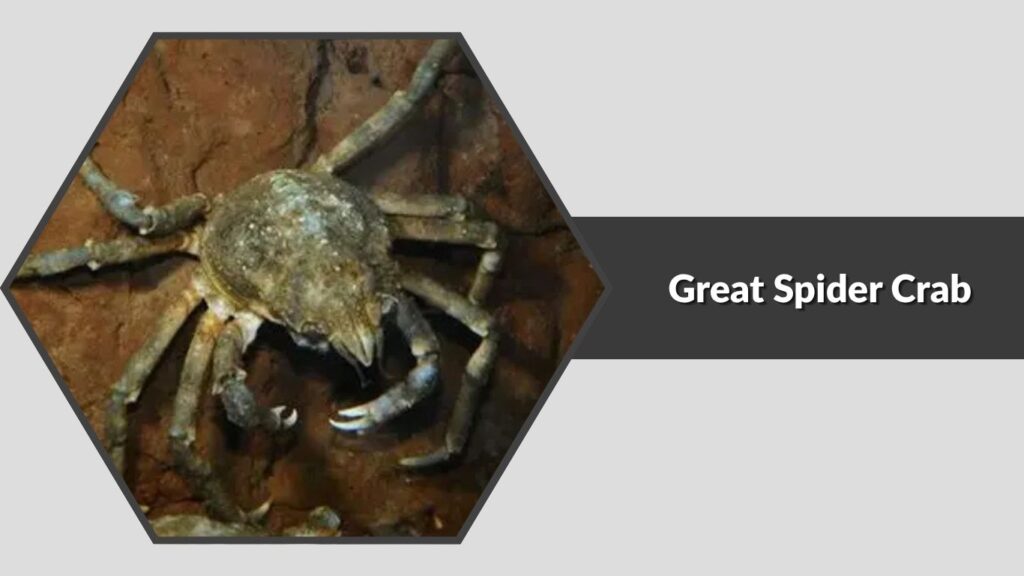
The great spider crab is a cold-water species found across northern Atlantic and Arctic coastal regions. It has a distinctive pear-shaped shell, long spider-like legs, and a rough surface that may become covered with algae, sponges, and other small marine organisms.
Identification
- Pear-shaped carapace
- Two tapering horns that meet at their tips
- Several large bumps across the upper shell
- Long, thin walking legs
- Shorter and thicker claw-bearing front legs
- Reddish-brown upper body
- Off-white or pale underside
Size and Color
The great spider crab’s carapace can reach approximately 10 centimetres long and 8 centimetres wide. Its upper surface is generally reddish brown, brown, or olive-toned, while the underside is off-white. Attached algae and marine organisms may give it a greenish, gray, or uneven appearance.
Habitat and Distribution
This northern species occurs around Iceland, Norway, Greenland, Svalbard, eastern North America, and the British Isles. It lives on rocky and sandy bottoms, among seaweed, and around lower-shore and subtidal habitats. It is commonly found from the shoreline to depths of around 50 metres.
Diet and Behavior
The great spider crab is an omnivorous scavenger that consumes algae, mollusks, worms, small crustaceans, echinoderms, and carrion. It may deliberately attach algae, sponges, anemones, and other organisms to its shell, creating camouflage that helps conceal it from predators on the seabed.
5. Toad Spider Crab (Hyas coarctatus)
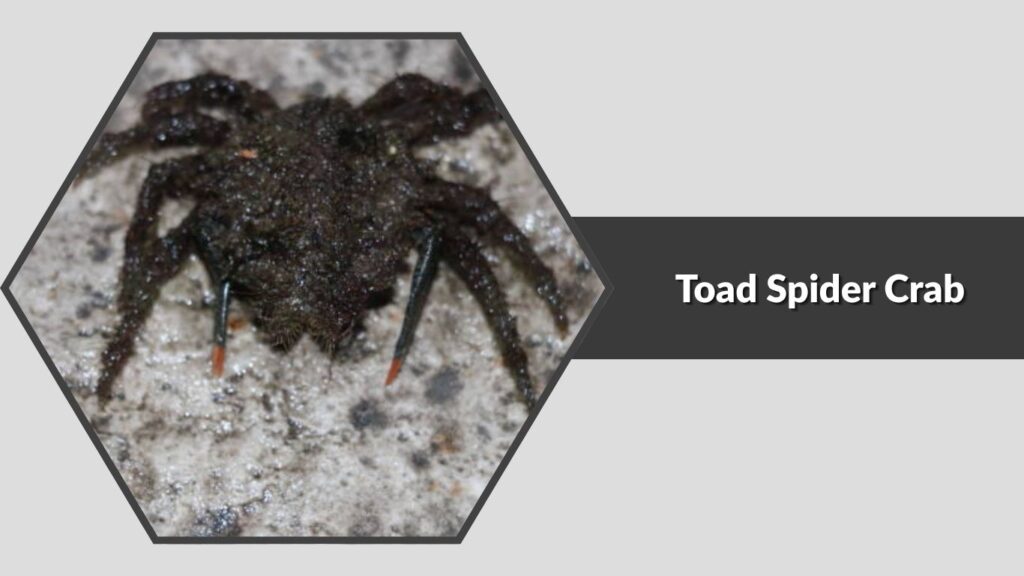
The toad spider crab, also called the contracted crab or Arctic lyre crab, is a relatively small member of the spider crab family. Its narrow front and expanded rear shell create a violin- or lyre-like shape. It inhabits cold northern waters on rocky, sandy, and soft seabeds.
Identification
- Pear-shaped or violin-shaped carapace
- Noticeably narrow front third of the shell
- Two separated, forward-pointing horns
- Claw-bearing legs nearly as long as the walking legs
- Long, thin walking legs
- Brownish-gray or reddish-brown upper body
- White or pale-colored underside
Size and Color
The carapace generally reaches around 4.5 centimetres wide and may grow to approximately 6.1 centimetres long. Its color varies from brownish gray and reddish brown to darker brown, while the belly is usually white. The final segments of its walking legs may have visible hairs.
Habitat and Distribution
The toad spider crab inhabits cold waters of the northern Atlantic and Arctic regions. It is found on hard, sandy, and soft bottoms from the intertidal zone to depths of around 50 metres. Its distribution includes the British Isles and parts of eastern Canada.
Diet and Behavior
This species feeds on algae, small bottom-dwelling animals, carrion, and organic debris. Its rough shell can hold algae and small invertebrates, improving camouflage. When disturbed, the crab may remain motionless against the seabed or move slowly into nearby rocks, vegetation, or sediment.
6. Decorator Spider Crab (Camposcia retusa)
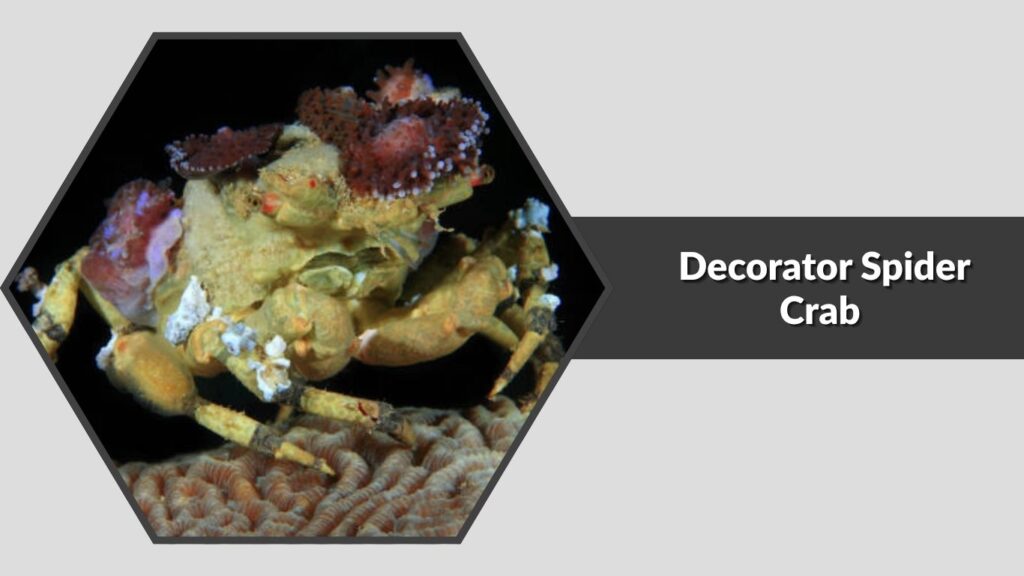
The decorator spider crab, also known as the Velcro crab, is a small Indo-Pacific crab famous for covering its body with living and nonliving materials. Its hooked body hairs hold algae, sponges, hydroids, and pieces of debris, making the crab extremely difficult to notice on coral reefs.
Identification
- Small, pear-shaped carapace
- Long, thin walking legs
- Rough body covered with hooked hairs
- Narrow, forward-pointing rostrum
- Small claws compared with its legs
- Usually covered with algae, sponges, or debris
- Natural body color often hidden by decorations
Its dense covering of attached marine material is the species’ most recognizable characteristic.
Size and Color
The carapace generally grows to around 3 centimetres, while the crab may span approximately 10 centimetres when its legs are extended. Its natural body is usually grayish, brown, cream, or reddish brown. However, attached algae and sponges may make it appear green, yellow, orange, or multicolored.
Habitat and Distribution
The decorator spider crab occurs throughout tropical Indo-Pacific waters, from the Red Sea and eastern Africa to parts of Southeast Asia and the western Pacific. It inhabits coral reefs, rocky bottoms, rubble fields, lagoons, and areas rich in sponges and algae.
Diet and Behavior
This crab is an opportunistic omnivore that consumes algae, organic debris, carrion, and small marine organisms. It deliberately collects suitable materials and attaches them to its body for camouflage. The attached organisms may continue growing, creating an effective living disguise.
7. Portly Spider Crab (Libinia emarginata)
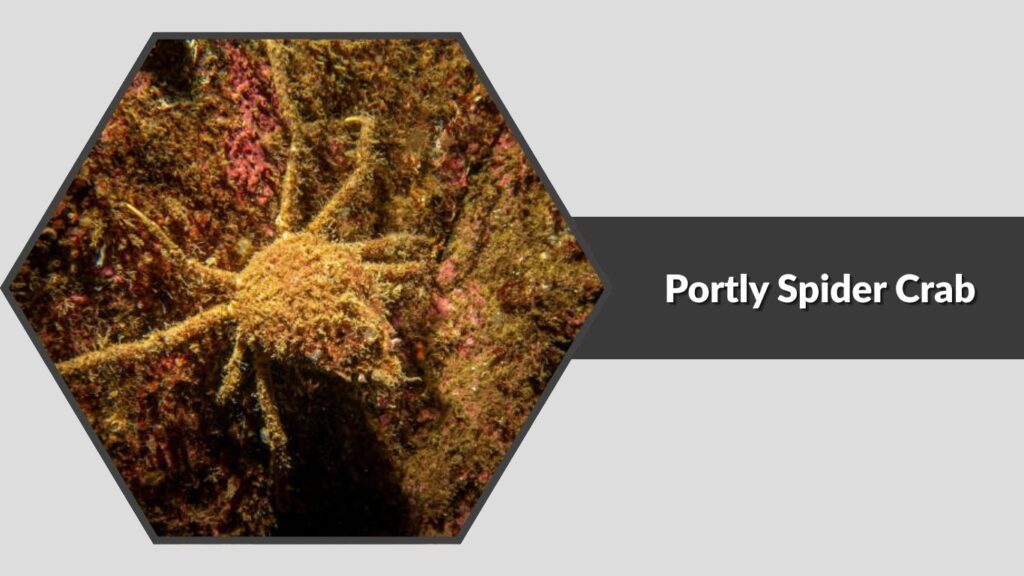
The portly spider crab is also called the common spider crab or nine-spined spider crab. It has a rounded, heavily spined shell and long walking legs. Younger individuals often decorate themselves with seaweed, sponges, and other materials, while large adults may carry fewer decorations.
Identification
- Broad, rounded, or pear-shaped carapace
- Nine prominent spines along the middle of the shell
- Short, slightly separated horns at the front
- Long, slender walking legs
- Hairy surface capable of holding decorations
- Small claws compared with overall body size
- Yellowish, grayish, or reddish-brown coloration
The nine median shell spines are useful for separating it from the similar longnose spider crab.
Size and Color
The portly spider crab commonly has a carapace measuring around 6–10 centimetres. Its body may be yellowish brown, gray, reddish brown, or orange-brown. Algae, sponges, and other attached organisms frequently change its visible color and texture.
Habitat and Distribution
This species lives along the Atlantic coast of North America. It inhabits marine environments with stable salinity, including sandy and muddy bottoms, bays, sounds, estuaries, seagrass areas, and shallow coastal waters.
Diet and Behavior
The portly spider crab is both a scavenger and predator. It feeds on carrion, algae, mollusks, small crustaceans, sea stars, and other bottom-dwelling organisms. Young crabs commonly place pieces of sponge or seaweed on their shells to avoid predators.
8. Longnose Spider Crab (Libinia dubia)
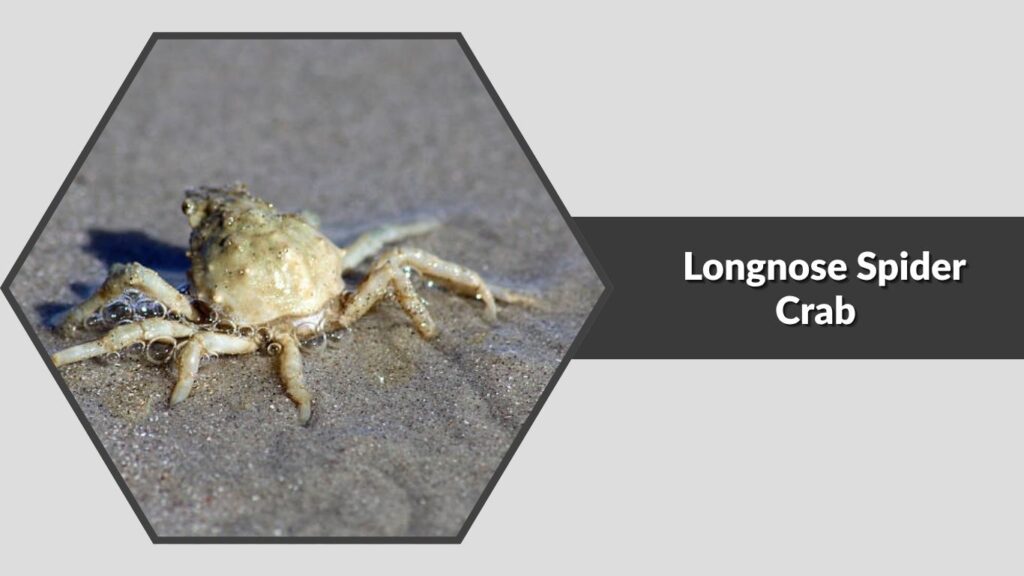
The longnose spider crab is a shallow-water species found along the eastern coast of North America. It resembles the portly spider crab, but its longer, divided front horns and lower number of central shell spines provide useful identification clues.
Identification
- Rounded or pear-shaped carapace
- Long, narrow, forked rostrum
- Six main spines along the middle of the shell
- Numerous smaller bumps and spines
- Long, thin walking legs
- Hairy upper body
- Brown, tan, gray, or yellowish coloration
The combination of six median spines and an elongated, forked rostrum helps distinguish it from Libinia emarginata.
Size and Color
Adults commonly have a carapace measuring approximately 5–10 centimetres. Their natural color ranges from grayish tan and yellow-brown to reddish brown. Young crabs may appear green, orange, or multicolored after attaching algae, sponges, and other materials to their shells.
Habitat and Distribution
The longnose spider crab ranges from Cape Cod southward through the Gulf of Mexico to southern Texas, Cuba, and the Bahamas. It occurs at depths down to approximately 50 metres. Adults frequently occupy sandy bottoms, while juveniles are often associated with seagrass meadows.
Diet and Behavior
This species scavenges dead animals and consumes algae, small mollusks, worms, crustaceans, and other available organisms. Juveniles decorate their shells for camouflage. Longnose spider crabs are slow-moving and usually rely on their appearance rather than speed when avoiding predators.
9. Sheep Crab (Loxorhynchus grandis)
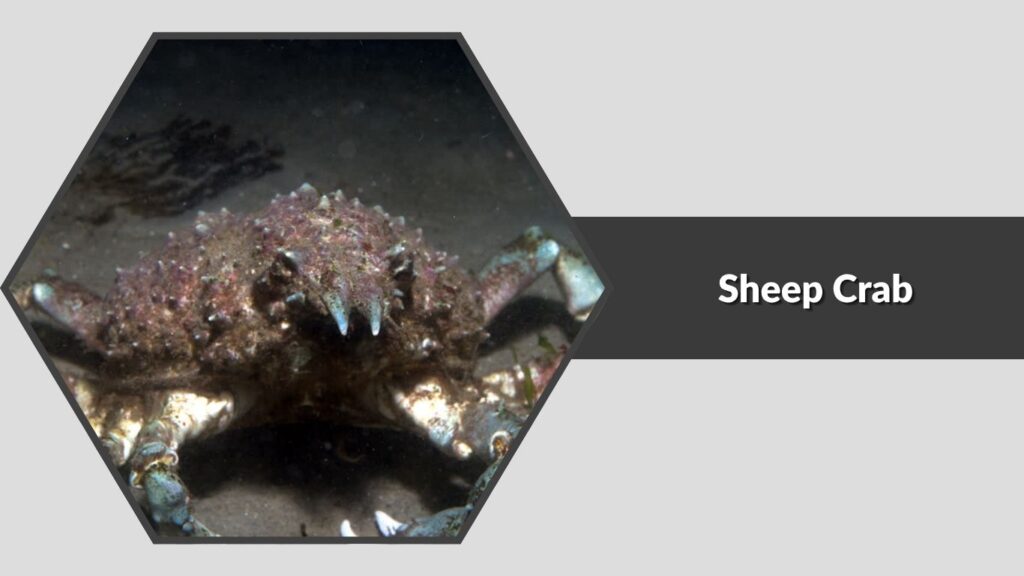
The sheep crab is the largest crab commonly found along the California coast. It has an oval, heavily armored body, long legs with large knobby joints, and a downward-curving rostrum. Its name may come from the woolly appearance created by algae and other organisms growing on its shell.
Identification
- Large, oval-shaped carapace
- Two pointed horns forming a downward-curving rostrum
- Numerous spines and raised bumps
- Long legs with enlarged, knobby joints
- Thick, powerful claws in adult males
- Rough shell capable of carrying living decorations
- Red, brown, orange, or purplish coloration
Adult males generally have longer legs and substantially larger claws than females.
Size and Color
The sheep crab can reach a total span of approximately 45 centimetres when its legs are extended. Its body is usually reddish brown, orange, dark red, or purple-brown. Algae, barnacles, anemones, and other organisms may cover the shell and obscure its natural coloring.
Habitat and Distribution
This eastern Pacific crab occurs along the coast of California and Baja California. It inhabits rocky and sandy seabeds, reefs, kelp forests, and other coastal environments at depths of approximately 6–152 metres.
Diet and Behavior
The sheep crab is a slow-moving omnivore and scavenger. It consumes algae, dead animals, mollusks, worms, echinoderms, and other seabed organisms. Younger crabs frequently decorate themselves, while older individuals may depend more on their size, spines, and strong claws for protection.
10. Caribbean King Crab (Maguimithrax spinosissimus)
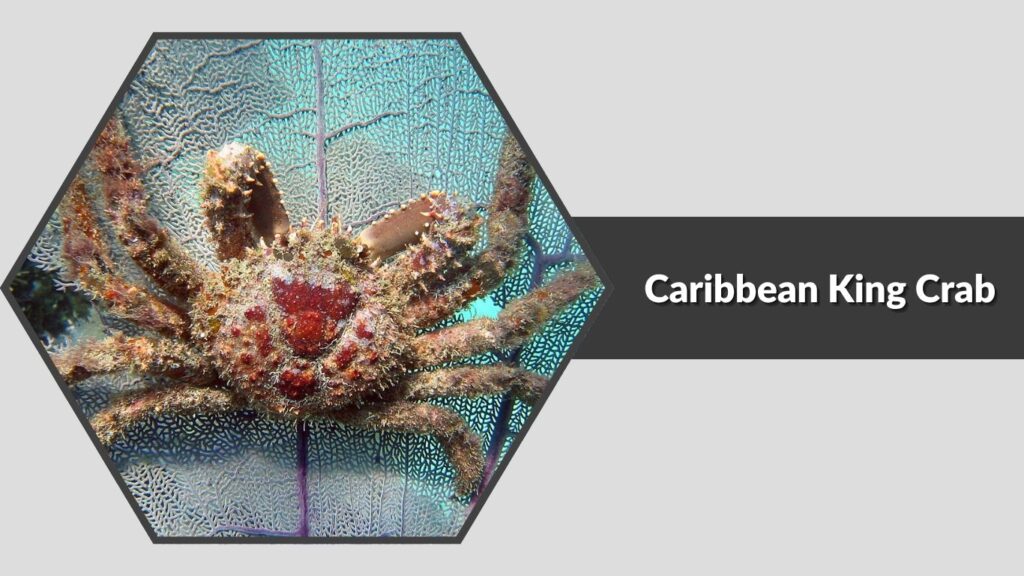
The Caribbean king crab is also called the spiny spider crab, reef spider crab, or channel clinging crab. It was formerly classified as Mithrax spinosissimus, but its currently accepted scientific name is Maguimithrax spinosissimus. It is the largest native true crab in the western Atlantic.
Identification
- Large, oval or rounded carapace
- Numerous short spines and raised nodules
- Thick, powerful front claws
- Smooth, purplish-gray claw surfaces
- Blunt claw tips
- Spiny reddish-brown walking legs
- Dark red, burgundy, or reddish-purple body
Its large size, heavily spined legs, and thick claws make it relatively easy to recognize.
Size and Color
Large individuals may weigh up to approximately 3 kilograms and develop a carapace measuring around 18 centimetres. The shell and legs are generally reddish brown, dark red, or burgundy. The claws may appear grayish purple, with lighter or yellowish tips.
Habitat and Distribution
The Caribbean king crab ranges from North Carolina and southern Florida through the Gulf of Mexico, the Caribbean, and northern South America to Venezuela. It shelters in caves, coral crevices, reef overhangs, and rocky holes from shallow coastal water to depths of around 200 metres.
Diet and Behavior
This crab is primarily nocturnal and often remains hidden during daylight. It is an omnivore that feeds heavily on algae but may also consume carrion, mollusks, small fish, and other invertebrates. Its strong legs allow it to cling securely to rocks and coral structures.
FAQs
1. Are spider crabs dangerous to humans?
Most spider crabs are not dangerous to humans. They are generally slow-moving and prefer to avoid contact. Large species can pinch with their claws when handled, but they are not venomous and rarely behave aggressively.
2. Why are they called spider crabs?
They are called spider crabs because of their long, thin legs and relatively small bodies. Their overall shape resembles a spider, especially when they walk slowly across rocks, reefs, or sandy seabeds.
3. What do spider crabs eat?
Spider crabs are usually omnivores and scavengers. They eat algae, mollusks, worms, small crustaceans, dead animals, and organic debris. Some species also capture small marine animals when suitable food becomes available.
4. Where do spider crabs live?
Spider crabs live in oceans around the world. Depending on the species, they may inhabit coral reefs, rocky shores, sandy bottoms, kelp forests, seagrass beds, deep-sea slopes, and cold northern waters.
5. What is the largest spider crab species?
The Japanese spider crab is the largest living arthropod by leg span. Its legs may stretch nearly 4 metres from tip to tip, while large adults can weigh around 16–20 kilograms.