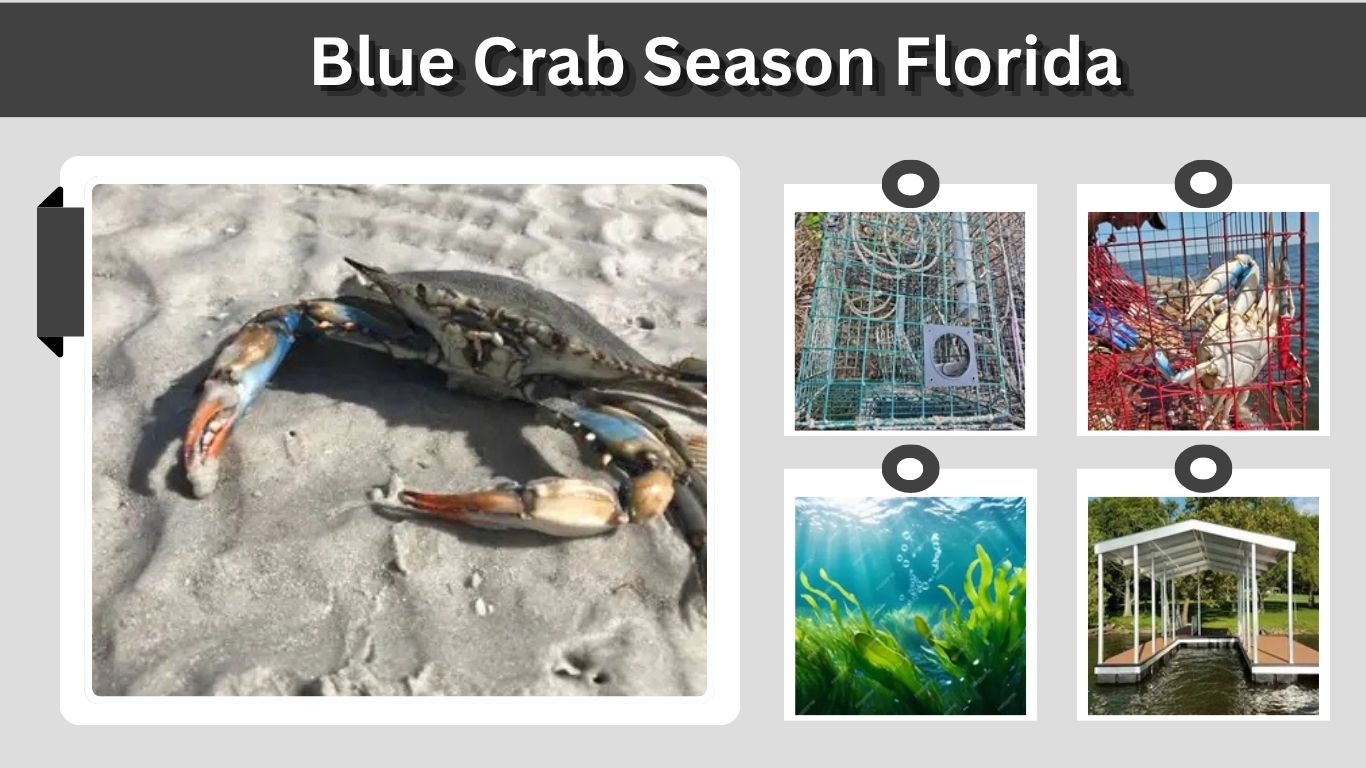
Florida blue crabs can be harvested during most of the year, making recreational crabbing possible across many coastal regions. However, the state has seasonal trap closures, licensing requirements, daily limits, and rules protecting egg-bearing females. Conditions also change with temperature, tides, salinity, and location. Understanding the current regulations helps crabbers avoid penalties while protecting future populations. This guide covers Florida’s 2026 blue crab season, legal gear, trap registration, size limits, productive habitats, and practical catching tips.
When Is Blue Crab Season in Florida?
Florida does not have one statewide closed season that prohibits all recreational blue crab harvesting. Crabs may generally be caught throughout the year, provided the area is open and the harvester follows current gear, bag, licensing, and trap rules.
Temporary regional closures apply specifically to standard blue crab traps. During these closures, blue crabs may still be harvested with approved alternatives such as dip nets and fold-up traps. Traps attached to private property, such as a private dock, are also excluded from the regional closures.
Best Time to Catch Blue Crabs
Blue crabs remain present throughout the year, but warmer months are often more productive because their feeding, movement, and molting activity increase as water temperatures rise. Their activity slows during winter, especially after cold weather.
On Florida’s Gulf Coast, spawning generally occurs from March through December. Atlantic Coast populations can spawn throughout the year, with stronger periods during winter through spring and again in late summer.
Early morning and evening can be productive times, particularly around moving tides. Crabbers should focus on shallow estuaries, tidal creeks, docks, marsh edges, and seagrass areas where food and shelter are available.
Florida Blue Crab Regulations for 2026
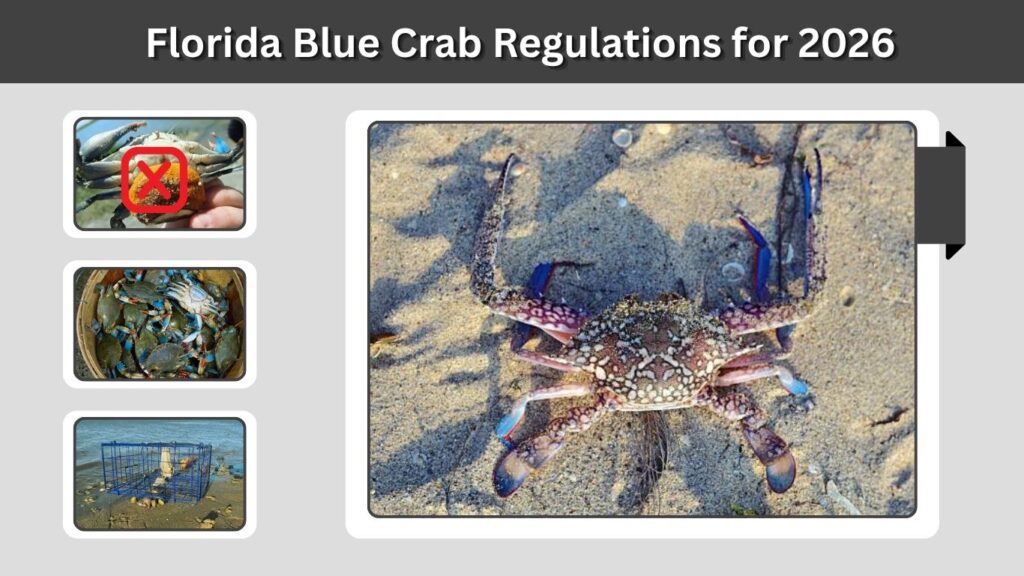
Florida’s recreational blue crab rules apply in both Gulf and Atlantic state waters. The basic limits are straightforward, but anyone using standard crab traps must also follow detailed construction and registration requirements.
| Regulation | Florida recreational rule |
| Minimum size | No recreational size limit |
| Daily bag limit | 10 gallons of whole crabs per harvester |
| Standard traps | Maximum of five per person |
| Egg-bearing females | Harvest prohibited |
| Crab snares | Not legal |
| Trap pulling | Daylight hours only |
| Trap registration | Required annually for users age 16 or older |
These are statewide recreational rules, although national parks, protected areas, local waterways, and federal waters may have additional restrictions.
Is There a Florida Blue Crab Size Limit?
Florida currently has no minimum recreational size limit for blue crabs. A crab does not have to reach a specific shell width before it can legally be retained.
Nevertheless, releasing very small crabs allows them to grow and reproduce. Many crabbers voluntarily keep only larger males and release small crabs and females as a conservation practice.
Can You Keep Female Blue Crabs?
A female may legally be kept when she is not carrying visible external eggs. However, harvesting an egg-bearing female is prohibited.
An egg-bearing female carries a sponge-like mass beneath her broad abdominal apron. The egg mass may look orange when newly produced and become darker as the embryos develop.
FWC encourages releasing females even when they are not visibly carrying eggs. Female blue crabs generally mate only once and can store sperm for later spawning, so protecting them can support population renewal.
Florida Blue Crab Trap Closures in 2026
Florida’s regional trap-removal program alternates between coasts. Closures occur on the Atlantic Coast in even-numbered years and on the Gulf Coast in odd-numbered years.
The following Atlantic regional trap closures apply in 2026:
- January 16–25: St. Johns River system and associated lakes and tributaries within the defined closure zone
- August 10–19: Brevard through Palm Beach counties, excluding the St. Johns River system
- August 20–29: Georgia–Florida state line south through Volusia County, excluding the St. Johns River system
The January St. Johns closure has already passed. Traps were scheduled to return to the water beginning January 26 unless the closure ended early. Regional closures can be shortened when trap-removal work finishes ahead of schedule.
A separate closure prohibits traps from September 20 through October 4 in Gulf waters beyond three nautical miles and applicable federal waters. Crabbers should check FWC notices immediately before setting traps because emergency orders and early reopenings can change scheduled dates.
Do You Need a License to Catch Blue Crabs?
Most recreational crabbers need an appropriate Florida saltwater fishing license unless they qualify for an exemption.
Anyone age 16 or older who uses standard recreational blue crab traps must also obtain the free annual Recreational Blue Crab Trap Registration. This requirement applies even to people normally exempt from buying a fishing license.
Registering a Blue Crab Trap
Registration is completed through Florida’s fishing-license system. After registering, the crabber receives a unique number beginning with the letter “B.”
Each trap must permanently display:
- The owner’s full name
- The owner’s address
- The FWC-issued registration number
The attached buoy must be at least six inches in size and marked with a clearly visible letter “R” at least two inches tall. Registration must be renewed annually, although the assigned number generally remains the same.
Legal Ways to Catch Florida Blue Crabs
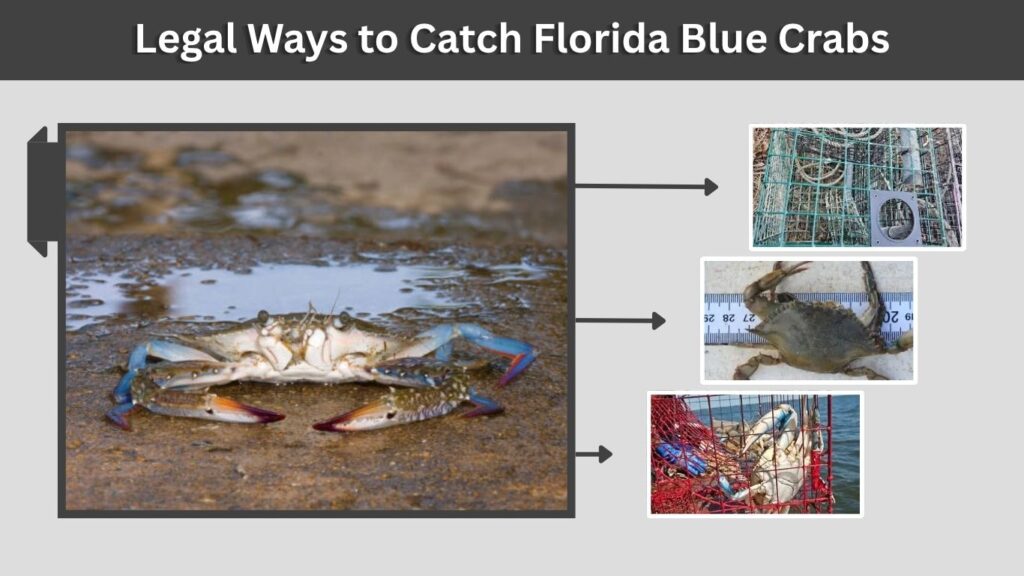
Florida allows several recreational harvesting methods. Legal gear includes standard blue crab traps, dip or landing nets, drop nets, fold-up traps, hook and line, push scrapes, and trotlines.
Crab snares are not considered legal blue crab gear in Florida. Standard traps must be pulled manually and only during daylight hours. They cannot be placed in marked navigation channels or pulled with mechanical equipment from a recreational vessel.
Standard Trap Requirements
A legal recreational trap must meet requirements that include:
- Maximum dimensions of 2 feet by 2 feet by 2 feet
- Mesh openings of at least 1½ inches
- Entrances no larger than 2 inches high by 6 inches wide at the narrowest point
- At least three escape rings measuring 2⅜ inches or larger
- A legally constructed degradable panel
- Permanently attached owner and registration information
These features allow undersized animals to escape, reduce diamondback terrapin bycatch, and prevent lost traps from continuing to capture wildlife indefinitely.
Where to Catch Blue Crabs in Florida
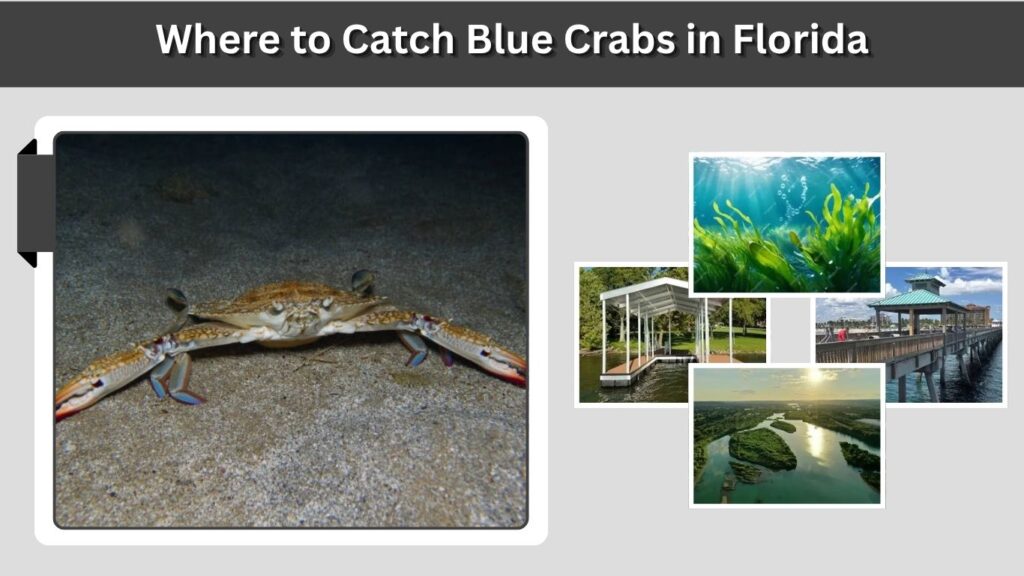
Blue crabs occur throughout Florida in freshwater, brackish, and saltwater environments. Juveniles depend heavily on seagrass and submerged vegetation, while adults use estuaries, bays, rivers, tidal creeks, coastal lagoons, and nearshore marine habitats.
Productive locations commonly include:
- Estuary shorelines
- Salt marshes and mangrove edges
- Tidal rivers and creeks
- Seagrass beds
- Public fishing piers
- Boat docks
- Sheltered bays
- Canal entrances
Well-known blue crab habitat exists around both Florida coasts, including the Panhandle bays, Tampa Bay region, southwest estuaries, Indian River Lagoon, St. Johns River system, and northeast Florida tidal waterways. Always confirm that crabbing is permitted at the exact access point before placing gear.
How to Catch Blue Crabs
Standard traps work well in deeper water, while drop nets and hand lines can be effective from docks, bridges, and shorelines.
Fish scraps and chicken are commonly used as bait. Secure the bait so crabs cannot pull it away without entering the trap or remaining above the net. UF/IFAS notes that blue crabs can be caught with traps, dip nets, or baited lines.
Simple Hand-Line Method
Tie bait securely to a strong line and lower it into shallow water. When a crab begins feeding, pull the line slowly toward the surface. Place a long-handled dip net behind and beneath the crab before lifting it from the water.
Move slowly because blue crabs release the bait when they detect sudden tension. Wear gloves or use tongs when handling them, as their claws can produce a painful pinch.
Florida Blue Crab Identification
The Atlantic blue crab’s scientific name is Callinectes sapidus. It has an olive-green or blue-green shell, bright blue legs and claws, sharp side spines, and paddle-shaped rear legs used for swimming.
Males usually have blue claws and a long, narrow abdominal apron. Mature females have wider, rounded aprons and often show red-orange claw tips. Adults can reach approximately nine inches across the carapace when measured from spine to spine.
Do not confuse the aquatic blue crab with Florida’s blue land crab. Blue land crabs have different limits, legal gear, and a closed harvest season from July 1 through October 31.
FAQs
Is blue crab season open year-round in Florida?
Recreational blue crab harvesting is generally available throughout the year. However, regional closures temporarily prohibit standard traps, and additional restrictions may apply in protected areas. Approved alternative gear may still be used during most regional trap closures.
What is the daily blue crab limit in Florida?
Each recreational harvester may keep up to 10 gallons of whole blue crabs per day. There is no statewide recreational minimum size, but egg-bearing females cannot be harvested or possessed.
How many blue crab traps can one person use?
A recreational harvester may use up to five standard blue crab traps. Users age 16 or older must obtain the free annual trap registration and permanently mark every trap with the required information.
What is the best bait for Florida blue crabs?
Fish scraps and chicken are commonly used because their scent attracts scavenging crabs. The bait should be secured inside a trap or firmly tied to a hand line so crabs cannot remove it easily.
Can you catch blue crabs with a dip net in Florida?
Yes. Dip or landing nets are legal recreational gear. They are useful along shallow shorelines, docks, and lighted areas where crabs can be seen. Dip nets may also be used when standard traps are prohibited during regional trap closures.