
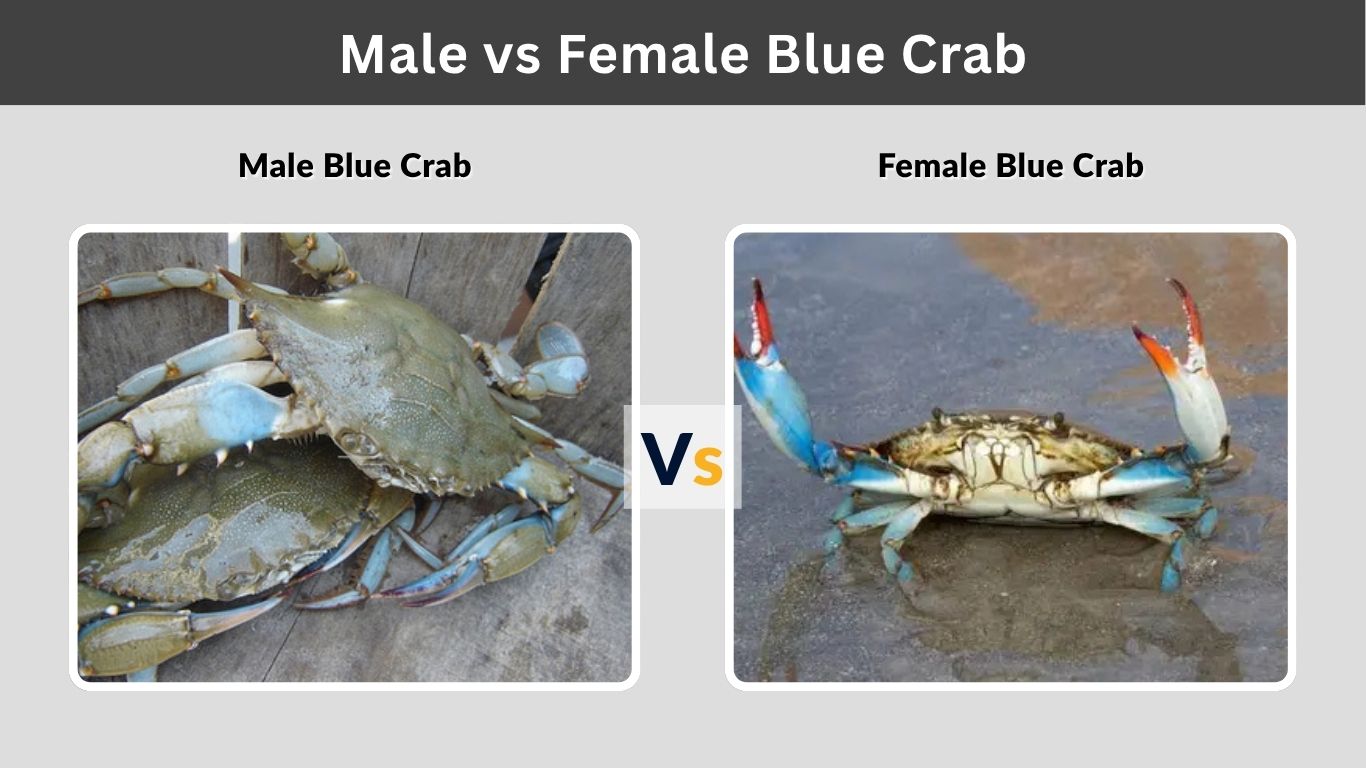
Male and female blue crabs may look similar from above, but several features make them easy to tell apart. The clearest difference is the abdominal flap, commonly called the apron, on the underside of the crab. Males have a narrow T-shaped apron, while mature females have a broad, rounded apron. Their claw colors, average size, reproductive roles, and meat can also differ. Understanding these characteristics helps crabbers identify legal catches, protect egg-bearing females, and select crabs for cooking.
Male vs Female Blue Crab: Quick Comparison
You do not need special equipment to determine whether a blue crab is male or female. Turn the crab over carefully and examine its apron and claws.
| Feature | Male Blue Crab | Female Blue Crab |
|---|---|---|
| Common name | Jimmy | Sook |
| Apron shape | Long, narrow, inverted T | Wide and rounded |
| Claw tips | Blue or blue-orange | Bright red or orange-red |
| Average build | Often larger and heavier | Usually smaller-bodied |
| Claws | Commonly larger | Commonly smaller |
| Mating | Can mate several times | Usually mates once |
| Eggs | Does not carry eggs | Carries eggs beneath apron |
| Meat | Often more total meat | Sometimes sweeter or richer |
| Roe | None | May contain orange roe |
How to Tell a Male Blue Crab From a Female
The apron is the most reliable identification feature. Claw color can help, but it should be used as a secondary clue because color intensity varies with age, molting stage, and individual condition.
Look at the Apron
The apron is the folded abdomen located in the middle of the crab’s underside. In an adult male, it resembles a narrow, elongated T or the Washington Monument. It remains relatively slim from the base to the pointed end.
A mature female has a broad, rounded apron that resembles a dome or an inverted U. This wider structure creates space for carrying a large egg mass. Texas Parks and Wildlife confirms that males have an inverted T-shaped apron, while the female apron is considerably broader.
Check the Claw Tips
Male blue crabs usually have blue claws with blue, orange, or reddish-orange tips. Females normally have brighter red or orange-red tips, which are sometimes compared to painted fingernails.
The upper portions of a female’s claws may still appear blue. Therefore, seeing blue claws does not automatically mean the crab is male. Look specifically at the claw tips and confirm the identification by checking the apron.
Compare Body and Claw Size
Male blue crabs are often larger, heavier, and equipped with more substantial claws. This is particularly noticeable when comparing mature crabs of a similar age.
However, size alone cannot determine sex. A mature female may be larger than a young male, while environmental conditions and access to food also affect growth. Always use the apron as the primary identification feature.
Mature vs Immature Female Blue Crab
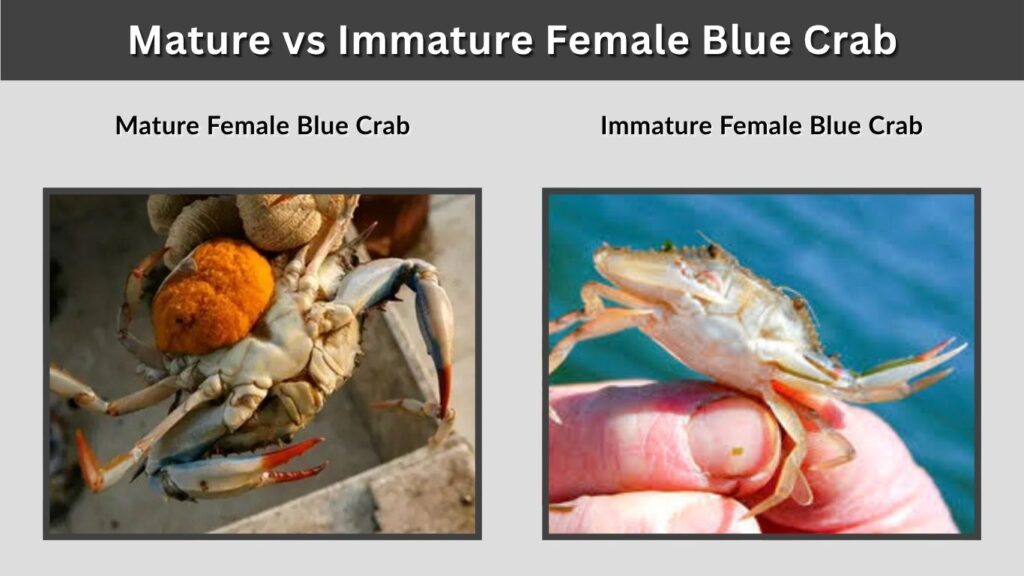
Female blue crabs change noticeably as they mature. Examining the apron allows crabbers to distinguish a juvenile female from an adult capable of reproduction.
Immature Female or “Sally”
An immature female is often called a Sally. Her apron is triangular and resembles an upside-down V. It is wider than a male’s T-shaped apron but much narrower than the rounded apron of a mature female.
The apron may also appear tightly sealed against the body. Depending on local regulations, keeping immature females may be prohibited even if they meet the general size requirement. Releasing them allows them to reach maturity and reproduce.
Mature Female or “Sook”
A mature female blue crab is commonly called a sook. Her apron is broad and rounded because it has expanded following her final molt.
The outer shell may also show reddish claw tips and mature coloration. Once a female reaches this stage, she generally does not molt again. This differs from males, which can continue molting and growing after reaching sexual maturity.
Is a Female With a Rounded Apron Pregnant?
A rounded apron only indicates that the crab is a mature female. It does not necessarily mean she is carrying eggs.
An egg-bearing female has a clearly visible sponge-like mass attached beneath her apron. If no external sponge is present, she may still be storing sperm or developing eggs internally, but this cannot be confirmed simply by looking at her shell.
Female Blue Crab Eggs and Sponge
Egg-bearing female blue crabs are commonly called sponge crabs because the egg mass beneath their abdomen resembles a soft sponge. These females are extremely important to the future crab population.
What Does a Blue Crab Egg Sponge Look Like?
A newly produced egg mass is usually bright yellow or orange. As the embryos develop, the sponge becomes brown and then nearly black before hatching.
The darkening occurs as the developing larvae become visible inside the eggs. A dark sponge is therefore closer to hatching than a bright orange one.
How Many Eggs Does a Female Blue Crab Carry?
An egg mass averages approximately two million eggs, although a large female may carry as many as eight million. The eggs attach to small appendages beneath the female’s apron, where she carries and aerates them until they hatch.
Although that number sounds enormous, only a tiny percentage survive. The larvae face predators, changing salinity, currents, limited food, and other environmental pressures before becoming adult crabs.
How Often Does a Female Blue Crab Reproduce?
A female generally mates once, shortly after her final molt. The male protects her while her new shell is soft, and she stores his sperm inside her body.
Stored sperm can remain viable for a year or longer. It allows the female to produce multiple egg masses without mating again. Depending on her health and environmental conditions, she may spawn several times during her reproductive period.
Male and Female Blue Crab Reproduction
Males and females use different parts of an estuary during their reproductive cycle. Their movements help explain why crabbers may catch mostly males in one location and mostly females in another.
Mating Behavior
A mature male can mate with multiple females during his lifetime. When he finds a female approaching her final molt, he carries and protects her in a behavior known as cradling.
After she sheds her old shell, mating occurs while her new shell remains soft. The male may continue protecting her until the shell hardens enough for her to defend herself.
Female Migration and Spawning
After mating, females often migrate toward saltier water near the mouth of an estuary. The higher salinity supports egg development and larval survival.
When ready to spawn, a female releases fertilized eggs onto the appendages beneath her apron. The larvae hatch into the water and pass through several free-swimming stages before returning to estuarine nursery habitats as young crabs.
In Florida, spawning can occur during much of the year because of warmer coastal conditions. In cooler regions, reproduction is more concentrated in spring and summer.
Male vs Female Blue Crab Taste
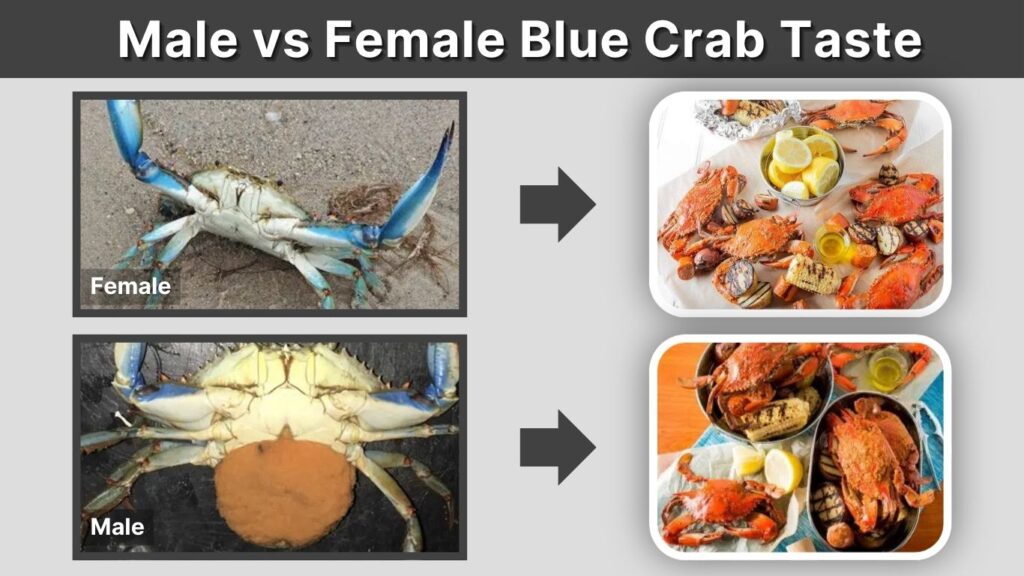
Both sexes are edible when legally harvested, and both can provide flavorful meat. Perceived differences in taste depend on the crab’s size, season, diet, shell condition, and whether the female contains roe.
Are Male Blue Crabs Better to Eat?
Many crab houses and seafood buyers prefer males because they tend to grow larger and may provide more meat per crab. Their larger claws can also be easier to pick.
Male meat is commonly described as flaky, mild, and slightly sweet. A heavy, full male caught late in the season may provide more usable meat than a smaller female.
What Do Female Blue Crabs Taste Like?
Female crabmeat is sometimes described as sweeter or more delicate. Mature females may contain orange roe, which has a rich, briny flavor and soft texture. Some diners consider roe a delicacy, while others prefer crabs without it.
The biological sex does not guarantee better flavor. A recently molted male may be light and watery, while a well-filled female may contain excellent meat. Shell hardness and weight are usually better quality indicators than sex alone.
Which Has More Meat?
Males generally provide more total meat because they often reach a larger size and develop heavier claws. However, meat yield varies considerably.
When selecting live crabs, compare their weight rather than relying only on shell width. A crab that feels heavy for its size is more likely to be full, whereas a light crab may have molted recently and contain less meat.
Can You Keep Female Blue Crabs?
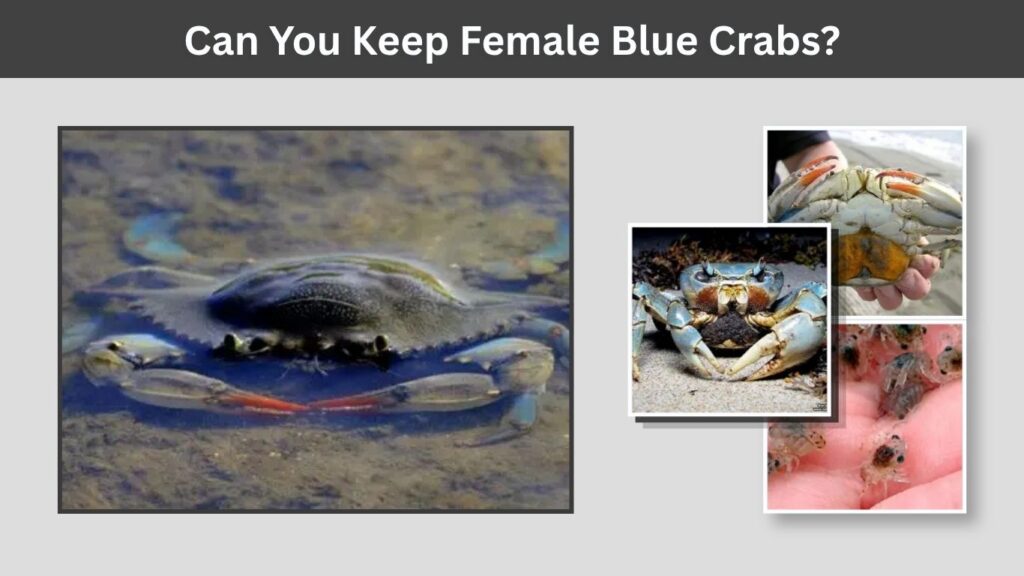
Whether a female blue crab can be legally kept depends on the state, season, size, maturity, and whether she is carrying eggs. Regulations can change, so check the rules for the exact water where you are crabbing.
Egg-Bearing Females
Egg-bearing sponge crabs are protected in many states and should be returned gently to the water. Never scrape off the egg sponge to make a crab appear legal.
Texas prohibits possession of egg-bearing blue crabs and females whose aprons have been removed.
Florida allows the harvest of females that are not carrying eggs, but the state encourages crabbers to release females as a conservation practice.
Maryland and Other Coastal States
Maryland regulations differ by location, season, crab maturity, and recreational or commercial status. Restrictions may apply to female hard crabs, immature females, soft crabs, and egg-bearing females.
North Carolina prohibits recreational possession of immature females and places additional seasonal protection on certain sponge crabs. South Carolina requires egg-bearing females to be released. Always consult the current state wildlife or marine-fisheries agency before harvesting.
Why Releasing Females Matters
A single mature female can produce millions of eggs and several egg masses. However, she usually mates only once. Removing her before she spawns can therefore eliminate a significant amount of potential reproduction.
Releasing mature females—especially sponge crabs—helps maintain the breeding population and supports future recreational and commercial harvests.
Female Blue Crab Anatomy
Apart from the rounded apron and reproductive organs, a female blue crab shares the same basic anatomy as a male. She has a hard carapace, two claws, three pairs of walking legs, and a final pair of paddle-shaped swimming legs.
The apron protects her reproductive openings and the appendages used to hold eggs. During spawning, eggs pass from her body, become fertilized by stored sperm, and attach beneath the apron. She then carries, cleans, and aerates the egg mass until the larvae hatch.
FAQs
What is a female blue crab called?
A mature female blue crab is commonly called a sook. An immature female with a triangular apron is often called a Sally. An adult female carrying an external egg mass is known as a sponge crab.
Are female blue crabs bigger than males?
Males are generally larger and develop heavier claws, but individual size varies. A mature female can be larger than a young male. Apron shape, rather than body size, is the most reliable way to identify sex.
Can you eat female blue crabs?
Yes, legally harvested females are edible and may have sweet meat and flavorful orange roe. However, egg-bearing females are protected in many places, while some states also restrict mature or immature females. Check local regulations before keeping one.
Do female blue crabs die after laying eggs?
A female does not necessarily die immediately after releasing one egg mass. She can use stored sperm to produce multiple broods. Nevertheless, adult females have a relatively short lifespan, and many die after completing their reproductive cycle.
Is a blue swimmer crab the same as a blue crab?
No. The Atlantic blue crab is Callinectes sapidus. Blue swimmer crabs generally belong to the genus Portunus and inhabit Indo-Pacific waters. Both have paddle-shaped rear legs, but their markings, ranges, biology, and harvesting regulations differ.