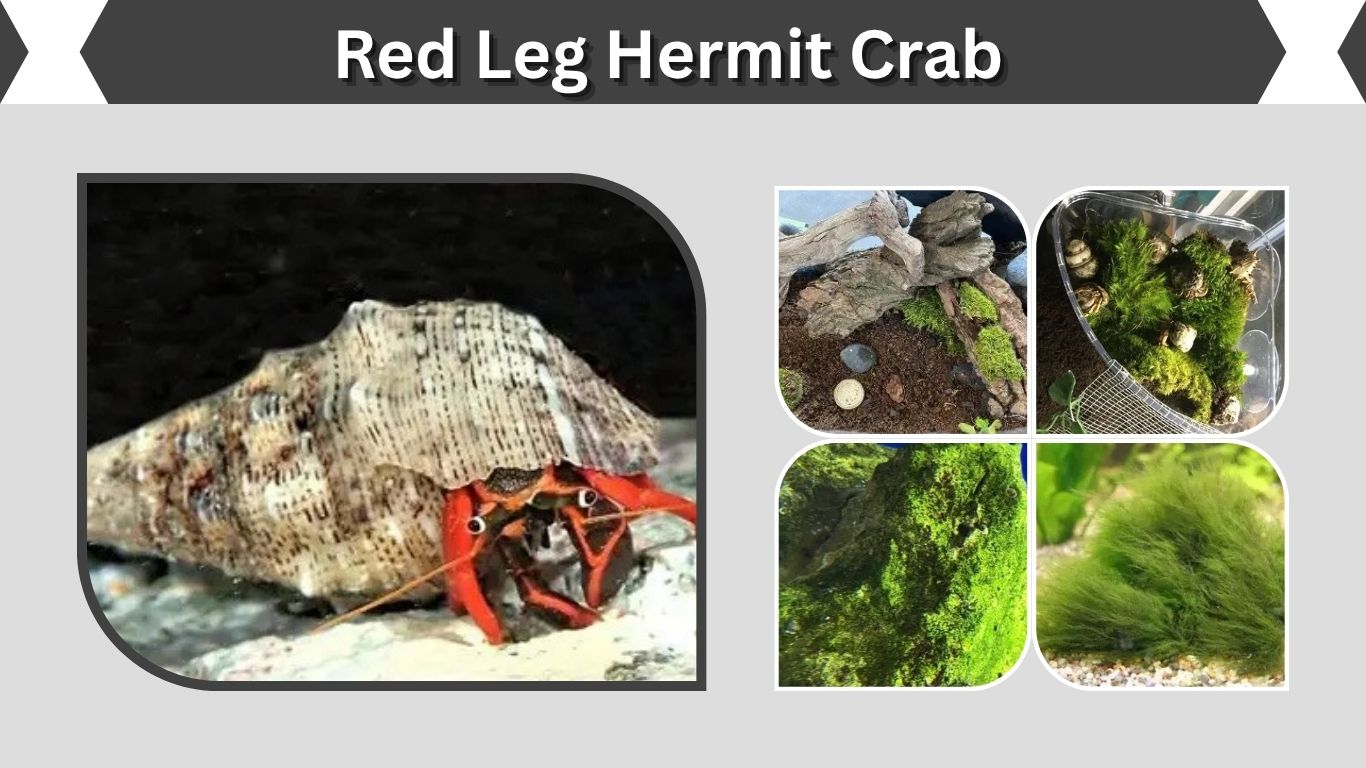
The red leg hermit crab is a colorful marine scavenger commonly kept in saltwater and reef aquariums. It is valued for eating algae, leftover food, and decaying organic matter while searching between rocks and across the substrate. However, “red leg hermit crab” is a common trade name applied to several species. The best-known is the scarlet reef hermit crab, Paguristes cadenati, which has bright red legs and yellow eyestalks. Proper identification is important because size, behavior, and reef compatibility can differ among species.
What Is a Red Leg Hermit Crab?
The name most commonly refers to the scarlet reef hermit crab, also called the red reef or red-legged hermit crab. Its accepted scientific name is Paguristes cadenati. This species belongs to the family Diogenidae and naturally occurs in the Caribbean region.
Several other marine hermit crabs may also be sold under similar names:
| Common trade name | Scientific identity | General range |
| Scarlet reef hermit crab | Paguristes cadenati | Caribbean |
| Mexican red-leg hermit crab | Clibanarius digueti | Western Mexico and Gulf of California |
| Dwarf red-tip hermit crab | Often sold as Clibanarius species | Tropical eastern Pacific |
| Red hairy hermit crab | Various larger species | Depends on species |
The Mexican red-leg hermit crab is a separate accepted species called Clibanarius digueti. It often has reddish or spotted legs, long reddish antennae, and noticeable blue eyes.
Red Leg Hermit Crab Identification
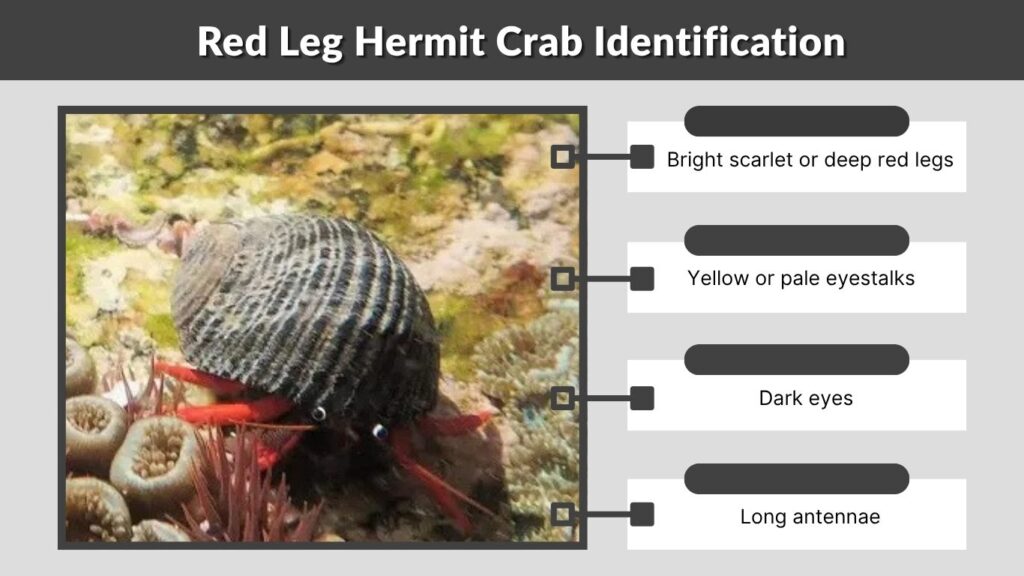
Scarlet reef hermit crabs are small but visually striking. Their strong coloration makes them easy to notice as they move around live rock.
Color and Appearance
Typical identification features include:
- Bright scarlet or deep red legs
- Red claws of similar size
- Yellow or pale eyestalks
- Dark eyes
- Long antennae
- A compact, soft abdomen hidden inside a shell
- A total leg span of roughly one to two inches
The scarlet reef hermit crab is generally described as a small Caribbean species measuring around three centimeters across, although apparent size changes according to the shell it occupies.
Red Leg vs Red Hairy Hermit Crab
A red hairy hermit crab is usually larger, darker, and covered with visible hairs or bristles. Some large hairy species can become aggressive and may disturb snails, corals, or smaller crustaceans.
The scarlet reef hermit has smoother, brighter legs and remains considerably smaller. Buyers should confirm the scientific name rather than relying entirely on a store label.
Natural Habitat
Scarlet reef hermit crabs naturally inhabit warm Caribbean marine environments. They move among rocks, coral rubble, sand, and reef structures where they can find algae, carrion, and organic debris.
They are fully marine animals and must remain underwater. They are not related to the commonly kept terrestrial hermit crabs that live in humid land tanks.
Are Red Leg Hermit Crabs Freshwater?
No. Red leg reef hermit crabs require saltwater. Placing one in freshwater or a land-hermit enclosure would cause severe stress and death.
A suitable aquarium must be fully cycled before the crab is introduced. Ammonia and nitrite should remain at zero, while temperature, salinity, and pH should remain stable.
Red Leg Hermit Crab Care
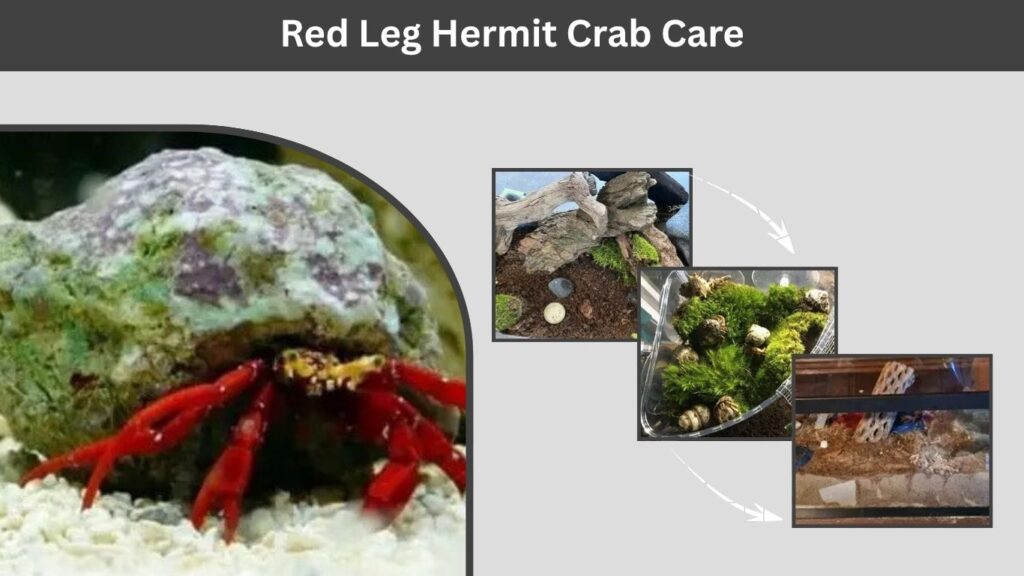
Red leg hermit crabs are often considered relatively easy marine invertebrates, but they are sensitive to poor water quality, sudden salinity changes, and copper.
Aquarium Setup
A suitable habitat should contain:
- A mature, cycled saltwater aquarium
- Live rock with hiding and grazing surfaces
- Sand or fine marine substrate
- Stable tropical water conditions
- Moderate circulation and good oxygenation
- Several empty natural shells
- Algae and other natural foods
- Secure rockwork that cannot collapse
A small group may be kept in a modest marine tank, but available food, shell choices, and bottom space are more important than simply counting gallons.
Water Conditions
A practical range for many red-legged marine hermits is:
| Requirement | Suitable range |
| Temperature | About 72–79°F |
| pH | Approximately 8.1–8.4 |
| Specific gravity | Around 1.023–1.026 |
| Ammonia | 0 ppm |
| Nitrite | 0 ppm |
| Nitrate | Kept low |
Stability is essential. Rapid acclimation can expose the crab to sudden changes in salinity or pH, so gradual drip acclimation is usually safer.
Copper-based medications should never be used in a display aquarium containing hermit crabs or other marine invertebrates.
What Do Red Leg Hermit Crabs Eat?

Red-legged hermit crabs are opportunistic omnivores and scavengers. They spend much of their time searching rocks and substrate for edible material.
Their diet may include:
- Film algae
- Hair algae
- Detritus
- Uneaten fish food
- Decaying animal material
- Small pieces of marine algae
- Fish pellets and flakes
- Frozen marine foods
- Biofilm growing on rocks
Scarlet reef hermits are commonly added to cleanup crews because they consume algae and debris in established aquariums. However, they should not be expected to survive entirely on waste. Supplemental feeding is necessary when the aquarium contains little natural algae or leftover food.
Suitable supplemental foods include sinking marine pellets, dried seaweed, mysis shrimp, finely chopped seafood, and quality invertebrate foods.
Are Red Leg Hermit Crabs Reef Safe?
Scarlet reef hermit crabs are generally considered reef safe because they do not normally eat healthy corals. They are widely kept in reef aquariums as algae grazers and scavengers.
However, “reef safe” does not mean completely risk-free. A hungry crab may investigate:
- Dying coral tissue
- Weak or dead snails
- Small sessile invertebrates
- Food trapped between coral branches
- Snails carrying desirable shells
A crab climbing over a coral can also cause it to close temporarily. Larger red hermit species may accidentally knock over loose coral fragments with their shells.
Will Red Leg Hermit Crabs Kill Snails?
They may attack a snail when food is scarce or when the snail has a shell the crab wants. This risk can be reduced by providing regular food and a variety of correctly sized empty shells.
Even with extra shells, occasional conflict remains possible because hermit crabs are opportunistic animals rather than perfectly predictable aquarium cleaners.
Shell Requirements
A hermit crab does not grow its own protective shell. As its body grows, it searches for larger empty gastropod shells.
Provide several shells for every crab, including options that are:
- Slightly smaller than its current shell
- Approximately the same size
- Slightly larger
- Similar in opening shape
- Natural and unpainted
- Free from sharp or broken edges
Do not force a crab out of its shell. A naked hermit crab is extremely vulnerable and should immediately be offered several suitable shells in a protected area.
Red Leg Hermit Crab Lifespan
The exact lifespan of scarlet reef hermit crabs is not well documented in controlled aquarium studies. Captive survival varies with water quality, diet, molting success, shell availability, predation, and correct species identification.
A properly maintained crab may survive for several years. Very short survival often points to unstable salinity, incomplete acclimation, starvation, copper exposure, aggressive tank mates, or a failed molt.
Molting Behavior
Red leg hermit crabs must molt their exoskeleton to grow. Before molting, a crab may eat less, hide for long periods, or remain unusually still.
After shedding, the new exoskeleton is soft and vulnerable. The crab usually hides until it hardens and may eat part of the discarded exoskeleton to recover minerals.
Never assume that a motionless crab is dead without checking carefully. A successful molt can leave behind an empty exoskeleton that resembles a complete crab.
Red Leg vs Blue Leg Hermit Crab
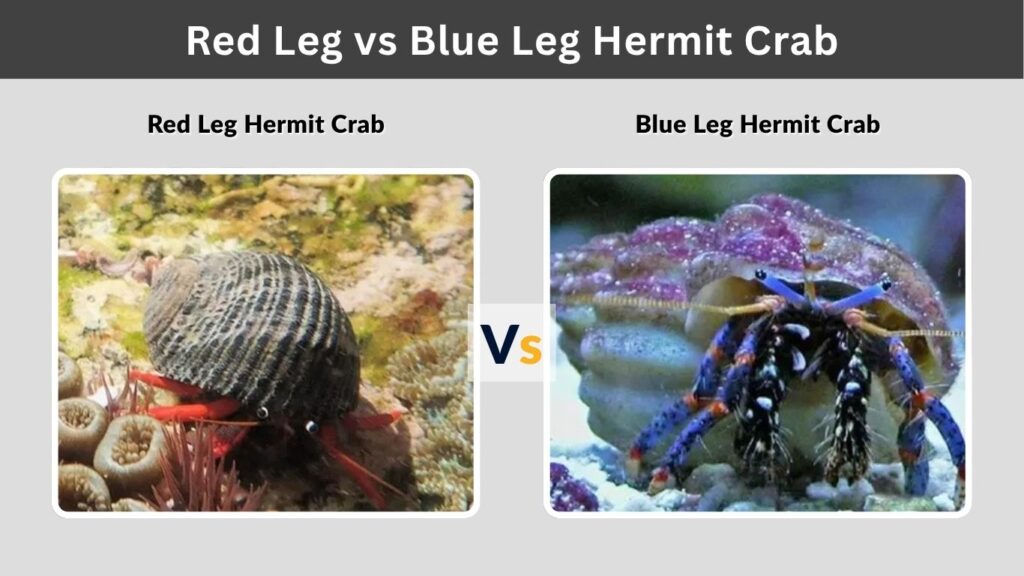
Both are popular members of saltwater cleanup crews, but they differ in appearance and behavior.
| Feature | Scarlet red-leg hermit | Blue-leg hermit |
| Typical color | Bright red legs | Blue legs with dark bands |
| Common scientific name | Paguristes cadenati | Often Clibanarius tricolor |
| General temperament | Usually peaceful | Often more active and competitive |
| Adult size | Small | Very small to small |
| Diet | Algae and detritus | Algae and detritus |
| Reef safety | Generally reef safe | Generally reef safe |
| Snail risk | Possible | Possible |
Red and blue-leg hermits can sometimes share an aquarium when there is enough food, space, live rock, and a large selection of spare shells. Monitor them for fighting, especially after new crabs are introduced.
Buying a Healthy Red Leg Hermit Crab
Choose an active crab that responds when approached and holds its body securely inside its shell.
Avoid specimens showing:
- Missing multiple legs
- A cracked or severely damaged shell
- No response to gentle disturbance
- A bad smell
- Blackened or deteriorating limbs
- Heavy visible parasites
- Inability to remain upright
Missing a single leg is not always fatal because hermit crabs may regenerate limbs during future molts. Quarantine is useful when practical, particularly when the crab comes from a tank containing diseased fish or unhealthy invertebrates.
FAQs
Are red leg hermit crabs nocturnal?
They may be active during both day and night, but many become more active after the aquarium lights dim. Activity depends on food availability, tank mates, shelter, and how secure the crab feels.
Do red leg hermit crabs eat red slime algae?
They may graze on cyanobacterial films, commonly called red slime algae, but they cannot reliably solve a major outbreak. Excess nutrients, weak circulation, trapped waste, and lighting conditions must also be corrected.
Can red and blue-leg hermit crabs live together?
They can often coexist in a sufficiently large aquarium. Provide ample food, hiding spaces, and many empty shells. Individual behavior varies, so remove a crab that repeatedly attacks others.
How many red leg hermit crabs should I keep?
Stocking depends on aquarium size and the amount of available algae and detritus. Begin with a small number and add more only when the tank produces enough natural food. Overstocking can lead to starvation and conflict.
Is a red leg hermit crab the same as a red king crab?
No. A red king crab is a huge cold-water crustacean that can develop a leg span measured in feet. A red leg hermit crab is a small shell-dwelling marine scavenger commonly kept in tropical saltwater aquariums.