
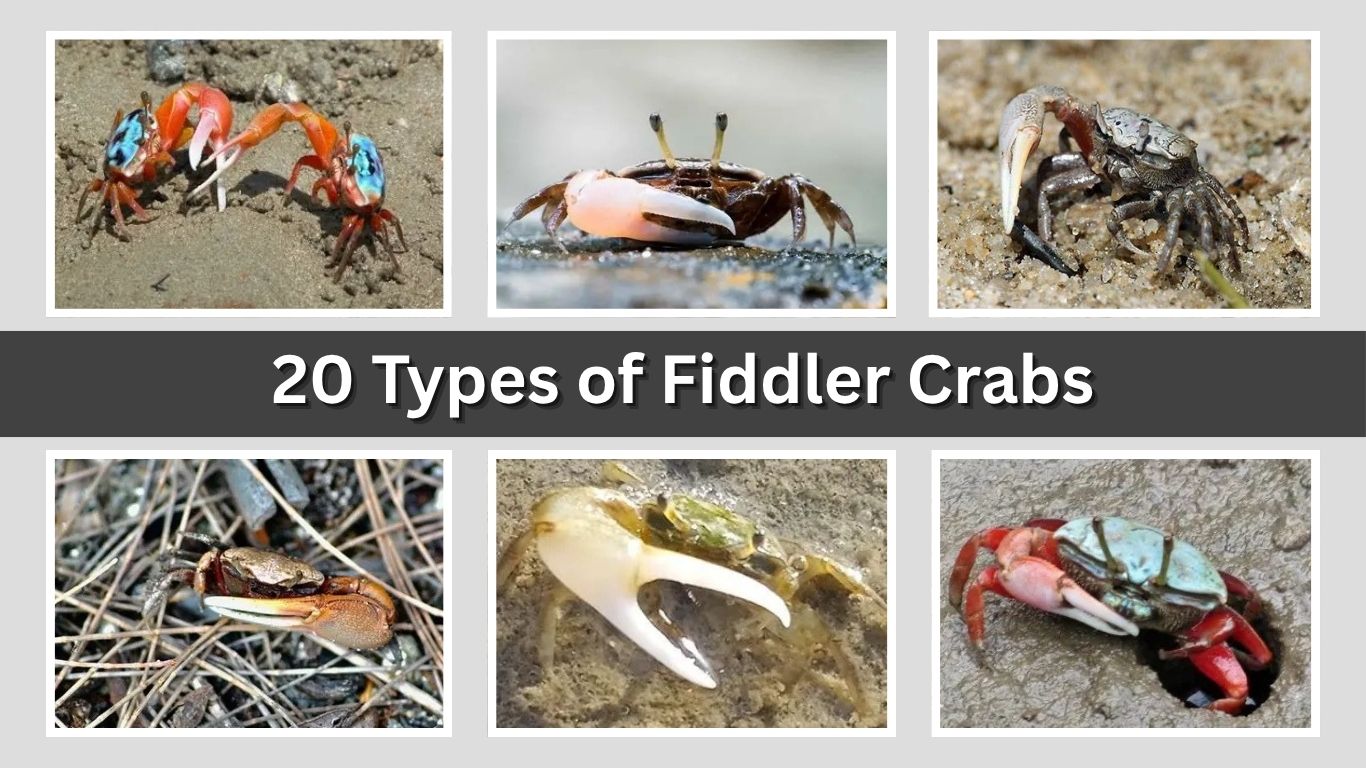
Fiddler crabs are small, semiterrestrial crustaceans recognized by the male’s dramatically enlarged claw. More than 100 species inhabit mangroves, salt marshes, estuaries, sandy beaches, and intertidal mudflats worldwide. Their colors range from pale white and yellow to brilliant orange, red, blue, and purple. Each species has distinctive features, habitat preferences, and geographic ranges. This guide explores 25 types of fiddler crabs, including their identification, distribution, diet, and fascinating behaviors.
1. West African Fiddler Crab
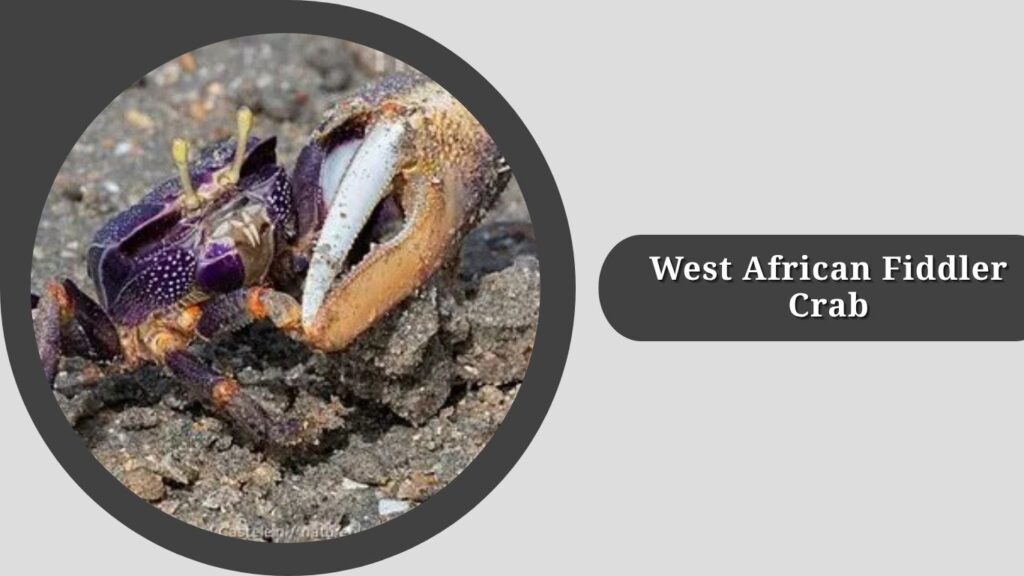
The West African fiddler crab (Afruca tangeri) is a large, highly recognizable species found along the eastern Atlantic coast. Males possess an oversized claw used for courtship, communication, and competition, while females have two small claws.
Identification
- Scientific name: Afruca tangeri
- Carapace width: Up to approximately 5 cm
- Color: Usually brown, gray, or purplish
- Male claw: Large, pale, and strongly curved
- Females: Two similarly sized feeding claws
Habitat and Distribution
This fiddler crab occurs from southern Portugal to Angola. It commonly occupies estuaries, tidal creeks, salt marshes, and intertidal mudflats. Each crab digs a burrow that provides shelter from predators, high temperatures, dehydration, and rising tides.
Diet and Feeding
West African fiddler crabs feed primarily on algae, bacteria, microorganisms, and decomposing organic material found in sediment. They scoop mud into their mouths, separate edible particles, and leave behind small processed sediment pellets.
Behavior
Males wave their enormous claws to attract females and warn competing males. They may also use the claw during territorial disputes. These crabs generally emerge during low tide to feed and socialize before returning to their burrows as the water rises.
2. White-Handed Fiddler Crab
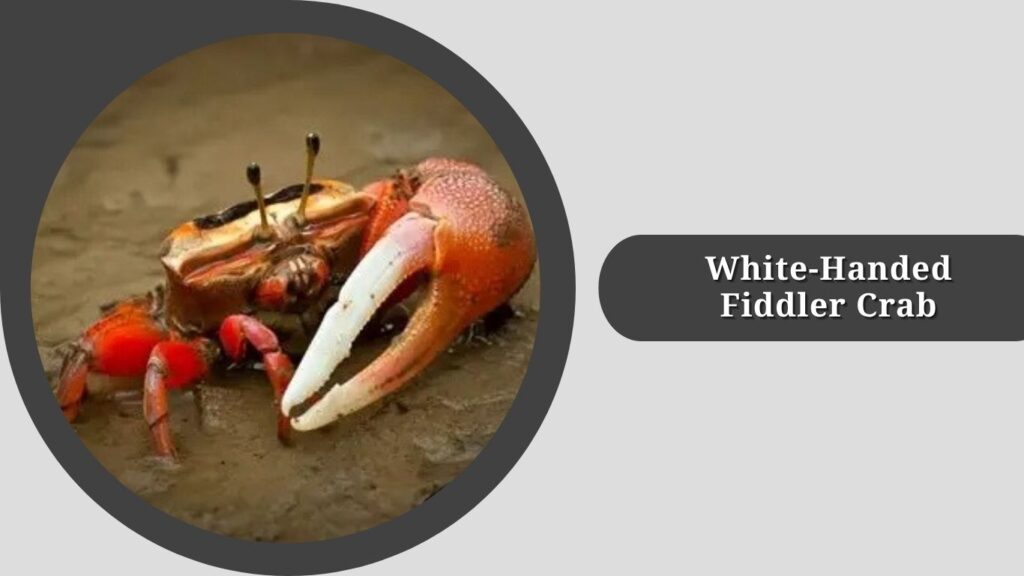
The white-handed fiddler crab (Austruca albimana) is a small coastal crab named after the pale oversized claw of the male. It belongs to a group of broad-fronted fiddler crabs adapted to warm intertidal environments.
Identification
- Scientific name: Austruca albimana
- Color: Brown, gray, or mottled
- Male claw: Creamy white or pale yellow
- Body shape: Small with a relatively broad front
- Females: Two small, equal-sized claws
Habitat and Distribution
This species occurs from northern Somalia to the eastern United Arab Emirates. Its range includes the Red Sea, Gulf of Aden, Socotra, southern Gulf of Oman, and southeastern Persian Gulf. It lives on sandy or muddy coastal flats near mangroves and estuaries.
Diet and Feeding
The white-handed fiddler crab collects sediment with its smaller claw and passes it to specialized mouthparts. It extracts microscopic algae, bacteria, detritus, fungi, and other organic particles before discarding the cleaned sediment.
Behavior
Males wave their pale major claws during courtship displays. The movements help females locate potential partners and allow neighboring males to recognize territorial boundaries. Burrows provide protection during high tide and offer a humid refuge from the intense daytime heat.
3. Ring-Legged Fiddler Crab
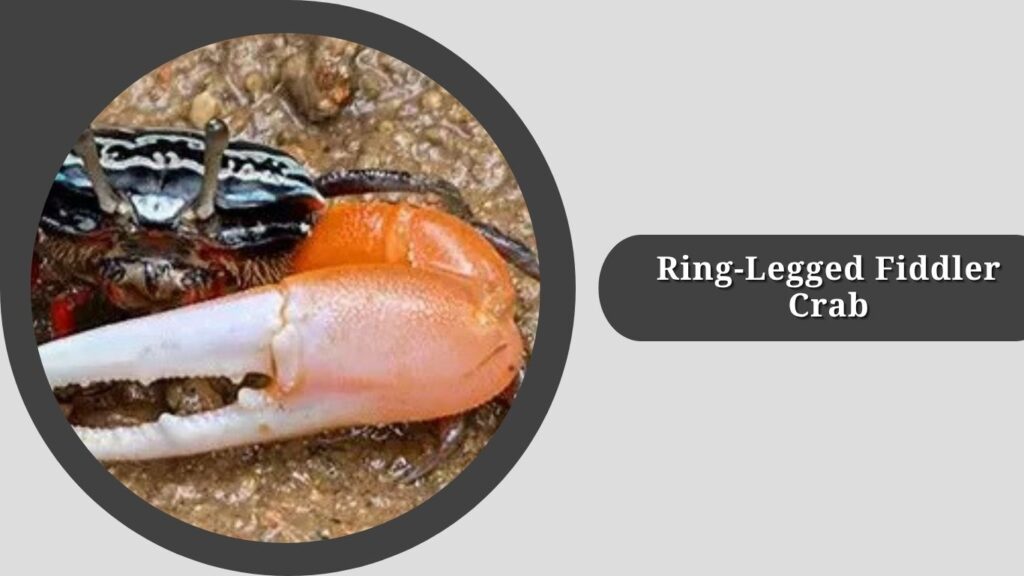
The ring-legged fiddler crab (Austruca annulipes) is a widespread Indo-West Pacific species. Its banded walking legs and the enlarged claw of the male make it relatively easy to recognize, although its coloration can vary among locations and individuals.
Identification
- Scientific name: Austruca annulipes
- Color: Brown, gray, cream, or mottled
- Legs: Commonly marked with dark and pale bands
- Male claw: Large and usually pale
- Body: Small with a broad frontal region
Habitat and Distribution
This species has an extensive range extending from eastern and southern Africa across India and Southeast Asia. It also occurs in Bangladesh, including coastal mangroves around Cox’s Bazar and St. Martin’s Island. It favors sandy mudflats, estuaries, and mangrove edges.
Diet and Feeding
Ring-legged fiddler crabs consume algae, microbes, fungi, and decaying plant or animal material within the substrate. Feeding activity produces small balls of processed sand or mud around the entrances of their burrows.
Behavior
The crabs are most active when low tide exposes their feeding grounds. Males defend small territories and wave their major claws to attract females. When threatened, individuals quickly retreat underground. Their burrowing activity also mixes and aerates coastal sediment.
4. Bengal Fiddler Crab
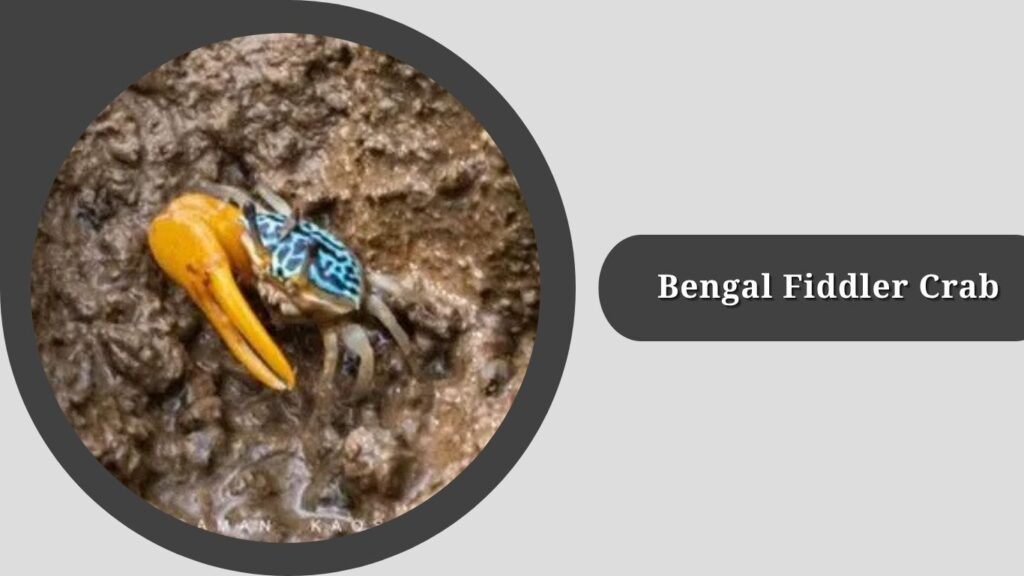
The Bengal fiddler crab (Austruca bengali) is a colorful broad-fronted species associated with tropical coastal wetlands. It has been recorded in Bangladesh’s Kuakata National Park and is particularly suited to muddy or sandy-mud intertidal habitats.
Identification
- Scientific name: Austruca bengali
- Carapace: Broad, hexagonal, and sometimes barred
- Color: Brown, yellowish, gray, or mottled
- Male claw: Enlarged and often yellowish
- Claw position: May occur on either side
Habitat and Distribution
Bengal fiddler crabs occur in coastal areas of South and Southeast Asia. They inhabit mangrove forests, estuaries, sheltered mudflats, and the middle-to-upper parts of intertidal zones. Their distribution is influenced by salinity, sediment texture, moisture, and tidal exposure.
Diet and Feeding
This species feeds by collecting thin layers of surface sediment. Organic particles, microscopic algae, bacteria, fungi, and decomposed vegetation are separated by the mouthparts, while the remaining sediment is deposited nearby.
Behavior
Males use their enlarged claws for rhythmic waving displays and competition over burrows. Their coloration may appear brighter or duller depending on age, environmental conditions, and activity. Both sexes remain close to their burrows and retreat rapidly when predators approach.
5. Citrus Fiddler Crab
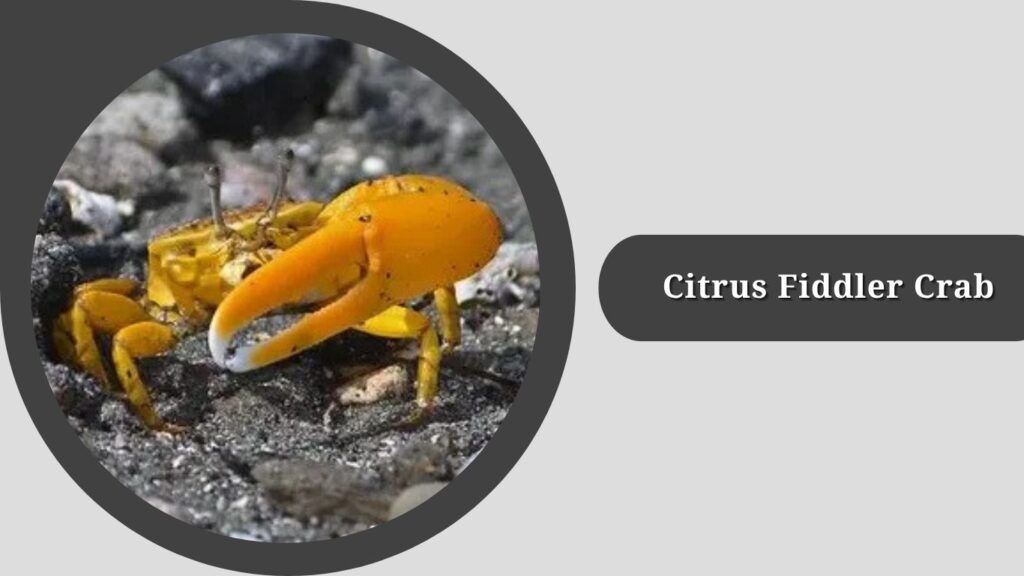
The citrus fiddler crab (Austruca citrus), also called the lemon fiddler crab, is a brightly colored species described in 2020. Its vivid yellow male claw inspired its citrus-themed name and distinguishes it from several related Indo-Pacific fiddler crabs.
Identification
- Scientific name: Austruca citrus
- Alternative name: Lemon fiddler crab
- Male claw: Large and bright yellow
- Carapace: Mottled brown, cream, and yellow
- Body form: Small with a broad front
Habitat and Distribution
The citrus fiddler crab is known from Fiji and Wallis in the southwestern Pacific. It occupies upper intertidal areas containing sand, muddy sand, or fine coastal sediment. Burrows are generally constructed above the lowest tidal level but remain connected to moist substrate.
Diet and Feeding
Like related species, it feeds on microscopic algae, bacteria, fungi, and decomposing organic matter. The smaller claw collects sediment and repeatedly carries it to the mouth. Males cannot efficiently feed with their oversized yellow claw.
Behavior
Male citrus fiddler crabs display their yellow claws to communicate and attract females. They remain active on exposed flats during low tide but quickly enter their burrows when disturbed. Their burrowing and feeding help redistribute organic material and improve sediment aeration.
6. Iranian Fiddler Crab
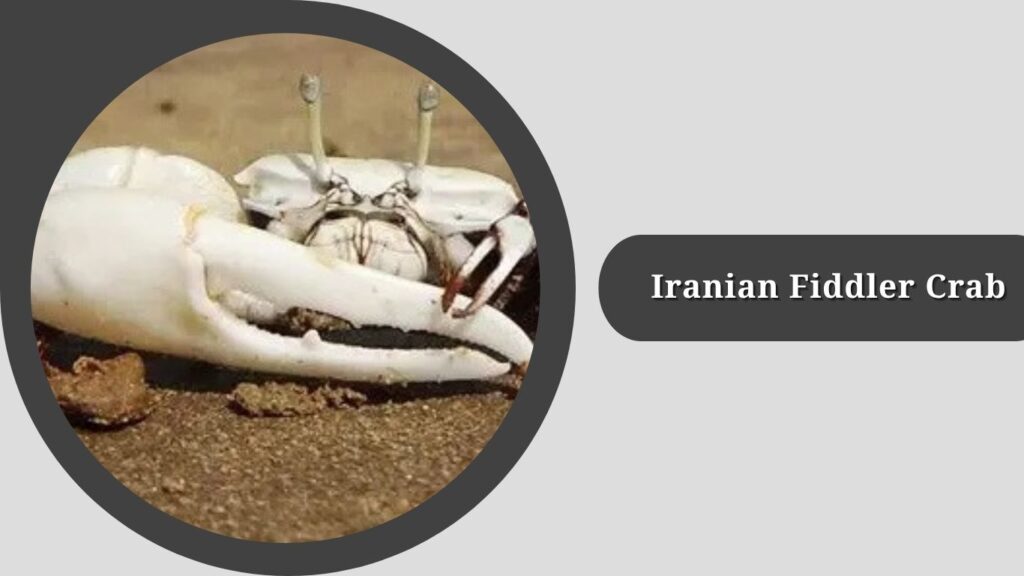
The Iranian fiddler crab (Austruca iranica) is a small broad-fronted crab found around the northern Arabian Sea and Persian Gulf. It was previously treated as a form of other fiddler crabs but is now recognized as a separate species.
Identification
- Scientific name: Austruca iranica
- Average carapace width: Around 9 mm
- Body color: Gray, brown, or mottled
- Male claw: Large and generally pale
- Female claws: Small and equal in size
Habitat and Distribution
This species occurs from Kuwait and the northeastern United Arab Emirates to Iran and Pakistan. It is particularly abundant along some muddy and sandy shores around Karachi. Iranian fiddler crabs prefer upper intertidal flats, estuaries, sheltered bays, and mangrove environments.
Diet and Feeding
Iranian fiddler crabs gather surface sediment using their small feeding claws. Their mouthparts separate algae, bacteria, fungi, microorganisms, and decomposing organic particles from the sand or mud. Processed sediment is deposited as small pellets around the feeding area.
Behavior
The crabs usually leave their burrows when the tide recedes. Males wave their enlarged claws to attract females and signal to rivals. Their burrows provide moisture, protection from predators, and shelter from the region’s intense heat and changing tides.
7. Milky Fiddler Crab
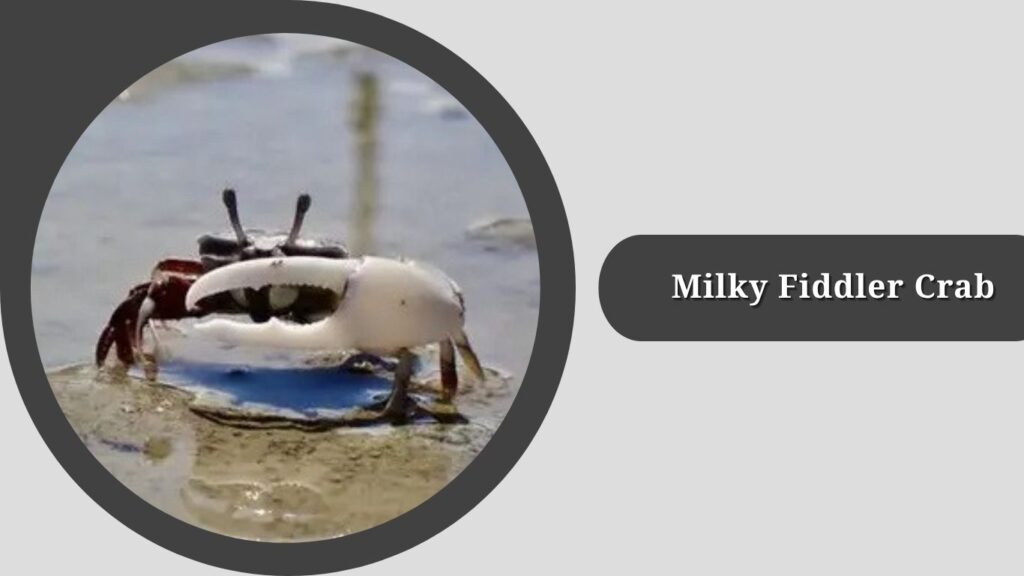
The milky fiddler crab (Austruca lactea) receives its common name from the creamy-white coloration frequently displayed by adult males. However, its appearance can vary considerably, with dark markings occurring across the shell and red coloration sometimes appearing on the legs.
Identification
- Scientific name: Austruca lactea
- Carapace: White with black or dark-brown markings
- Male claw: Predominantly white or pale yellow
- Legs: White, brown, or reddish
- Body shape: Small and broad-fronted
Habitat and Distribution
This species occurs in Japan, Korea, China, Taiwan, and northern Vietnam. It lives on sheltered tidal flats containing sand, sandy mud, or fine sediment. It is commonly associated with estuaries, mangrove edges, and protected coastal wetlands.
Diet and Feeding
Milky fiddler crabs obtain food by passing sediment through their mouthparts. They consume microscopic algae, bacteria, fungi, detritus, and decomposing plant material. The male must perform most feeding activities with its small claw because the major claw is unsuitable for collecting sediment.
Behavior
Males use their white claws in conspicuous waving displays during courtship. They also defend burrows and small feeding territories against neighboring crabs. Habitat destruction and modification of tidal flats have caused local population declines, particularly in parts of Japan.
8. Banana Fiddler Crab
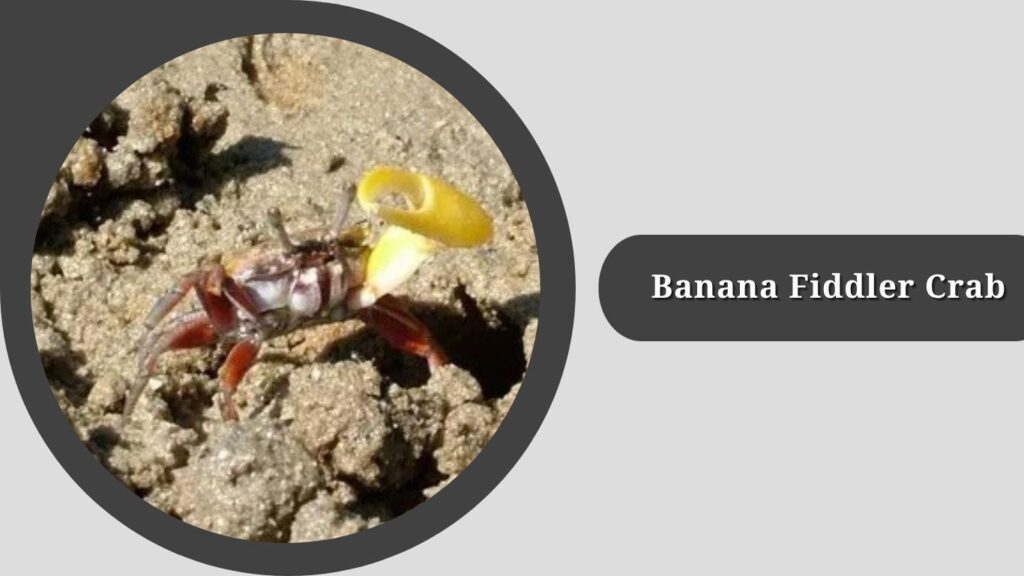
The banana fiddler crab (Austruca mjoebergi) is a small Australian species known for the bright yellow or orange major claw of the male. This colorful claw resembles a banana and plays an important role in courtship and territorial competition.
Identification
- Scientific name: Austruca mjoebergi
- Male carapace width: Around 10 mm
- Female carapace width: Around 9 mm
- Male claw: Yellow, orange, or cream
- Carapace: Brown, gray, or mottled
Habitat and Distribution
Banana fiddler crabs occur along northern and northwestern Australia, from the Dampier region to the Gulf of Carpentaria. Populations are also reported from nearby parts of Indonesia and New Guinea. They inhabit exposed intertidal mudflats and sheltered mangrove environments.
Diet and Feeding
These crabs feed on organic particles found in surface sediment, including algae, microbes, fungi, and decaying vegetation. Females can feed with both claws, while males use only their smaller claw to collect and process food.
Behavior
Males gather around searching females and compete through rapid claw-waving displays. Females may compare several males before choosing a partner. Males also grapple with rivals over territories and burrows, sometimes pushing, lifting, or attempting to dislodge their opponents.
9. East African Fiddler Crab
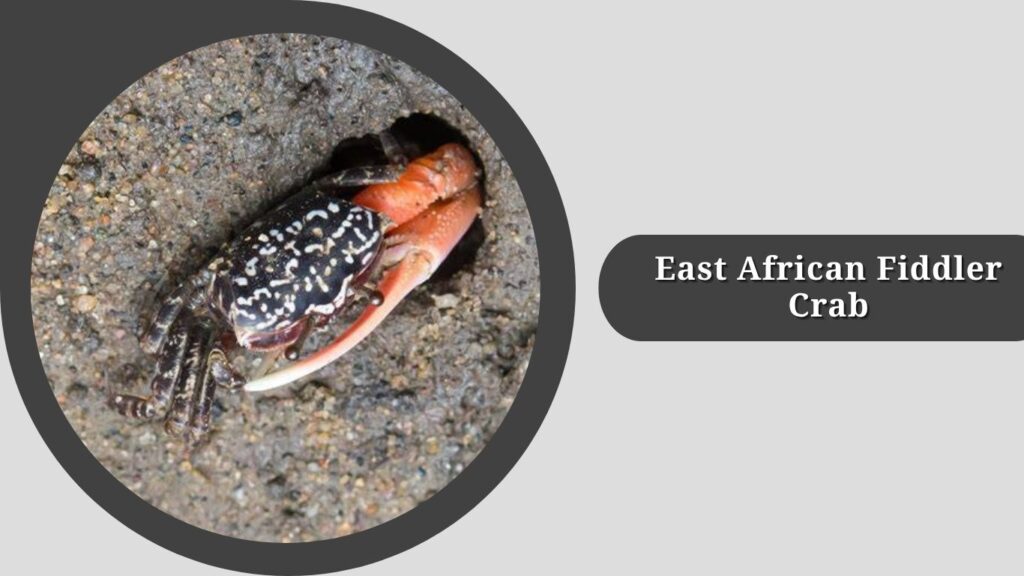
The East African fiddler crab (Austruca occidentalis) is a common inhabitant of mangrove forests along the western Indian Ocean. It was formally recognized as a separate species in 2016 after previously being confused with the ring-legged fiddler crab.
Identification
- Scientific name: Austruca occidentalis
- Carapace: Primarily black with white spots
- Male claw: Pink, red, or orange
- Claw tip: Pointed without a fork
- Body form: Small with a broad front
Habitat and Distribution
This species occurs along eastern Africa from Somalia to South Africa. It is also found around Madagascar, Mauritius, Seychelles, Mayotte, and Réunion. East African fiddler crabs occupy mangrove forests, estuarine banks, intertidal mudflats, and sheltered sandy-mud areas.
Diet and Feeding
Its diet includes microalgae, bacteria, tiny sediment-dwelling animals, and decomposed mangrove material. The crab gathers food from the mud’s surface during low tide. Its feeding activity helps break down and redistribute organic matter throughout the mangrove ecosystem.
Behavior
Males wave their colorful claws to attract females and communicate with rivals. Large groups may inhabit the same mudflat, although each crab maintains access to a burrow. Digging helps mix the sediment, increase soil aeration, and circulate nutrients around mangrove roots.
10. Perplexing Fiddler Crab
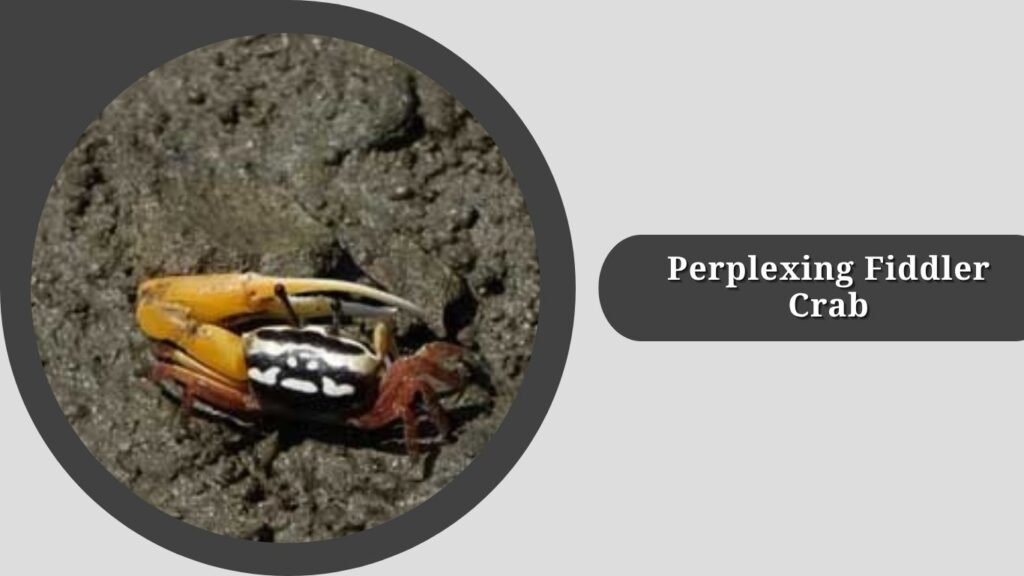
The perplexing fiddler crab (Austruca perplexa) is named for its close resemblance to several related species, particularly the milky fiddler crab. Examining its carapace pattern, front corners, leg color, and major claw can help distinguish it.
Identification
- Scientific name: Austruca perplexa
- Carapace: Black and white with noticeable bands
- Male claw: Yellow, cream, or white
- Legs: Usually pale rather than dark red
- Front corners: Relatively pointed
Habitat and Distribution
This species is widely distributed across the western Pacific and parts of the Indo-Pacific. It occurs in Taiwan, the Philippines, Indonesia, northern Australia, New Caledonia, and several Pacific islands. It prefers upper intertidal flats with sand or muddy sand.
Diet and Feeding
Perplexing fiddler crabs consume algae, microorganisms, and organic detritus contained in coastal sediment. The small claw repeatedly carries sediment to the mouth, where food is separated from mineral particles. Cleaned sand or mud is then deposited nearby.
Behavior
Males perform rhythmic claw-waving displays to attract females. The size of a male and the quality of his burrow can influence mating success. The crabs quickly retreat underground when threatened, during high tide, or when daytime temperatures become dangerously high.
11. Indus Fiddler Crab
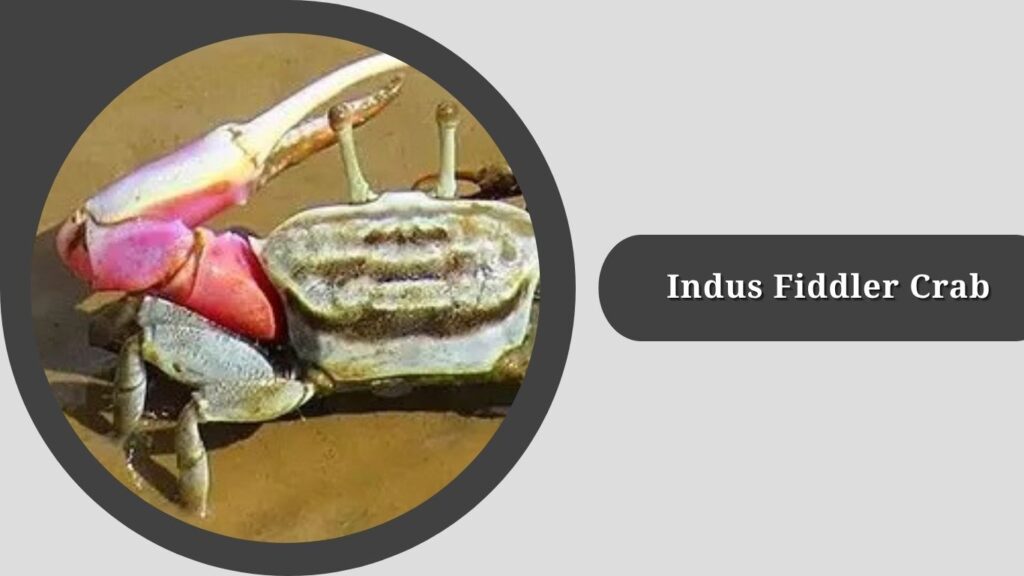
The Indus fiddler crab (Austruca sindensis) is a small, highly social species native to the northern Arabian Sea and Persian Gulf. Its pale striped shell and lilac-colored major claw distinguish adult males from most neighboring fiddler crabs.
Identification
- Scientific name: Austruca sindensis
- Carapace: Pale gray with darker stripes
- Male claw: Predominantly lilac or pale purple
- Body size: Small
- Female claws: Small and similar in size
Habitat and Distribution
This species occurs along the coasts of Pakistan, Iran, Iraq, and Kuwait. Its distribution is relatively limited compared with many Indo-Pacific fiddler crabs. It prefers high intertidal areas, saline mudflats, sheltered shores, and mangrove habitats.
Diet and Feeding
Indus fiddler crabs feed on microscopic algae, bacteria, fungi, detritus, and other organic material contained in surface sediment. Females use both claws to gather food, whereas males rely on the single smaller feeding claw.
Behavior
These social crabs may form dense colonies where suitable sediment is available. Males wave their lilac claws to attract females and establish boundaries with rivals. Their burrows provide essential protection against high temperatures, predators, dehydration, and incoming tides.
12. Triangular Fiddler Crab
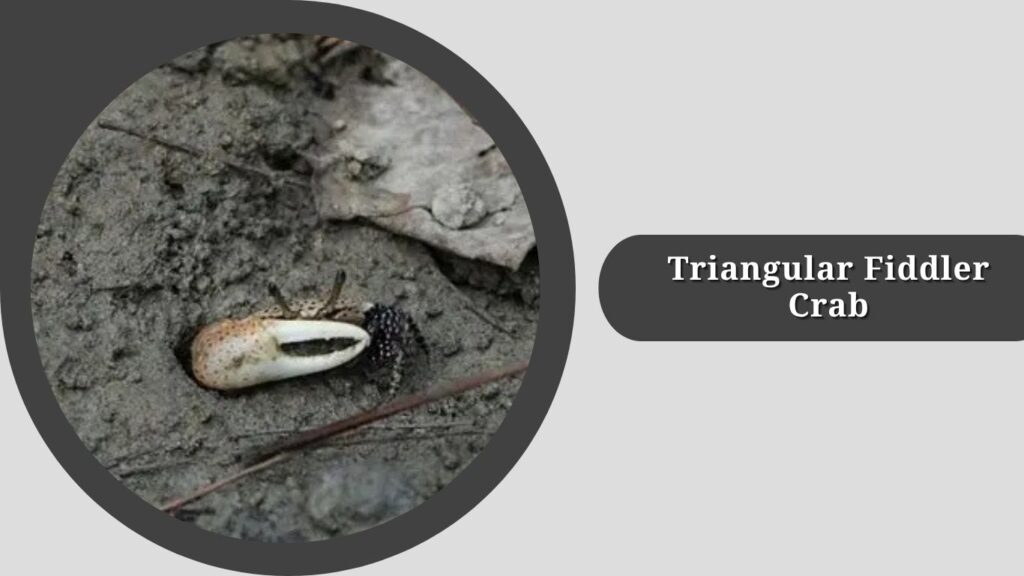
The triangular fiddler crab (Austruca triangularis) is a small Indo-West Pacific species named after its distinctly angled carapace. Its body coloration can resemble several related species, but the pointed front corners help with identification.
Identification
- Scientific name: Austruca triangularis
- Average carapace width: Around 11 mm
- Carapace: Brown or black with white bands
- Male claw: White, cream, or yellowish
- Front corners: Sharply pointed and triangular
Habitat and Distribution
This fiddler crab occurs in Indonesia, the Philippines, Taiwan, southern Japan, New Caledonia, and northern and eastern Australia. It has also been recorded in parts of coastal China. The species often occupies shaded intertidal areas containing fine muddy sediment.
Diet and Feeding
Triangular fiddler crabs sift through sediment to collect microscopic algae, bacteria, fungi, and decomposing organic matter. The feeding process leaves small balls of cleaned mud or sand scattered around the burrow entrance.
Behavior
The species becomes active when receding water exposes its feeding grounds. Males perform claw-waving displays during courtship and may defend their burrows from neighboring crabs. They retreat underground during high tide, extreme heat, or sudden danger.
13. Green-Eyed Fiddler Crab
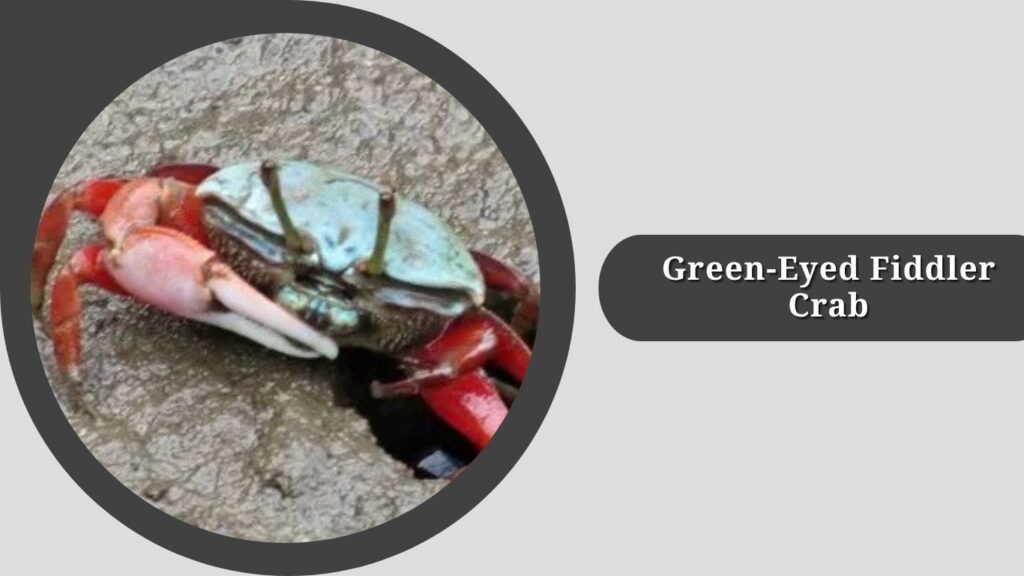
The green-eyed fiddler crab (Paraleptuca chlorophthalmus) is a colorful East African species. Its greenish eyes, red legs, and blue-and-black shell create a distinctive appearance that separates it from other fiddler crabs living in the same mangrove environments.
Identification
- Scientific name: Paraleptuca chlorophthalmus
- Average carapace width: Around 15 mm
- Eyes: Yellow-green or green
- Carapace: Blue with black markings
- Legs and male claw: Commonly bright red
Habitat and Distribution
This species occurs from southern Somalia to South Africa. It is also found in Madagascar, Mauritius, and Réunion. Green-eyed fiddler crabs inhabit mangrove forests, salt marshes, estuaries, and muddy or sandy banks within the intertidal zone.
Diet and Feeding
The crab gathers mud and separates edible detritus, algae, bacteria, and microorganisms with its mouthparts. Decomposed mangrove leaves can provide an important source of organic matter in habitats occupied by the species.
Behavior
Green-eyed fiddler crabs remain close to burrows that protect them from predators, extreme temperatures, and high tide. Males defend these burrows against intruders and wave their red major claws to communicate with rivals and attract females.
14. Calling Fiddler Crab
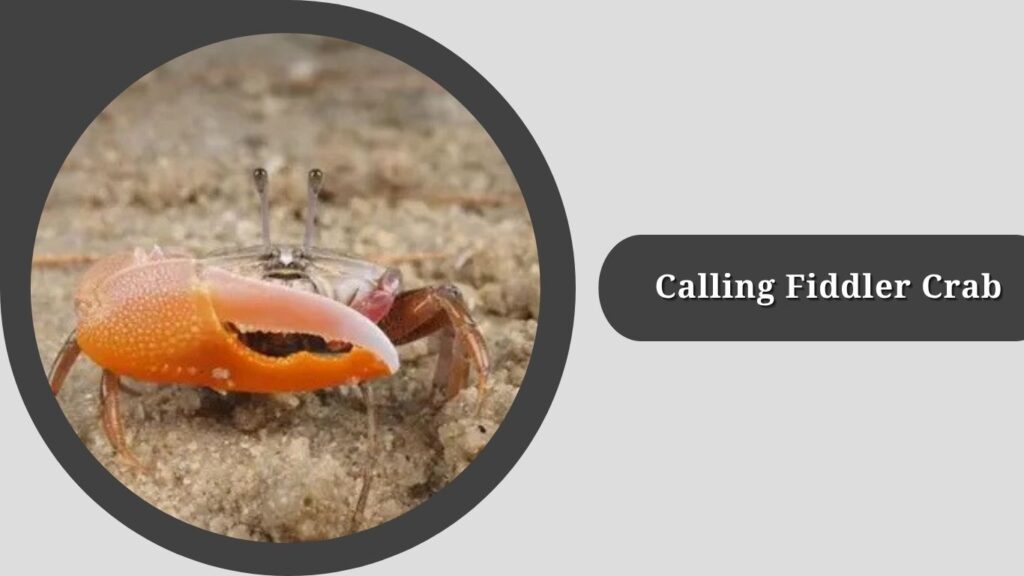
The calling fiddler crab (Gelasimus vocans) is a widespread Indo-Pacific species. Adult males possess a prominent claw used to produce visual “calling” displays, creating the appearance that they are signaling or beckoning toward nearby females.
Identification
- Scientific name: Gelasimus vocans
- Carapace width: Approximately 8–27 mm
- Carapace: Brown, gray, blue, or mottled
- Male claw: Orange, yellow, or pale
- Body form: Narrow-fronted
Habitat and Distribution
Calling fiddler crabs occur from the Red Sea and eastern Africa across Southeast Asia to the central Pacific. They live on sheltered mudflats, estuarine shores, mangrove edges, and muddy coastal areas. Their burrows may reach approximately 50 cm deep.
Diet and Feeding
The species feeds by sifting fine coastal sediment. Its diet includes algae, bacteria, fungi, decomposed vegetation, microorganisms, and other organic particles. Males collect food with their small claws because their major claws cannot effectively handle sediment.
Behavior
Males repeatedly raise and lower their enlarged claws during territorial and courtship displays. They may also fight over access to burrows. Deep burrows help the crabs maintain moisture, regulate body temperature, escape predators, and remain protected during high tide.
15. Orange-Clawed Fiddler Crab
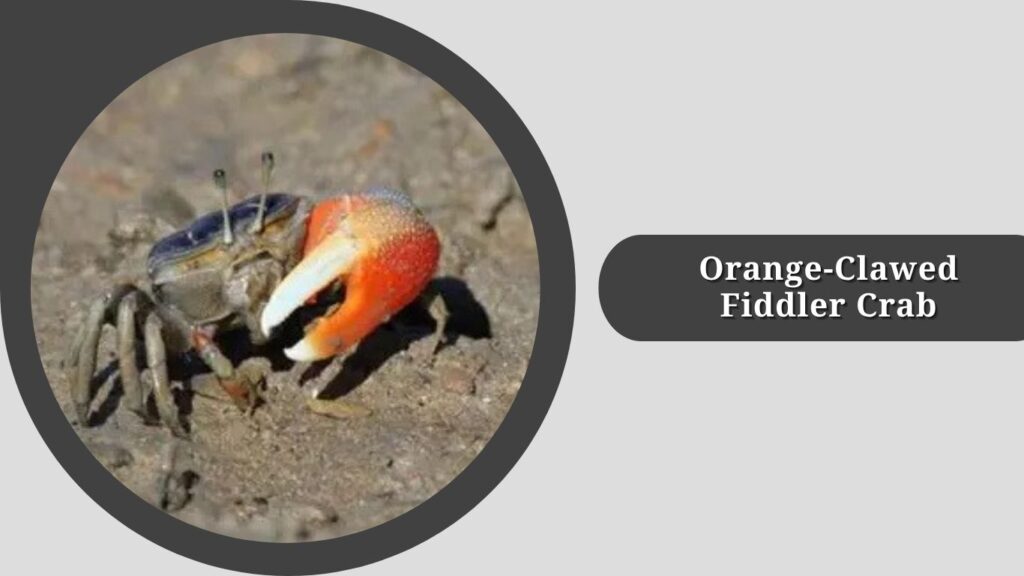
The orange-clawed fiddler crab (Gelasimus vomeris) is also called the two-toned or southern calling fiddler crab. It is a colorful southwestern Pacific species whose appearance can change according to stress, environmental background, and predator activity.
Identification
- Scientific name: Gelasimus vomeris
- Carapace width: Up to approximately 30 mm
- Carapace: Dark brown or black with blue patches
- Male claw: Orange with a gray or pink upper finger
- Body form: Medium-sized and narrow-fronted
Habitat and Distribution
This species occurs mainly around northern and eastern Australia, ranging from Darwin to the Sydney region. It is also recorded from New Caledonia and possibly New Guinea. It favors unshaded sandy mud around bays, estuaries, mangroves, and tidal creeks.
Diet and Feeding
Orange-clawed fiddler crabs consume microorganisms, algae, fungi, and decomposed organic material extracted from the sediment. They usually forage within a short distance of their burrows, allowing them to escape rapidly when danger appears.
Behavior
Males wave their orange claws to attract females and intimidate competitors. They are usually right-clawed, although left-clawed individuals occur occasionally. Their bright blue markings may become duller when predators are frequently present, improving camouflage against muddy surroundings.
16. Atlantic Sand Fiddler Crab
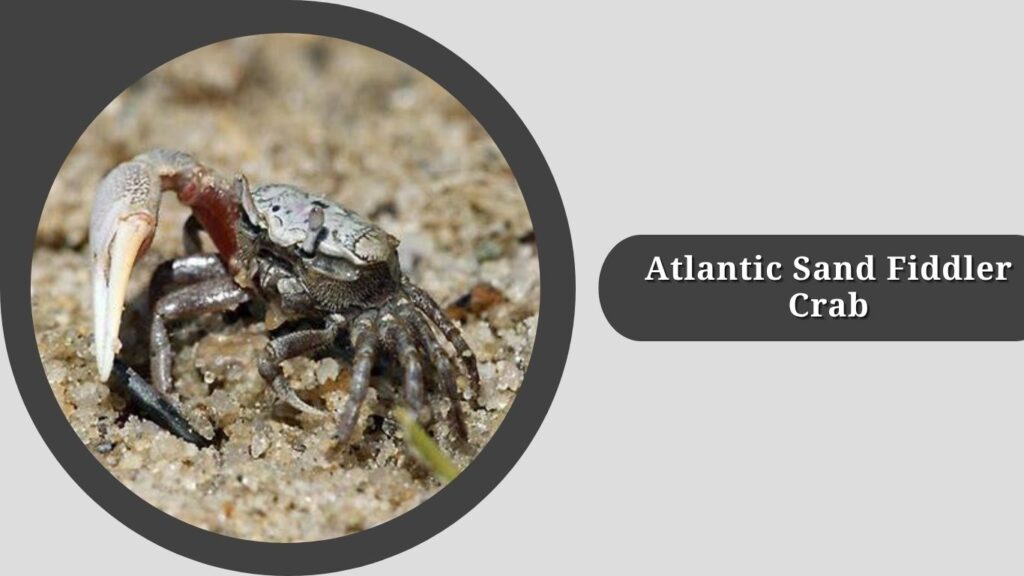
The Atlantic sand fiddler crab (Leptuca pugilator) is one of the most abundant fiddler crabs on the eastern coast of North America. It is highly variable in color and commonly forms enormous colonies on sandy beaches and estuarine flats.
Identification
- Scientific name: Leptuca pugilator
- Carapace width: Usually up to 21 mm
- Carapace: Blue, purple, gray, white, or mottled
- Male claw: Up to approximately 41 mm long
- Inner claw surface: Relatively smooth
Habitat and Distribution
This species ranges from Massachusetts down the Atlantic coast and around the Gulf of Mexico to Florida and Texas. It prefers sandy or sandy-mud shorelines, salt marsh borders, protected beaches, tidal-stream banks, and upper estuarine flats.
Diet and Feeding
Atlantic sand fiddler crabs sift through sediment to extract algae, bacteria, fungi, detritus, and other microscopic organic particles. Females feed with both claws, while males collect food only with their smaller claw.
Behavior
Males wave their oversized claws to attract females and fight with rivals over burrows. They can form colonies containing thousands of individuals. Their burrows provide moisture and protection from high tides, extreme temperatures, shorebirds, fish, and other predators.
17. Mexican Fiddler Crab
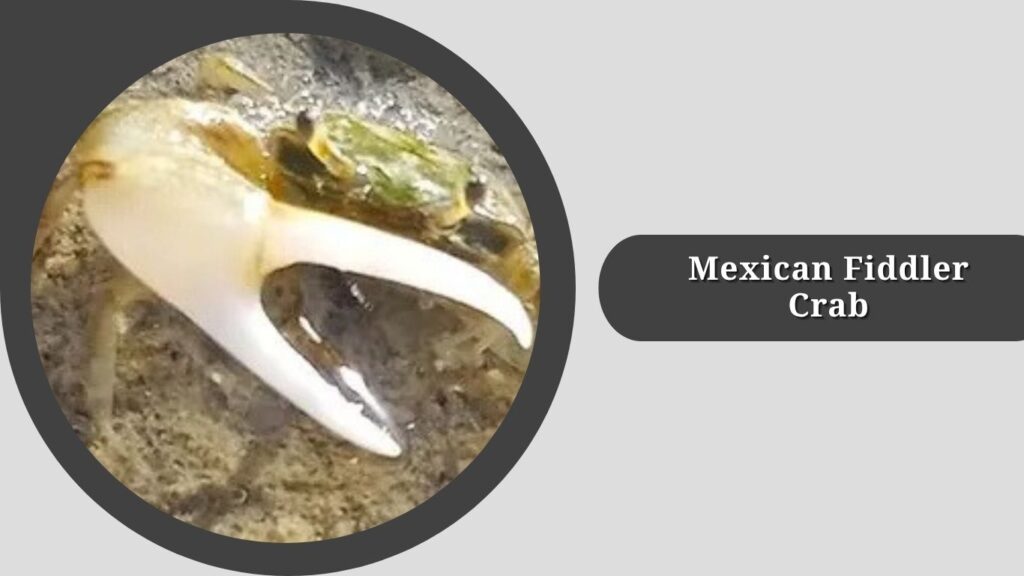
The Mexican fiddler crab (Leptuca crenulata), also called the crenulated fiddler crab, is a small broad-fronted species native to the eastern Pacific. It occupies coastal environments in southern California and western Mexico.
Identification
- Scientific name: Leptuca crenulata
- Average carapace width: Around 10 mm
- Body shape: Small and broad-fronted
- Carapace: Brown, gray, or mottled
- Male claw: Enlarged and generally pale
Habitat and Distribution
Mexican fiddler crabs occur from Santa Barbara in southern California to Manzanillo, Mexico. They inhabit protected bays, coastal lagoons, estuaries, salt marshes, and tidal flats containing mud, sand, or a mixture of both.
Diet and Feeding
The species collects sediment and processes it with specialized mouthparts. Its diet consists mainly of microscopic algae, bacteria, fungi, decomposing vegetation, and other organic material. Processed sediment is left as small pellets near the feeding site.
Behavior
These crabs emerge from their burrows as the tide recedes. Males use claw-waving displays to communicate and attract females, while both sexes remain alert for predators. Rapidly entering a burrow helps them escape birds, fish, intense sunlight, and incoming water.
18. Gulf Sand Fiddler Crab
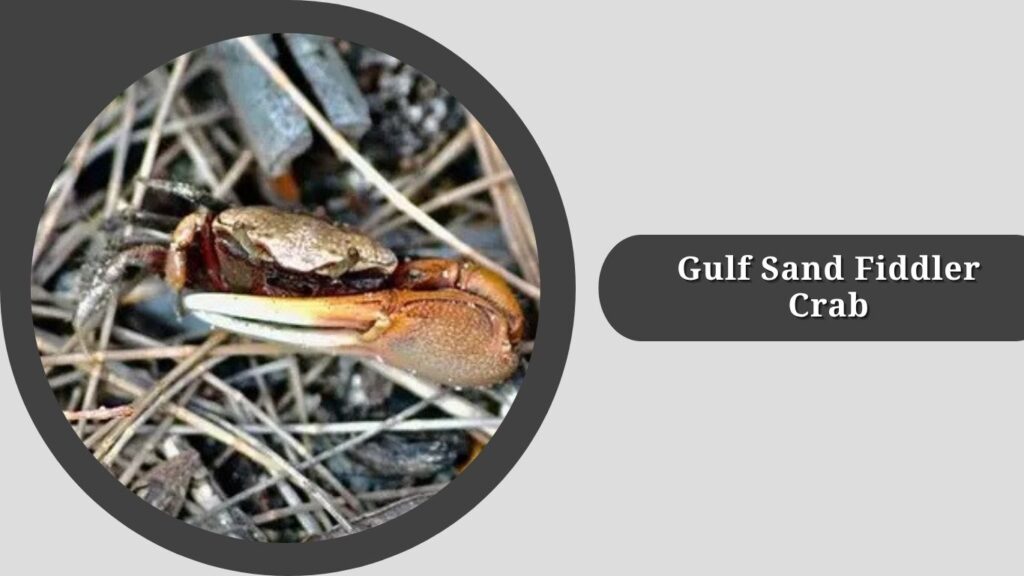
The Gulf sand fiddler crab (Leptuca panacea) is closely related to the Atlantic sand fiddler crab. The two species overlap and may hybridize in northwestern Florida, but the Gulf species is primarily distributed along the Gulf of Mexico.
Identification
- Scientific name: Leptuca panacea
- Average carapace width: Around 16 mm
- Carapace edge: Bright orange or reddish-orange
- Male claw: Large with a smooth inner surface
- Claw fingers: Long, slender, and curved
Habitat and Distribution
This species ranges from northwestern Florida around the Gulf Coast to Campeche, Mexico. It occupies open sand flats, salt marshes, sheltered beaches, and estuarine shorelines containing sand or sandy-mud substrate.
Diet and Feeding
Gulf sand fiddler crabs consume microalgae, bacteria, fungi, detritus, and other organic particles found between grains of sediment. Feeding produces small sand pellets that may accumulate around the burrow entrance during low tide.
Behavior
Males wave their claws during courtship and use them to push or grapple with competitors. The crabs dig burrows for shelter, mating, and temperature control. They usually forage near these burrows so they can retreat quickly when threatened.
19. Pygmy Fiddler Crab
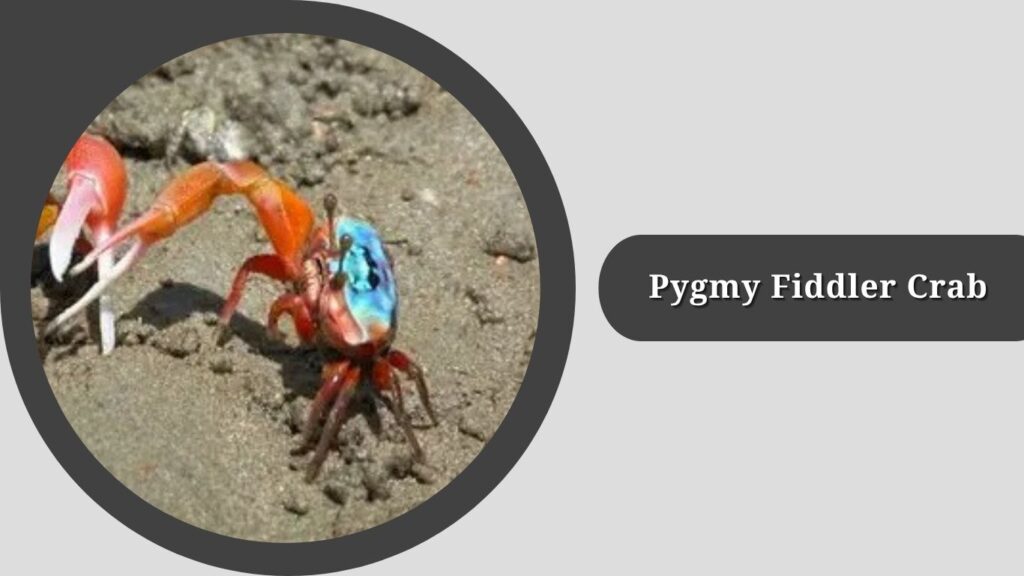
The pygmy fiddler crab (Leptuca pygmaea) is one of the smallest members of its group. Its tiny body makes it difficult to notice among coastal sediment, but the swollen, heavily textured major claw of the male helps distinguish it.
Identification
- Scientific name: Leptuca pygmaea
- Average carapace width: Around 8 mm
- Body size: Very small
- Male claw: Swollen and coarsely textured
- Claw fingers: Possess prominent teeth near the base
Habitat and Distribution
This species is found along the eastern Pacific coast from southern Costa Rica to Colombia. It inhabits tropical estuaries, mangrove margins, sheltered mudflats, and coastal areas containing moist muddy or sandy sediment.
Diet and Feeding
Pygmy fiddler crabs feed on microscopic algae, bacteria, fungi, detritus, and decomposing plant material. Their small size allows them to process fine surface sediment and use tiny patches of habitat unavailable to larger crab species.
Behavior
The crabs remain close to protective burrows while feeding. Males use their enlarged claws in miniature courtship displays and territorial encounters. Shorebirds, larger crabs, and other coastal predators can easily consume them, making rapid burrow retreat especially important.
20. Brilliant Fiddler Crab
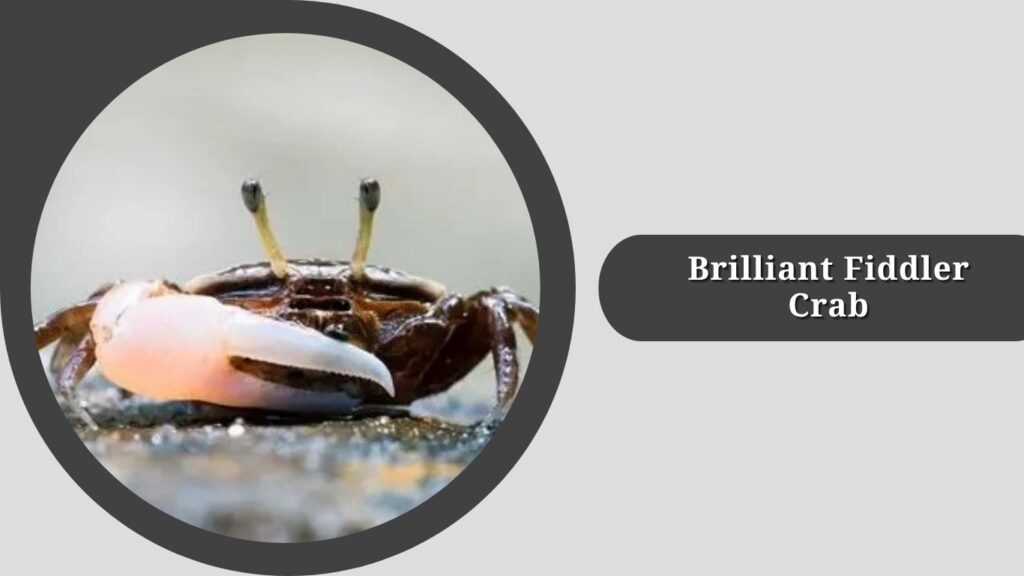
The brilliant fiddler crab (Leptuca speciosa), also known as the longfinger fiddler crab, is a colorful American species. Males possess long, pale claws that create an especially striking appearance when displayed against dark coastal sediment.
Identification
- Scientific name: Leptuca speciosa
- Carapace width: Up to approximately 15 mm
- Male claw: Long, slender, and whitish
- Body color: Brown, gray, blue, or mottled
- Body form: Small and broad-fronted
Habitat and Distribution
This species occurs along Florida’s coast and the outer islands of Alabama and Mississippi. It is also found on Mexico’s Yucatán Peninsula, parts of the Bahamas, and western Cuba. It prefers brackish marshes, mangrove thickets, and intertidal silt or silty sand.
Diet and Feeding
Brilliant fiddler crabs consume algae, microorganisms, bacteria, fungi, and decomposing organic matter within the sediment. Males use their small claws for feeding because their elongated major claws are primarily specialized for display and competition.
Behavior
Males raise and wave their pale claws to attract females and signal to neighboring males. Burrows provide shelter during high tide and hot weather. Their digging and feeding activities turn over sediment, improve aeration, and help recycle organic nutrients.