
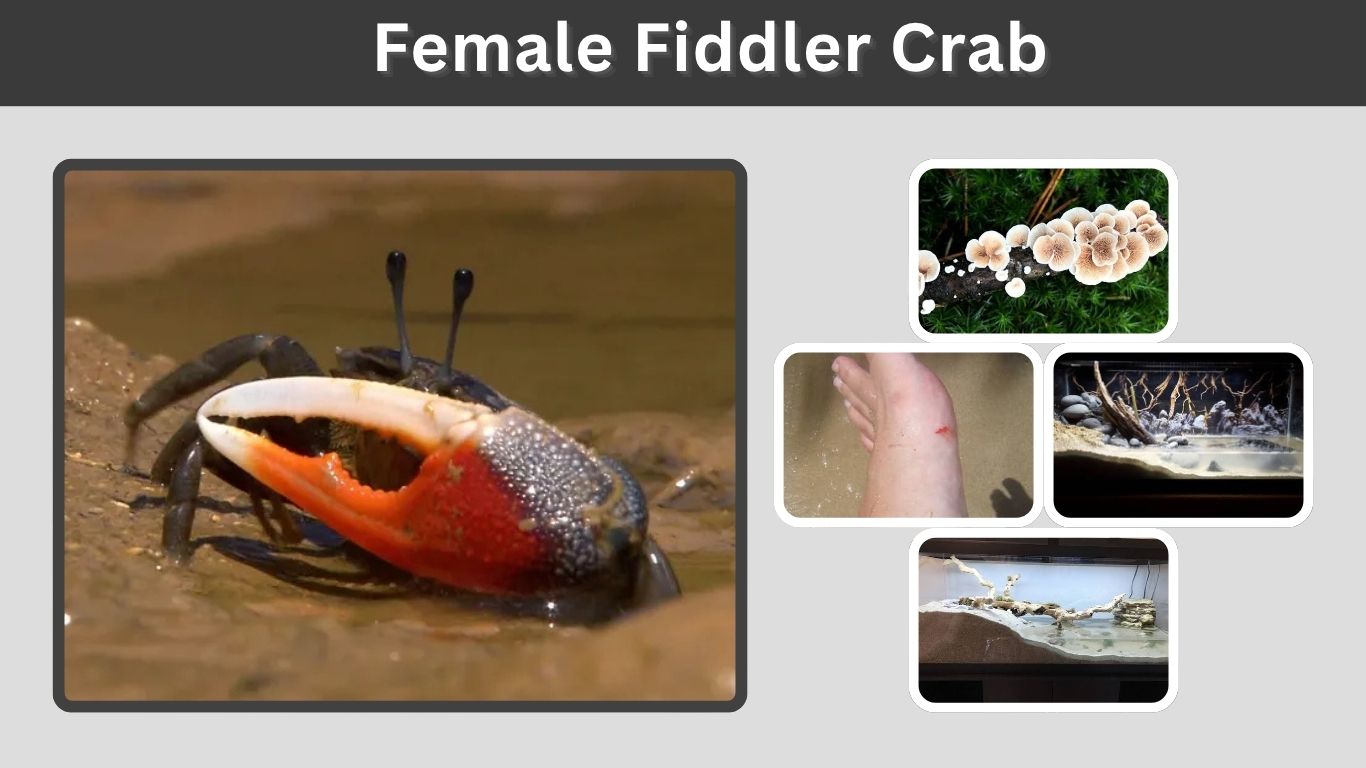
A female fiddler crab is easy to recognize because she has two similarly sized feeding claws. In comparison, a male has one small claw and one dramatically enlarged claw used for courtship, fighting, and territorial displays. Females spend much of their active time filtering microscopic food from wet sand or mud. During reproduction, they select mates, carry fertilized eggs beneath their abdomen, and release newly hatched larvae into tidal water.
What Does a Female Fiddler Crab Look Like?
Female fiddler crabs have compact bodies, elevated eyestalks, eight walking legs, and two small front claws. Their exact color depends on the species and may include brown, gray, orange, red, yellow, blue, or purple markings.
The most reliable identification feature is the pair of similarly sized claws. Smithsonian descriptions distinguish females by their two small feeding claws, whereas males possess one small claw and one greatly enlarged display claw.
Female Fiddler Crab Identification
Look for these features:
- Two small claws of roughly equal size
- No oversized “fiddle” claw
- Two raised eyestalks
- A broad abdomen folded beneath the body
- A hard, flattened carapace
- Long legs adapted for moving over mud and sand
- A cluster of eggs beneath the abdomen during reproduction
A female may occasionally lose a claw through injury and regenerate it during later molts. However, an adult with one exceptionally large claw is normally a male rather than a female.
Male vs Female Fiddler Crab
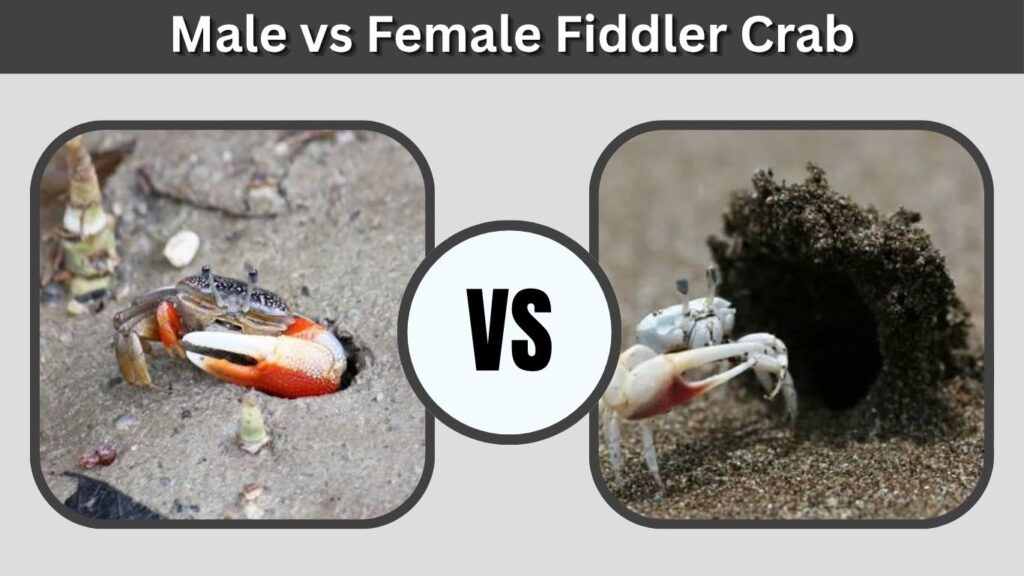
The claws provide the fastest way to distinguish male and female fiddler crabs.
| Feature | Female fiddler crab | Male fiddler crab |
| Front claws | Two small feeding claws | One small and one enlarged claw |
| Primary claw function | Collecting food | Feeding, display, and fighting |
| Courtship behavior | Evaluates displaying males | Waves large claw |
| Egg carrying | Carries eggs beneath abdomen | Does not carry eggs |
| Feeding ability | Can scoop with both claws | Feeds with one small claw |
| Territorial behavior | May defend a burrow | Often fights other males |
Why Do Males Have One Large Claw?
The male’s oversized claw acts as both an advertisement and a weapon. Males wave it to attract females, threaten rivals, and fight over burrows. Some species also use body movements or vibrations as part of their courtship displays.
Why Do Females Have Two Small Claws?
Both of a female’s claws are adapted for feeding. She repeatedly scoops sediment, moves it toward her mouth, and separates microorganisms and organic matter from the sand or mud.
Research on several fiddler-crab species has found that females can perform more feeding motions because they use two functional feeding claws. Males compensate partly by moving their single feeding claw faster or possessing a somewhat larger feeding claw.
What Do Female Fiddler Crabs Eat?
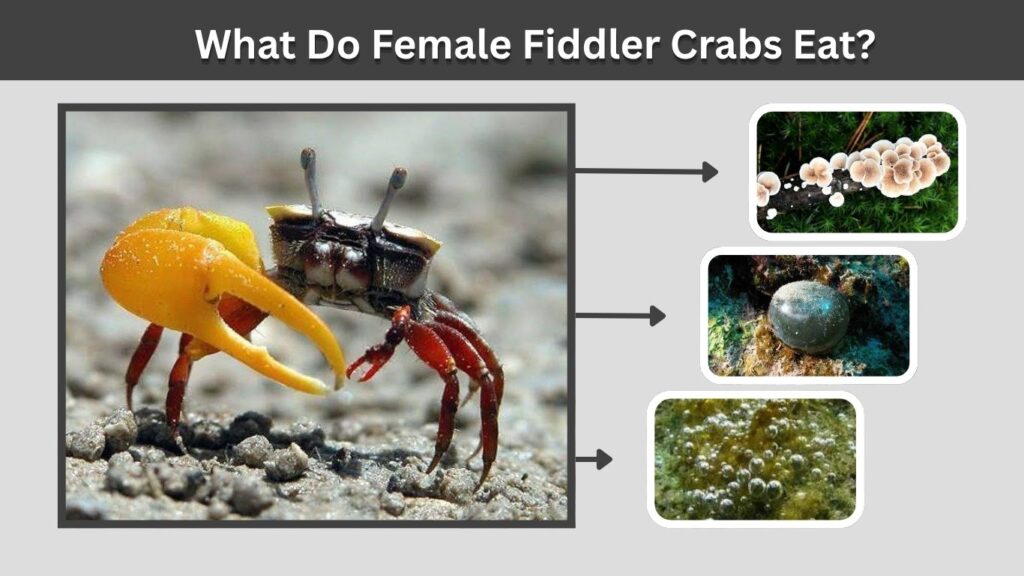
Female fiddler crabs eat essentially the same foods as males. They are deposit feeders that collect microscopic food from wet sediment rather than actively hunting large animals.
Their diet may include:
- Microscopic algae
- Diatoms
- Bacteria
- Fungi
- Decaying marsh plants
- Mangrove leaf detritus
- Tiny animals in the sediment
- Other decomposing organic matter
After processing a mouthful of sediment, a crab drops the cleaned sand or mud as a small pellet. Groups of pellets around a burrow often indicate recent feeding activity. Adult fiddler crabs commonly extract organic material from mud and return the processed sediment to the ground.
Female Fiddler Crab Mating Behavior
Mating behavior varies among fiddler-crab species, but males commonly stand near their burrows and wave their large claws. A receptive female may inspect several displaying males before choosing one.
How Females Select Mates
A female may consider the male’s waving display, size, claw movement, territory, and burrow. In some species, she enters and examines several burrows before making a final choice.
Research on California fiddler crabs found that females evaluated both male characteristics and breeding-burrow qualities. A properly sized burrow can provide a protected place for mating and egg development.
What Happens After a Female Chooses a Male?
An interested female may follow the displaying male into his burrow, where mating occurs. Depending on the species, mating may also happen on the sediment surface near a female’s own burrow.
Some males seal the burrow after mating, allowing the female to remain protected underground while developing and carrying her egg clutch. Fiddler-crab mating systems differ considerably among species, so one pattern does not apply universally.
Female Fiddler Crab Eggs
After fertilization, the female attaches her eggs beneath the abdominal flap. The eggs form a dense mass sometimes called a sponge because of its soft, clustered appearance.
What Does a Pregnant Female Look Like?
An egg-carrying, or berried, female may show a brown, orange, reddish, or almost black mass beneath her body. Egg color can change as embryos develop.
She may spend more time inside a burrow and reduce normal surface activity while incubating the clutch. Research on Uca lactea found that females were less active during periods when they incubated broods underground.
How Many Eggs Does a Female Carry?
The number varies greatly among species and with the female’s size. A clutch may contain thousands or, in some larger species, far more. For example, reported numbers for Atlantic marsh fiddlers range from several thousand to more than 20,000, while Atlantic sand fiddlers may produce considerably larger clutches.
How Are the Babies Released?
When the embryos are ready, the female travels toward tidal water and releases the newly hatched larvae. Release is often synchronized with tides, improving the chance that currents will carry the larvae away from shoreline predators and into suitable nursery waters.
The larvae are free-swimming and pass through several planktonic stages before transforming into juvenile crabs and returning to the shoreline.
Do Female Fiddler Crabs Fight or Pinch?
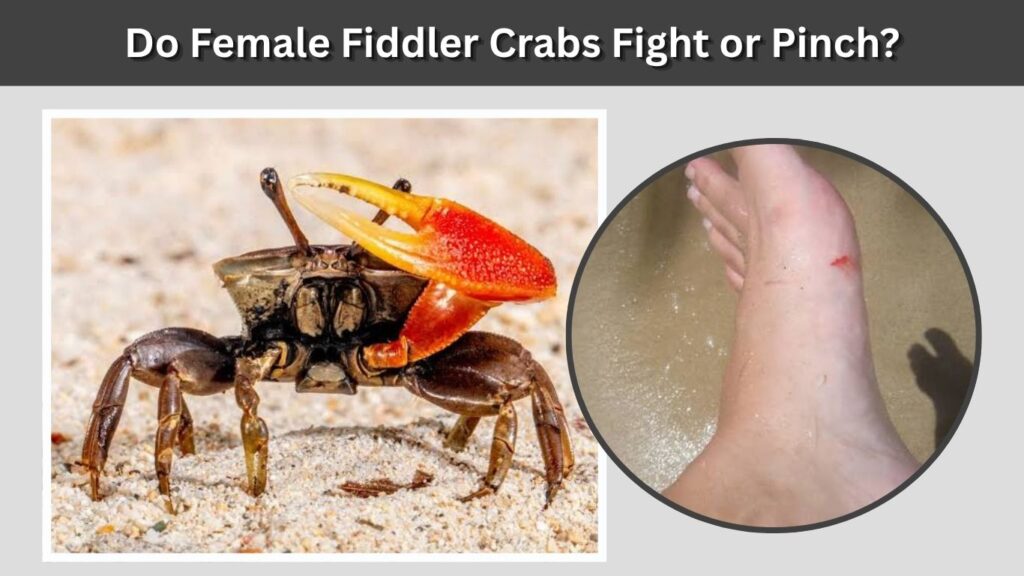
Females can pinch with either claw, although their small claws cannot produce the same force as a male’s major claw. A pinch may still be uncomfortable, especially if the crab is frightened or handled roughly.
Female fiddler crabs may also compete for food, shelter, or burrows. Most conflicts involve pushing, displaying, or retreating rather than severe injury. Crowding and insufficient hiding places can increase aggression in captivity.
Can Male and Female Fiddler Crabs Live Together?
Male and female fiddler crabs naturally live in colonies and can share a properly designed enclosure. However, they require sufficient land, burrowing substrate, shelter, and personal space.
A group should not contain too many males because males frequently compete over territories. Providing several females for one male may reduce constant courtship pressure, although individual behavior varies.
Watch for:
- Repeated chasing
- One crab blocking another from food
- Damage to legs or claws
- A crab remaining hidden continuously
- Aggression toward a molting crab
- A male repeatedly trapping or attacking a female
Separate an injured or heavily harassed crab when necessary.
Female Fiddler Crab Care
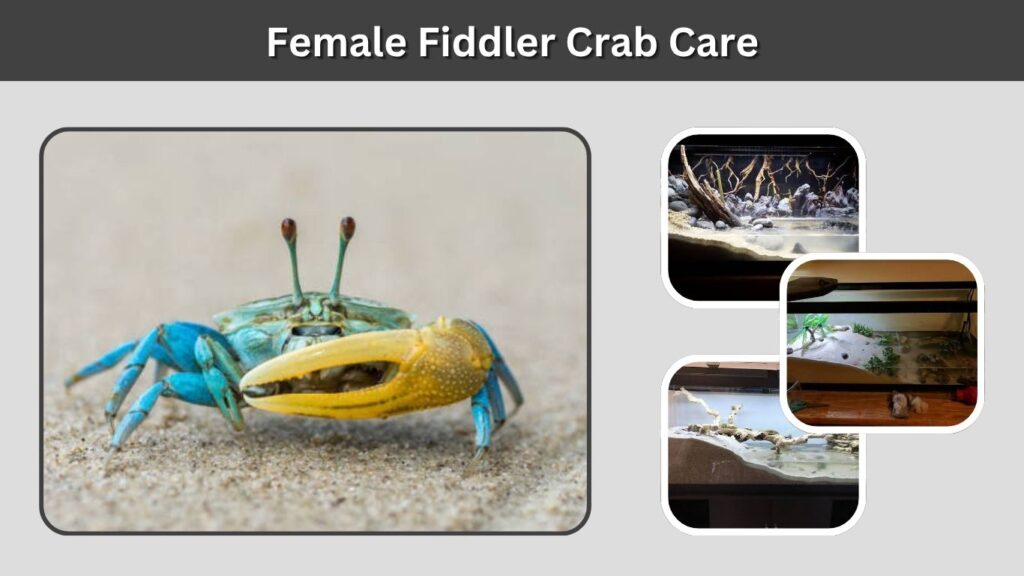
Female and male fiddler crabs have nearly identical basic care requirements. They need a paludarium that combines a damp land area with shallow water.
Tank Requirements
Provide:
- A secure, ventilated lid
- Deep, damp sand for burrowing
- A large land area
- Shallow water with an easy exit
- Marine salt mix when keeping a brackish species
- Stable warmth appropriate to the species
- Hiding places and visual barriers
- Gentle filtration or regular partial water changes
Most pet-trade fiddler crabs are coastal animals and should not be kept permanently submerged in an ordinary freshwater fish tank. Correct care depends partly on identifying the particular species.
Feeding a Female Fiddler Crab
Offer a balanced commercial crab food supplemented with algae wafers, seaweed, dried plankton, and small portions of appropriate vegetables or protein foods. Place some food near the damp substrate where the crab naturally searches.
Remove leftovers before they decay. A female carrying eggs may remain hidden and eat less frequently, so avoid digging her out or repeatedly disturbing the burrow.
Why Did My Female Fiddler Crab Disappear?
A missing female may have buried herself to molt, rest, avoid aggression, or incubate eggs. Fiddler crabs spend significant periods inside burrows, and an egg-carrying female may remain underground for much of the incubation period.
She may also have escaped. Check openings around filters, cables, tubing, and tank lids. Do not aggressively dig through the substrate because a molting crab is soft and easily injured.
FAQs
How can you tell whether a fiddler crab is female?
Examine the front claws. A female has two similarly sized small claws used for collecting food. A male has one small feeding claw and one conspicuously enlarged claw used for courtship displays, fighting, and defending a burrow.
Can a female fiddler crab have two large claws?
A normal female does not have two oversized claws. She has two small feeding claws. A crab with one strongly enlarged claw is usually male. Claw injuries, regeneration, or unusual development may alter appearance, but two large male-style claws would be highly abnormal.
Do female fiddler crabs pinch?
Yes. Females can pinch with both small claws when frightened, trapped, or handled. The pinch is normally weaker than the grip of a male’s enlarged claw, but handling should still be minimized to prevent injury and unnecessary stress.
How do you know whether a female fiddler crab has eggs?
Look beneath her abdomen for a dense, sponge-like cluster of eggs. Depending on their developmental stage and species, the eggs may appear orange, brown, reddish, gray, or nearly black. An egg-carrying female may also remain hidden inside her burrow.
Are female fiddler crabs less aggressive than males?
Females generally engage in fewer large-claw territorial battles because they lack the male’s enlarged fighting claw. However, they may still defend burrows, compete for food, pinch tank mates, or react aggressively when crowded, stressed, or approached during molting and egg incubation.