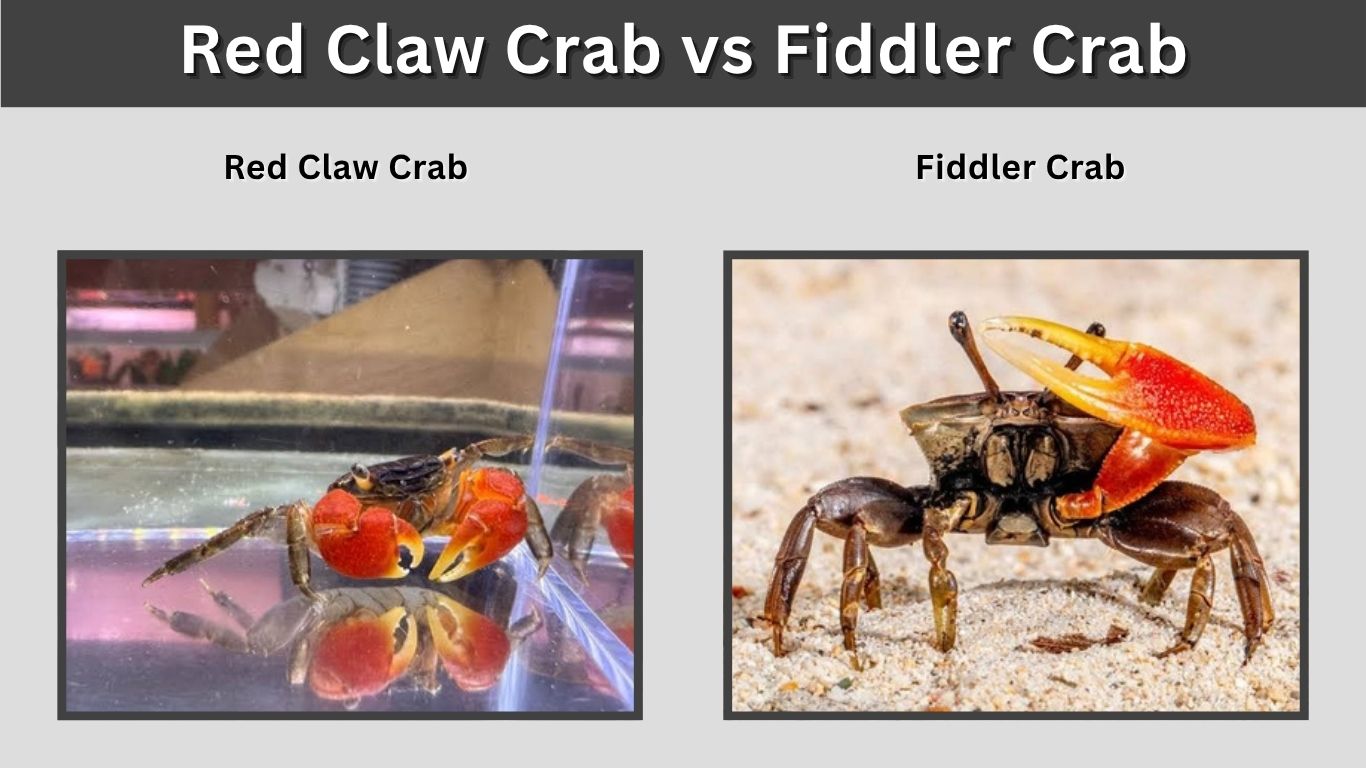
Red claw crabs and fiddler crabs are attractive semi-aquatic pets, but they are frequently confused with each other. Although both inhabit coastal environments and require access to land, they differ in appearance, behavior, natural range, and aquarium needs. Neither crab should be kept in a standard freshwater fish tank. They need a carefully designed brackish paludarium with warm water, moist land, hiding places, and a secure lid. Understanding these requirements is essential before deciding which crab is right for your aquarium.
Are Red Claw Crabs and Fiddler Crabs the Same?
No, red claw crabs and fiddler crabs are different animals.
The red claw crab is commonly identified as Parasesarma bidens, although the older scientific name Perisesarma bidens remains widely used in the aquarium trade. It is a mangrove-associated crab native to the Indo-Pacific region.
The red-jointed fiddler crab is commonly listed as Uca minax, with Minuca minax also used in modern classifications. It occurs along the eastern coast of North America and is recognized by the reddish joints on its claws. Male fiddler crabs have one dramatically enlarged claw, while females have two smaller claws of similar size.
| Feature | Red Claw Crab | Red-Jointed Fiddler Crab |
| Common scientific name | Parasesarma bidens | Uca minax or Minuca minax |
| Main identification | Two red claws | Male has one oversized claw |
| Natural habitat | Asian mangroves and estuaries | North American marshes and mudflats |
| Water type | Brackish | Low-salinity brackish |
| Temperament | Territorial and aggressive | Social but territorial |
| Typical captive lifespan | Around 2–2.5 years | Up to approximately 3 years |
| Best enclosure | Brackish paludarium | Sandy brackish paludarium |
Red Claw Crab Care
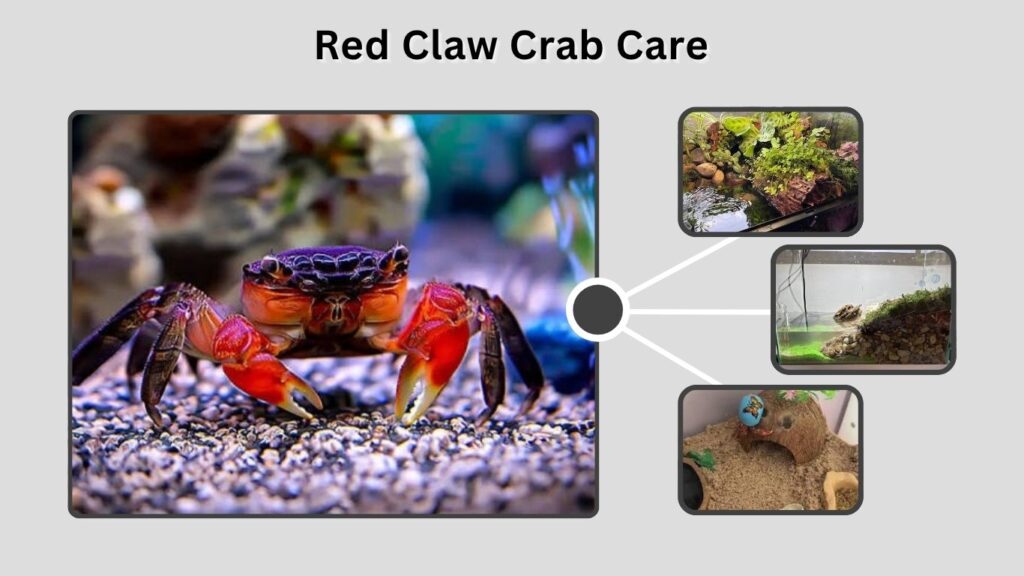
Red claw crab care is moderately challenging because these crabs require both water and dry land. They are often incorrectly sold as fully aquatic freshwater animals, which can result in poor health, molting problems, and a shortened lifespan.
Tank Size and Habitat
A 10-gallon tank may house one red claw crab, but a 20-gallon enclosure is easier to maintain and provides more territory. Groups require additional space, especially when a male is present.
Create a sloping sand substrate that allows the crab to walk easily between water and land. Approximately one-quarter to one-third of the enclosure should remain above the waterline. Rocks, driftwood, caves, and artificial mangrove roots provide shelter during the day and protection while molting.
A tight-fitting lid is essential. Red claw crabs are excellent climbers and may escape through small openings around filters, heaters, or cables.
Water Conditions
Red claw crabs require brackish water rather than pure freshwater or full-strength seawater. Suitable general conditions include:
- Temperature: 75–82°F
- pH: 7.5–8.5
- Specific gravity: approximately 1.005–1.010
- Ammonia and nitrite: 0 ppm
- Nitrate: kept as low as practical
Use marine aquarium salt to prepare the water. Ordinary table salt, cooking salt, and freshwater aquarium tonic salt do not provide the correct mineral balance.
The enclosure should contain gentle filtration without a powerful current. Test the salinity with a hydrometer or refractometer and perform regular partial water changes.
Diet and Feeding
Red claw crabs are omnivorous scavengers. A varied diet helps them molt successfully and maintain strong shells.
Suitable foods include sinking crab pellets, algae wafers, bloodworms, brine shrimp, small pieces of fish, spirulina, peas, zucchini, spinach, and other leafy vegetables. Foods containing calcium can support shell development.
Remove uneaten food before it begins to decay. Red claw crabs may also damage live plants, capture small animals, or eat tank mates when given the opportunity.
Red Claw Crab Lifespan
A properly maintained red claw crab may live approximately two to two and a half years in captivity. Poor salinity, dirty water, failed molts, fighting, and the absence of a land area can significantly reduce its lifespan.
Red-Jointed Fiddler Crab Care
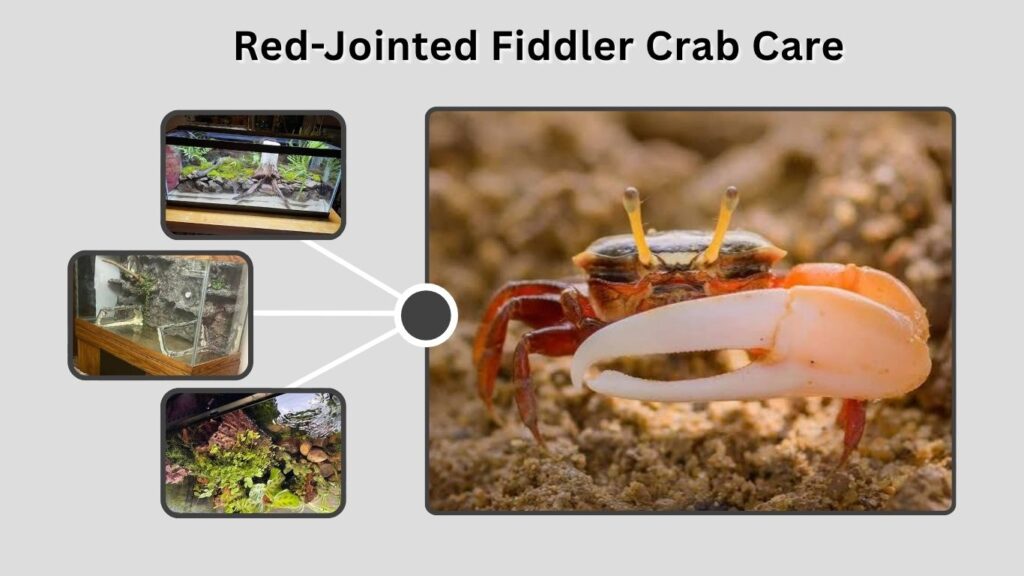
The red-jointed fiddler crab is also called the red-joint fiddler or brackish-water fiddler. In nature, it occupies muddy or sandy shorelines exposed during low tide and creates burrows for shelter.
Tank Setup
A 10-gallon aquarium can accommodate a small number of fiddler crabs, but a 20-gallon tank is better for a group. Fiddler crabs spend considerable time out of the water, so their enclosure should contain a large sandy land area.
Use moist, deep sand that allows limited digging and burrowing. Create a gradual slope leading to a shallow brackish pool. Add rocks, wood, caves, and visual barriers so individual crabs can establish separate territories.
Keep the lid tightly secured because fiddler crabs can climb decorations and aquarium equipment.
Water and Temperature
Recommended general conditions include:
- Temperature: 75–85°F
- pH: approximately 7.5–8.5
- Specific gravity: around 1.005–1.010
- Shallow, gently filtered water
- Moist land with access to air
Red-jointed fiddler crabs naturally prefer low-salinity coastal areas. Although they may temporarily survive in freshwater, it is not an appropriate permanent environment.
Food and Diet
Fiddler crabs naturally sift through sand and mud to collect algae, decaying vegetation, microorganisms, and other organic material. In captivity, offer sinking crustacean pellets, algae wafers, spirulina, dried seaweed, finely chopped vegetables, frozen brine shrimp, and occasional bloodworms.
Place some food near the water’s edge or on moist sand. Feeding small portions prevents waste and allows timid individuals to eat without competing directly with dominant crabs.
Can Fiddler Crabs Live With Red Claw Crabs?
Keeping fiddler crabs and red claw crabs together is not recommended.
Their basic water requirements may appear similar, but their behavior and preferred enclosure layouts are different. Red claw crabs can be highly territorial and may attack fiddler crabs, particularly during feeding or molting. Male fiddler crabs also defend burrows and display toward rivals.
A mixed enclosure may work temporarily when it is very large and contains numerous hiding places, but there is no guarantee of long-term safety. A species-specific aquarium is the more responsible choice. Red claw crabs are generally safest when kept alone or as one male with carefully selected females.
Can Fiddler Crabs Live With Red Cherry Shrimp?
Fiddler crabs should not be kept with red cherry shrimp.
Red cherry shrimp are primarily freshwater animals, while fiddler crabs require brackish conditions and access to land. Additionally, a fiddler crab may catch and eat shrimp, especially when the shrimp are resting, injured, or molting.
Red claw crabs are also unsuitable companions for cherry shrimp because of the same water mismatch and predation risk.
Are Red Fiddler Crabs Reef Safe?
Fiddler crabs are not appropriate for a traditional reef aquarium.
Most commonly sold fiddler crabs require brackish water, exposed sand, and regular access to air. A conventional reef tank normally contains full-strength seawater and no suitable dry land. Fiddler crabs may also disturb substrate, damage delicate organisms, or attempt to climb out.
Red claw crabs are likewise unsuitable for reef aquariums because they require brackish water and may attack small invertebrates.
Identifying Male and Female Fiddler Crabs
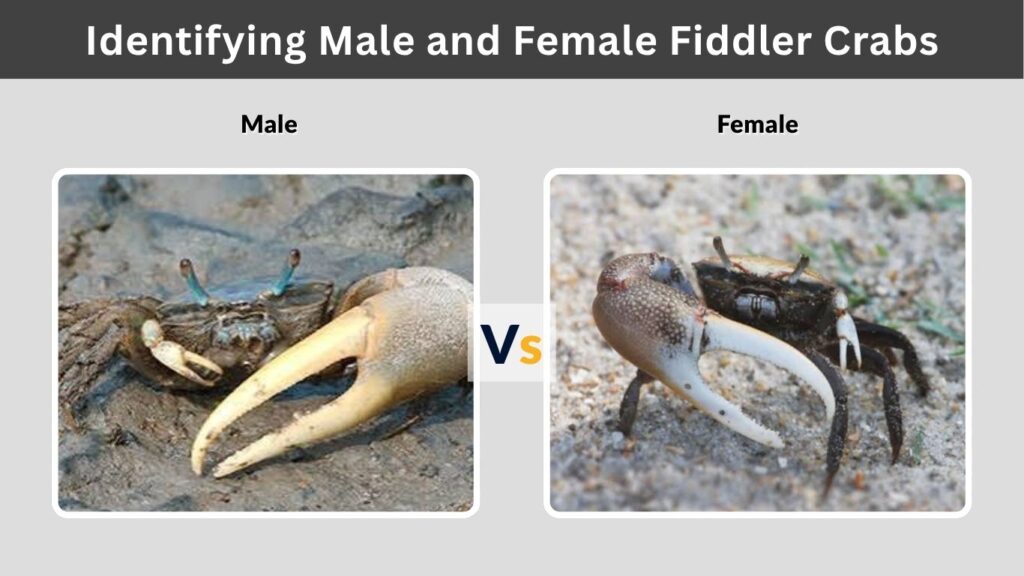
Sexing fiddler crabs is usually straightforward.
Male fiddler crabs have one enormous claw used for communication, courtship, and territorial displays. The other claw remains small and is used for feeding. Females have two similarly sized feeding claws.
A female red-jointed fiddler crab may not appear particularly red. Body and claw coloration can vary with age, environment, molt stage, and species. Therefore, names such as “red fiddler crab,” “red and blue fiddler crab,” or “red devil fiddler crab” may be informal trade names rather than reliable species identifications.
Molting and Common Care Problems
Both crabs must shed their old exoskeleton to grow. Before molting, a crab may become inactive, stop eating, hide frequently, or spend more time in a burrow.
Never pull a crab from its hiding place during this period. Its new shell is soft, making it vulnerable to injuries and attacks. Provide several secure shelters and leave the discarded exoskeleton in the enclosure temporarily. The crab may eat it to recover calcium and other minerals.
Common problems include improper salinity, ammonia buildup, overcrowding, dehydration, failed molts, missing limbs, aggression, and escape attempts.
FAQs
Can red claw crabs live permanently in freshwater?
No. Red claw crabs may survive in freshwater temporarily, but they are brackish-water animals. Long-term freshwater housing can weaken them, interfere with molting, and shorten their lifespan. They should receive properly prepared brackish water and an accessible dry land area.
Can red claw crabs and fiddler crabs live together?
It is possible for them to survive together temporarily, but mixing them is risky. Red claw crabs are territorial and may injure fiddler crabs. Separate species-specific enclosures provide better control over aggression, feeding, land space, and molting safety.
How long do red claw crabs live?
Red claw crabs generally live around two to two and a half years under proper captive conditions. Clean brackish water, balanced nutrition, suitable temperature, hiding places, and safe molting areas are necessary for achieving their expected lifespan.
Do fiddler crabs need a land area?
Yes. Fiddler crabs are semi-terrestrial and spend much of their time walking and feeding on exposed mud or sand. Their aquarium should contain a large moist land section connected to a shallow brackish-water area by a gentle slope.
Can a red-eared slider live with fiddler crabs?
No. A red-eared slider may attack or eat fiddler crabs. The two animals also require different enclosure designs. Turtles need deeper swimming water, while fiddler crabs require exposed sandy land, shallow brackish water, and protection from larger predators.