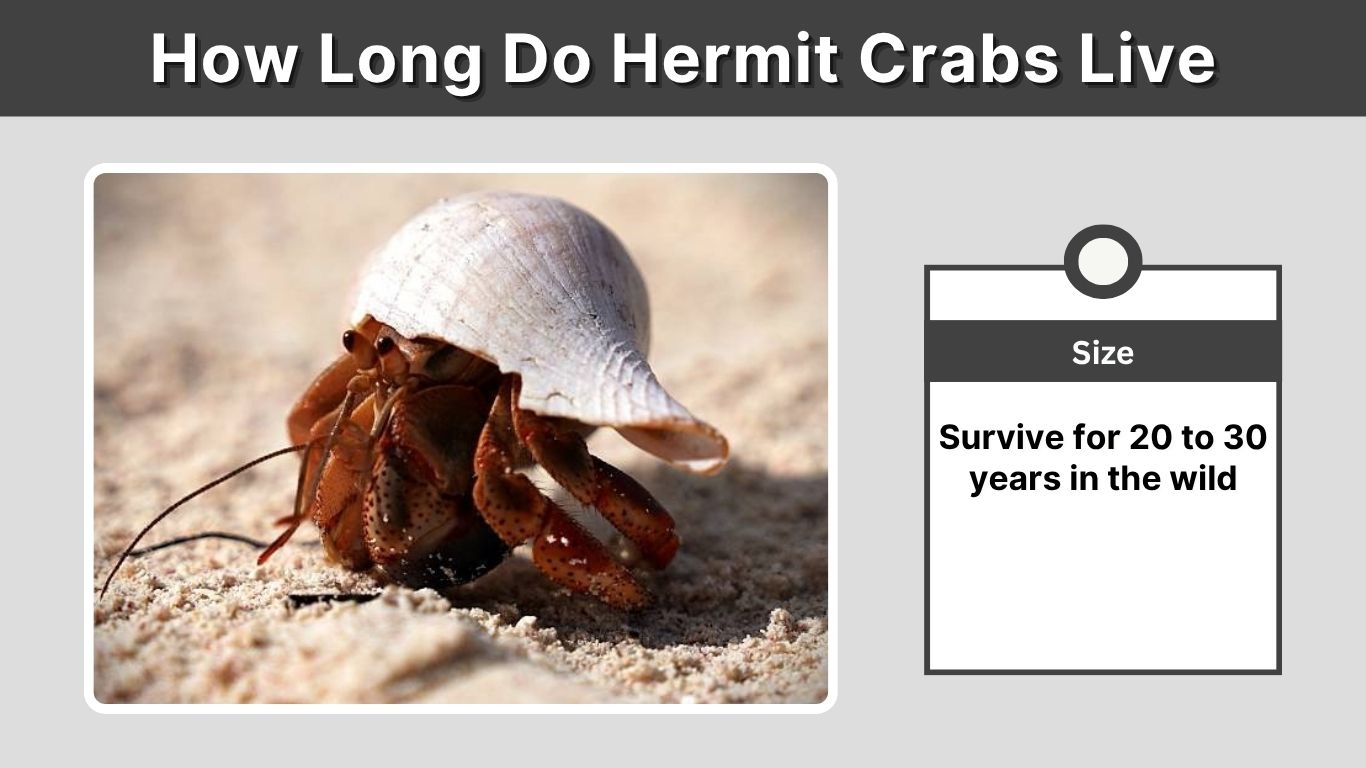
Hermit crabs can live much longer than many people expect. Depending on the species and living conditions, some land hermit crabs may survive for 20 to 30 years in the wild, while smaller marine species may live only a few years. Unfortunately, pet hermit crabs often die much earlier because of incorrect temperature, low humidity, unsuitable water, poor nutrition, or a lack of safe shells. Understanding their natural life cycle and care requirements can help owners support healthier growth and potentially enjoy these unusual crustaceans for many years.
How Long Do Hermit Crabs Live?
The lifespan of a hermit crab varies greatly by species. “Hermit crab” refers to hundreds of different species, including land-dwelling and fully aquatic crabs. They do not all grow at the same rate or live for the same number of years.
Some tropical land hermit crabs can live for several decades under natural conditions. For example, the strawberry land hermit crab may reach approximately 25 to 30 years in the wild. However, reported captive lifespans for this species are often much shorter, commonly around one to four years when its specialized needs are not met.
The common marine hermit crab, Pagurus bernhardus, is reported to live for up to about four years in the wild. Its survival depends partly on shell availability, successful molting, food, habitat conditions, and protection from predators.
Approximate Lifespan by Type
| Hermit crab type | Possible lifespan |
|---|---|
| Large tropical land hermit crabs | 10–30 years or more |
| Strawberry hermit crab | Up to about 25–30 years in the wild |
| Common marine hermit crab | Up to about 4 years |
| Small aquarium hermit crabs | Often several years, depending on species |
| Poorly cared-for pet hermit crabs | Sometimes only a few months to several years |
These figures are general estimates rather than guarantees. Genetics, species, environment, diet, disease, stress, and access to appropriate shells all influence longevity.
How Long Do Pet Hermit Crabs Live?
A properly cared-for land hermit crab may live for many years and can become a long-term pet. However, hermit crabs sold in shops frequently survive for a much shorter period because their care is more demanding than it first appears.
Many newly purchased crabs have already experienced stress caused by collection, transportation, overcrowding, temperature changes, dehydration, and unsuitable painted shells. Once brought home, incorrect housing can create additional health problems.
A small plastic container with gravel, a sponge, and dry commercial pellets is not a complete habitat. Land hermit crabs need a warm, humid enclosure, deep moist substrate, social companions, suitable natural shells, nutritious food, climbing space, and separate freshwater and marine-saltwater pools.
A hermit crab that receives these essentials has a much better chance of reaching its natural lifespan.
Hermit Crab Life Cycle
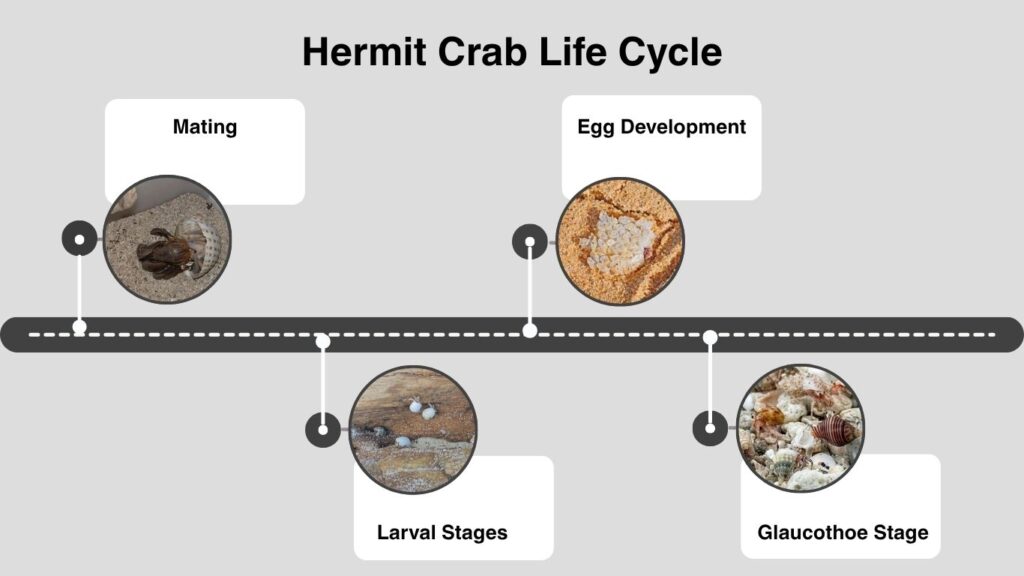
The hermit crab life cycle begins in the ocean, even for most species that spend their adult lives on land. Their development includes eggs, several free-swimming larval stages, a transitional post-larval stage, a juvenile crab, and finally an adult.
1. Mating
Land hermit crabs normally reproduce near coastal areas. The male approaches and holds the female, often tapping or moving her shell before mating. Both animals partially emerge from their shells and position their bodies together.
Marine hermit crabs also mate underwater. Courtship behavior varies among species, but males may guard females before mating, particularly when females are approaching a molt.
2. Egg Development
After mating, the female carries fertilized eggs beneath her abdomen. The eggs form a mass that may contain thousands of individual embryos.
The color of the egg mass can change as the embryos develop. Newly produced eggs may appear orange or reddish, while mature eggs may become darker or gray shortly before hatching.
Female land hermit crabs must eventually reach the ocean to release their eggs. Their young cannot complete the earliest stages of development entirely on land.
3. Larval Stages
When the eggs are released into seawater, they hatch into tiny free-swimming larvae known as zoeae. These larvae are part of the plankton and may be carried by ocean currents.
They look very different from adult hermit crabs. Zoeae have transparent bodies, prominent appendages, and structures that help them swim and feed in open water.
The larvae pass through several developmental stages and molt repeatedly. The exact number of stages varies among species. Smithsonian information on striped hermit crabs describes four swimming larval stages followed by a post-larval stage.
Many larvae are eaten by fish and other marine animals. Only a small percentage survive long enough to continue developing.
4. Glaucothoe Stage
After the zoeal stages, the larva develops into a post-larval form commonly called a glaucothoe. At this point, it begins to look more crab-like and can crawl as well as swim.
The glaucothoe searches for a tiny empty snail shell to protect its soft abdomen. Finding a suitable first shell is a critical step because the young crab is highly vulnerable without one.
Land-hermit-crab species gradually move from seawater toward the shoreline during this stage. Their respiratory system changes as they prepare for a mostly terrestrial life.
5. Juvenile Hermit Crab
After leaving the water, a juvenile land hermit crab begins living near the coast. It remains very small and uses tiny abandoned shells.
Juveniles eat, grow, and molt frequently. Each time the crab becomes too large for its shell, it must find another shell with enough internal space and a suitable opening.
Young crabs face many dangers, including birds, fish, larger crabs, insects, drying conditions, habitat disturbance, and shell shortages.
6. Adult Hermit Crab
As the hermit crab matures, it grows larger, molts less frequently, and becomes capable of reproduction. Adult land hermit crabs continue living near coastal forests, beaches, mangroves, and other humid habitats with access to seawater.
They never stop needing shells. Even fully grown hermit crabs may inspect, exchange, compete for, or abandon shells when a better one becomes available.
Smithsonian sources note that land hermit crabs reproduce and spend their earliest life stages in water before moving toward a terrestrial adult life.
How Hermit Crabs Grow
Hermit crabs cannot grow continuously inside a rigid outer skeleton. Instead, they periodically shed their old exoskeleton in a process called molting.
Before molting, a crab stores nutrients, water, and energy. It may eat more than usual and then suddenly become inactive. Land hermit crabs usually bury themselves deeply in moist substrate, where they can molt in darkness and relative safety.
During the molt, the old exoskeleton splits and the crab slowly pulls its soft body free. Its new exoskeleton is initially flexible and vulnerable. The crab often eats the shed exoskeleton because it contains calcium and other nutrients needed to harden the new covering.
Molting can take weeks or even months, especially in large crabs. Smithsonian guidance notes that some land hermit crab molts may last approximately 45 to 120 days.
Signs a Hermit Crab May Be Preparing to Molt
- Increased digging
- Eating and drinking more than usual
- Reduced activity
- Cloudy-looking eyes
- Ashy or dull exoskeleton color
- Remaining near saltwater or freshwater
- Growing a dark limb-replacement bud
- Staying hidden for extended periods
These signs do not always confirm molting, but a crab showing them should be left undisturbed.
How Often Do Hermit Crabs Molt?
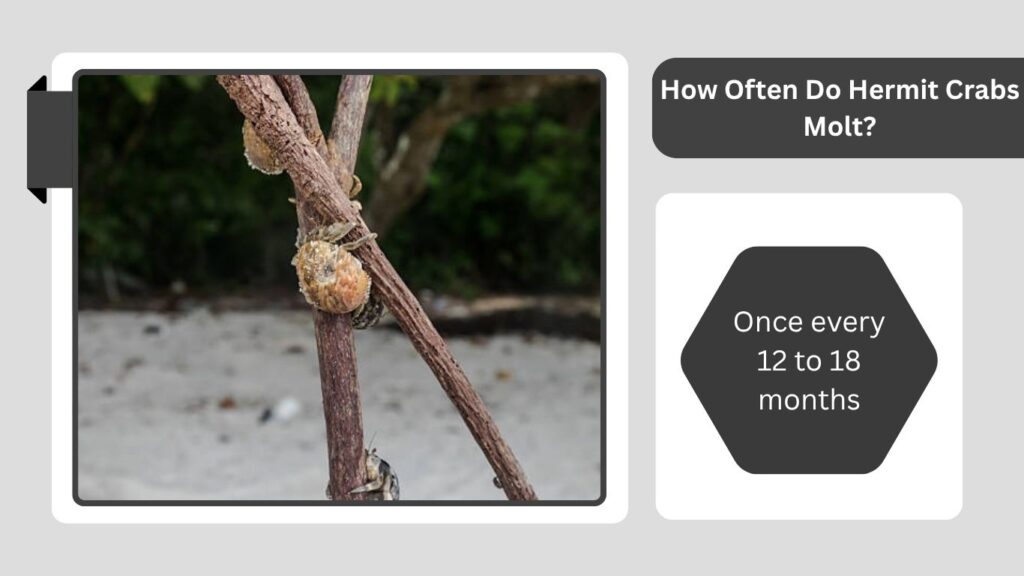
Young hermit crabs molt more frequently because they grow quickly. A small juvenile may molt several times during a year, while a large adult may molt only once every 12 to 18 months.
Molting frequency depends on:
- Age and body size
- Species
- Food quality
- Temperature and humidity
- Health and stress
- Available substrate depth
- Previous injuries
- Rate of growth
A missing leg or claw can gradually regenerate during later molts. The replacement may begin as a small gel-like limb bud and become larger with each molt.
What Affects a Hermit Crab’s Lifespan?
Several environmental and biological factors determine whether a hermit crab lives for a few years or several decades.
Correct Temperature and Humidity
Land hermit crabs breathe through modified gills that must remain moist. Dry air can damage these sensitive respiratory structures and eventually cause suffocation.
Most commonly kept tropical land species need warm, stable temperatures and high humidity. Sudden temperature drops, overheating, or prolonged dryness can significantly reduce their lifespan.
Freshwater and Saltwater
Land hermit crabs need both dechlorinated freshwater and properly mixed marine saltwater. They use these pools for drinking, bathing, and regulating the moisture and salinity carried inside their shells.
The dishes should be deep enough for complete submersion but must have textured ramps that allow easy escape.
Deep Molting Substrate
A hermit crab needs enough substrate to bury itself completely. A mixture with the consistency of sand suitable for building a sandcastle allows the crab to create a stable underground chamber.
Digging up a buried crab can interrupt its molt and may be fatal. Owners should not search for a crab simply because it has disappeared beneath the substrate.
Balanced Nutrition
Hermit crabs are omnivorous scavengers. A varied diet should provide animal protein, vegetables, fruit, seeds, healthy fats, natural pigments, and calcium.
Feeding only commercial pellets or one type of fruit can create nutritional deficiencies that interfere with growth and molting.
Proper Shell Selection
A hermit crab’s shell protects its soft abdomen, reduces moisture loss, and provides shelter from predators. Shell shape and size can influence survival, movement, growth, reproduction, and longevity.
Pet crabs should receive several unpainted natural shells in appropriate sizes. Painted shells may chip, trap the crab, or expose it to unsafe materials.
Social Environment
Land hermit crabs are social animals and commonly live near others. Strawberry hermit crabs, for example, may travel in groups and live in colonies.
They should generally be kept with compatible members of their species, provided the enclosure offers enough space, food, hiding areas, and shells to reduce competition.
Common Causes of Early Death
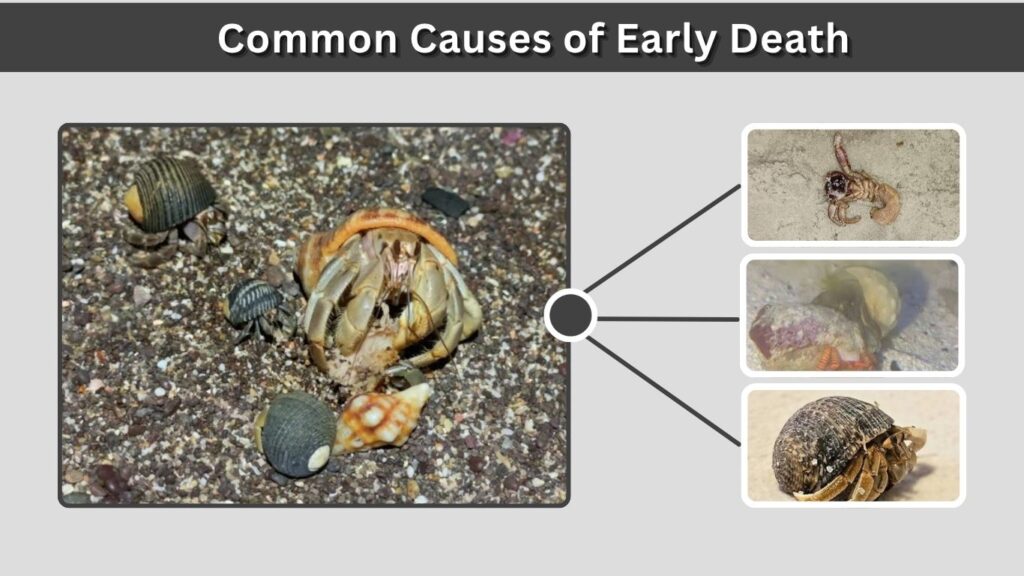
Hermit crabs often hide illness until their condition becomes severe. Many early deaths are linked to habitat errors rather than old age.
Common risks include:
- Low humidity
- Extreme heat or cold
- Untreated tap water
- Missing saltwater or freshwater
- Shallow substrate
- Interrupted molting
- Poor nutrition
- Toxic cleaning chemicals
- Painted or unsuitable shells
- Injury from other crabs
- Overcrowding
- Pesticide exposure
- Persistent handling and stress
A crab lying outside its shell may be seriously stressed, overheated, ill, attacked, or unable to find a suitable replacement. It should be protected immediately and offered appropriate natural shells without forcing it into one.
How to Help a Hermit Crab Live Longer
Create a stable habitat before bringing hermit crabs home. Use a secure glass or plastic enclosure that retains heat and humidity, and provide deep substrate for safe molting.
Offer both conditioned freshwater and marine saltwater in accessible pools. Rotate protein, vegetables, fruit, seeds, seaweed, and calcium-rich foods. Supply multiple natural shells in each crab’s preferred shape and size.
Limit unnecessary handling because hermit crabs are observation pets rather than animals that benefit from frequent physical contact. Maintain cleanliness without repeatedly disturbing the substrate or using scented chemicals.
Most importantly, learn the needs of the particular species. A marine aquarium hermit crab cannot be cared for like a tropical land hermit crab, and even land species may have different environmental preferences.
FAQs
Can hermit crabs live for 30 years?
Some large tropical land hermit crabs may live for approximately 20 to 30 years in the wild. Reaching that age in captivity requires stable temperature, humidity, water, nutrition, safe molting conditions, companionship, and suitable shells.
Why do pet hermit crabs die so quickly?
Many pet hermit crabs die early because of dehydration, low humidity, temperature problems, poor diets, untreated water, shallow substrate, or interrupted molts. Stress experienced during capture and transport can also weaken newly purchased crabs.
How can you tell how old a hermit crab is?
A hermit crab’s exact age generally cannot be determined from its size or shell. Growth rates vary with species, nutrition, molting frequency, environment, and shell availability. A large crab is usually mature, but its precise age remains unknown.
How long does a hermit crab molt?
A molt may last from several weeks to several months. Small crabs usually finish sooner than large adults. The complete process includes preparation, shedding, hardening, eating the old exoskeleton, and recovering before returning to the surface.
Do hermit crabs die during molting?
Molting is natural, but it is also one of the most vulnerable periods in a hermit crab’s life. Poor nutrition, shallow substrate, dryness, disturbance, illness, or attacks from other crabs can cause a molt to fail.