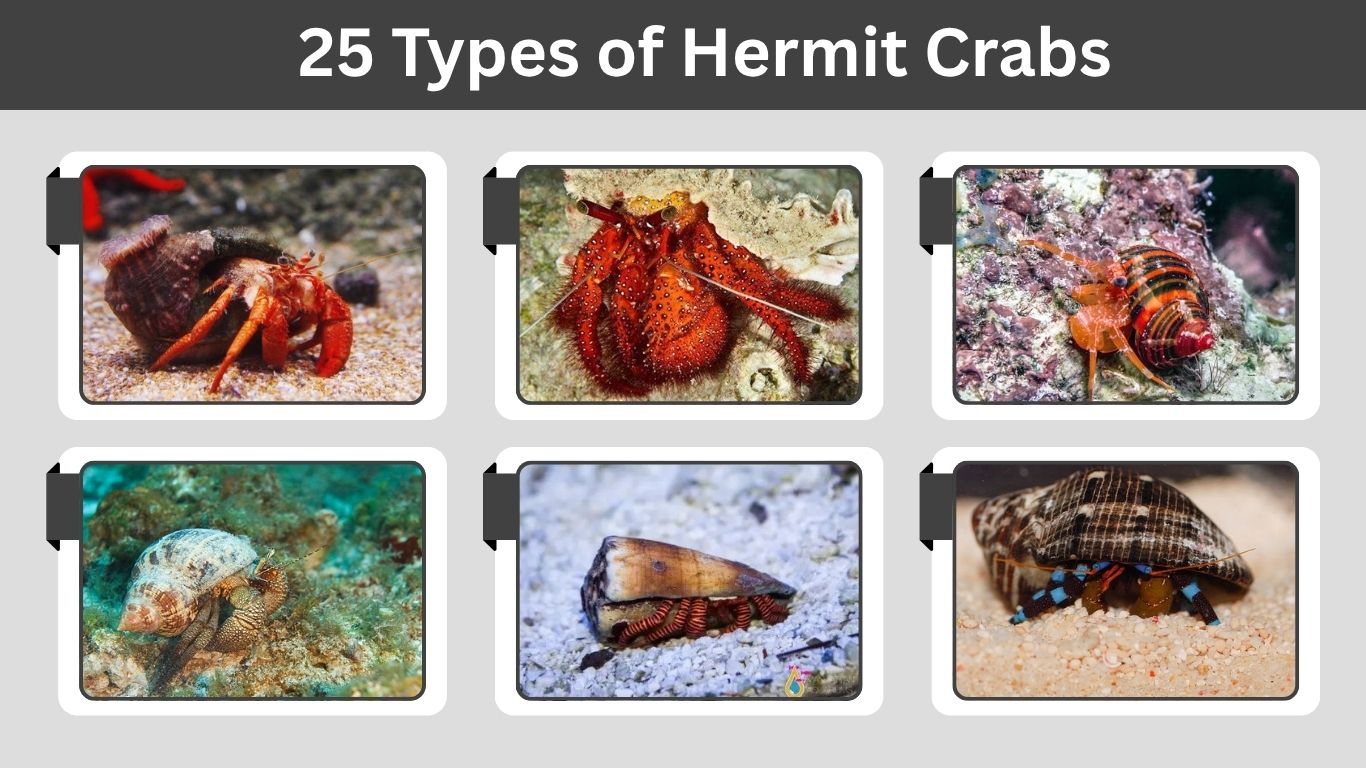
Hermit crabs are fascinating crustaceans known for protecting their soft abdomens inside empty snail shells. More than 1,000 species live in oceans, coral reefs, beaches, mangroves, coastal forests, and tropical islands around the world. They vary greatly in size, color, behavior, habitat, and shell preference. Some species are tiny reef scavengers, while others, such as the coconut crab, grow exceptionally large and eventually stop carrying shells. This guide explores 25 types of hermit crabs, including their scientific names, key identification features, natural habitats, average sizes, body colors, feeding habits, and distinctive behaviors.
1. Caribbean Hermit Crab
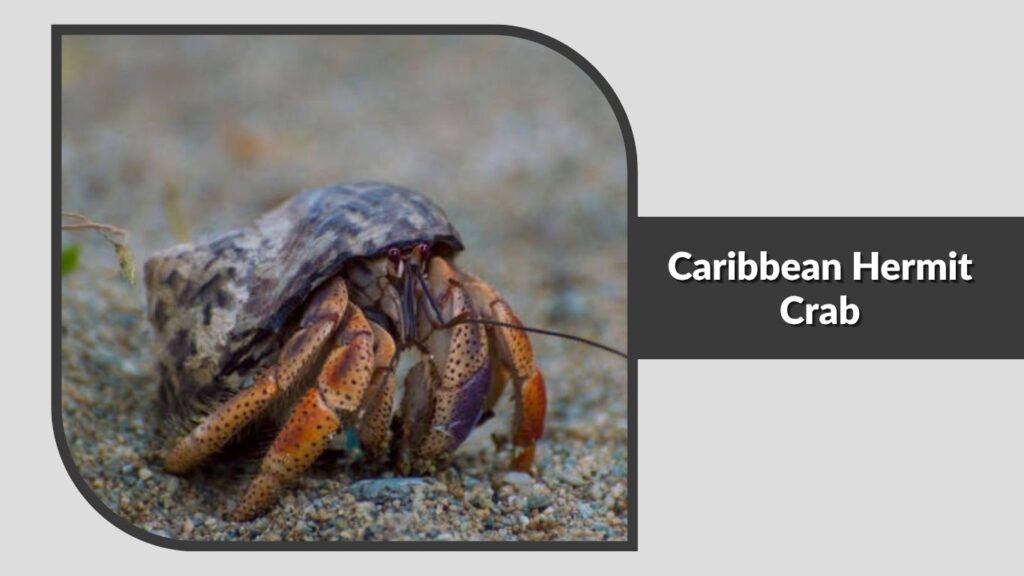
The Caribbean hermit crab (Coenobita clypeatus) is a large land-dwelling species commonly kept as a pet. It is also called the purple pincher hermit crab because of its noticeably larger purple claw. This species inhabits warm coastal regions and depends on empty snail shells to protect its soft abdomen.
Identification
- Large purple or dark violet front claw
- Smaller claw usually brown or purple
- Reddish-brown, tan, or dark brown legs
- Round, black eyes on long stalks
- Rough and slightly hairy walking legs
- Hard, armored front section
- Soft, curved abdomen hidden inside a shell
- Usually uses shells with round openings
Habitat and Distribution
Caribbean hermit crabs occur throughout the Caribbean region, including the Bahamas, Florida Keys, Belize, Venezuela, and several nearby islands. They live in coastal forests, mangroves, dunes, rocky shorelines, and areas near beaches.
Although they live mainly on land, they require access to both freshwater and saltwater. Their modified gills must remain moist, so they prefer humid habitats and commonly hide beneath leaves, logs, rocks, or inside burrows during hot periods.
Size and Color
Adult Caribbean hermit crabs commonly measure between 2 and 4 inches across the body and legs, although some can grow larger. They are among the largest hermit crabs regularly kept as pets.
Their coloration varies from reddish brown and tan to deep purple. The oversized left claw is usually the most recognizable feature. Younger crabs may appear lighter, while older individuals often develop darker and more intense coloration.
Diet and Behavior
Caribbean hermit crabs are omnivorous scavengers that eat fallen fruit, seeds, leaves, algae, insects, dead animals, and decaying organic material. In captivity, they benefit from a varied diet containing vegetables, fruit, protein, calcium, and natural plant matter.
They are mainly active at night and spend daylight hours hiding in humid shelters. These social crabs often live in groups and communicate through movement and chirping sounds. As they grow, they regularly inspect and change shells.
2. Ecuadorian Hermit Crab
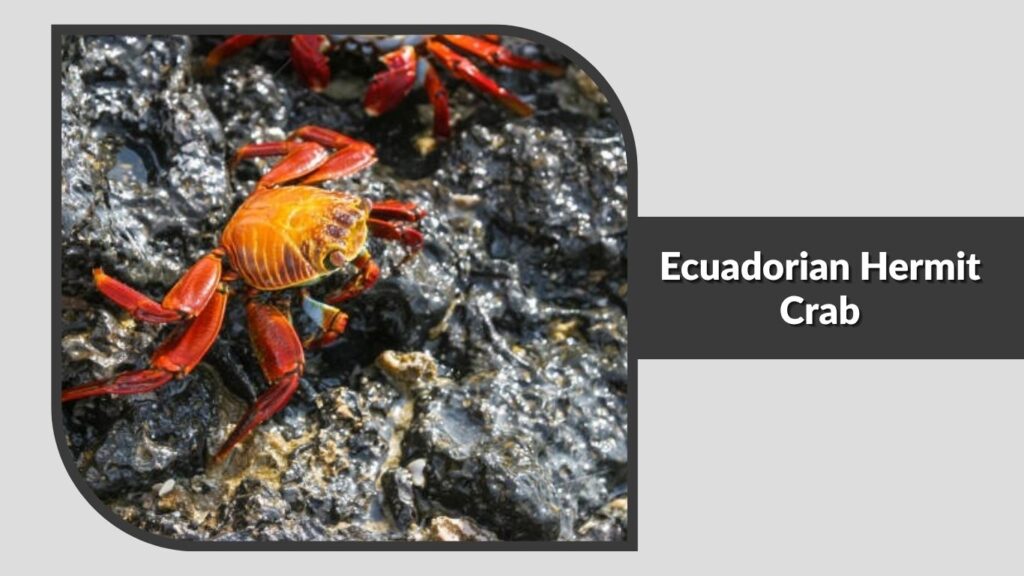
The Ecuadorian hermit crab (Coenobita compressus), also called the Pacific hermit crab, is a fast and active land hermit crab native to the Pacific coast of the Americas. It is generally smaller than many commonly kept land species and is recognized by its elongated eyes, broad body, and varied coloration.
Identification
- Elongated or oval-shaped eyes
- Broad and flattened body
- Large left claw with a rough surface
- Pale underside and inner legs
- Long, slender walking legs
- Dark patch may appear beneath each eye
- Smaller than many other land hermit crabs
- Commonly uses shells with D-shaped openings
Habitat and Distribution
Ecuadorian hermit crabs occur along the Pacific coast from Mexico and Central America southward through Colombia, Ecuador, Peru, and Chile. They are also found on the Galápagos Islands. Their habitats include sandy beaches, coastal dunes, moist vegetation, and tropical forest areas close to the shoreline.
Size and Color
The carapace may reach approximately 18 millimeters in length, although the crab appears larger when its legs and shell are included. Young individuals may be blue, green, or yellowish. Adults commonly become tan, brown, cream, orange, army green, or reddish. Their undersides often remain noticeably pale.
Diet and Behavior
Ecuadorian hermit crabs eat fruit, flowers, insects, carrion, seeds, and other organic material. They can be selective feeders and may temporarily ignore familiar foods. These crabs are extremely energetic, quick, and skilled at climbing and digging. They may remain active during both daytime and nighttime.
3. Indonesian Hermit Crab
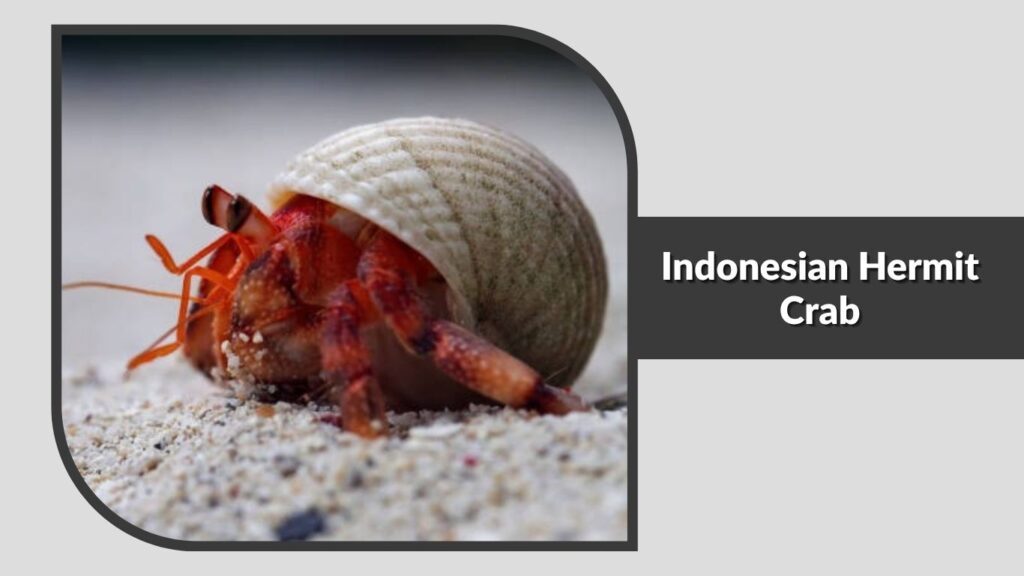
The Indonesian hermit crab (Coenobita brevimanus) is one of the largest land hermit crab species commonly kept in captivity. Also called the Indo or short-handed hermit crab, it has a heavy body, an exceptionally large left claw, and distinctive cylindrical eye stalks. It is widely distributed throughout the Indo-Pacific region.
Identification
- Exceptionally large and rounded left claw
- Small right claw
- Round black eyes
- Thick, cylindrical eye stalks
- Heavy and strongly built walking legs
- Short, broad abdomen
- Purple, brown, gray, or pinkish body
- Commonly chooses large turbo shells
Habitat and Distribution
Indonesian hermit crabs inhabit islands and coastal regions across the Indian and Pacific oceans. They are commonly associated with humid rainforests, coastal woodland, grassy island interiors, and areas containing leaf litter and fallen trees. Although highly adapted to land, they remain connected to coastal water for reproduction and moisture.
Size and Color
This is a particularly large and heavy-bodied land hermit crab. Mature individuals may become considerably larger than Caribbean, Ecuadorian, or rugosus hermit crabs. Their coloration usually includes shades of dark brown, grayish purple, lavender, or pink. The large claw is often smoother and lighter than the walking legs.
Diet and Behavior
Indonesian hermit crabs are omnivores and detritivores. They consume fallen leaves, bark, wood fibers, fruit, grains, coconut, dead animals, and other organic matter. They are curious, active, and primarily nocturnal. Their large claw is useful for defense, breaking food apart, and sealing the opening of their shell.
4. Strawberry Hermit Crab
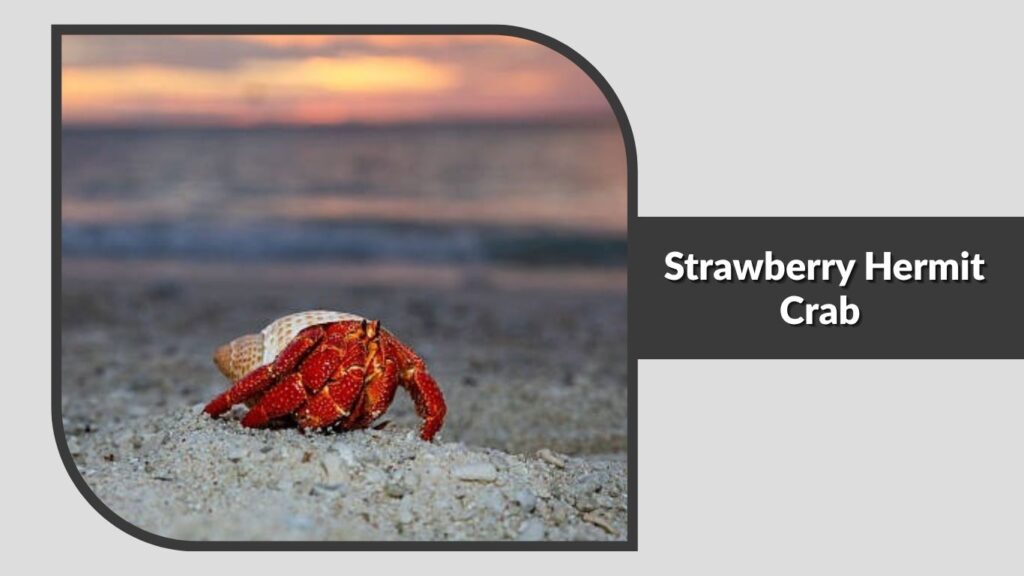
The strawberry hermit crab (Coenobita perlatus) is a colorful land hermit crab named for its bright red-orange body and small pale markings. It is widely distributed across tropical Indo-Pacific islands and is strongly associated with warm, humid coastal environments.
Identification
- Bright red, orange-red, or scarlet body
- Small white or cream-colored bumps
- Thick, sturdy walking legs
- Large left claw with a rough surface
- Round, dark eyes on pale stalks
- Short antennae compared with some species
- Darker red coloration in mature adults
- Commonly occupies rounded turbo shells
Habitat and Distribution
Strawberry hermit crabs occur on islands across the Indian and Pacific oceans, from Mauritius and the Seychelles eastward to Samoa. They inhabit beaches, coastal forests, mangroves, rocky shorelines, and areas containing damp vegetation. They usually remain close enough to the ocean to obtain salt water and release their larvae.
Size and Color
Adults may reach approximately 3 inches in overall body length, although size varies according to age, shell availability, and habitat conditions. Their brilliant red or orange exoskeleton is covered with raised white or yellowish spots, creating an appearance similar to strawberry seeds. Younger crabs may be paler than mature individuals.
Diet and Behavior
Strawberry hermit crabs are active omnivorous scavengers. They eat fallen fruit, leaves, seaweed, seeds, insects, mollusks, fish remains, wood, and other decaying organic material. They are strong diggers and climbers and usually become most active during cooler evening and nighttime hours. They may bury themselves in damp sand during hot weather to conserve moisture.
5. Blueberry Hermit Crab
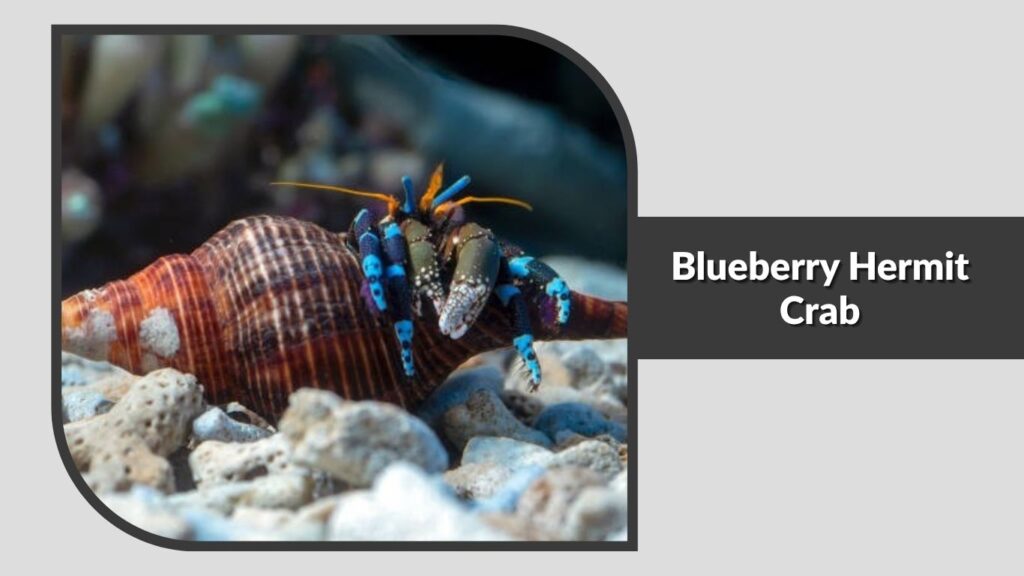
The blueberry hermit crab (Coenobita purpureus), also called the Okinawan blueberry hermit crab, is a striking terrestrial species known for its blue, violet, or purple coloration. It is primarily associated with the southern islands of Japan and is one of the most visually distinctive members of the genus Coenobita.
Identification
- Blue, violet, or deep purple body
- White, cream, or pale eye stalks
- Round black eyes
- Large left claw
- Rough-textured walking legs
- Color often becomes stronger with age
- Juveniles may appear beige or light brown
- Commonly uses rounded marine snail shells
Habitat and Distribution
Blueberry hermit crabs inhabit tropical and subtropical islands in southern Japan, particularly the Ryukyu and Okinawa island groups. Populations have also expanded northward along parts of Japan’s Pacific coast. They live around sandy beaches, coastal vegetation, rocky crevices, forest edges, and areas above the high-tide line.
Size and Color
Adults commonly measure about 7–10 centimeters when the extended body and legs are considered, although shell and body sizes vary. Their coloration ranges from pale blue and lavender to dark violet or purplish blue. Juveniles are generally cream, beige, or light brown and gradually develop deeper colors as they mature.
Diet and Behavior
Blueberry hermit crabs are omnivorous scavengers that consume fruit, leaves, seeds, algae, insects, dead fish, and other organic material. They often hide beneath vegetation, rocks, driftwood, or sediment during hot periods. Although they live on land, females must return to coastal water to release their eggs, and the young initially develop as aquatic larvae.
6. Viola Hermit Crab
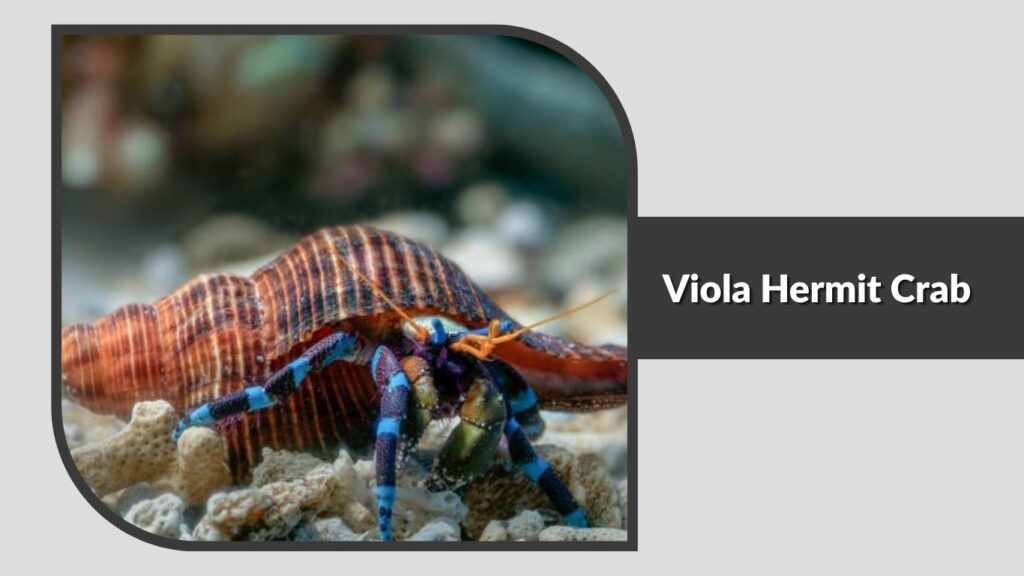
The viola hermit crab (Coenobita violascens) is a land-dwelling species found across parts of Southeast Asia and the western Pacific. It is named for the violet, purple, or bluish coloration commonly seen in mature individuals. This hermit crab lives in warm coastal habitats and uses discarded marine snail shells to protect its soft abdomen.
Identification
- Violet, purple, blue-gray, or brown body
- Large and strongly developed left claw
- Dark oval eyes on elongated stalks
- Smooth or lightly textured walking legs
- Pale patches around the joints
- Narrow body compared with larger species
- Juveniles may appear tan or brown
- Often chooses shells with oval openings
Habitat and Distribution
Viola hermit crabs occur in coastal regions of Southeast Asia, including Indonesia, Malaysia, Thailand, the Philippines, and nearby Pacific islands. They inhabit mangrove forests, sandy beaches, coastal woodland, rocky shorelines, and areas containing moist leaf litter.
They usually remain close to the sea because females must return to saltwater to release their eggs. During hot or dry periods, the crabs shelter beneath logs, rocks, vegetation, or damp soil to prevent moisture loss.
Size and Color
Viola hermit crabs are generally medium-sized, although mature adults may become relatively large when suitable food and shells are available. Their coloration varies considerably between individuals.
Young crabs are often beige, brown, or gray. As they mature, their legs and claws may develop deeper shades of violet, lavender, blue, or dark purple. The large claw may be darker than the remaining legs.
Diet and Behavior
Viola hermit crabs are omnivorous scavengers that eat fruit, seeds, leaves, flowers, algae, insects, carrion, and decaying wood. They are mainly active at night but may emerge during humid or cloudy daytime conditions.
These crabs are strong diggers and frequently rearrange objects while exploring. They may also climb branches, rocks, and enclosure decorations while searching for food or suitable shells.
7. Rugosus Hermit Crab
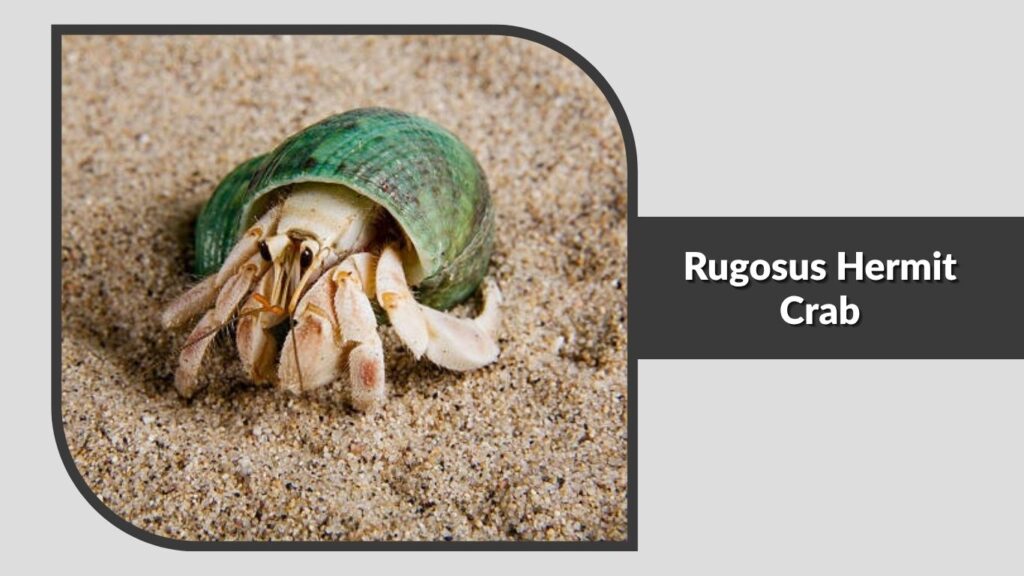
The rugosus hermit crab (Coenobita rugosus) is a widely distributed land hermit crab found throughout tropical Indo-Pacific regions. It is also known as the wrinkled hermit crab because of the rough ridges visible on its large claw. This adaptable species lives near beaches, coastal forests, and mangroves.
Identification
- Rough ridges on the large left claw
- Dark diagonal stripe behind each eye
- Long, narrow eye stalks
- Black or dark brown oval eyes
- Tan, gray, brown, pink, or purple coloration
- Slender walking legs
- Small hairs covering parts of the body
- Usually occupies shells with round openings
Habitat and Distribution
Rugosus hermit crabs occur across the Indian and Pacific oceans, including eastern Africa, Southeast Asia, Australia, Japan, and many tropical islands. They inhabit sandy beaches, coral rubble, mangrove edges, coastal forests, grasslands, and areas above the high-tide line.
They prefer warm, humid conditions and commonly hide beneath driftwood, stones, leaves, and vegetation during the hottest parts of the day.
Size and Color
This species is usually small to medium-sized. Adults vary considerably depending on age, food supply, and the availability of suitable shells. Their bodies may appear pale cream, sandy brown, gray, pink, lavender, reddish, or dark purple.
A distinctive dark line behind each eye often helps separate the rugosus hermit crab from similar land species. Its large claw usually has clearly visible horizontal ridges.
Diet and Behavior
Rugosus hermit crabs consume fallen fruit, seeds, algae, seaweed, leaves, insects, dead fish, animal remains, and other organic material. They help recycle nutrients by feeding on decaying matter.
These crabs are active climbers, diggers, and explorers. They usually forage at night and may travel considerable distances in search of food, moisture, or better-fitting shells.
8. Cavipe Hermit Crab
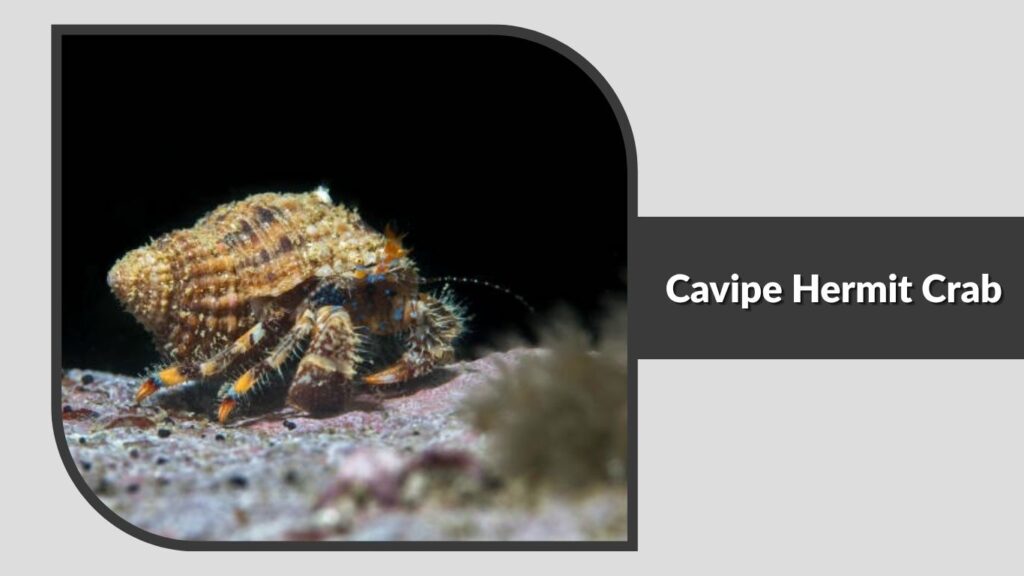
The cavipe hermit crab (Coenobita cavipes) is a terrestrial hermit crab found across tropical parts of the Indo-Pacific region. It is a medium-sized species with long walking legs, dark coloration, and a strong left claw. Like other land hermit crabs, it uses an empty snail shell to protect its soft, curved abdomen.
Identification
- Brown, gray, olive, or purplish body
- Large and powerful left claw
- Smaller right claw used for feeding
- Long, relatively slender walking legs
- Dark eyes positioned on elongated stalks
- Rough texture on the claws and legs
- Soft abdomen carried inside a snail shell
- Commonly occupies shells with oval openings
Habitat and Distribution
Cavipe hermit crabs occur across parts of eastern Africa, Southeast Asia, southern Japan, Australia, and numerous tropical islands. They inhabit coastal forests, mangroves, sandy beaches, coral-covered shorelines, and areas containing moist leaf litter.
Although adults spend most of their lives on land, they require humid conditions to keep their modified gills moist. They commonly shelter beneath logs, rocks, vegetation, or inside shallow burrows during hot and dry periods.
Size and Color
The cavipe hermit crab is generally a medium-sized species, although mature individuals may become relatively large when sufficient food and shells are available. Its exact size varies according to age, sex, habitat, and shell availability.
The body may be dark brown, gray, olive, tan, or muted purple. Some individuals have paler joints or undersides. Younger crabs are usually lighter, while mature crabs may develop darker legs and claws.
Diet and Behavior
Cavipe hermit crabs are omnivorous scavengers that consume fallen fruit, seeds, leaves, algae, insects, carrion, wood, and other decaying material. Their feeding helps break down organic matter in coastal environments.
They are mostly active at night, when humidity is higher and temperatures are cooler. They can dig, climb, and travel across the forest floor while searching for food, moisture, and suitable replacement shells.
9. Coconut Crab
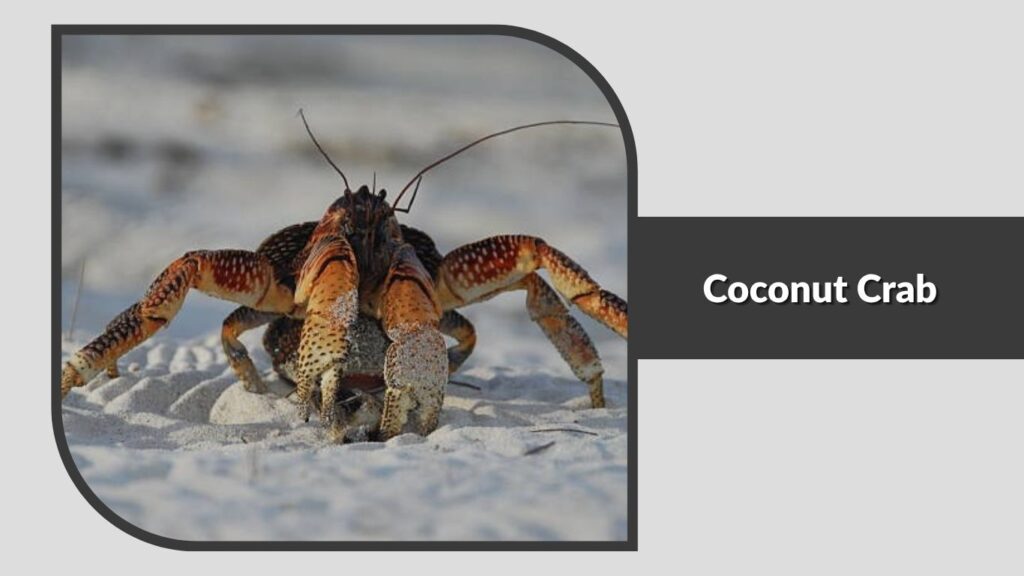
The coconut crab (Birgus latro), also called the robber crab or palm thief, is the largest land-dwelling arthropod in the world. It belongs to the same family as terrestrial hermit crabs. Young coconut crabs use empty snail shells, but adults develop a hardened abdomen and no longer need to carry a protective shell.
Identification
- Extremely large, heavily armored body
- Powerful claws capable of crushing hard food
- Long and muscular walking legs
- Blue, purple, red, orange, or brown coloration
- Small eyes positioned on short stalks
- Hardened abdomen in mature adults
- Juveniles temporarily occupy snail shells
- Strongly developed sense of smell
Habitat and Distribution
Coconut crabs inhabit tropical islands across the Indian and Pacific oceans. They live in coastal forests, limestone areas, coconut groves, rocky shelters, and dense island vegetation. Adults dig deep burrows or shelter inside rock crevices to remain cool and moist.
Although they begin life in the ocean, mature coconut crabs are adapted to breathing air and may drown when kept underwater for too long. Females return to the shoreline to release their fertilized eggs into seawater.
Size and Color
Large coconut crabs can weigh around 4 kilograms and have a leg span approaching one meter. Males are generally larger than females, and growth is extremely slow.
Color varies between populations and individuals. Some coconut crabs are vivid blue or purple, while others appear reddish orange, brown, or dark violet. Their thick exoskeleton provides protection that other adult land hermit crabs receive from borrowed shells.
Diet and Behavior
Coconut crabs eat coconuts, fallen fruit, nuts, seeds, vegetation, insects, carrion, and smaller animals. Their enormous claws allow them to break hard food, defend themselves, and move heavy objects.
They are mainly nocturnal and spend much of the day inside humid burrows. Coconut crabs are capable climbers and may climb trees to reach fruit or escape danger. After hatching in the ocean, the larvae develop through aquatic stages before young crabs move onto land and begin using small shells.
10. Australian Land Hermit Crab
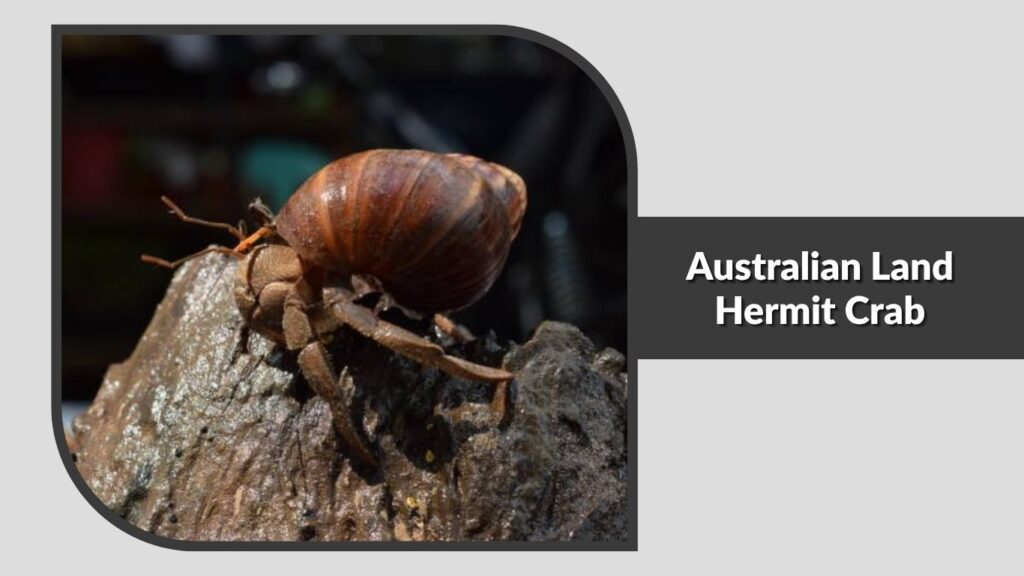
The Australian land hermit crab (Coenobita variabilis) is a terrestrial species native to northern Australia. Commonly called the Aussie hermit crab, it inhabits warm coastal environments and depends on discarded marine snail shells to protect its soft abdomen. It is also one of the land hermit crab species commonly kept as a pet in Australia.
Identification
- Cream, tan, or pale brown body
- Irregular dark markings on the legs and shield
- Large left claw
- Smaller right claw used for feeding
- Eyestalks compressed from side to side
- Long antennule stalks with short feelers
- Legs and claws without prominent spines
- Usually occupies rounded marine snail shells
Habitat and Distribution
Australian land hermit crabs occur across northern Australia, from the Exmouth Gulf region of Western Australia to northern Queensland. They are especially common near mangrove forests but also inhabit sandy beaches, rocky shores, coastal dunes, and areas above the high-tide line.
Some individuals travel approximately 100 metres or more inland from the beach. During the day, they usually shelter beneath logs, stones, vegetation, or other objects that provide shade and moisture.
Size and Color
The carapace of an Australian land hermit crab can reach approximately 40 millimetres in length. When its walking legs and borrowed shell are included, the animal appears considerably larger.
Its body is usually cream, sandy brown, or pale brown. Darker brown patches may appear across the shield, claws, and legs. Coloration varies between individuals and may help the crab blend into sand, dried vegetation, rocks, and coastal debris.
Diet and Behavior
Australian land hermit crabs are omnivorous scavengers that consume dead fish, animal remains, fallen fruit, leaves, seeds, algae, insects, and other decaying material. By removing organic waste, they help clean beaches and recycle nutrients.
They are primarily active at night, when temperatures are cooler and humidity is higher. During their nightly activities, they search for food, water, and better-fitting shells. Large groups may gather behind mangroves or around abundant food sources.
11. Lilac Hermit Crab
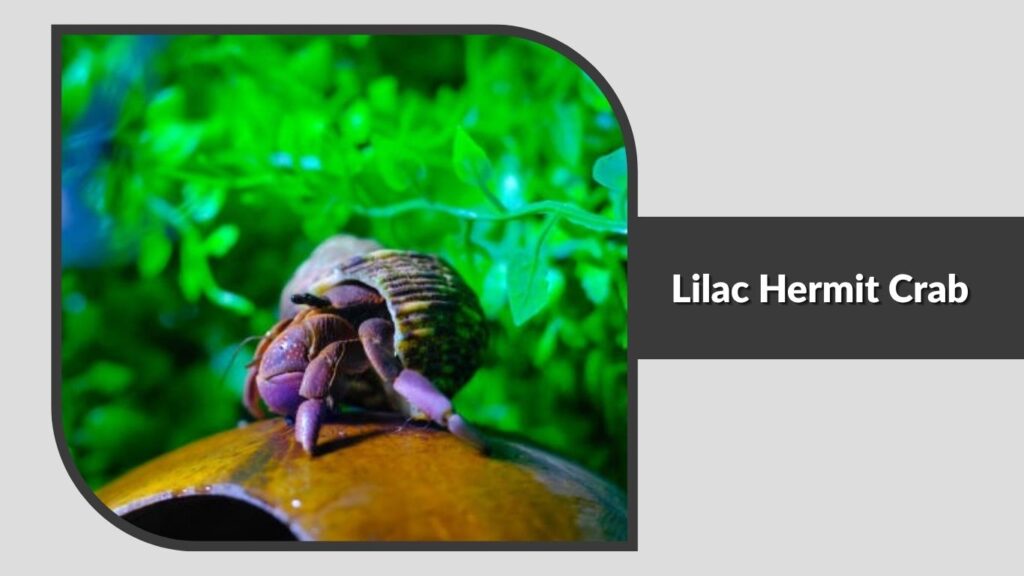
The lilac hermit crab (Coenobita lila) is a terrestrial hermit crab recognized for the violet or pale-purple coloration of mature individuals. It was formally identified as a separate species in 2016 after previously being confused with other Asian land hermit crabs.
Identification
- Purple, violet, or pale-lilac adult coloration
- Light-purple or whitish eye stalks
- Dark brown eyes
- Large left claw without stitch-like ridges
- Rough tubercles across the claws and legs
- Dark patch on the front of the shield
- Dark line running behind the eyes
- Younger females may appear greenish or yellowish
Habitat and Distribution
Lilac hermit crabs are recorded in Singapore, Malaysia, and parts of Indonesia, including Batam. They occupy upper intertidal areas and may travel approximately 100 metres inland from the shoreline.
They are commonly associated with reef environments but may also occur near mangrove edges, estuaries, coastal grass beds, and rocky areas. During daylight hours, groups sometimes shelter beneath stones or within dense vegetation.
Size and Color
This species is generally small to medium-sized. The male specimen used in its original scientific description had a shield length of approximately 16.7 millimetres, while examined females included smaller individuals.
Adults are commonly purple, violet, or pale violet. Some have brown patches or darker purple markings on the shield and large claw. Smaller females may appear pale purple, greenish white, yellow-green, or brown, showing considerable variation within the species.
Diet and Behavior
Lilac hermit crabs are omnivorous scavengers that feed on available plant and animal material, including fruit, leaves, algae, insects, carrion, and other decaying organic matter. They use their small claw to collect food while the larger claw provides defense and helps close the shell opening.
They commonly remain hidden during hot daylight hours and become more active when temperatures fall. This species is also capable of producing chirping or stridulating sounds, particularly when disturbed or interacting with another crab.
12. Red-Legged Hermit Crab
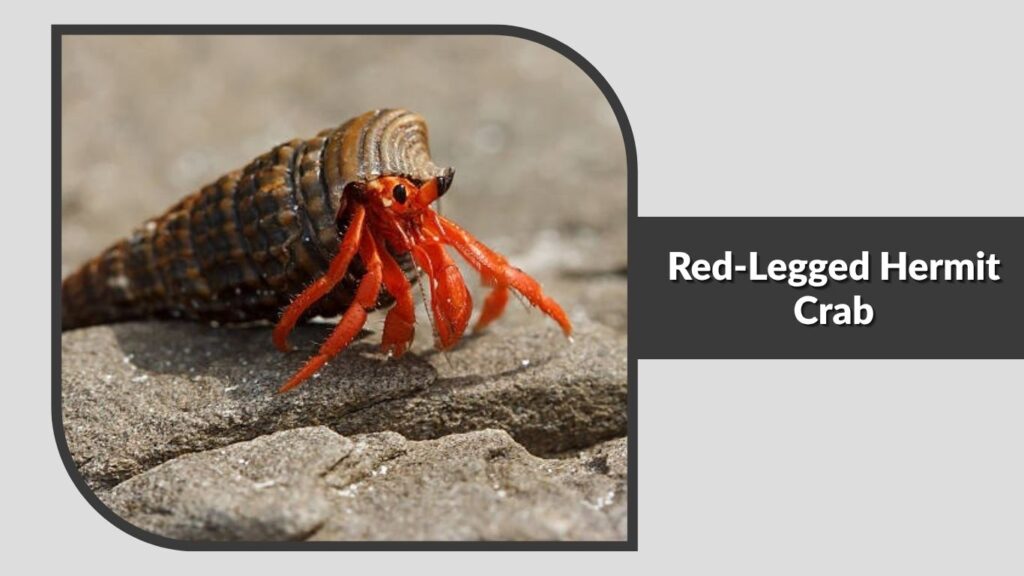
The red-legged hermit crab featured here is the Mexican red-legged hermit crab (Clibanarius digueti), also called the dwarf red-tip hermit crab. It is a small marine species native to the eastern Pacific and should not be confused with the scarlet reef hermit crab. It occupies discarded snail shells and frequently searches rocky coastal habitats for algae and organic material.
Identification
- Reddish-brown or dark red walking legs
- Bright red or orange leg tips
- Pale bands or markings on the legs
- Dark eyes on short stalks
- Long, slender antennae
- Left claw slightly larger than the right
- Small body carried inside a snail shell
- Frequently occupies rounded marine shells
Habitat and Distribution
Red-legged hermit crabs occur along the Pacific coast of Mexico and are especially abundant around the Gulf of California. They live in rocky intertidal areas, tide pools, shallow reefs, sandy rubble, and protected coastal shallows. Their occupied zone may overlap with those of other small hermit crab species.
Size and Color
This is a dwarf marine hermit crab that commonly measures approximately 2–3 centimeters when extended from its shell. Its legs range from rusty brown to vivid red, often ending in brighter orange, red, or pale tips. Small cream or white markings may also occur along the joints.
Diet and Behavior
Red-legged hermit crabs are omnivorous scavengers that graze on algae and consume detritus, leftover animal material, and other edible particles. They actively explore rocks and sediment while feeding. Individuals may gather in groups, compete for food, and inspect abandoned shells when they need larger homes.
13. Blue-Legged Hermit Crab
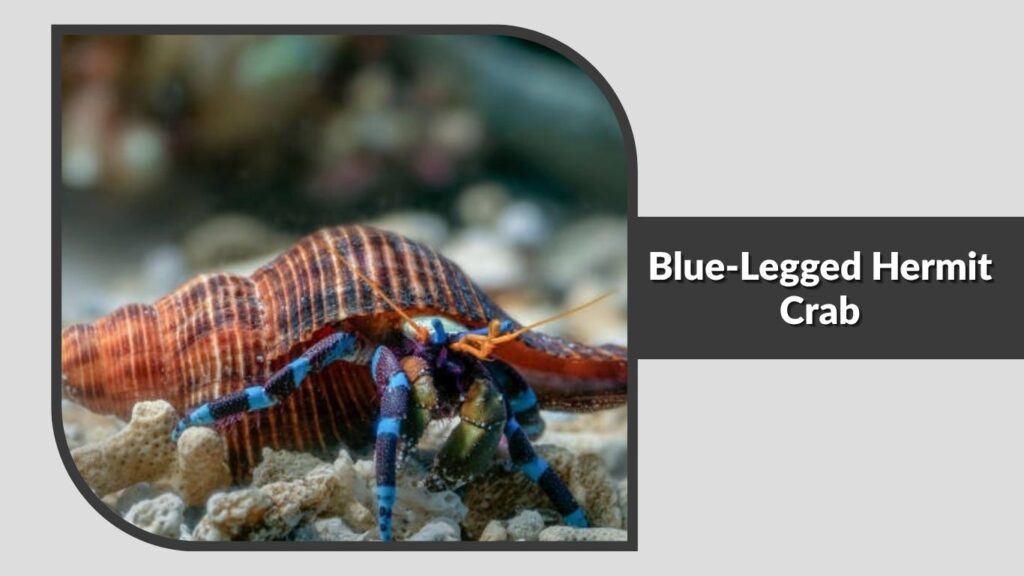
The blue-legged hermit crab (Clibanarius tricolor) is a small marine species recognized by its brilliant blue legs and contrasting orange markings. It is also known as the tricolor or blue-leg reef hermit crab. This species inhabits warm, shallow Caribbean waters and is frequently seen crawling across rocks, coral rubble, and sandy reef bottoms.
Identification
- Bright blue walking legs
- Orange or red bands around the leg joints
- Small black spots on the blue sections
- Dark claws with pale or black tips
- Long orange antennae
- Dark eyes on bluish stalks
- Left claw slightly larger than the right
- Small body housed inside a snail shell
Habitat and Distribution
Blue-legged hermit crabs occur throughout the Caribbean, including Florida, the Bahamas, Bermuda, and coastal areas of Mexico. They prefer shallow reefs, tide pools, lagoons, rocky shores, and sandy areas containing coral rubble. Many are found in water only a few meters deep.
Size and Color
This species usually reaches approximately 2–3 centimeters in extended body length. Its vivid blue legs are decorated with orange-red bands and small dark spots, producing the three-colored appearance behind its scientific name. The claws and front body are generally darker than the walking legs.
Diet and Behavior
Blue-legged hermit crabs feed on algae, detritus, dead organisms, and tiny food particles collected from rocks and sediment. They spend much of their time grazing and scavenging within a relatively small area. Individuals may form groups and display strong attachment to familiar sections of their habitat.
14. Scarlet Reef Hermit Crab
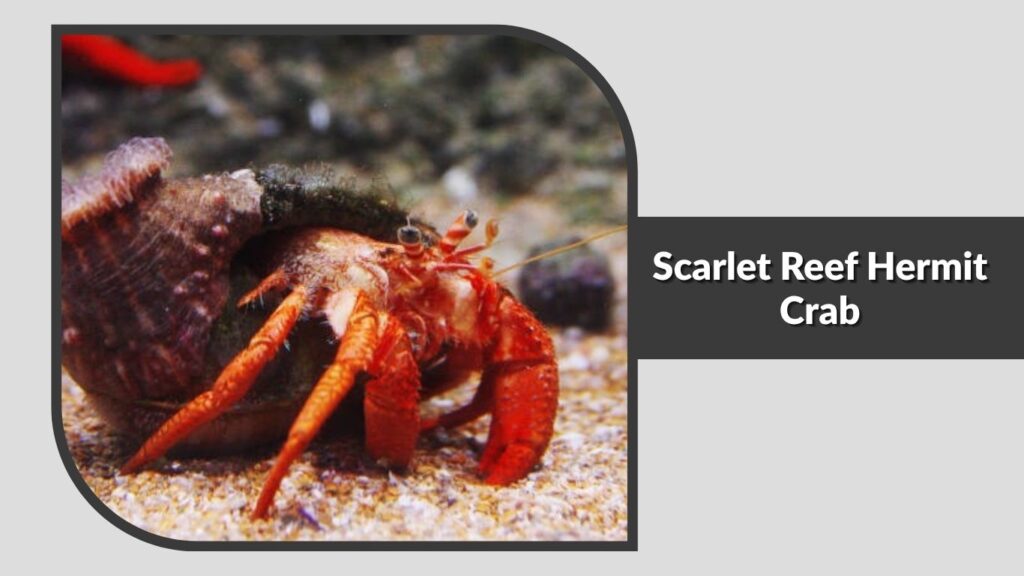
The scarlet reef hermit crab (Paguristes cadenati), also called the red reef hermit crab, is a small marine species recognized by its brilliant red body and yellow eye stalks. Native to Caribbean waters, it inhabits rocky reef environments and spends much of its time searching surfaces for algae, leftover food, and decaying organic matter.
Identification
- Bright scarlet-red walking legs
- Red claws of nearly equal size
- Yellow or golden eye stalks
- Small dark eyes
- Long, thin antennae
- Smooth or lightly textured legs
- Compact body hidden inside a snail shell
- Commonly occupies rounded marine shells
Habitat and Distribution
Scarlet reef hermit crabs occur throughout the Caribbean Sea and nearby western Atlantic waters. They inhabit coral reefs, rocky seabeds, rubble-covered areas, lagoons, and shallow coastal environments.
They usually remain around hard surfaces where algae and organic debris collect. Rocks and reef crevices also provide protection from predators and strong water movement.
Size and Color
This is a relatively small hermit crab, commonly reaching about 3–5 centimeters when extended from its shell. Its vivid red legs and claws make it easy to distinguish from most other reef-dwelling hermit crabs.
The yellow eye stalks create a strong contrast with the scarlet body. Some individuals may display orange-red tones or small pale markings near the leg joints.
Diet and Behavior
Scarlet reef hermit crabs graze on algae and consume detritus, uneaten food, dead organisms, and other edible material found on rocks or sediment. They spend much of the day slowly exploring the reef while picking at surfaces with their smaller feeding appendages.
15. Electric Blue Hermit Crab
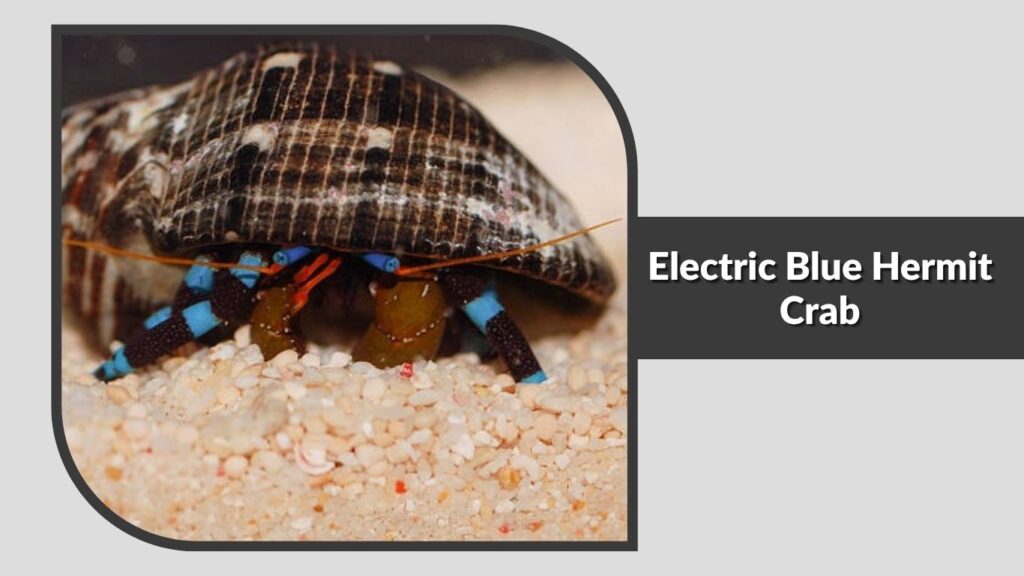
The electric blue hermit crab (Calcinus elegans), also called the blue-knuckled or elegant hermit crab, is a colorful marine species from the Indo-Pacific region. Its alternating blue and black leg bands, orange antennae, and greenish claws make it one of the most visually distinctive reef hermit crabs.
Identification
- Electric-blue bands on the walking legs
- Dark brown or black areas between blue bands
- Bright orange antennae
- Blue eye stalks
- Olive-green or brownish claws
- Small white spots near the claw tips
- Two claws that are nearly equal in size
- Larger body than the dwarf blue-legged hermit crab
Habitat and Distribution
Electric blue hermit crabs are distributed across tropical Indo-Pacific waters, including areas around Hawaii, Japan, the Red Sea, Pacific islands, and Australia. They inhabit coral reefs, rocky shallows, lagoons, and rubble-covered seabeds.
They frequently shelter beneath rocks or inside reef crevices when inactive. Their environment provides abundant algae, detritus, and discarded snail shells that can be used as the crab grows.
Size and Color
The electric blue hermit crab may reach approximately 5 centimeters when extended, although its apparent size depends greatly on the shell it occupies. It becomes noticeably larger and heavier than the smaller blue-legged hermit crab.
Its walking legs feature alternating electric-blue and dark bands. The claws are generally olive green or brownish, while the antennae are vivid orange. Small white spots may occur near the claw tips.
Diet and Behavior
Electric blue hermit crabs are omnivorous scavengers that consume algae, cyanobacteria, detritus, leftover food, and dead animal material. They actively crawl across rocks and sediment, using their claws to collect food from narrow spaces.
They can become territorial toward other hermit crabs and may attack snails when suitable empty shells are scarce. Providing several appropriately sized replacement shells helps reduce competition and destructive shell-seeking behavior.
16. Electric Orange Hermit Crab
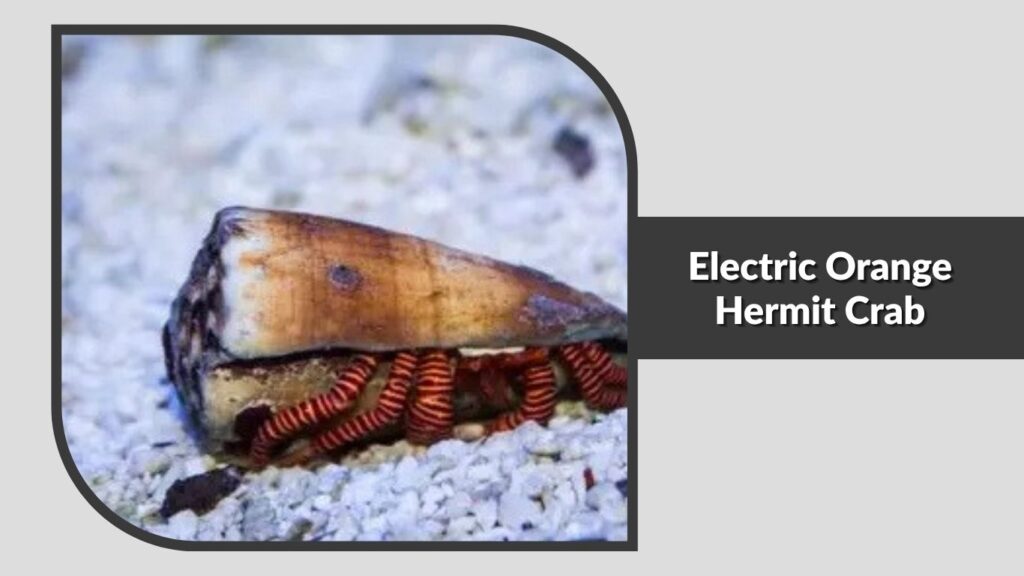
The electric orange hermit crab is a colorful marine hermit commonly associated with Hawaiian reef habitats. The name is used somewhat inconsistently in the aquarium trade, where specimens may be listed simply as Calcinus species. Hawaiian orange-banded forms of the elegant hermit crab, Calcinus elegans, may also be sold under this name.
Identification
- Vivid orange or reddish-orange walking legs
- Dark brown or black bands around the legs
- Blue or turquoise eyes
- Pale markings near the leg joints
- Dark-colored claws with lighter tips
- One claw may be larger than the other
- Long, slender antennae
- Body protected inside a marine snail shell
Habitat and Distribution
Electric orange hermit crabs are most often associated with the Hawaiian Islands. They inhabit shallow coastal waters, rocky reefs, coral rubble, sandy bottoms, and areas around tide pools.
They spend much of their time crawling over rockwork or digging through loose substrate. Crevices and empty shells provide protection from predators and strong water movement.
Size and Color
This hermit crab may reach approximately 2 inches when fully extended, although its visible size depends heavily on the shell it occupies.
Its most noticeable features are the intensely orange legs crossed by darker bands. Blue eyes or eye stalks create a strong contrast with the orange body. Color intensity can vary among individuals and populations.
Diet and Behavior
Electric orange hermit crabs are omnivorous scavengers that consume algae, detritus, uneaten food, and dead animal material. While foraging, they sift and disturb surface sand, helping move organic debris.
They actively inspect empty shells as they grow. When suitable replacements are unavailable, they may compete with other hermit crabs or attack snails for their shells.
17. Halloween Hermit Crab
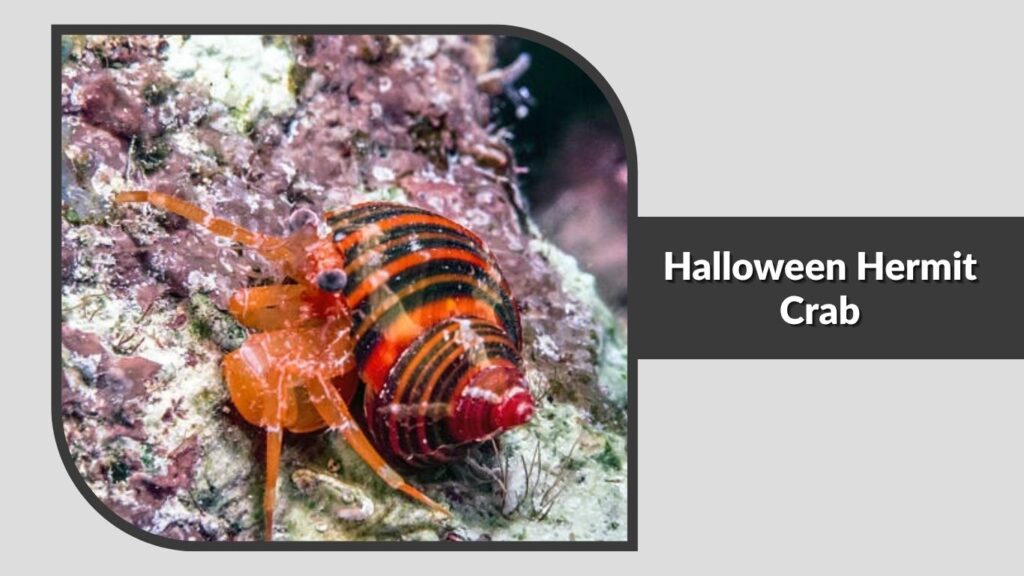
The Halloween hermit crab (Ciliopagurus strigatus) is a brightly patterned marine species from the Indo-Pacific. It is also called the striped hermit crab, orange-legged hermit crab, or cone-shell hermit crab. Its alternating orange, red, and dark leg bands resemble traditional Halloween colors.
Identification
- Bright orange or reddish walking legs
- Dark red or nearly black horizontal bands
- Thin pale or yellowish stripes
- Orange eye stalks
- Small dark eyes
- Strong claws with striped markings
- Long antennae
- Frequently occupies cone-shaped snail shells
Habitat and Distribution
Halloween hermit crabs occur across tropical areas of the Indian and Pacific oceans. They inhabit coral reefs, reef flats, lagoons, sandy areas, rocky bottoms, and coral-rubble habitats.
They commonly shelter beneath rocks or inside reef crevices when inactive. Their cone-shaped shells help protect the abdomen and provide a stable base while the crab moves across uneven reef surfaces.
Size and Color
The Halloween hermit crab commonly reaches around 2 inches in extended length, although some individuals may appear larger when carrying a heavy shell.
Its walking legs display closely spaced orange, red, yellowish, and dark bands. The body and claws may be reddish or orange, while the eyes are positioned on bright orange stalks.
Diet and Behavior
Halloween hermit crabs graze on film algae, hair algae, cyanobacteria, detritus, leftover food, and small pieces of animal matter. They spend much of their time moving over rocks and sediment while searching for edible material.
This species is generally active and strong for its size. It may move loose objects, compete with other hermit crabs, or attack snails when food or suitable replacement shells are limited.
18. White-Spotted Hermit Crab
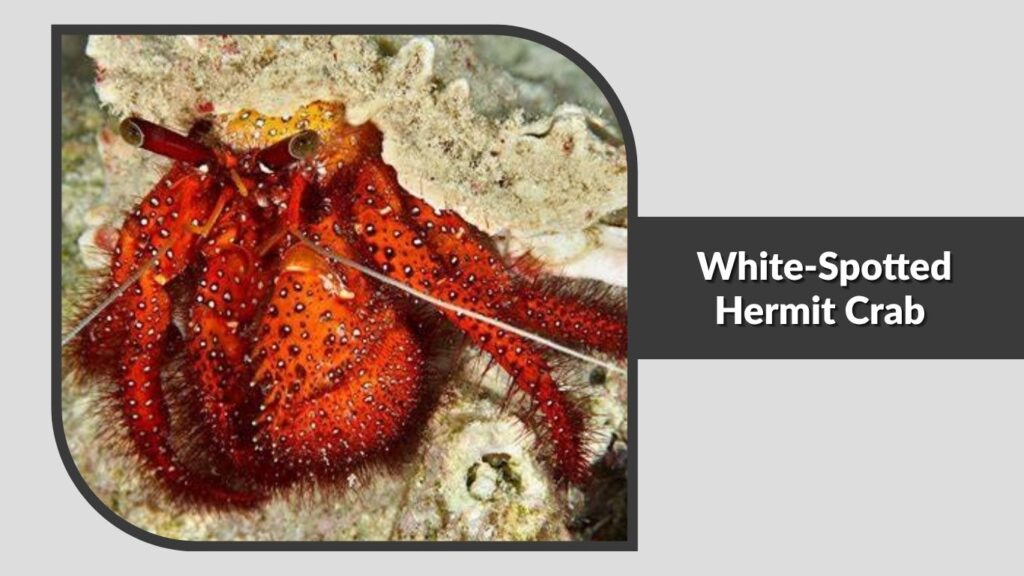
The white-spotted hermit crab (Dardanus megistos) is a large and colorful marine species found throughout the tropical Indo-Pacific. It is also called the red hermit crab or spotted hermit crab. Its bright red body, numerous white spots, and hairy legs make it easy to recognize among reef-dwelling hermit crabs.
Identification
- Bright red or orange-red body
- Numerous round white spots
- Thick hairs covering the legs and claws
- Large left claw
- Dark eyes on reddish stalks
- Strong, heavily built walking legs
- Long reddish antennae
- Usually carries a large marine snail shell
Habitat and Distribution
White-spotted hermit crabs occur across the Indian and Pacific oceans, including the Red Sea, eastern Africa, Japan, Australia, Indonesia, and many Pacific islands. They inhabit coral reefs, rocky slopes, lagoons, sandy bottoms, and areas containing coral rubble.
They commonly shelter beneath reef ledges or inside crevices during periods of inactivity. Larger individuals may move across open reef surfaces at night while searching for food and suitable replacement shells.
Size and Color
This is one of the larger marine hermit crabs. Mature individuals may reach approximately 6 inches in extended length, although their apparent size depends on the shell being carried.
The legs and claws are usually vivid red or reddish orange. Large white spots cover much of the body, while yellowish or dark hairs grow between them. Younger individuals may have paler coloration and less prominent markings.
Diet and Behavior
White-spotted hermit crabs are omnivorous scavengers that eat algae, detritus, dead fish, mollusks, worms, small crustaceans, and leftover animal material. Large individuals may also capture slow-moving marine animals.
They are strong, active, and sometimes aggressive. They may overturn loose rocks, disturb corals, or attack snails to obtain food or shells. Their powerful claws provide defense and help tear apart hard or tough food.
19. Giant Hermit Crab
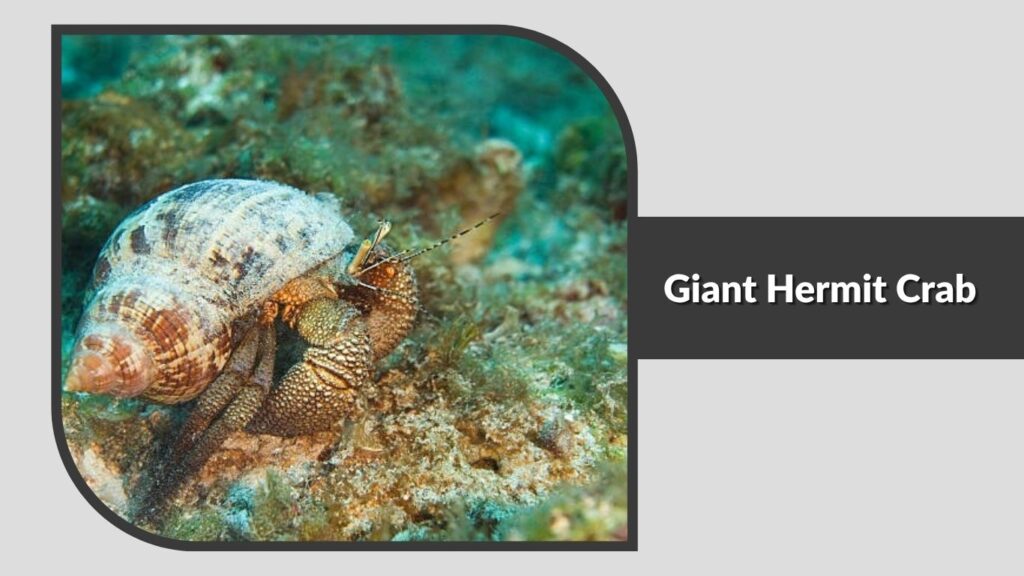
The giant hermit crab (Petrochirus diogenes) is a large marine species native to the western Atlantic Ocean. It is also known as the giant red hermit crab or Caribbean giant hermit crab. This heavily built animal occupies large empty snail shells and is one of the biggest hermit crabs found in Caribbean waters.
Identification
- Large, powerful body
- Reddish-brown or orange coloration
- Thick hairs covering the legs
- Large right claw
- Smaller left claw used for feeding
- Rough, heavily armored walking legs
- Dark eyes on long stalks
- Usually occupies large conch or whelk shells
Habitat and Distribution
Giant hermit crabs occur from the southeastern United States and Bermuda through the Caribbean Sea, Gulf of Mexico, and northern South America. They inhabit coral reefs, seagrass beds, rocky bottoms, sandy flats, and deeper offshore environments.
Juveniles may remain in relatively shallow coastal water, while larger adults can occur at greater depths. They often hide beneath ledges, among rocks, or inside reef structures during daylight hours.
Size and Color
A giant hermit crab may grow to approximately 12 inches in extended length, including its legs, although most individuals are smaller. Its large body requires spacious shells produced by conchs, whelks, and other sizable marine snails.
The legs and claws are commonly reddish brown, orange, tan, or dark red. Yellowish hairs and pale bands may appear around the joints. The oversized claw is thick, rough, and capable of sealing much of the shell opening.
Diet and Behavior
Giant hermit crabs feed on algae, carrion, mollusks, worms, dead fish, small crustaceans, and other organic material. Their large claws can tear food apart and break the shells of smaller prey.
They are mainly nocturnal and spend nighttime hours roaming the seafloor. Although generally scavengers, they can become predatory when opportunities arise. They may compete aggressively for large shells because appropriately sized empty shells are often difficult to find.
20. Anemone Hermit Crab
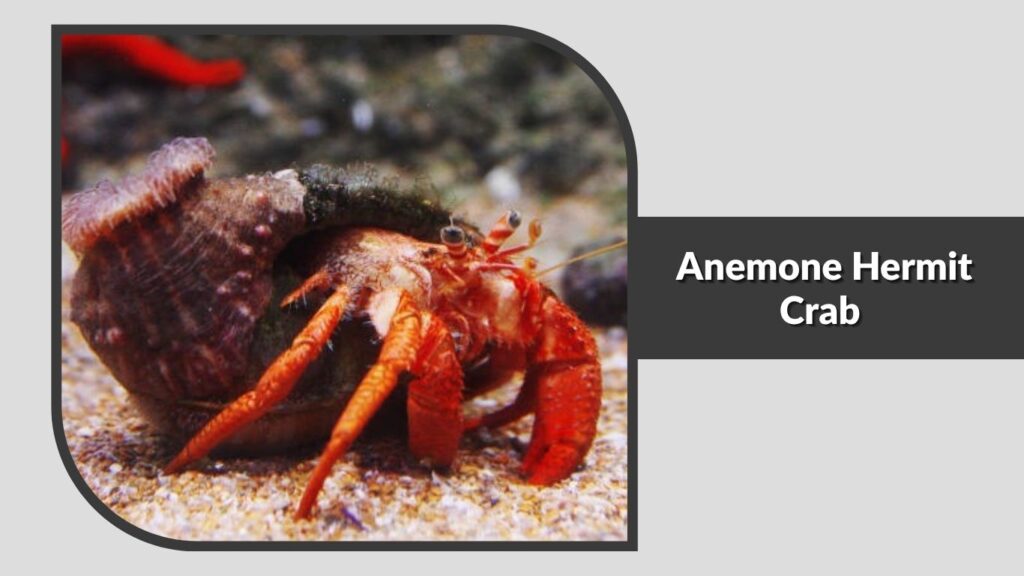
The anemone hermit crab (Dardanus pedunculatus) is a medium-sized marine species named for its habit of carrying living sea anemones on its borrowed shell. The crab receives protection from the anemones’ stinging tentacles, while the anemones gain transportation and access to food particles disturbed by the crab.
Identification
- Mottled cream, tan, orange, or reddish body
- White eye stalks marked with red bands
- Large left claw
- Smaller right claw used for feeding
- Hairy walking legs and claws
- Rough or spotted body surface
- One or more sea anemones attached to its shell
- Long antennae used to explore its surroundings
Habitat and Distribution
Anemone hermit crabs occur widely throughout the tropical Indo-Pacific, from the Seychelles and surrounding Indian Ocean regions to Japan, Hawaii, and Australia. They inhabit coral reefs, rocky coastal areas, seagrass beds, sandy bottoms, lagoons, and intertidal environments.
The species generally lives in shallow water, although individuals may occur at depths of approximately 27 metres. Rocks, reef crevices, and discarded snail shells provide shelter from predators and strong currents.
Size and Color
Anemone hermit crabs may reach approximately 8–10 centimetres when extended from their shells. Their apparent size varies according to the type and dimensions of the borrowed shell.
The body is usually cream, tan, pinkish, or orange-brown with darker mottling. Reddish bands on the pale eye stalks are especially noticeable. The claws and legs may also carry small spots, hairs, and irregular markings.
Diet and Behavior
This hermit crab scavenges animal remains and consumes algae, detritus, mollusks, small invertebrates, and edible material found across the seabed. It uses its claws to tear food apart and collect particles from narrow reef spaces.
The crab may carefully remove an anemone from a rock and transfer it onto its shell. When changing shells, it can move its anemones to the new shell rather than leaving them behind.
21. Dwarf Zebra Hermit Crab
The dwarf zebra hermit crab (Calcinus laevimanus) is a small marine species also known as the zebra hermit crab, Hawaiian reef hermit crab, or left-handed hermit crab. It is recognized by its contrasting black-and-white legs, colorful eye stalks, and noticeably enlarged left claw.
Identification
- Black or dark brown walking legs
- Bright white bands around the legs
- Large white or pale left claw
- Much smaller right claw
- Blue-and-orange eye stalks
- Dark, rounded eyes
- Long orange antennae
- Compact body protected inside a snail shell
Habitat and Distribution
Dwarf zebra hermit crabs inhabit tropical Indo-Pacific waters, including Hawaii, Indonesia, Australia, and areas across the Indian and central Pacific oceans. They commonly occupy rocky shores, reef flats, coral rubble, tide pools, and shallow intertidal environments.
They hide beneath rocks and inside crevices when threatened. Their small size allows them to explore narrow spaces where algae, detritus, and discarded snail shells accumulate.
Size and Color
This is a relatively small hermit crab, commonly reaching approximately 2.5–4 centimetres when extended, though some records describe individuals approaching 6 centimetres. Its visible size depends greatly on the shell being carried.
The legs are dark green, brown, or nearly black with clear white bands. The enlarged left claw is generally pale gray or white, while the orange-and-blue eye stalks provide additional color.
Diet and Behavior
Dwarf zebra hermit crabs graze on film algae and consume detritus, cyanobacteria, leftover food, and decaying animal material. They spend much of their time searching rocks, sand, and reef surfaces for small edible particles.
The disproportionately large left claw helps protect the shell entrance. Although usually peaceful, individuals may compete for shells or attack snails when appropriately sized empty shells are unavailable.
22. Dwarf Yellow-Tip Hermit Crab
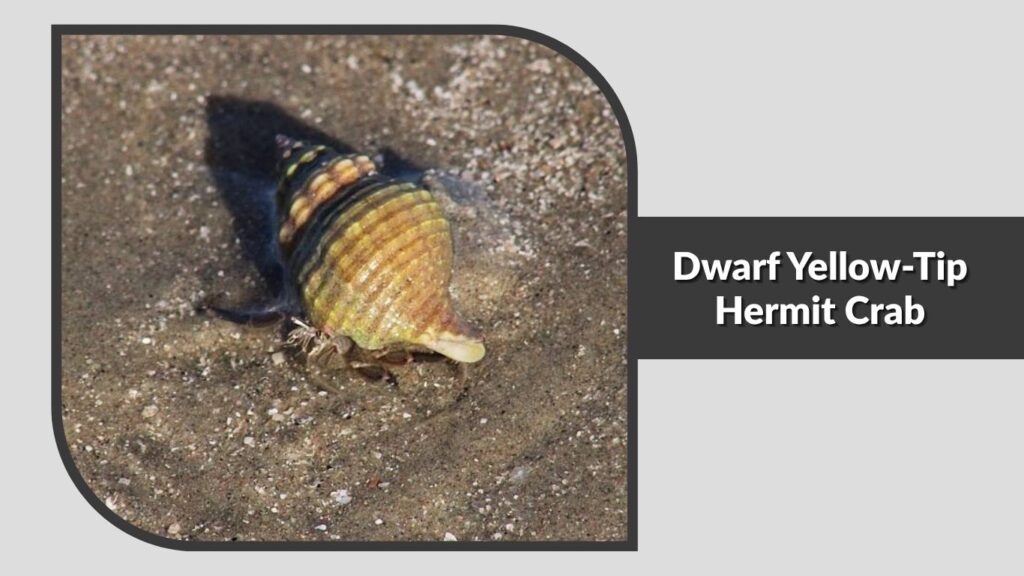
The dwarf yellow-tip hermit crab commonly refers to Clibanarius virescens, a small marine hermit crab also known as the coastal or yellow-legged hermit crab. Aquarium suppliers sometimes apply the yellow-tip name to more than one species, but C. virescens is recognized by its dark body, pale markings, and contrasting yellowish leg tips.
Identification
- Dark green, blue-green, or brownish legs
- Yellow, cream, or pale-colored leg tips
- Numerous small white spots on the claws
- Long antennae extending beyond the shell
- Dark eyes on slender eye stalks
- Left claw slightly larger than the right
- Small body carried inside a snail shell
- Roughly textured claws and walking legs
Its coloration can vary between individuals, but the combination of dark limbs, pale spots, and yellowish tips helps distinguish it from blue-legged and red-legged hermit crabs.
Habitat and Distribution
Dwarf yellow-tip hermit crabs occur widely throughout the Indo-Pacific region. Their range includes eastern Africa, the Red Sea, Japan, Indonesia, the Philippines, Australia, Fiji, Taiwan, and several western Pacific islands.
They inhabit intertidal coastlines, rocky shores, muddy areas, shallow coastal water, and seagrass beds. Most remain in very shallow water, where they crawl among stones, algae, sand, and marine vegetation while searching for food and shelter.
Size and Color
This is a small marine species that commonly reaches around 2.5 centimetres in body length, although the shell it carries may make it appear larger. Its compact size allows it to enter small spaces between rocks and coral rubble.
The legs are usually dark green, bluish green, blackish, or brown. Yellow or cream markings occur near the tips, while small pale spots may cover the claws and legs. Color intensity can change slightly with age, lighting, diet, and molting.
Diet and Behavior
Dwarf yellow-tip hermit crabs are omnivorous scavengers. They graze on algae and consume detritus, uneaten food, dead organisms, and other edible particles collected from rocks and sediment.
They are active explorers that spend much of their time walking over reef surfaces and searching inside crevices. Like other hermit crabs, they require increasingly larger snail shells as they grow and may compete with nearby crabs when suitable empty shells are scarce.
23. Long-Wristed Hermit Crab
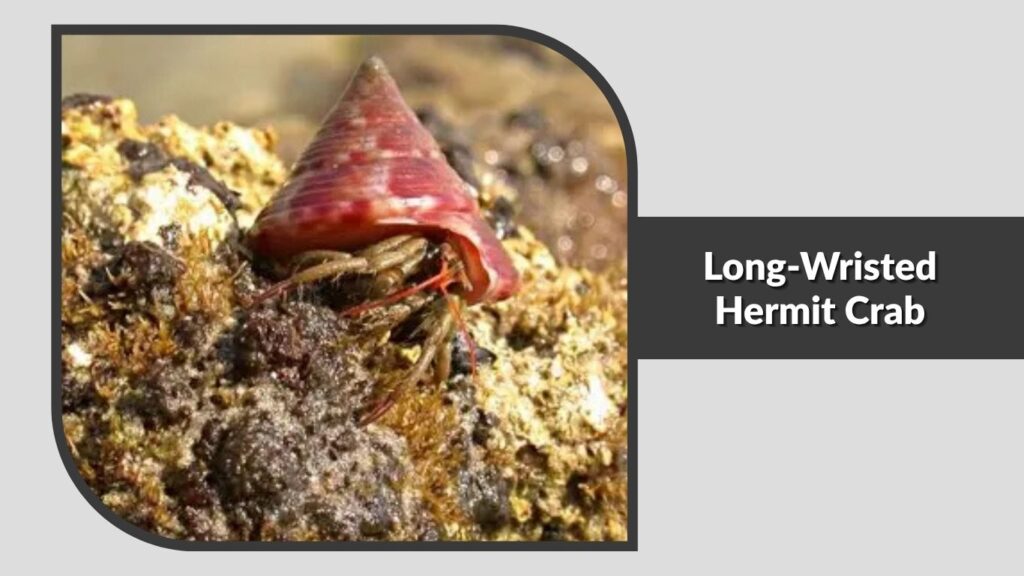
The long-wristed hermit crab (Pagurus longicarpus) is a small marine species also called the long-armed or long-clawed hermit crab. Its name refers to the extended wrist section of its noticeably enlarged right claw. It is common along Atlantic and Gulf coastlines in North America.
Identification
- Right claw much larger than the left
- Long wrist section on the enlarged claw
- Gray, greenish, cream, or whitish body
- Tan or gray stripe along each claw
- Long, thin antennae
- Small dark eyes on short stalks
- Slender walking legs
- Commonly occupies small periwinkle or mud-snail shells
The enlarged right claw is the most useful identification feature. When threatened, the crab can pull into its borrowed shell and use this claw to partly block the entrance.
Habitat and Distribution
Long-wristed hermit crabs occur along the Atlantic coast of North America, from Canada southward to Florida. They also inhabit the Gulf Coast as far west as Texas. Introduced populations have been recorded in parts of Europe.
They live in tidal pools, salt marsh creeks, estuaries, bays, sandy flats, muddy bottoms, and shallow subtidal environments. Although they can occur in deeper water, they are especially common in sheltered intertidal habitats during warmer months.
Size and Color
This is a small species with a body or carapace generally measuring up to approximately 1.5 centimetres. Its overall appearance depends on the size and shape of the occupied snail shell.
The exposed body is commonly gray, pale green, cream, tan, or white. Both claws may have a darker central stripe, while the enlarged right claw is long, slender, and noticeably larger than the left.
Diet and Behavior
Long-wristed hermit crabs eat detritus, algae, microscopic crustaceans, carrion, and organic particles collected from sand, mud, and surface foam. Their claws scoop through sediment and tear larger pieces of food before passing them to the mouth.
Competition for shells is common. Individuals inspect abandoned shells and may fight other hermit crabs for better-fitting homes. An appropriately sized shell protects the crab from predators, changing salinity, moisture loss, and sudden temperature changes in tidal pools.
24. Thinstripe Hermit Crab
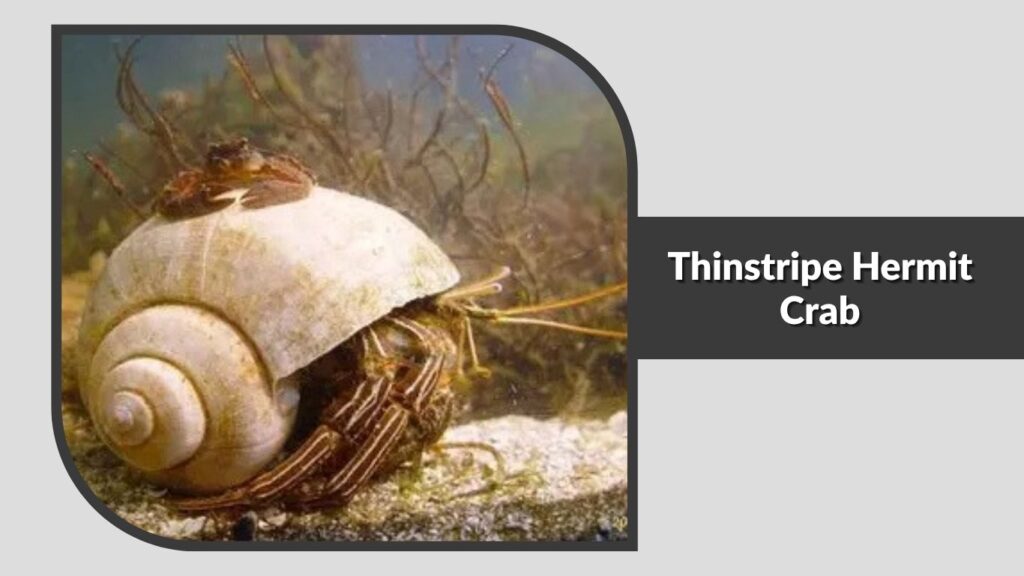
The thinstripe hermit crab (Clibanarius vittatus), also called the striped hermit crab, is a medium-sized marine species found in warmer Atlantic coastal waters. Its narrow leg stripes, equal-sized claws, and greenish-brown body make it relatively easy to recognize. It spends nearly its entire life inside a discarded gastropod shell.
Identification
- Thin white or cream stripes along the legs
- Greenish, reddish-brown, or dark-brown body
- Two claws of approximately equal size
- Short hairs covering parts of the claws
- Long walking legs
- Dark eyes positioned on stalks
- Soft, curved abdomen hidden inside the shell
- Commonly uses whelk, conch, or similar snail shells
The equal claws and narrow longitudinal leg stripes separate it from many hermit crabs with one noticeably enlarged claw.
Habitat and Distribution
Thinstripe hermit crabs occur along the western Atlantic coast, from Virginia through Florida, the Gulf of Mexico, the Caribbean region, and farther south. They inhabit bays, mangrove swamps, sandy beaches, mudflats, seagrass beds, estuaries, and intertidal shorelines.
They tolerate both brackish and fully marine water. Some individuals remain exposed on wet shorelines during low tide but return to water as tidal conditions change.
Size and Color
The body measures approximately 1.25 inches long, while the crab may reach around 3 inches when its walking legs are fully extended. Shell size can make an individual appear considerably larger.
Its body varies from greenish blue and olive brown to reddish or dark brown. Thin white, cream, or pale-brown stripes extend along the walking legs and provide its most recognizable coloration.
Diet and Behavior
Thinstripe hermit crabs are scavengers that eat seagrass, plant material, detritus, dead animals, and other organic matter. They usually search for food along the seabed but can also forage briefly on wet land.
When searching for larger shells, several crabs may gather and form a vacancy chain. Each crab waits for a larger individual to change shells before moving into the newly available smaller shell.
25. Stareye Hermit Crab
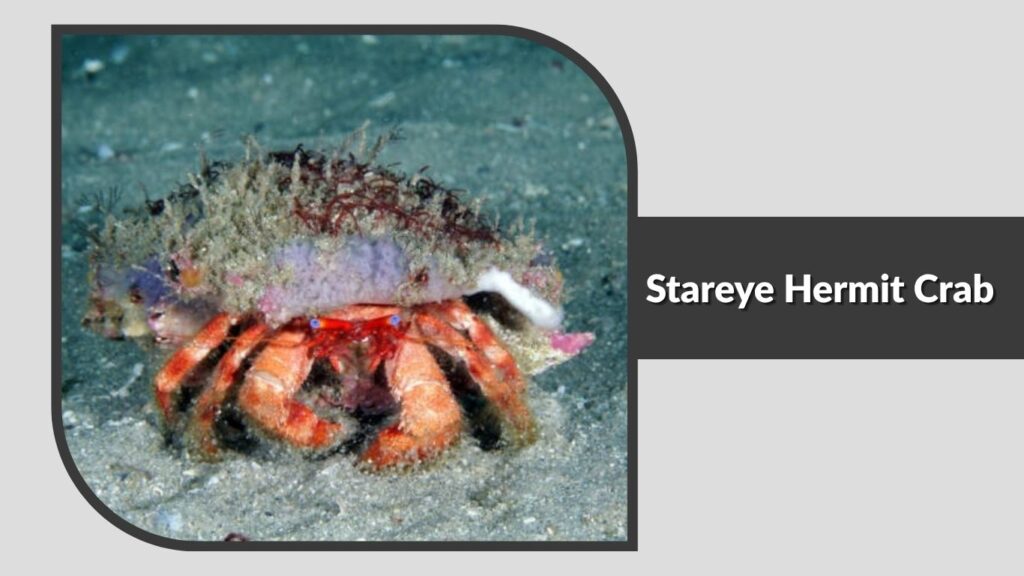
The stareye hermit crab (Dardanus venosus), also called the starry-eyed hermit crab, is a large marine species belonging to the left-handed hermit crab family. Its pale blue-green eyes, reddish legs, and heavily patterned claws create a distinctive appearance. It inhabits warm western Atlantic waters.
Identification
- Pale blue, greenish, or whitish eyes
- Thick, prominent eye stalks
- Reddish, pink, orange, or cream-colored legs
- Large left claw
- Smaller right claw
- Mottled or net-like markings on the claws
- Hairy, strongly built walking legs
- Large body carried inside a heavy snail shell
The unusual light-colored eyes are its most noticeable identification feature and give the species its common name.
Habitat and Distribution
Stareye hermit crabs occur around Florida, the Bahamas, the Caribbean, the Gulf of Mexico, Venezuela, and Brazil. They inhabit rocky seabeds, coral rubble, gravel, shell-covered sediment, algae zones, and other coastal marine environments.
Individuals have been recorded from shallow water to considerable depths. Caribbean observations commonly place them between approximately 1 and 40 metres deep, although records from deeper habitats also exist.
Size and Color
A stareye hermit crab commonly reaches approximately 3–5 inches, or 7–13 centimetres, when extended from its shell. Its apparent size varies according to the shell being carried.
The legs may be red, pinkish red, cream, or orange with pale spots and irregular bands. Its claws commonly display reddish network-like markings over a lighter background, while the eyes are pale blue or greenish.
Diet and Behavior
Stareye hermit crabs are bottom-dwelling scavengers that feed primarily on carrion, detritus, and other organic material found across the seabed. Their powerful claws allow them to collect, hold, and tear apart food.
They walk across rocks, gravel, and shell-covered bottoms while searching for meals and appropriately sized shells. As the crab grows, it must leave its current shell and locate a larger empty gastropod shell.
FAQs
How Many Species of Hermit Crabs Are There?
There are more than 1,000 known hermit crab species worldwide. Most are marine, while a smaller number live mainly on land. They vary greatly in size, color, behavior, habitat, and shell preference, ranging from tiny reef species to the enormous coconut crab.
Where Do Hermit Crabs Live?
Hermit crabs live in oceans, coral reefs, tide pools, mangrove forests, sandy beaches, coastal woodlands, and tropical islands. Marine species remain underwater, while land hermit crabs live mostly on shore but still require moisture and access to saltwater for reproduction.
What Do Hermit Crabs Eat?
Hermit crabs are opportunistic omnivores and scavengers. They eat algae, fruit, leaves, seeds, insects, carrion, mollusks, detritus, and leftover organic material. Their exact diet depends on the species and habitat, but most benefit from a varied combination of plant and animal foods.
Why Do Hermit Crabs Change Their Shells?
Hermit crabs change shells as they grow or when their current shell becomes damaged, uncomfortable, or too small. They may inspect several shells before selecting one. Shell shape, opening size, weight, condition, and protection all influence which replacement shell a crab chooses.
Can Hermit Crabs Live Without a Shell?
Most hermit crabs cannot safely remain without a shell because their soft, curved abdomen is vulnerable to injury, dehydration, and predators. They may briefly leave a shell while changing homes. Adult coconut crabs are an exception because they develop a hardened abdomen and no longer carry shells.