

Fiddler crabs are small coastal crabs, although the male’s oversized claw can make them appear much larger. Most commonly encountered species have shells measuring approximately 1–1.5 inches across. Depending on the species, a full-grown crab may remain under an inch wide or approach 2 inches. This guide explains fiddler crab body size, claw length, differences between males and females, growth through molting, and what their adult size means for aquarium care.
How Big Can Fiddler Crabs Get?
Most adult fiddler crabs have a carapace—the hard upper shell—measuring approximately 0.75–1.5 inches wide. Their legs increase their total width, while the male’s major claw can make the entire animal appear several times larger than the shell alone.
The Atlantic sand fiddler, Leptuca pugilator, is about 1.5 inches wide and one inch long. The smaller Atlantic marsh fiddler, Minuca pugnax, may reach approximately 26 millimeters, or just over one inch, in carapace width.
| Measurement | Typical size |
| Carapace width | About 0.75–1.5 inches |
| Carapace length | About 0.5–1 inch |
| Total width with legs | Often 2–3 inches |
| Large male claw | May equal or exceed shell width |
| Hatchling stage | Tiny aquatic larva |
| Maximum size | Varies considerably by species |
There is no single maximum measurement for every fiddler crab because the common name covers many species. Habitat, sex, geographic population, nutrition, age, and environmental conditions can all influence adult size.
How Is a Fiddler Crab Measured?
Scientists usually measure fiddler crabs across the widest part of the carapace. This measurement is called carapace width.
The legs and claws are normally excluded because they can be stretched, folded, lost, or regenerated. Measuring only the shell provides a more consistent way to compare different crabs.
A crab advertised as two or three inches wide may have been measured from one leg tip to the other. Its actual shell may be only around one inch across. Male fiddler crabs may appear particularly large when they extend both their legs and major claw.
Fiddler Crab Size by Species
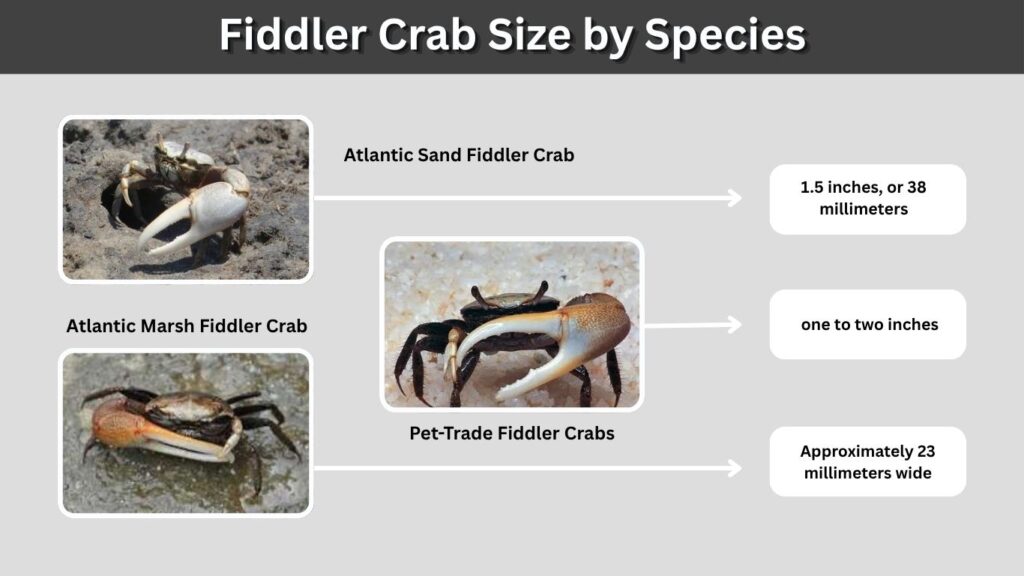
Different fiddler crab species do not all reach the same adult size. Even populations of the same species can vary geographically.
Atlantic Sand Fiddler Crab
The Atlantic sand fiddler commonly reaches around 1.5 inches, or 38 millimeters, across its shell and approximately one inch from front to back. It is one of the larger fiddler crabs commonly encountered along sandy coastal areas of eastern North America.
Atlantic Marsh Fiddler Crab
The Atlantic marsh fiddler is smaller. Adults may reach around 26 millimeters, or roughly one inch, across the shell.
Average males measure approximately 23 millimeters wide, while average females measure about 18 millimeters. Males are therefore commonly somewhat larger than females even before the oversized claw is considered.
Pet-Trade Fiddler Crabs
Fiddler crabs sold for aquariums are often not identified by their precise species. Most remain around one to two inches across the shell, although their extended legs and claws make them look wider.
The label “freshwater fiddler crab” does not identify a separate size category. It is usually a pet-trade description, and the crab’s eventual size depends on its actual species.
How Big Is a Male Fiddler Crab’s Claw?
An adult male’s major claw can be approximately as long as the width of his body, including the extended legs. In some species, the claw accounts for nearly half of the male’s total body weight.
The large claw consists of a thick palm and two elongated fingers. Its proportions vary among species: some males have long, lightweight display claws, while others possess shorter and more powerful claws.
Body Size vs. Claw Size
The male’s huge claw can create a misleading impression of his true size. For example, a crab with a one-inch shell may appear three inches or more across when its legs and claw are fully extended.
The claw continues growing relative to the body as the male matures. Larger males generally have larger claws, although two males with identical shell widths may not have claws of precisely the same size.
Why Do Fiddler Crabs Have One Big Claw?
Male fiddler crabs use the major claw to attract females, signal to neighboring crabs, threaten rivals, and fight over burrows. They wave it rhythmically during courtship and territorial displays.
The enlarged claw is not normally used for feeding. The male collects food with his small claw, while females can feed with both of their equally sized claws.
Do All Fiddler Crabs Have a Big Claw?
Only mature males normally possess one enlarged claw. Females have two small claws that are similar in size.
Young males may not yet have a fully developed major claw. An adult male may also temporarily appear to have two small claws if his large claw has been lost and is still regenerating.
Why Is the Large Claw on Only One Side?
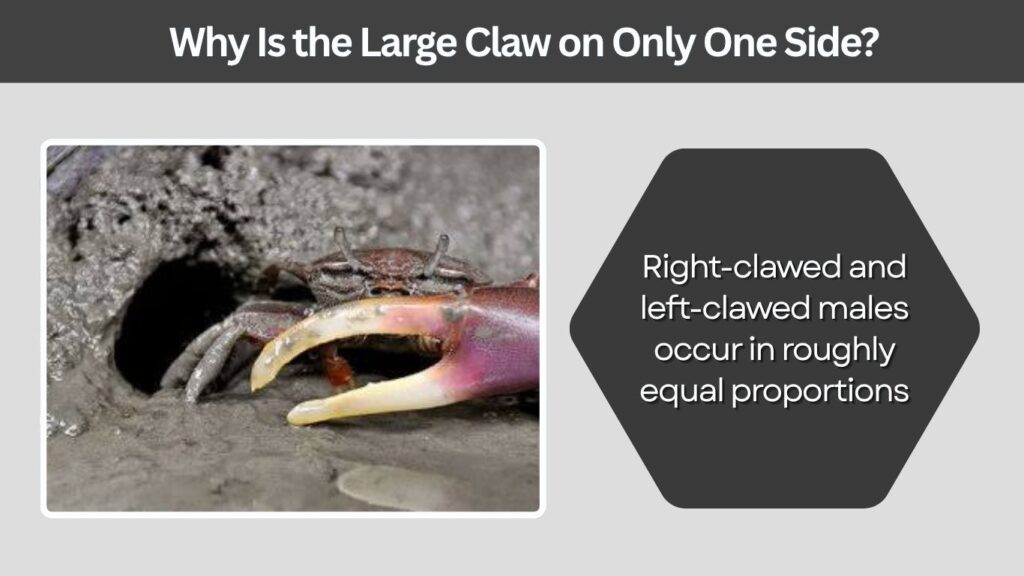
The major claw can occur on either the right or left side. In most fiddler crab species, right-clawed and left-clawed males occur in roughly equal proportions, although a few species show a strong preference for the right side.
Research indicates that young males initially develop similar claws. Developmental loss of one claw can establish which side becomes the major claw, with the intact claw developing into the larger appendage.
Do Fiddler Crabs Grow Their Big Claw Back?
Yes. A male can regenerate a lost major claw, but it does not immediately return at full size. Regeneration occurs as the crab passes through successive molts.
Several molts may be needed to restore a full-sized claw. Studies have also found that a regenerated claw may be lighter, less robust, and less effective as a weapon than the original, even though it can still function as a visual display.
A crab missing its claw should not be handled unnecessarily. Appropriate food, minerals, water conditions, and secure hiding areas are particularly important during molting.
How Do Fiddler Crabs Grow?
Like other crustaceans, fiddler crabs have rigid exoskeletons that cannot expand continuously. To grow, a crab must shed its old shell through molting.
After emerging from the old shell, the crab temporarily has a soft body. It absorbs water to expand before the new exoskeleton hardens. Each successful molt allows the shell, legs, and claws to become larger.
Young crabs molt more frequently because they grow rapidly. Mature crabs molt less often. The Atlantic marsh fiddler may molt approximately once or twice annually after reaching adulthood.
How Big Are Baby Fiddler Crabs?
Fiddler crabs do not hatch as miniature land-dwelling adults. They begin as tiny aquatic larvae and pass through several developmental stages before becoming recognizable juvenile crabs.
After settling onto suitable coastal sediment, juveniles grow through repeated molts. Their major sexual differences become more noticeable as they mature, with males developing one greatly enlarged claw.
Does Habitat Affect Fiddler Crab Size?
Species and genetics establish the main size range, but environmental conditions influence whether a crab reaches its full potential.
Important factors include:
- Food availability
- Water temperature
- Salinity
- Population density
- Habitat quality
- Molting success
- Predation pressure
- Geographic location
Research on Atlantic marsh fiddler crabs found that average carapace width increased in populations at higher latitudes, showing that body size can vary across the same species’ range.
What Tank Size Does a Fiddler Crab Need?

Although fiddler crabs are small, their enclosure should not be selected according to body size alone. They need room for dry land, shallow brackish water, burrowing substrate, shelters, and territorial behavior.
A 10-gallon aquarium is a practical starting size for a small group. A larger enclosure is preferable when keeping several males because they may compete over burrows and space.
Provide more floor area rather than deep water. Fiddler crabs are semi-terrestrial animals and require an easily accessible land section.
FAQs
Can a fiddler crab grow as big as a blue crab?
No. Fiddler crabs remain much smaller than blue crabs. Most have shells around one inch across, while blue crabs can develop shells several inches wide. The male fiddler’s claw makes it look larger than its body really is.
Are male fiddler crabs bigger than females?
Males are often slightly larger across the shell, but the most obvious difference is the claw. A mature male has one oversized claw, whereas a female has two small feeding claws.
Does a larger claw mean an older crab?
Not necessarily. Claw size generally increases with body size and maturity, but it also varies by species and individual. A regenerated claw may differ in size and strength from an original claw.
Can a fiddler crab have two big claws?
Adult males normally have only one large claw. Developmental experiments have found unusual cases in which two enlarged claws formed, but this is not the normal appearance of wild fiddler crabs.
Why has my fiddler crab stopped growing?
Adult crabs grow slowly and increase in size only when they molt. Poor nutrition, unsuitable salinity, low temperature, stress, illness, or inadequate conditions may interfere with successful molting and growth.