
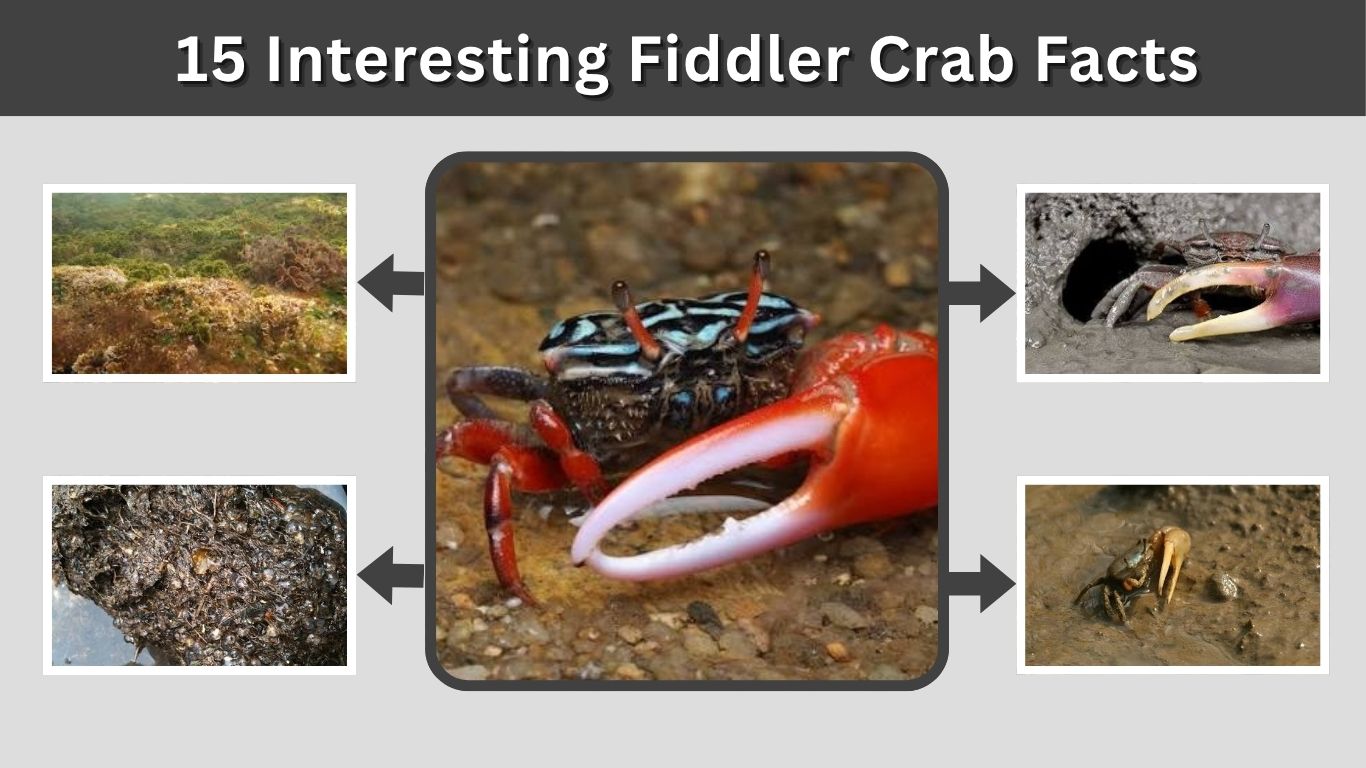
Fiddler crabs are small coastal crabs famous for the male’s enormous claw and unusual waving displays. They live around salt marshes, mangroves, estuaries, and tidal flats, where they dig burrows and search the sediment for food. Despite their size, these crabs influence entire coastal ecosystems through their feeding and burrowing activities. Here are 15 fun and important fiddler crab facts covering their claws, color, habitat, diet, behavior, reproduction, and pet care.
Quick Facts About Fiddler Crabs
| Feature | Information |
| Animal group | Crustacean |
| Family | Ocypodidae |
| Typical habitat | Salt marshes, mangroves, and tidal flats |
| Average shell width | Around 1–2 inches |
| Diet | Algae, microbes, detritus, and organic particles |
| Activity | Usually most visible during low tide |
| Male identification | One greatly enlarged claw |
| Female identification | Two similarly sized claws |
| Water needs | Usually brackish or marine conditions |
| Main predators | Birds, fish, mammals, and larger crabs |
1. Only Male Fiddler Crabs Have a Giant Claw
The male’s most recognizable feature is one greatly enlarged front claw. Depending on the species and individual, this claw may represent nearly half the male’s total body mass.
Males use it to attract females, threaten competitors, defend burrows, and wrestle with rival males. Although it looks dangerous, much of its evolutionary value comes from being visible during courtship displays.
2. Females Have Two Small Claws
Female fiddler crabs do not possess the enormous display claw. Instead, they have two small claws of approximately equal size.
This difference makes males and females relatively easy to identify. Because females can collect food with both claws, they may feed more efficiently than males, which can use only their smaller claw for gathering sediment.
3. Males Can Be Right- or Left-Clawed
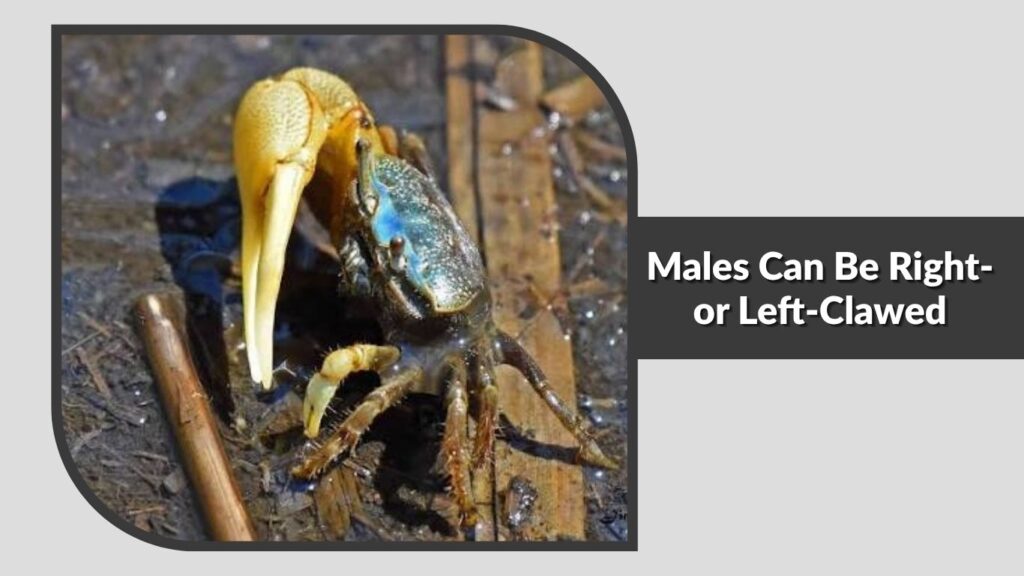
The large claw may develop on either side of a male’s body. In many species, right-clawed and left-clawed males occur in roughly equal numbers, although some species strongly favor one side.
Claw position can influence how males align themselves and grip one another during territorial contests.
4. The Giant Claw Is Not Used for Eating
The oversized claw is too specialized and cumbersome to handle food effectively. A male gathers food using only his smaller claw, while the female can use both claws.
Males must repeatedly move their small claw between the ground and mouthparts to obtain enough food. This motion may resemble someone moving a bow across a fiddle, helping explain the crab’s common name.
5. They Eat Microscopic Food From Mud and Sand
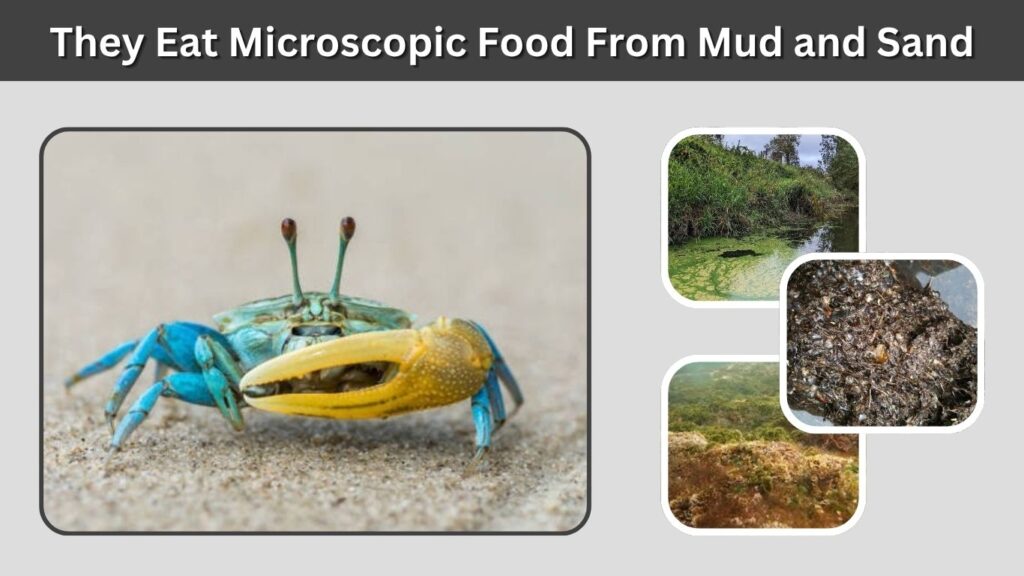
Fiddler crabs are primarily deposit feeders. They scoop up sediment and pass it through specialized mouthparts that separate edible material from sand or mud.
Their diet includes algae, bacteria, decaying vegetation, fungi, microorganisms, and tiny pieces of organic matter. Once the nutrients are removed, the processed sediment is left behind in small pellets or balls.
6. Fiddler Crabs Follow the Tides
Many fiddler crabs time their daily activities around tidal cycles. They generally emerge when low tide exposes the mudflat and return to shelter as the water rises.
During low tide, they feed, clean their burrows, defend territories, and search for mates. At high tide, they commonly remain underground, sometimes sealing the burrow entrance with mud.
7. Their Burrows Have Several Purposes
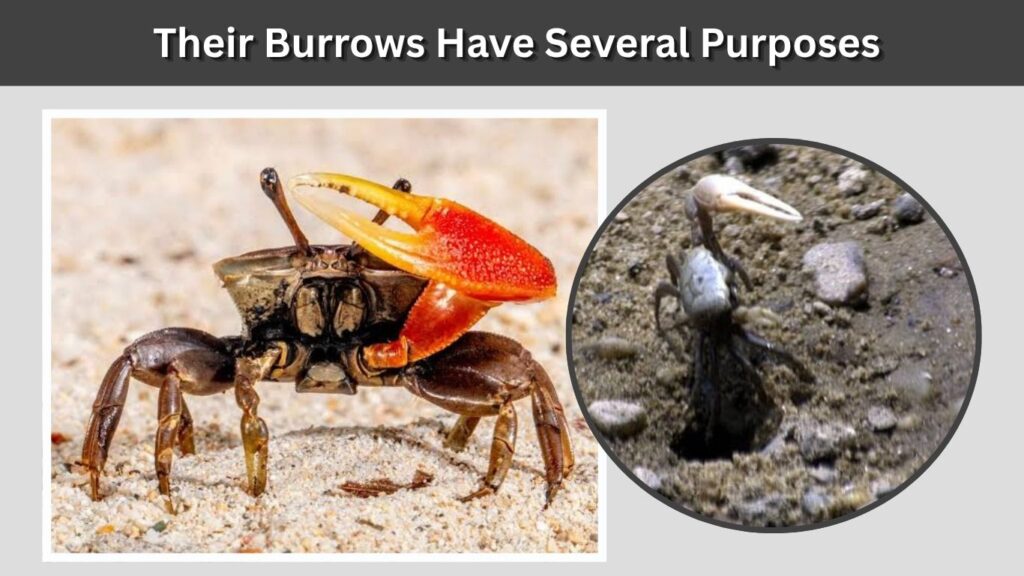
A fiddler crab burrow is much more than a hiding hole. It protects the crab from predators, incoming tides, intense heat, cold weather, and dehydration.
Burrows are also used for resting, molting, mating, and incubating eggs. Some males build small sand structures near their entrances that help attract females toward the burrow.
8. They Communicate by Waving and Drumming
Male fiddler crabs perform rhythmic claw-waving displays. A wave may advertise the male’s size, attract a female, or warn another male to stay away.
Communication is not limited to visual signals. Some males stamp their legs or drum their claws against the ground, creating vibrations that travel through the sediment and can be detected by nearby crabs.
9. Some Fiddler Crabs Can Change Color
Fiddler crabs occur in shades of brown, gray, red, orange, yellow, blue, purple, and white. Their appearance can change because of age, molting, stress, temperature, social activity, and daily biological rhythms.
Research on some species has found that they become darker during the day and lighter at night. Pigment changes may help with communication, camouflage, temperature regulation, or protection from ultraviolet radiation.
10. A Lost Claw Can Grow Back
Fiddler crabs can deliberately release an injured limb through a process called autotomy. A lost major claw can regenerate through later molts.
The replacement may initially be smaller and less powerful than the original. Several molts can be required before it approaches full size, and regenerated claws may remain less effective during fights.
11. They Help Maintain Coastal Ecosystems
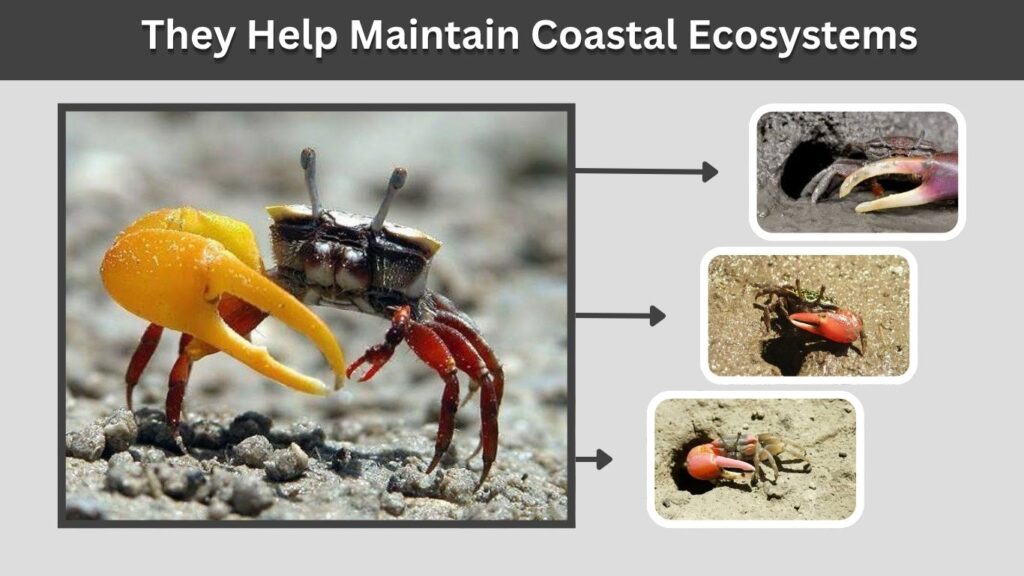
Fiddler crabs are often called ecosystem engineers because their burrows change the physical and chemical properties of coastal sediment.
Digging mixes and oxygenates the soil, affects drainage, moves nutrients, and creates pathways for water. Their feeding also influences algae, microbes, decaying material, and nutrient cycling within salt marshes and mudflats.
12. They Breathe With Gills but Spend Time on Land
Fiddler crabs possess gills, but they are semi-terrestrial rather than fully aquatic. Their gills must remain moist to absorb oxygen properly.
They can spend long periods above water when humidity is adequate. Their damp burrows help prevent the respiratory surfaces from drying out during low tide and hot weather.
13. Most Cannot Live Permanently in Freshwater
Although some species tolerate low salinity, most commonly kept fiddler crabs originate from brackish or saltwater habitats. Brackish water forms where freshwater mixes with seawater.
A pet fiddler crab should generally have a paludarium containing shallow brackish water, exposed land, moist sand, and an easy route between the two areas. A fully submerged freshwater tank does not reproduce its natural habitat.
14. Many Animals Eat Fiddler Crabs
Fiddler crabs are an important food source for coastal wildlife. Their predators include herons, egrets, rails, ibises, fish, raccoons, blue crabs, and other animals that forage along marshes and tidal flats.
Their raised eyestalks help them detect approaching danger. When threatened, groups of crabs may rapidly disappear into nearby burrows.
15. Baby Fiddler Crabs Begin Life in Water
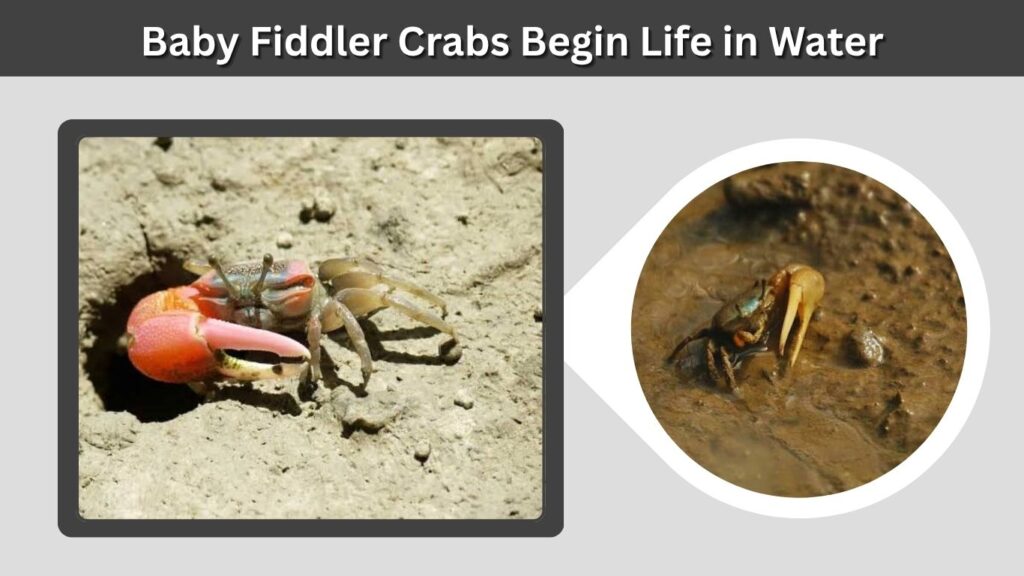
After mating, the female carries a mass of fertilized eggs beneath her abdomen. She later releases the developing young into tidal water.
The offspring initially live as tiny free-swimming larvae. After passing through several developmental stages, they transform into juvenile crabs and begin living on or near the sediment.
FAQs
Why is it called a fiddler crab?
The name refers to the male’s mismatched claws and feeding motion. Its large claw resembles a fiddle, while the small feeding claw repeatedly moves toward the mouth like a bow being drawn across the instrument.
Are fiddler crabs dangerous?
Fiddler crabs are not considered dangerous to people. A large male may pinch when frightened or handled, but the injury is usually minor. It is better to observe them without unnecessary handling.
Are fiddler crabs fully aquatic?
No. They are semi-terrestrial crabs that need access to both water and land. They regularly enter water to keep their gills wet but spend much of their active time feeding and communicating on exposed sediment.
How long do fiddler crabs live?
Lifespan varies by species and environmental conditions. For example, the expected wild lifespan reported for the Atlantic marsh fiddler is approximately one to one-and-a-half years, while some captive individuals may survive longer with appropriate care.
Do fiddler crabs make good pets?
They can be fascinating pets, but they require specialized care. Their enclosure needs a secure lid, warm temperatures, moist digging substrate, exposed land, clean brackish water, and enough space to reduce territorial conflict.