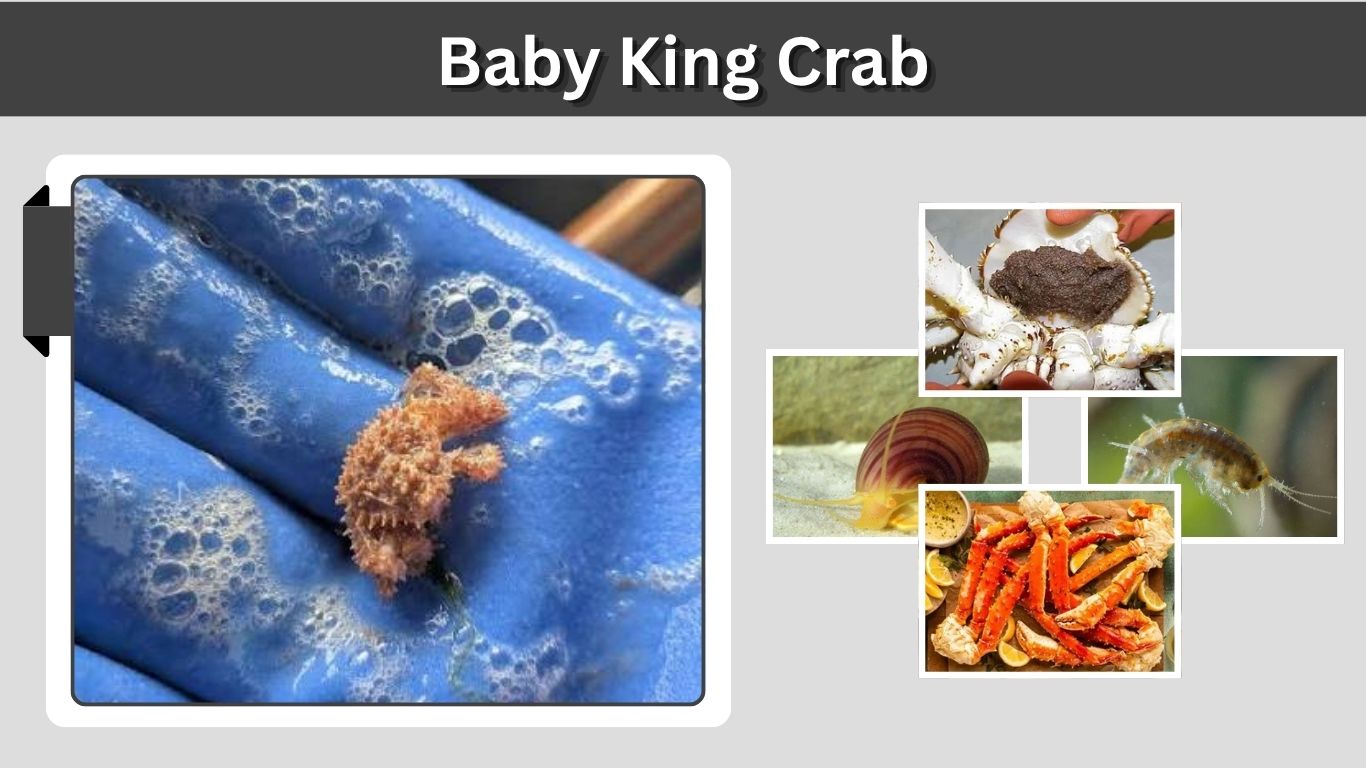
A baby king crab begins life looking nothing like the enormous, spiny crab served in seafood restaurants. It first hatches as a tiny, shrimp-like larva that floats in the ocean and feeds on plankton. After passing through several developmental stages, it settles on the seafloor and transforms into a miniature king crab. Young king crabs are extremely vulnerable, and only a small proportion survive predators, food shortages, changing water conditions, and cannibalism.
Baby King Crab Quick Facts
| Feature | Details |
| Common term | Baby or juvenile king crab |
| First life stage | Egg |
| Newly hatched stage | Zoea larva |
| Later larval stage | Glaucothoe |
| First crab-like stage | Juvenile |
| Early size | Smaller than a dime |
| Larval habitat | Open water |
| Juvenile habitat | Seafloor shelters |
| Larval food | Phytoplankton and zooplankton |
| Main threats | Fish, octopuses, other crabs, and habitat loss |
What Is a Baby King Crab Called?
“Baby king crab” is an informal term. Scientists use different names depending on the animal’s stage of development.
A newly hatched king crab is called a larva, not a juvenile crab. It passes through several zoeal stages before becoming a glaucothoe. After settling on the ocean bottom and completing another molt, it becomes a first-stage juvenile that resembles a miniature adult.
King Crab Developmental Names
- Embryo: The developing crab inside an egg carried by its mother.
- Zoea: A tiny, free-swimming larva that resembles a small shrimp.
- Glaucothoe: A transitional stage that searches for suitable seafloor habitat.
- First-stage juvenile: The first stage that looks recognizably like a king crab.
- Older juvenile: A growing crab that remains sexually immature.
- Adult: A sexually mature male or female.
It is therefore correct to say that king crab babies are initially called zoea larvae. However, “juvenile king crab” is the correct term after they settle and develop the familiar crab-like body.
What Does a Baby King Crab Look Like?
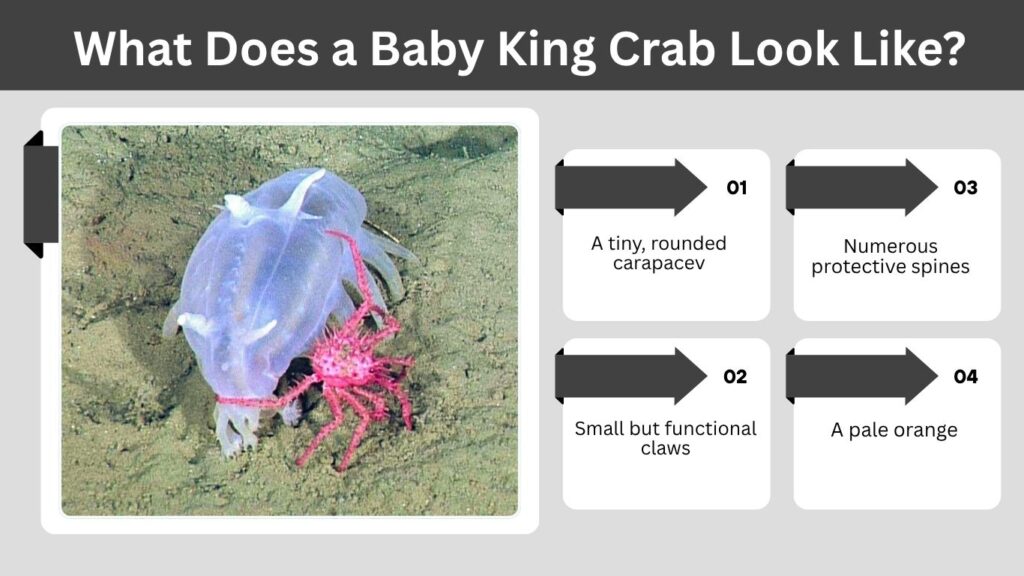
A newly hatched red king crab does not immediately have the broad shell and thick legs associated with an adult. It looks more like a translucent shrimp, with a narrow body, small swimming structures, and prominent spines.
After metamorphosis, the young animal develops a rounded, spiny shell, walking legs, and small claws. Hatchery-raised first-stage red king crabs have been recorded at approximately 2 millimeters across the carapace, while Alaska authorities describe newly settled juveniles as smaller than a dime.
Baby King Crab Identification
A newly settled juvenile may have:
- A tiny, rounded carapace
- Long, thin legs relative to its body
- Numerous protective spines
- Small but functional claws
- A pale orange, reddish, or translucent appearance
- Dark eyes projecting from the front of the shell
Its coloration becomes stronger as it grows, molts, eats pigment-rich food, and develops a thicker shell.
How Do King Crabs Have Babies?
King crabs reproduce sexually. During mating, a male transfers sperm to a female, which later releases eggs that become fertilized and attach beneath her abdomen.
The female carries and protects the developing eggs under her body for many months. Red king crab females generally reproduce once per year, with egg development lasting nearly a full annual cycle. When the embryos are ready, the female gradually releases the larvae into the surrounding water.
How Many Babies Do King Crabs Have?
A female red king crab can release approximately 50,000 to 500,000 eggs during one reproductive cycle. Larger females usually produce more eggs than smaller ones.
This enormous number does not mean that hundreds of thousands will become adults. Many eggs and larvae are eaten, fail to find enough food, drift away from suitable habitat, or die before completing metamorphosis.
What Do King Crab Eggs Look Like?
King crab eggs are extremely small—approximately the size of a pinhead or pencil tip. They remain attached to hair-like structures beneath the female’s abdomen while the embryos develop. As hatching approaches, the developing larvae and their eyes may become visible through the egg coverings.
Baby King Crab Life Cycle
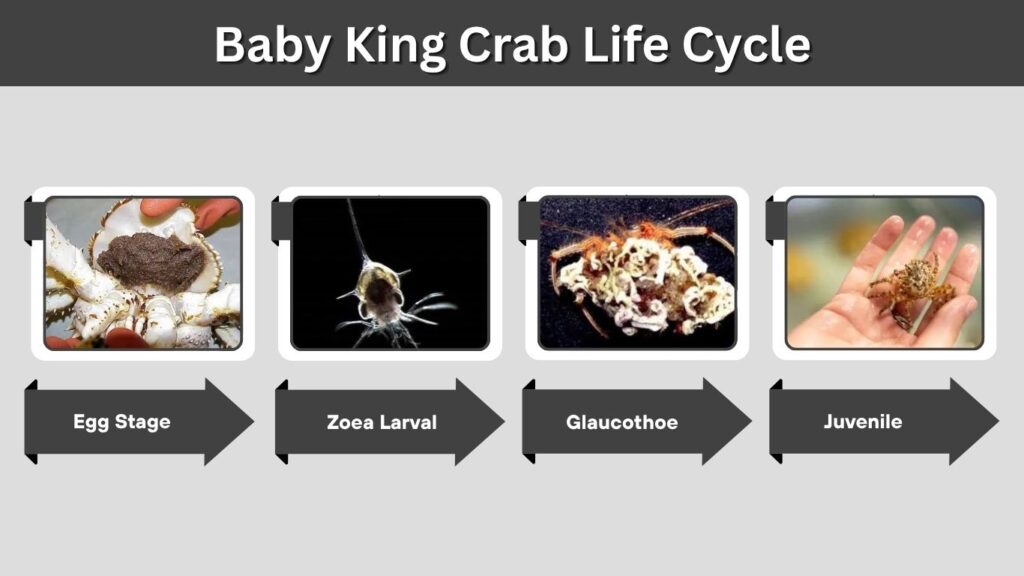
The transformation from an egg to a miniature bottom-dwelling crab involves several dramatic changes.
1. Egg Stage
A female holds the fertilized eggs beneath her abdomen, where they remain protected and receive oxygen from moving seawater. The embryos gradually develop inside the eggs until they are ready to hatch.
2. Zoea Larval Stages
Red and blue king crabs usually pass through four zoeal stages. During this period, they float and swim in the water column instead of walking along the bottom.
The larvae must find phytoplankton and zooplankton to eat. Red and blue king crab larvae do not carry enough stored yolk to survive the entire larval period without feeding.
3. Glaucothoe Stage
After the zoeal stages, the larva molts into a glaucothoe. This transitional form stops feeding and begins searching for appropriate habitat on the ocean floor.
Suitable shelter is essential because the tiny crab is highly exposed to predators. Complex habitats containing shell fragments, rocks, hydroids, or other structures provide places to hide.
4. First Juvenile Stage
Once it finds suitable bottom habitat, the glaucothoe molts again and becomes a juvenile. At this stage, it finally looks like a miniature king crab and remains on the seafloor instead of returning to a free-swimming life.
For red king crabs, the planktonic period normally lasts about two to three months before settlement.
5. Growth Through Molting
A baby king crab has a rigid external skeleton that cannot expand continuously. To grow, it must shed its old shell and produce a larger one.
Juveniles molt frequently and may grow by only a few millimeters during each early molt. Molting becomes less frequent as the crab ages. Red king crabs generally require approximately six years or longer to reach legal harvest size, depending on the population and environmental conditions.
Where Do Baby King Crabs Live?
Larval king crabs drift in the water column, where currents can transport them considerable distances. Their survival depends partly on eventually reaching an area with suitable juvenile habitat.
After settlement, baby red king crabs prefer complex areas containing rocks, shells, gravel, algae, hydroids, and other structures. These environments provide hiding places and make it harder for predators to locate them.
Young red king crabs may gather in dense groups called pods. Clustering can provide some protection, although it may also increase competition and cannibalism when food or shelter is limited.
What Do Baby King Crabs Eat?
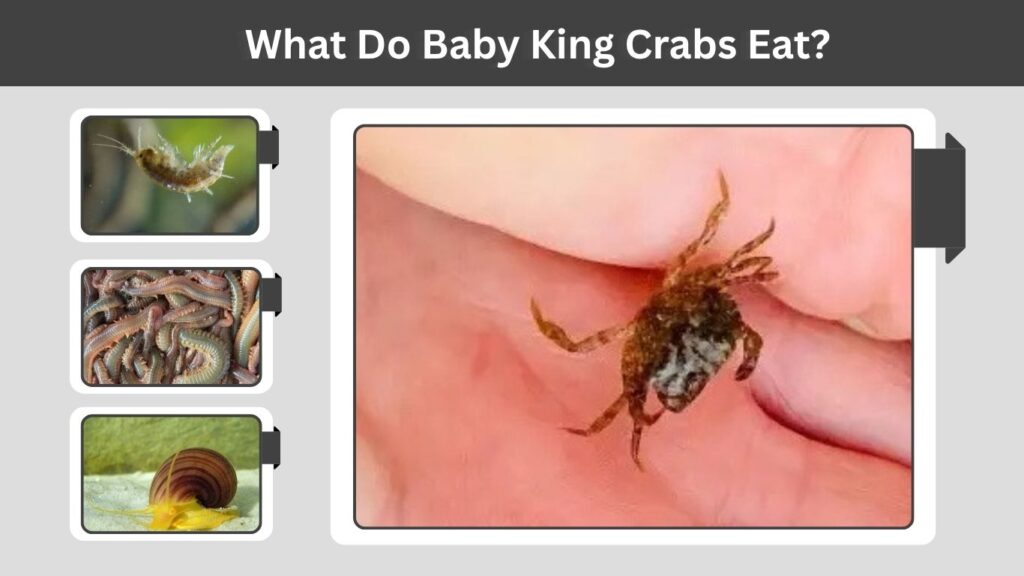
Zoea larvae feed mainly on tiny organisms suspended in the water, including phytoplankton and zooplankton.
After settling, juvenile king crabs become bottom feeders. Depending on their size and habitat, they may consume:
- Tiny clams and mussels
- Marine worms
- Small crustaceans
- Snails
- Brittle stars
- Algae and organic material
- Other juvenile crabs
King crabs are opportunistic feeders. As they grow, their claws become strong enough to crush increasingly hard prey.
What Is a Blue Baby King Crab?
A blue baby king crab is a juvenile belonging to the blue king crab species, Paralithodes platypus. It is not simply a young red king crab that happens to be blue.
Blue and red king crab juveniles have similar overall forms, but they differ in color, habitat preferences, growth, and behavior. Blue king crab larvae may remain planktonic for approximately 2.5 to four months before settling. Unlike young red king crabs, juvenile blue king crabs are not known to form large pods.
The name “blue king crab” can also be misleading. Its shell may appear dark bluish, purple-brown, or bluish red rather than bright blue. Red king crabs themselves can range from brownish to bluish red.
What Eats Baby King Crabs?
Young king crabs face much greater danger than large adults. Their predators include Pacific cod, halibut, sculpins, octopuses, sea otters, and other crabs.
Cannibalism is another major risk. Larger king crabs may eat smaller individuals, particularly when shelter or alternative food is limited. Research on hatchery-reared juveniles found that mortality was highest when the crabs were at their smallest and most vulnerable.
Can Human Babies Eat King Crab?
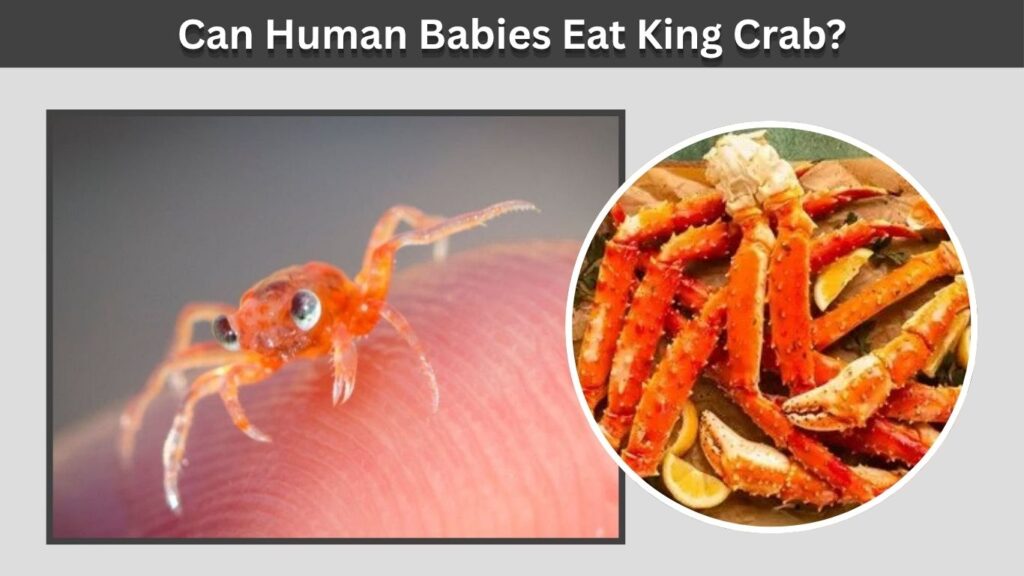
A baby who is developmentally ready for solid foods—usually around six months—may be introduced to a small amount of thoroughly cooked crab. Shellfish is a common allergen, so introduce it carefully and do not combine it with several other new foods during the same meal.
Remove every piece of shell and finely shred or mash the meat into a texture the baby can safely swallow. Do not offer large, rubbery pieces, and never serve raw or undercooked crab to a young child.
Stop feeding and seek urgent medical help if the child develops breathing difficulty, facial swelling, widespread hives, repeated vomiting, or unusual weakness. Parents concerned about food allergies or a child’s readiness for shellfish should speak with a pediatric healthcare professional.
FAQs
How big are baby king crabs?
Newly settled red king crabs are smaller than a dime. Hatchery examples have measured only about 2 millimeters across the carapace, although size increases with every molt.
Are baby king crabs born with shells?
They hatch with an external covering, but they initially look like tiny shrimp-like larvae. The familiar spiny king crab shell and body shape develop after metamorphosis and settlement.
How many babies can one king crab have?
A female red king crab may release approximately 50,000 to 500,000 eggs in one reproductive cycle. Only a very small percentage are likely to survive to adulthood.
Are baby king crabs red?
Juvenile red king crabs may appear translucent, pale orange, reddish, brownish, or bluish red. Their color becomes darker and more noticeable as the shell develops.
Can you buy a live baby king crab?
Live juveniles are generally raised or handled for authorized scientific research, hatchery programs, and population-restoration projects. They are not suitable ordinary aquarium pets because they require cold saltwater, specialized food, appropriate habitat, and significant space as they grow.