
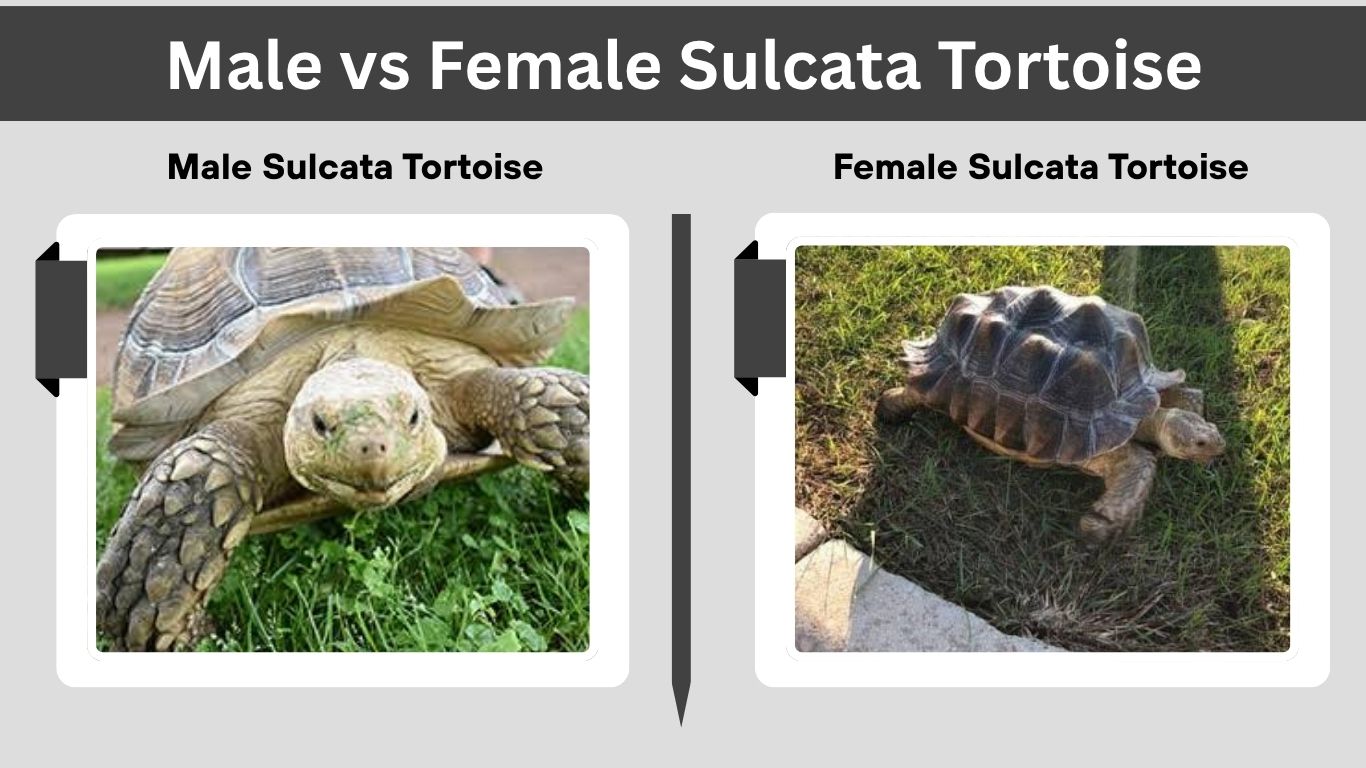
Male and female sulcata tortoises can look very similar, especially when they are young. Adult males usually show clearer signs, such as a longer, thicker tail, a more concave plastron, wider anal scutes, and sometimes larger size. Females usually have a shorter tail and flatter bottom shell. This guide explains the main male vs female sulcata tortoise differences, including size, shell shape, tail, behavior, and baby sexing.
Male vs Female Sulcata Tortoise: Quick Comparison
Sulcata tortoises, also called African spurred tortoises, are not always easy to sex by appearance alone. Animal Diversity Web notes that it is externally hard to tell males from females, although males usually have slightly longer, thicker tails and a more concave plastron.
| Feature | Male Sulcata Tortoise | Female Sulcata Tortoise |
| Tail | Longer and thicker | Shorter and thinner |
| Plastron | More concave | Flatter |
| Anal scutes | Wider V-shape opening | Narrower opening |
| Size | Often larger | Usually smaller |
| Behavior | More ramming, mounting, territorial behavior | More nesting behavior when mature |
| Baby sexing | Very difficult | Very difficult |
The most reliable signs usually appear as the tortoise matures. A small juvenile may not show obvious male or female traits yet.
Tail Difference
The tail is one of the most useful ways to compare a male vs female sulcata tortoise. In many tortoise species, males develop longer and thicker tails than females. Tortoise Trust also notes that male tortoises generally have longer tails than females.
Male Tail
A male sulcata usually has a long, thick tail. The tail may curve to one side and extend farther beyond the shell. The cloaca, or vent opening, is usually farther from the body and closer to the tail tip.
Look for:
- Long, thick tail
- Tail often carried sideways
- Vent farther from the shell
- Wider tail base
Female Tail
A female sulcata usually has a shorter and thinner tail. The cloaca is closer to the body, and the tail may not extend far beyond the rear shell.
Look for:
- Shorter tail
- Thinner tail base
- Vent closer to the shell
- Less visible tail when viewed from above
Plastron Shape
The plastron is the bottom part of the shell. This is another important feature when comparing male and female sulcata tortoises. Males often have a concave plastron, while females usually have a flatter one. Animal Diversity Web also lists a more concave plastron as a male trait in sulcatas.
Male Plastron
A male’s plastron may curve inward. This shape helps the male balance on the female during mating. In young sulcatas, the curve may be very slight or not visible yet.
Female Plastron
A female’s plastron is usually flat or only slightly curved. A flatter bottom shell gives more internal space for egg development.
Anal Scutes and Rear Shell Shape
The anal scutes are the two shell plates near the tail opening. These can help with gender identification, especially in mature sulcata tortoises.
In males, the anal scutes often form a wider V-shaped opening. This gives the larger tail more room. In females, the anal opening is usually narrower and rounder.
| Rear Shell Feature | Male | Female |
| Anal opening | Wider V-shape | Narrower U-shape |
| Tail space | More open | More closed |
| Rear plastron | Often more flared | Usually less flared |
| Best seen in | Mature tortoises | Mature tortoises |
This sign works best when compared with tail and plastron shape. Do not use anal scutes alone to decide sex.
Size Difference Between Male and Female Sulcata Tortoises
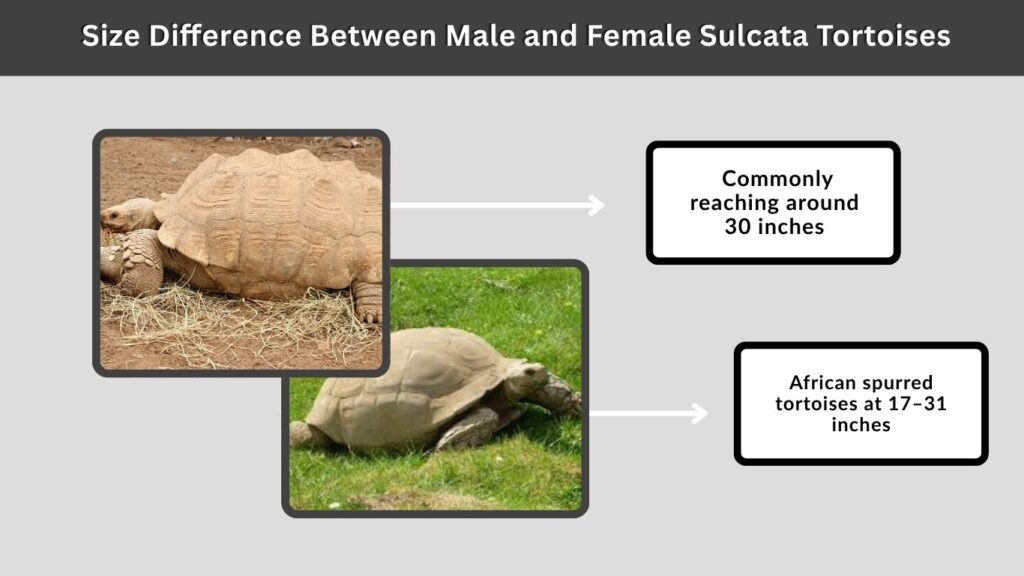
Adult male sulcata tortoises are often larger than females, but size alone is not always enough to determine sex. San Diego Zoo describes African spurred tortoises as the largest mainland tortoise, commonly reaching around 30 inches and well over 100 pounds, with some males reaching 200 pounds.
Zoo New England lists African spurred tortoises at 17–31 inches long and 79–110 pounds on average, with some individuals reaching up to 220 pounds.
A large sulcata may be male, but females can also become very big. Age, diet, genetics, health, and housing all affect growth. For this reason, size should be used with other signs, not by itself.
Behavior Differences
Behavior can give clues, but it is not a perfect way to sex a sulcata tortoise. Males are often more territorial and may ram, chase, or mount other tortoises. Animal Diversity Web notes that sulcata males can be aggressive toward each other, especially during breeding time.
Common male behaviors include:
- Ramming other tortoises
- Mounting behavior
- Chasing females
- Head bobbing
- Territorial pushing
Female sulcatas may show digging or nesting behavior when mature. A female can sometimes lay infertile eggs even without a male present. However, behavior should not be the only method used for sexing.
Baby Male vs Female Sulcata Tortoise
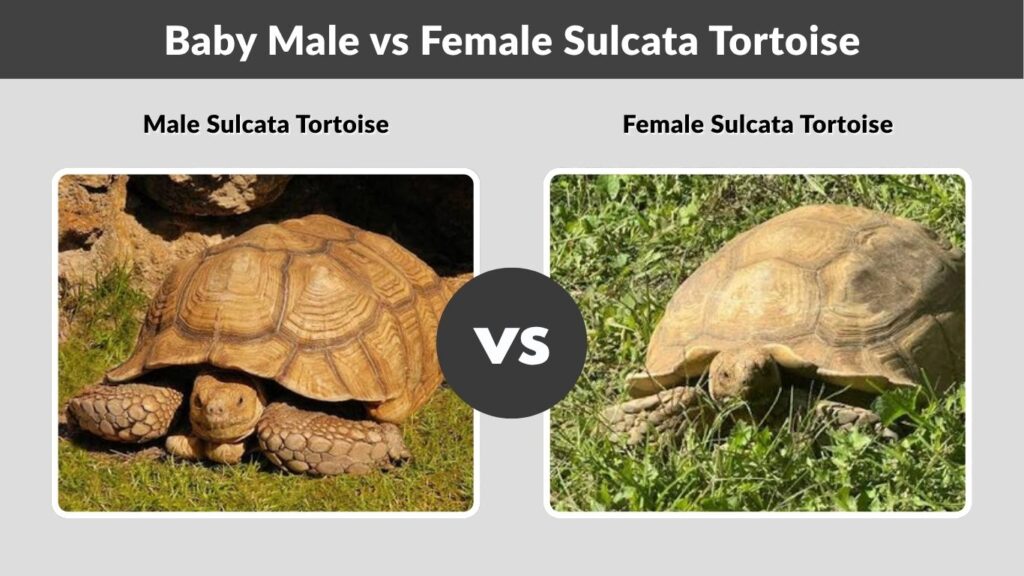
Baby sulcata tortoises are very hard to sex. Hatchlings and young juveniles usually do not have clear male or female features. Their tails, plastrons, and anal scutes are still developing.
Why Baby Sulcatas Are Difficult to Sex
Most baby sulcatas look almost identical. A 3-month-old or 1-year-old sulcata usually cannot be sexed accurately by appearance. The plastron is often flat, the tail is small, and body size does not prove anything.
Baby sexing is difficult because:
- Tails are not fully developed
- Plastron shape is not clear
- Growth rates vary
- Size does not confirm sex
- Sexual traits appear later
For young sulcatas, it is better to wait until they are larger and more mature before making a confident guess.
When Can You Tell a Sulcata Tortoise’s Gender?
Many owners cannot reliably tell the sex until the tortoise is several years old. In sulcatas, clearer signs often appear when the tortoise grows larger and approaches sexual maturity. Animal Diversity Web notes that males reach sexual maturity when the carapace is about 35 cm in diameter.
A young sulcata may be labeled male or female by a breeder, but that label can be wrong if the animal is too small. For the best result, compare multiple signs together: tail, plastron, anal scutes, size, and behavior.
Best Way to Sex a Sulcata Tortoise
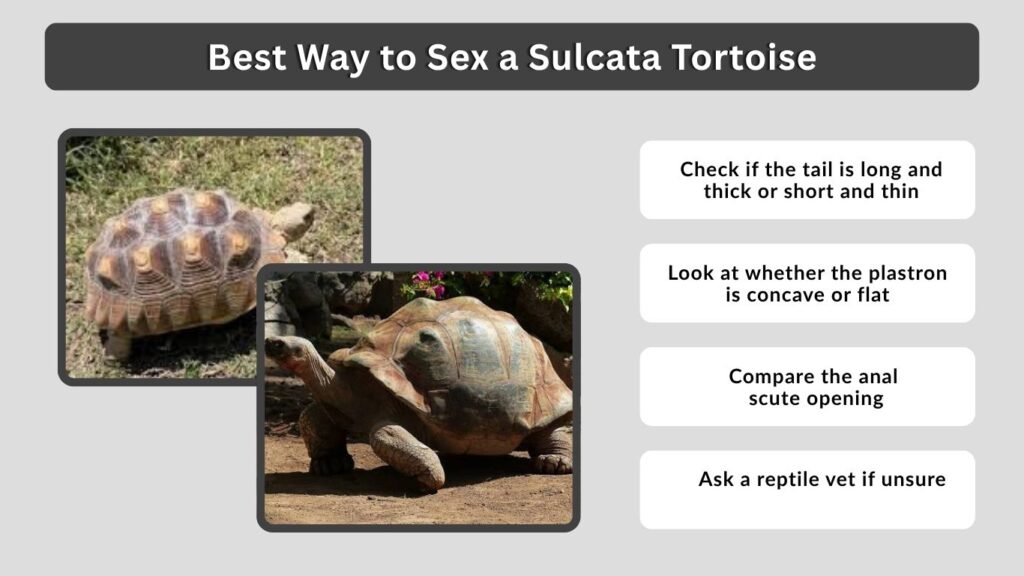
The best method is to check several physical signs together instead of relying on one feature. A reptile veterinarian or experienced tortoise breeder can also help, especially if the tortoise is still young.
Use this checklist:
- Check if the tail is long and thick or short and thin
- Look at whether the plastron is concave or flat
- Compare the anal scute opening
- Consider adult size, but do not rely on it alone
- Watch behavior after maturity
- Ask a reptile vet if unsure
Avoid flipping a large sulcata onto its back for long. These tortoises are heavy, strong, and can become stressed or injured if handled incorrectly.
FAQs
How do I know if my sulcata tortoise is male or female?
Check the tail, plastron, and anal scutes. Males usually have longer, thicker tails, a more concave plastron, and a wider rear opening. Females usually have shorter tails and flatter plastrons. Young sulcatas are much harder to sex.
Are male sulcata tortoises bigger than females?
Adult males are often larger than females, but size alone is not always reliable. Some females also grow very large. Use size together with tail length, plastron shape, anal scutes, and behavior before deciding the tortoise’s sex.
Can you tell the gender of a baby sulcata tortoise?
Usually, no. Baby sulcata tortoises are very difficult to sex because their male or female traits are not fully developed. A baby’s tail, plastron, and body size may change a lot as it grows.
Do female sulcata tortoises have flat shells?
Female sulcata tortoises usually have a flatter plastron, which is the bottom part of the shell. Males often develop a more concave plastron as they mature. This difference is easier to see in adults than in juveniles.
Are male sulcata tortoises more aggressive?
Male sulcatas are often more territorial, especially around other males or during breeding behavior. They may ram, push, chase, or mount. Females can also be assertive, but strong ramming and territorial behavior are more commonly associated with males.