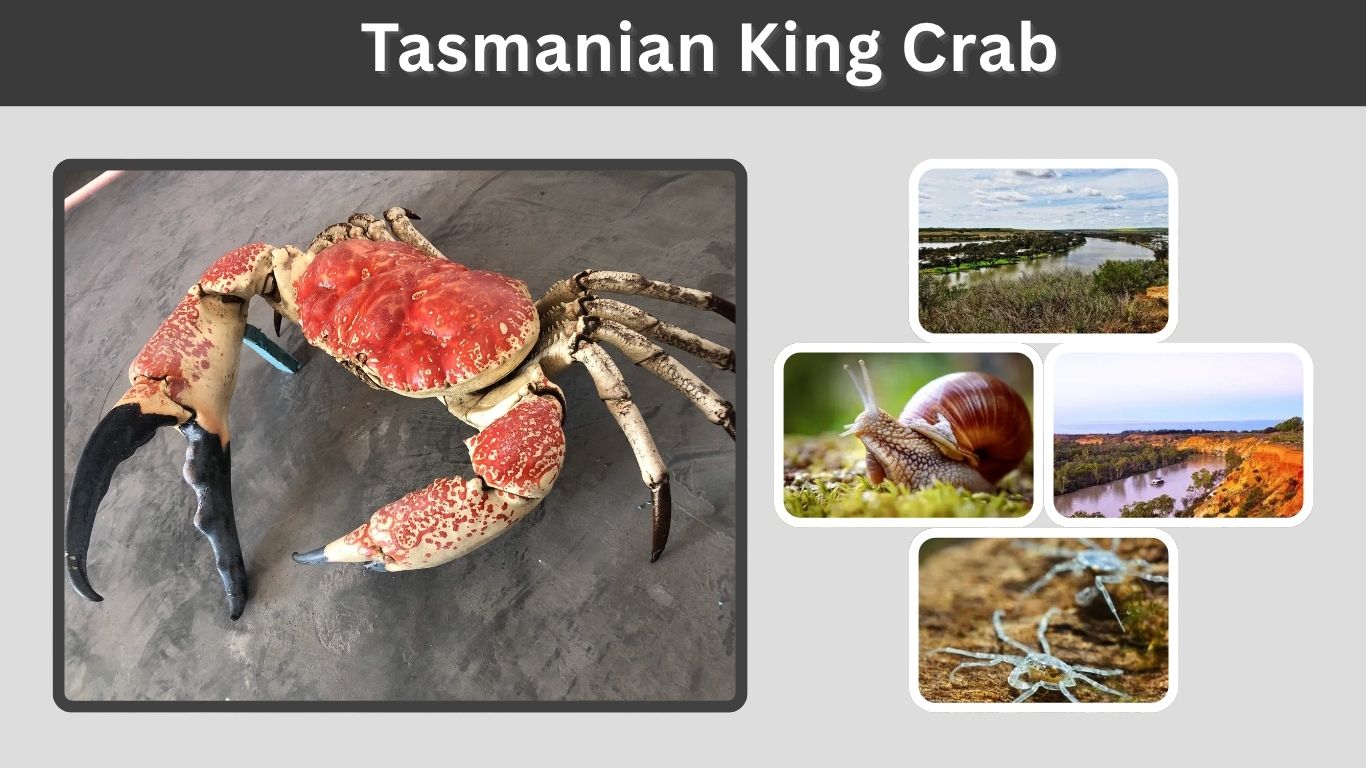
The Tasmanian king crab is a massive deep-sea crab famous for its heavy body, orange-red shell, and remarkably powerful claws. More accurately called the Tasmanian giant crab, this rare Australian species can weigh about as much as a medium-sized dog. Its slow growth, limited commercial harvest, and highly valued meat make it one of Australia’s most unusual and expensive seafood species.
Tasmanian King Crab Quick Facts
| Feature | Details |
| Scientific name | Pseudocarcinus gigas |
| Other names | Tasmanian giant crab, giant crab, king crab, bull crab |
| Maximum weight | About 17–17.6 kg |
| Maximum carapace size | Up to approximately 46 cm |
| Lifespan | At least 30 years |
| Habitat | Deep rocky and muddy seafloors |
| Typical depth in Tasmania | Around 140–270 metres |
| Distribution | Southern Australian waters |
| Diet | Molluscs, crustaceans, carrion and other bottom-dwelling animals |
| Stock condition | Varies by region; some stocks are depleted or depleting |
What Is a Tasmanian King Crab?
The Tasmanian king crab is a large marine crustacean native to southern Australia. Although people commonly call it a king crab, it is not closely related to the red, blue or golden king crabs harvested around Alaska.
Its accepted scientific name is Pseudocarcinus gigas. It is a true crab with a broad, heavily armoured body and five pairs of legs, including its front claws.
Tasmanian authorities list “king crab” and “Tasmanian giant crab” as common names for the same species.
Identification
A Tasmanian giant crab can be identified by its:
- Large triangular or heart-shaped body
- Orange-red shell covered with cream-colored flecks
- Thick, heavily developed front legs
- Black claw tips
- Shorter legs than a Japanese spider crab
- Extremely oversized claw in mature males
Male crabs generally grow larger than females. An adult male often develops one claw that is considerably bigger than the other, while females usually have two more evenly sized claws.
How Big Is a Tasmanian King Crab?
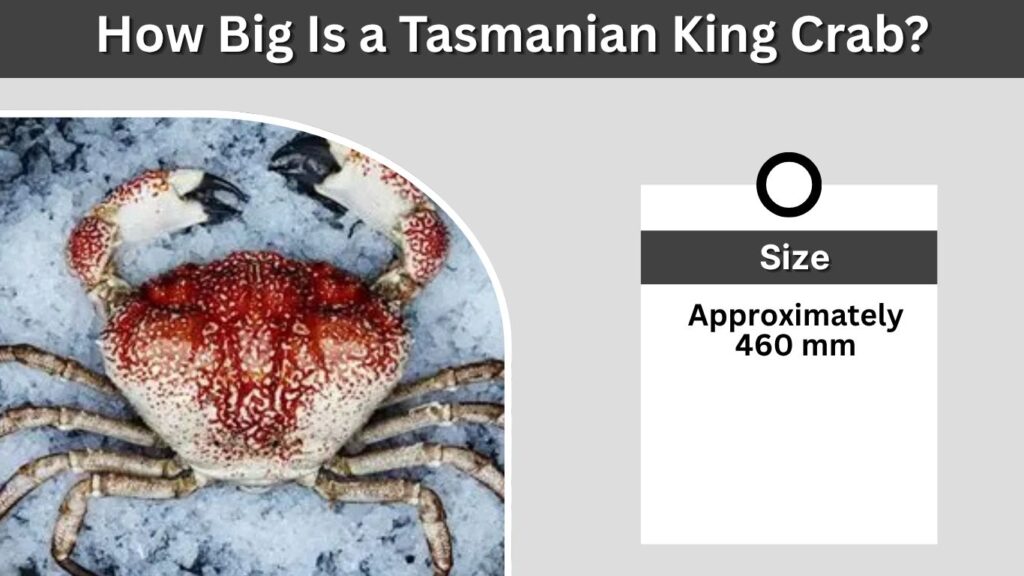
The Tasmanian giant crab is one of the world’s heaviest crab species. Tasmania’s fisheries department reports a maximum carapace measurement of approximately 460 mm and a weight of up to 17 kg. Museum information has reported exceptional specimens weighing as much as approximately 17.6 kg.
However, most commercially caught crabs are considerably smaller than the theoretical maximum. Females rarely attain the enormous weight of the largest males and may reach around 7 kg.
Largest Tasmanian King Crab Recorded
There is no widely recognized world-record authority maintaining an official record for the single largest Tasmanian giant crab ever caught. Therefore, online claims about a specific “record-breaking” or “monster” crab should be treated cautiously.
The most dependable figures from Australian government and museum sources place the species’ maximum known weight at approximately 17 to 17.6 kg. A crab approaching this size would be an exceptionally old adult male.
How Large Is Its Claw?
The giant claw can appear almost too large for the crab’s body. In mature males, it accounts for a substantial portion of the animal’s total weight.
This claw is designed for crushing hard prey rather than simply cutting it. It can break thick mollusc shells and overpower other crustaceans. The smaller claw is more useful for holding and manipulating pieces of food.
Tasmanian King Crab Habitat and Distribution
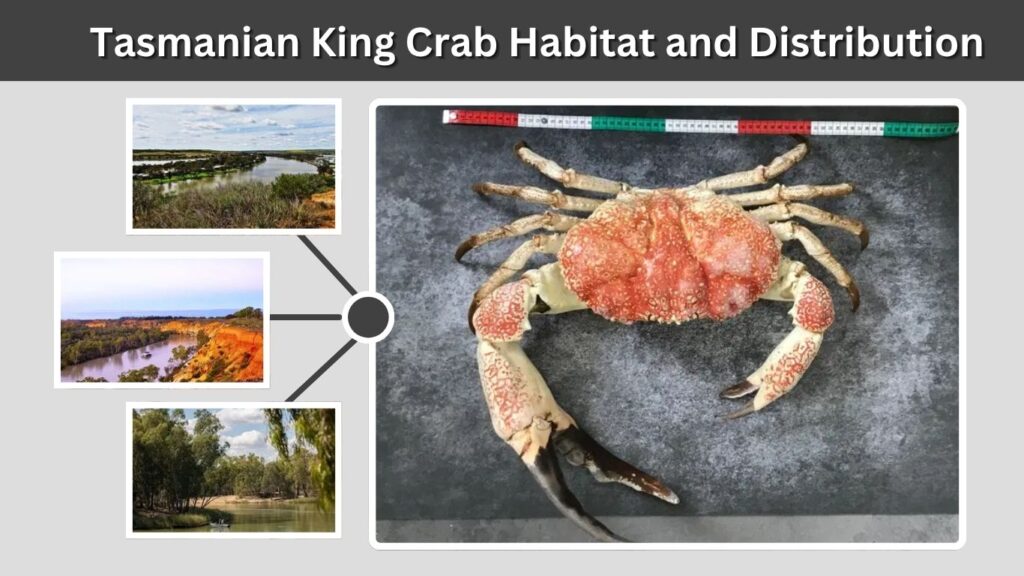
Tasmanian king crabs live in the cold marine waters surrounding southern Australia. Their range extends from Western Australia across South Australia and Victoria to Tasmania.
They generally occupy rocky or muddy areas near the edge of the continental shelf. In Tasmanian waters, fisheries authorities commonly describe their habitat as depths of approximately 140 to 270 metres. Living so far below the surface makes them difficult for recreational divers to observe.
How Long Do Tasmanian King Crabs Live?
Tasmanian giant crabs are slow-growing and long-lived. Fisheries assessments estimate that they can survive for at least 30 years.
Like other crabs, they grow by shedding their existing exoskeleton and producing a larger one. Adult crabs may have long intervals between moults, which is one reason their populations can take many years to recover after heavy fishing.
What Do Tasmanian King Crabs Eat?
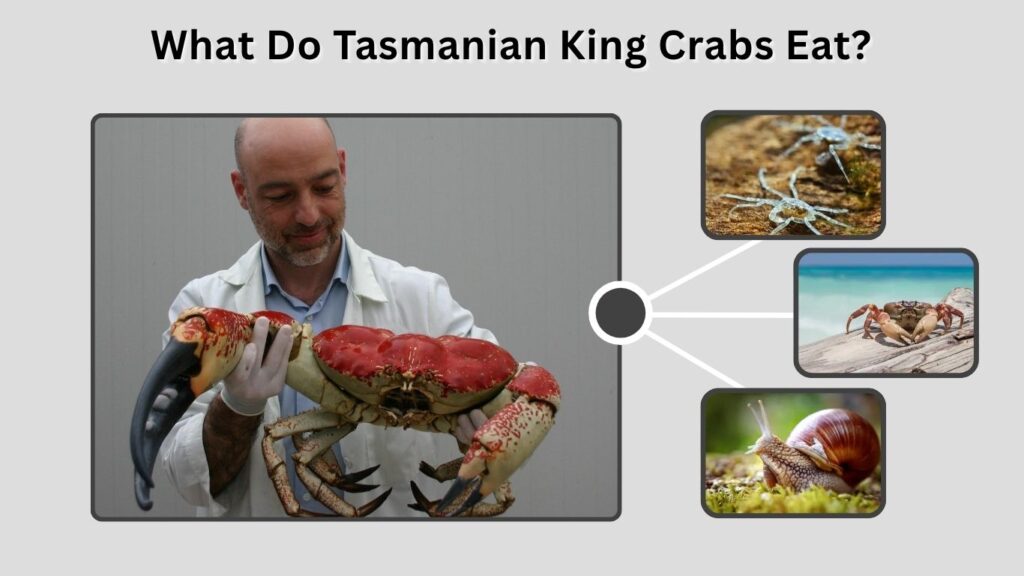
Tasmanian giant crabs are predators and scavengers that search the seafloor for available food. Their natural diet includes:
- Molluscs and other shellfish
- Smaller crabs
- Other crustaceans
- Dead fish and carrion
- Slow-moving bottom-dwelling animals
Their massive claws allow them to crush animals protected by hard shells. They may also consume dead marine animals they encounter, helping recycle nutrients within deep-sea ecosystems.
Tasmanian King Crab Price
Tasmanian giant crab is expensive because it is scarce, difficult to catch and costly to keep alive during transportation. Its final price depends on the crab’s size, condition, season, destination and whether it is sold wholesale, live at a seafood market or prepared in a restaurant.
Tasmania’s commercial fishery is relatively small but has an estimated landed value of around A$2 million, with the annual harvest controlled through a quota system. For the 2026–27 quota year, the total allowable Tasmanian catch was maintained at 20.7 tonnes.
Large live specimens can cost hundreds or even thousands of Australian dollars. One widely reported Sydney example involved an approximately 8 kg Tasmanian giant crab carrying a price tag of about A$2,000. That was an individual retail example, not a fixed price for every crab.
Where Can You Buy One?
Tasmanian giant crab is rarely available in ordinary supermarkets. Buyers are more likely to find it through:
- Specialist seafood markets
- Premium live-seafood suppliers
- Selected Chinese seafood restaurants
- Wholesale seafood distributors
- Large fish markets in Sydney or Melbourne
Availability can be unpredictable because the fishery is small. Buyers should confirm that the crab was legally harvested and supplied through a licensed commercial operator.
What Does Tasmanian King Crab Taste Like?
The meat is generally described as firm, sweet and rich. Its thick legs and claws contain the most desirable meat, although the yield can vary according to the crab’s size and condition.
Its flavour is often compared with premium king crab or lobster, but the texture may be denser. Simple cooking methods are usually preferred because heavy sauces can hide the natural sweetness.
Is the Tasmanian King Crab Endangered?
The species is not considered extinct, but that does not mean every regional population is healthy. Stock conditions vary across southern Australia.
A national assessment classified the Western Australian stock as sustainable, the South Australian stock as depleting, the eastern Tasmanian stock as undefined and the shared Tasmania–Victoria stock west of Bass Strait as depleted. Slow growth and a long lifespan make the species particularly vulnerable to overfishing.
Management measures include commercial quotas, minimum legal sizes, seasonal rules and protection for egg-carrying females. In Tasmania, the minimum carapace length is 140 mm for males and 150 mm for females. Females carrying eggs cannot legally be kept.
Tasmanian King Crab vs Other Giant Crabs
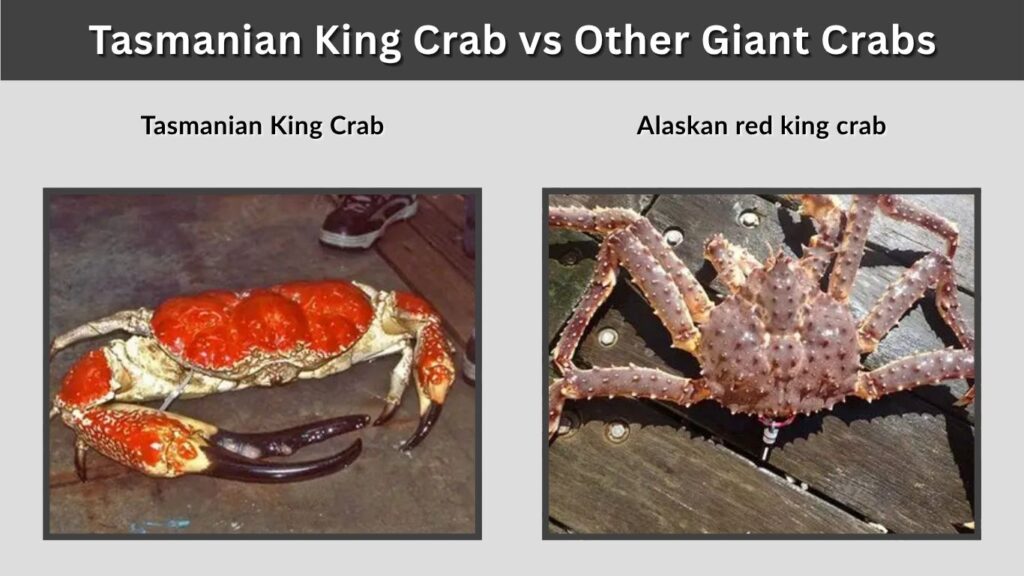
| Feature | Tasmanian giant crab | Alaskan red king crab | Japanese spider crab |
| Scientific name | Pseudocarcinus gigas | Paralithodes camtschaticus | Macrocheira kaempferi |
| Main region | Southern Australia | North Pacific and Alaska | Waters around Japan |
| Body type | Heavy, compact true crab | Long-legged king crab | Extremely long-legged true crab |
| Notable feature | Massive body and claw | Long edible legs | World-famous leg span |
| Maximum distinction | One of the heaviest true crabs | Major commercial seafood species | Largest leg span among crabs |
The Japanese spider crab is longer when measured across its legs and can span approximately four metres. The Tasmanian giant crab has a much more compact appearance, but its dense body and enormous claw make it one of the heaviest true crabs.
How to Cook Tasmanian King Crab
The crab is normally killed humanely before cooking and should not be placed directly into boiling water while fully conscious. Because specimens are extremely large, professional seafood sellers may clean and divide them before sale.
The legs and claws can be steamed, boiled or baked until the meat becomes opaque. Overcooking should be avoided because it can make the meat dry and rubbery. Cooked meat works well with melted butter, garlic, lemon, mild herbs or a light seafood sauce.
FAQs
Is the Tasmanian king crab the biggest crab in the world?
It is one of the world’s heaviest true crabs, but it does not have the greatest leg span. The Japanese spider crab is much wider when its long legs are measured from tip to tip.
How much does a Tasmanian king crab weigh?
Exceptionally large adult males can weigh approximately 17 to 17.6 kg. Most crabs encountered in commercial markets are smaller, and females generally remain much lighter than the largest males.
Can Tasmanian king crabs regenerate their claws?
They can gradually regenerate lost limbs during later moults. However, regeneration is slow, particularly in mature adults that may spend long periods between moulting events.
Are Tasmanian king crabs dangerous?
They are not venomous and do not normally threaten humans. Nevertheless, their claws are exceptionally strong and can cause a serious crushing injury when the animal is handled carelessly.
Can you keep a Tasmanian king crab as a pet?
It is not a practical home aquarium animal. Its enormous adult size, cold deep-water habitat, strength and specialized care requirements make it suitable only for properly equipped professional facilities.