
King crabs are among the largest and most valuable crustaceans harvested from cold northern waters. They are famous for their long, spiny legs, heavy shells, and sweet meat. Although red king crabs are the best-known type, the group also includes blue, golden, Japanese, and several other king crab species. Some can weigh more than 20 pounds and spread several feet from leg to leg. This guide explores their appearance, habitat, behavior, diet, life cycle, and major species.
What Is a King Crab?
King crabs are large marine crustaceans belonging mainly to the family Lithodidae. Despite their name and crab-like appearance, they are more closely related to hermit crabs than to true crabs.
Scientists believe their crab-shaped bodies developed through a process called carcinization. During this evolutionary process, hermit-crab-like ancestors gradually developed broader bodies, harder shells, and reduced abdomens.
| Feature | Description |
| Animal group | Crustacean |
| Main family | Lithodidae |
| Habitat | Cold marine waters |
| Diet | Mollusks, worms, echinoderms, and other animals |
| Body covering | Hard, spiny exoskeleton |
| Number of visible legs | Usually eight |
| Largest well-known type | Red king crab |
| Lifespan | Commonly 20–30 years, depending on species |
King Crab Identification
King crabs have broad, hardened shells covered with bumps or sharp spines. Their powerful walking legs extend far beyond the body, giving large adults an impressive overall size.
Physical Characteristics
- Broad, triangular or rounded shell
- Long legs covered with spines
- One pair of claws, usually unequal in size
- Reddish, brown, blue-gray, or golden coloration
- Thick exoskeleton protecting the body
- Small abdomen folded beneath the shell
- Five pairs of legs, although the last pair is reduced and hidden
- Stalked compound eyes
The larger claw is often used for crushing hard prey, while the smaller claw is better suited for handling softer food.
How Big Do King Crabs Get?
King crab size varies considerably among species. Adult red king crabs are among the largest, with some exceptional males reaching more than 20 pounds.
A large red king crab may have a leg span approaching five or six feet. However, most commercially harvested individuals are smaller.
Male vs. Female Size
Male king crabs generally grow larger than females. They usually have broader shells, longer legs, and larger claws.
Females have wider abdominal flaps beneath the body. This expanded area helps them carry and protect thousands of developing eggs. Harvest regulations often protect females to support future crab populations.
Where Do King Crabs Live?

King crabs inhabit marine environments, particularly cold waters in the Northern Hemisphere. Different species occur across the North Pacific, Bering Sea, Gulf of Alaska, Sea of Okhotsk, and waters surrounding Japan and Russia.
Preferred Habitat
Depending on their age and species, king crabs may live on:
- Rocky seafloors
- Gravel beds
- Sandy or muddy bottoms
- Areas containing shells and broken rock
- Continental shelves
- Deep continental slopes
- Shallow coastal nursery grounds
Young crabs often remain in shallower water where rocks, algae, and shell debris provide protection. Adults may migrate into deeper areas as they grow.
Major Types of King Crabs
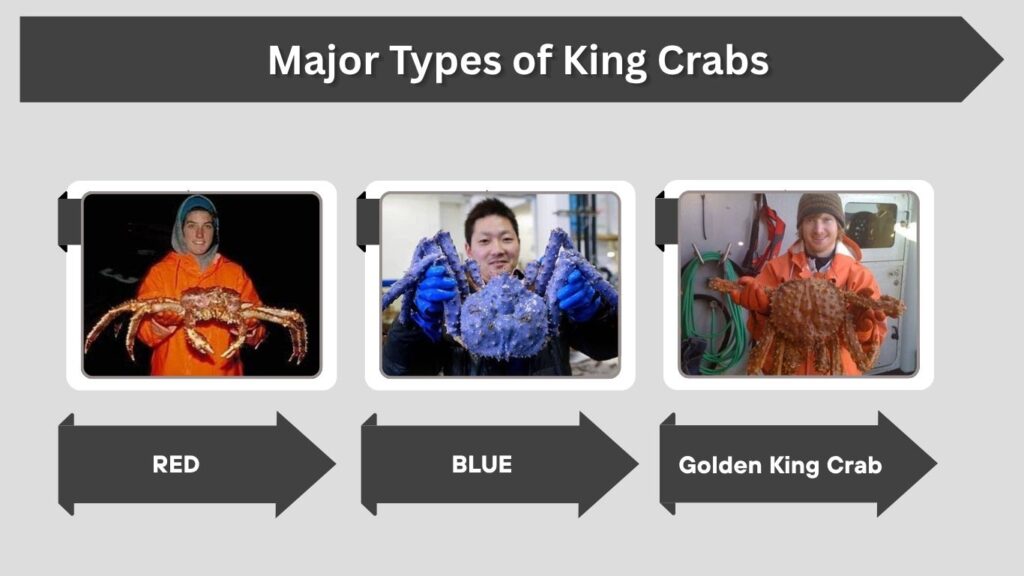
The name “king crab” includes numerous species. The red, blue, and golden king crabs are particularly important to commercial fisheries.
Red King Crab
The red king crab, Paralithodes camtschaticus, is the largest and most recognizable type. Despite its name, a living red king crab may appear burgundy, dark red, or brownish. Its shell becomes brighter red when cooked.
Red king crabs occur naturally in the Bering Sea and northern Pacific. They are valued for their large legs and mild, sweet meat.
Blue King Crab
The blue king crab, Paralithodes platypus, has a dark blue, purple, or brownish shell. When cooked, its shell also turns reddish-orange.
Blue king crabs are generally less abundant than red king crabs. Important populations have occurred around St. Matthew Island, the Pribilof Islands, and other parts of Alaska.
Golden King Crab
The golden king crab, Lithodes aequispinus, is smaller and more slender than the red king crab. It usually has a golden-orange, brown, or reddish shell.
Golden king crabs inhabit deeper waters, often along steep underwater slopes. Their meat is sweet but is usually found in smaller sections than red king crab meat.
Japanese King Crab
Several king crab species occur around Japan and nearby northern Pacific waters. The Japanese king crab, Paralithodes brevipes, is also called the Hanasaki crab.
It has a heavily spined shell and becomes bright red when cooked. It is valued in Japanese seafood markets and regional dishes.
Puget Sound King Crab
The Puget Sound king crab, Lopholithodes mandtii, lives along the Pacific coast of North America. It has a striking red, orange, and purple shell with large white-tipped spines.
Unlike major commercially harvested species, it is mostly known for its unusual appearance and role in rocky marine ecosystems.
What Do King Crabs Eat?
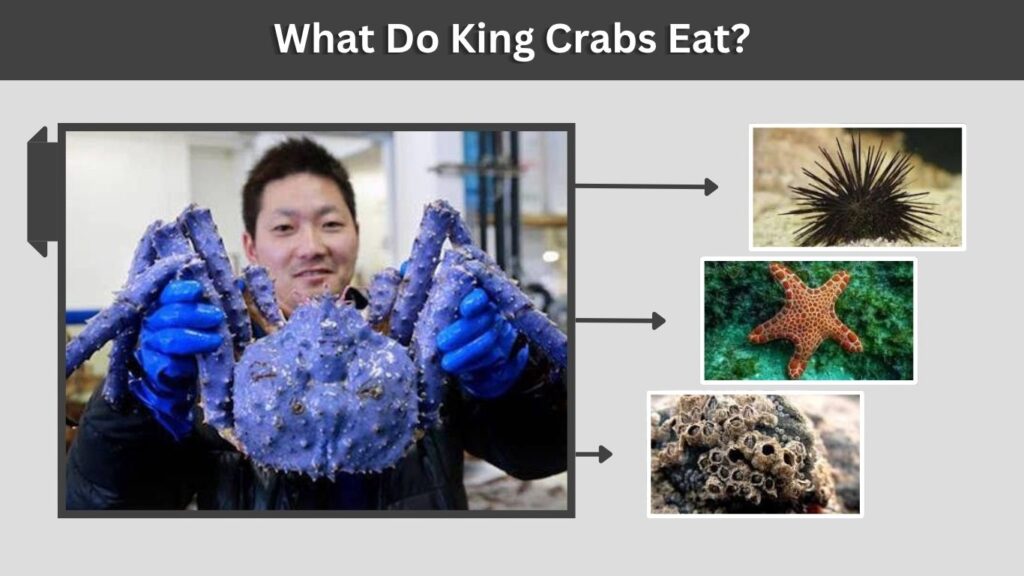
King crabs are opportunistic omnivores and bottom feeders. Their exact diet depends on their size, location, and available prey.
Common foods include:
- Clams and mussels
- Snails
- Marine worms
- Sea stars
- Sea urchins
- Barnacles
- Small crustaceans
- Fish remains
- Algae and organic debris
- Other king crabs
Young king crabs usually consume small worms, algae, planktonic organisms, and tiny bottom-dwelling animals. Large adults can crush hard shells with their powerful claws.
King Crab Behavior
King crabs spend much of their time walking across the seafloor in search of food. They do not swim through open water like many fish, although larvae drift in the plankton before settling.
Migration
Some king crab populations make seasonal migrations. They may move into shallow water during mating and egg-hatching periods before returning to deeper feeding grounds.
Temperature, reproduction, food availability, and shell condition can influence these movements.
Podding Behavior
Young red king crabs sometimes form dense groups called pods. Hundreds or thousands of juveniles may gather together and move across the seafloor.
This behavior may reduce the risk of an individual crab being captured by predators. As the crabs become larger, they generally form smaller groups or live more independently.
Reproduction and Life Cycle
King crabs reproduce sexually. During mating, the male holds and protects the female, especially around the time she molts.
After mating, the female carries fertilized eggs beneath her abdominal flap. Depending on her size and species, she may carry tens of thousands or even hundreds of thousands of eggs.
From Egg to Adult
The life cycle includes several stages:
- Eggs develop beneath the female’s abdomen.
- Free-swimming larvae hatch into the water.
- Larvae pass through several planktonic stages.
- Young crabs settle on the seafloor.
- Juveniles molt repeatedly as they grow.
- Mature adults migrate, feed, and reproduce.
King crabs must shed their old shells through molting. A newly molted crab has a soft body and is vulnerable until its new shell hardens.
How Long Do King Crabs Live?
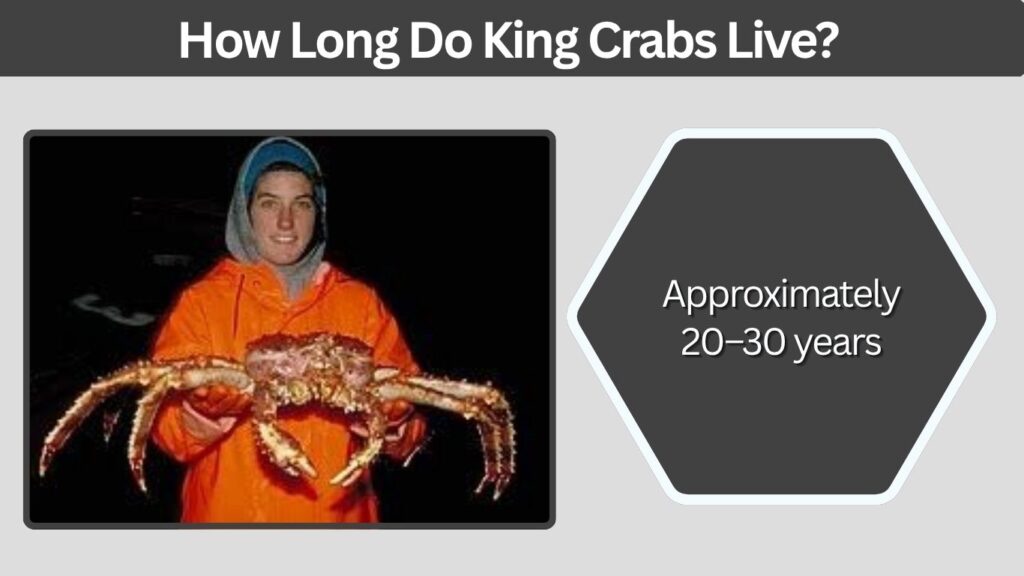
Some king crab species may live for approximately 20–30 years. Growth is relatively rapid during the juvenile stages but slows as the crab becomes older.
Age can be difficult to determine because king crabs shed their exoskeletons. Unlike trees, they do not retain permanent growth rings that can be counted easily.
King Crab Predators
Young king crabs face more predators than large, heavily armored adults. Their spiny shells and powerful claws provide increasing protection as they grow.
Predators may include:
- Pacific cod
- Halibut
- Sculpins
- Octopuses
- Sea otters
- Seals
- Larger crabs
- Humans
Cannibalism may also occur, particularly when large crabs encounter smaller or freshly molted individuals.
Why Are King Crab Legs So Expensive?
King crab legs are expensive because harvesting them is difficult, seasonal, and potentially dangerous. Fishing vessels work in cold, rough waters and use heavy steel pots to capture the crabs.
Prices are also affected by:
- Limited fishing quotas
- Population changes
- Short harvesting periods
- Fuel and labor costs
- Processing and freezing expenses
- Transportation from remote fishing areas
- High demand for large crab legs
Commercially sold king crab is commonly cooked and frozen soon after harvest. As a result, packaged king crab legs usually need reheating rather than full cooking.
King Crab vs. Snow Crab
| Feature | King Crab | Snow Crab |
| Body size | Larger and heavier | Smaller and lighter |
| Legs | Thick and spiny | Long and relatively thin |
| Shell | Harder and more heavily armored | Smoother and easier to crack |
| Meat | Large, firm pieces | Delicate, string-like pieces |
| Flavor | Rich and sweet | Mild and slightly sweet |
| Typical cost | Higher | More affordable |
King crab provides larger pieces of meat, while snow crab legs are easier to break by hand. Both are harvested from cold northern waters.
Are King Crabs Dangerous?
King crabs are not venomous or poisonous. However, live adults should be handled carefully because their spines and powerful claws can cause painful injuries.
People working with live crabs typically wear heavy gloves and use specialized equipment. Cooked king crab is safe for most people, but anyone with a shellfish allergy should avoid it.
FAQs
What is the biggest king crab?
The red king crab is generally considered the largest commercially important king crab. Exceptional males may weigh more than 20 pounds and have leg spans approaching five or six feet.
Why are king crabs called crabs if they are related to hermit crabs?
Their ancestors gradually evolved broader, crab-shaped bodies through carcinization. Although they resemble true crabs, anatomical and genetic evidence connects them closely to hermit crabs.
How many legs does a king crab have?
A king crab has five pairs of legs, totaling ten. However, the final pair is small and usually hidden beneath the shell, so the animal often appears to have only eight legs.
Do king crabs live in freshwater?
No. King crabs are marine animals and require saltwater. They live on ocean floors ranging from relatively shallow coastal areas to deep continental slopes.
Can king crabs regrow lost legs?
King crabs may gradually regenerate a lost leg through successive molts. The replacement begins small and becomes larger each time the crab sheds its shell.